
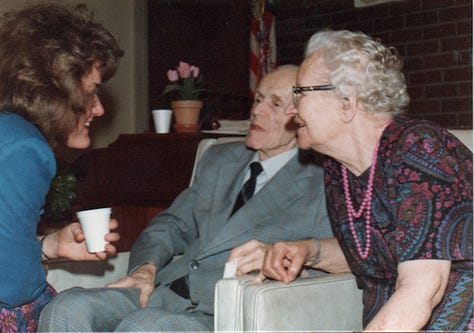
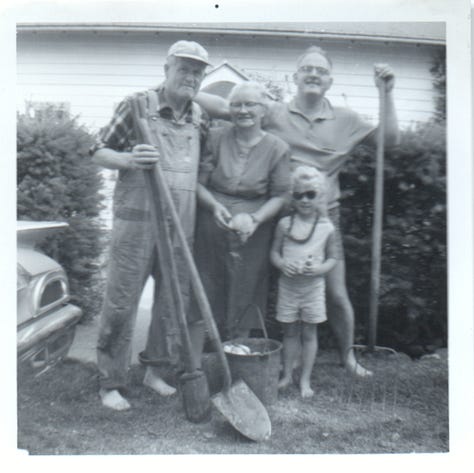
WHEN I was in third grade, my grandpa told me a tale quite unlike his usual bedtime stories and parables. Sitting beside my bed, in his thick German accent, Grandpa spoke about growing up in Crimea. Russia.
But my family was American. We couldn’t be Russian. It was 1969, and Russian meant only bad things: the Cold War, Cuban missiles, China, and communism. I did not want to be Russian.
That wasn’t all. Grandpa was trapped in Moscow. In 1929, forty years before this so-called bedtime story. And most bewildering? Disconcerting? His arrest and imprisonment. Jail.
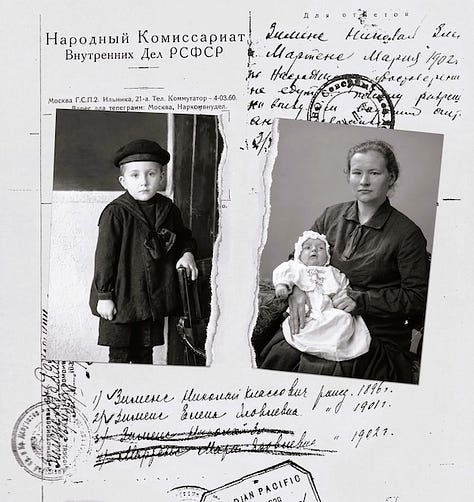
“Lubyanka.” He whispered the name of Moscow’s infamous prison, as if it were a well-kept secret. Both horrified and ashamed that my grandfather was a criminal, I assumed he must have done something awful to be jailed and separated from his wife and little boy. And what was happening with Grandma? When Grandpa had been thrown in jail, she had been almost nine months pregnant and hurried off to a maternity home for safety.
The image of a helpless young father in trouble and a terrified mother did not reconcile with the grandpa and grandma I knew. The story my God-fearing grandfather told was too hard for me to understand. And certainly not a story I would repeat.
But there was more. The worst part.
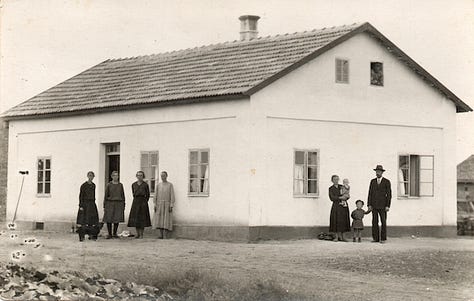
With fragments of history, journals, recordings, and artifacts, as a college student I tried to piece together what happened to Nikolai and Lena Siemens. How two German Mennonites living fifteen hundred miles apart could meet, their first kiss when he asked her to marry him. Theirs is the story of a young couple who wanted to farm, make a home, and raise a family in their small village in the heart of Crimea, a jewel-shaped piece of land on the Black Sea, but that would become impossible.
It took another forty years and the 2022 Russian invasion of Crimea and Ukraine for me to make sense of what I learned. It took a greater perspective of family and choices.
Now I’m ready to tell their story.
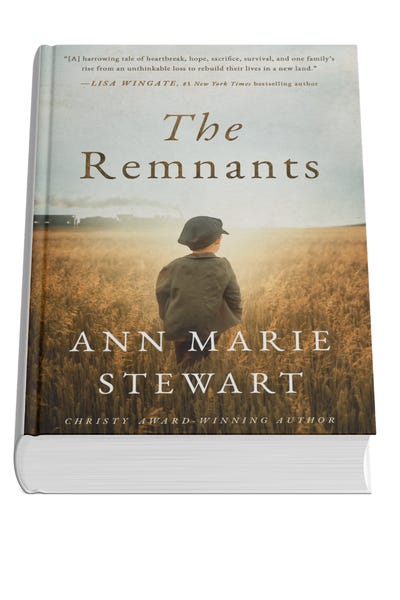
The novel is complete: The Remnants: One Family’s Escape from Stalin’s Russia. I ran a Kickstarter in April/May and it will come out in retail in October 2026. Please sign up for my newsletter at AnnMarieStewart.com to further follow the journey to publication.
NIKOLAI prodded the horses home against the stinging wind, his warm breath freezing in the scarf wrapped about his face. The Crimean Peninsula in December always felt cold and bitter, but the air seemed especially harsh because of the burden Nikolai hauled behind him.
The body on the cart had frozen, now completely stiff. The horses stumbled on the deep, icy ruts. With the next jolt, Nikolai reached back to secure the load lest it fall to the once-soft mud path, now hardened into grooves. Just like train tracks. Lines running parallel, never meeting.
As he did with all obligations, Nikolai would take the responsibility for his father’s burial seriously. This observance would be the last thing he could do for his namesake. He was Nikolai Klaasovitsch Siemens, son of Johann Klaas Siemens, or Klaas, as everyone in their village of Borangar called his father.
Nikolai shuddered at the outline of the corpse beneath the blankets: his father’s sturdy jaw, square face, broad shoulders, and long legs. The blanket hid his father’s thick red hair and robust mustache, which had faded in his last years. His familiar hazel eyes were now closed against this world.
Nikolai drew his black pudlekapp down over his ears and pulled the lapels of his coat higher, clenching his teeth against the swirling snow. In so many ways, this would be a cold Christmas.
Just three days before, his father had boarded the train to Crimea’s capital city of Simferopol to buy presents for his wife Elisabeth, Nikolai, and Lena and a suit for Nikolai’s eighteen-month-old son. Little Kolja always came running to his grandfather, calling “Opa, Opa!” and holding out his arms to be embraced. Klaas so wanted the holiday to be memorable for Kolja, his third-generation namesake and grandson. Much better than what Klaas, an orphan, had grown up with.
Now it would be memorable in a terrible way.
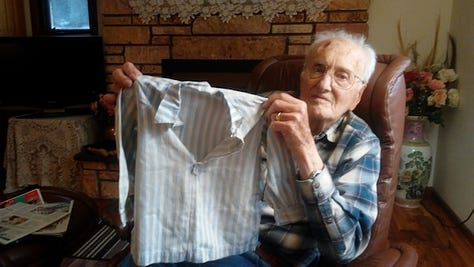
Klaas never got off the train at the capital. The other passengers hadn’t thought it strange that he lay so still; after all, Klaas had fallen asleep while waiting at the depot in Borangar. But Klaas did not sleep. He’d had a stroke, and the train had rumbled on.
Only yesterday, officials had informed Nikolai of his father’s death. There must be a mistake, he thought as he readied his wagon for the journey. His father had been so healthy. He was only fifty-eight.
Then the policeman returned his father’s pocket watch. The piece Klaas had been so proud to own, always tucked neatly in his pocket, now felt cold in Nikolai’s hand. He glanced at it, studying the circular bow that connected to the fob. The scratched gold lid opened with a crisp click; Roman numerals graced the face. Nikolai turned it over. Cillindre Aquilles. Guilloche. Enchappement a ancre. Anchor escapement. The inner wheel that turned, and the special key that could move time forward. Except no more.
Nikolai folded his fingers around the clock and flicked the horse’s reins. Though barely thirty, he was now the senior generation with no one older to mark the road ahead. The tears came easily, grief expelled, which then froze to his face, clinging persistently.
At dusk, Nikolai and his father’s body returned to Borangar’s single wide avenue lined by stone fences, then uniformly flanked by houses connected to barns, with ruler-straight fields stretching behind in neat rectangular packages.
Nikolai neared the center of the village—the schoolhouse at its heart much like the village was central to the whole of Crimea. The well, usually the hub of each day’s activities, stood empty in the black evening. But tomorrow at daybreak, when villagers arrived to draw water, life at the well would begin again.
The well tender would lower a twenty-gallon steel reinforced wooden barrel as a full barrel came up. Counterbalancing. In three rounds of the horse circling the well, the filled barrel would rise above the edge of the well, and the horse would stop. The driver would then pour the water into his hundred-gallon barrel and turn the horse in the opposite direction. This monotonous circular routine was repeated hour by hour, day by day, week after week.
So much of farming was like that. Plant, cultivate, harvest. Nikolai planted with the hope of meeting the government’s quota. If he didn’t, he could face severe consequences. Counterbalancing. Weight against weight. Even if he could stabilize his farm, his village, it might not last, they might yet be pulled under. Like Phillip Goosen, their previous well tender.
As he worked, the horse’s rope had frayed, breaking and then wrapping itself around Philip’s body. The heavy bucket pulled him into the well, the rope cut into his body, his head hit the edge of the well, and he tumbled to his death. For days, the villagers pulled buckets of water from the well until the blood of an innocent man no longer tainted their drinking supply.
Nikolai shuddered at the thought of the familiar constraints around him. He tried to find a balance with church, family, and rules, always struggling against the noose of communism.
“Tovarich! Nikolai Siemens!” A man on horseback approached. Nikolai bristled at the greeting. He didn’t consider himself anyone’s tovarich—comrade—at least not in the way the Reds had tarnished the word. The Revolution of 1917 had divided Russia in new ways, especially after Lenin’s death and Stalin’s rise.
Stalin’s push for collectivization threatened to do far worse than splinter the country. Industrialization was coming at the expense of the common farmer. Bolsheviks were not only stealing land and harvests from people like Nikolai; they were denying the right to practice their religion. Though Nikolai had fought in two wars, this battle might be far more dangerous.
“Whoa!” Nikolai pulled the reins and nodded to the man on horseback. Closer, Nikolai recognized him as Alexey Mikhailovich. Neither friend nor foe.
The wind had calmed, and Nikolai unwrapped his scarf. Every breath hung before him in a cloud of fog. Alexey’s horse stepped forward and backward restlessly.
“I heard about your father. I am sorry.” Alexey pulled his felted cap tighter about his head. “I must ask. What kind of funeral?”
“My father will have a proper funeral.” Nikolai fingered the horse’s harness as if to keep the blood flowing, then clenched the reins, reminding himself to bridle his mouth. Words were dangerous weapons used against oneself.
“Your father has a proper funeral, and you may have one too.” Alexey’s horse stepped back cautiously, in contrast to Alexey’s direct words.
“Is that a threat, Comrade?” Nikolai’s face numbed, speaking becoming more difficult.
“I’m telling you. You’re watched.”
“We’re all watched.” Nikolai was tired. He knew he shouldn’t speak so candidly. It was no secret Alexey was the Soviet officer assigned to watch Borangar.
“Ah, but you’re the pastor.” Alexey cocked his head. “Do you read only your German papers? Ours don’t speak well of the Mennonites. Pravda and Izvestia say your people steal from the Russian peasants. They spy for the Germans. They hoard food.”
Nikolai considered the names of Alexey’s papers. Truth and News. Did the names mean anything? What was that old saying? Papier ist geduldig! Now that was truth. On paper you can say anything.
“And they say you have too many special privileges,” Alexey concluded. His horse snorted to make the point and shook his mane.
“Special privileges?” Nikolai couldn’t help himself from sputtering. The clouds of his breath shortened. “Do you forget 1921 and the Tenth Party Congress? Lenin stripped us of our religious freedoms. When I became a minister, I lost my voting rights and Stalin decreed I couldn’t teach.”
Alexey raised his eyebrows but said nothing. For the past year, since Alexey’s arrival to Borangar, the two men had debated politics and religion. Nikolai didn’t mind—he actually welcomed the conversation. After all, “One knife sharpens another, and one man sharpens another.”
But as head of the village soviet, whom did Alexey report to? Still, Nikolai was not ready to cut Alexey off entirely. Their unique friendship served not only as a tool for Nikolai to know what the government was thinking but also as a way for Alexey to decipher the Mennonites’ stance. In some ways, mutual understanding could be helpful.
“Things will change, Nikolai,” Alexey said flatly. “You know this. Your people must bend.”
Nikolai sighed. Bend. Speak a new language. Take up arms. Sacrifice your religious education. His people had heard it before. Every few hundred years, they fled torture or death.
From its earliest roots in the Anabaptist Church, to be a Mennonite meant opposition. In the 1500s Nikolai’s ancestors had left their farms in Dutch-speaking low countries of central Europe because of religious and economic persecution. They’d settled in a new country that promised they could stay out of the military and freely practice their religion.
Settling the marshy swamps of the Vistula Delta, they reclaimed the land from the sea with canals, windmills, and dikes in exchange for the right to be left alone. Then, Polish rule weakened, along with their privileges.
Wasn’t that where their Low German poem originated?
Text within this block will maintain its original spacing when published
Jeprachat, jejaft, jeborjcht.
Jenome onn dan wada fekofft.
So senn Fodakje onn Muttakje entlijch
Fonn Dietschlaunt nom wille Russland jeflocht.
Begged, given, borrowed, and taken.
Destitute, sick, hungry, and forsaken.
Thus Father and Mother fled from Prussia
To the wild steppes of southern Russia.
Comments
Nothing yet. Say the first thing.
Sign in to join the conversation.