
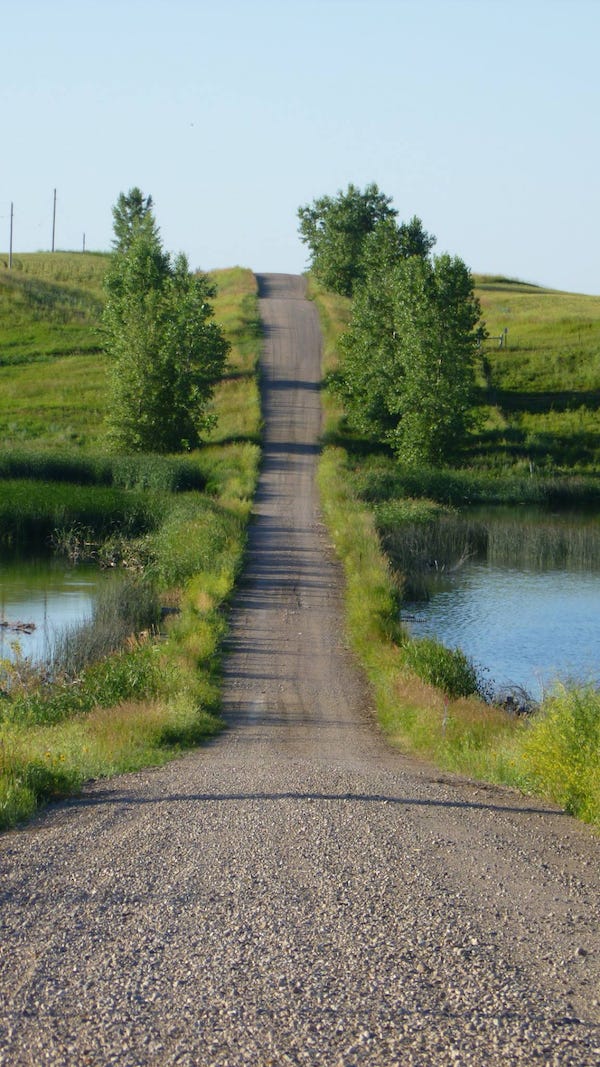
His very first horses were nags, broken-down nags. They had barely survived years of grinding work for those ruthless Hardanger folk on the neighboring claim. Ah, those Hardanger folk. They were the crafty ones, smiling lovers of ale and accordion polkas. Though not altogether righteous, they were occasionally generous to those who lent a hand as he kindly had, tilling both their Homestead quarters through two springs and two harvest seasons with only home-cooked meals and a few Bible verses read aloud by the Mrs. as compensation. For some, that was deemed great plenty in those days, the 1890s on the hardscrabble, immigrant plains of North Dakota. After a time, payment came in the form of these horses, hand-me-down horses, hardly what anyone could call a team. To prove up his claim on the land, Peder Johan put them to good use just the same.
The bow-back roan dropped over dead in early January, right there in the yard just north of the trapdoor dugout he called home. Lifeless. He found it near the triangular birch-pole-and-willow-brush lean-to which served as a barn in those earliest years—the first of four barns to come in the next hundred. The roan’s carcass he left on that very spot to become solid or disappear, as all living or dead things did in those hard times. It was quickly raked to the bone by wolves, foxes, tufted cat-like creatures and, eventually, snowy owls swooping invisibly out of the whiteness to pick off the last blood-red specks of flesh.
And then the other one, a pony the Skrælinger(1) had ridden half to death before those scheming Hardanger folk had bartered it away for half a bag of oats. Small, ornery, unpredictable, and such an odd name, too! ‘Paloosa,’ with so many brown splotches over the rump. It, too, turned up lifeless after a three-day blizzard late in March. He didn’t have the heart to dig this one down either. By August, its bones were already starting to bleach in the unforgiving sun, exactly where they had last moved.
Now these two new ones here, they were Peder Johan’s first real team. Such tame, gentle creatures were precious beyond words. Almost young, they were mismatched in color as well as size. The gray mare was bulky, broad-shouldered, while the chestnut gelding was tall, narrow at the hip. He slept near their warmth in the treeless, howling winters during those first trying years, spoke to them in the only human tongue they understood: “Søt liten Hvitaktig, kom berre i nærleiken. Til høgre litt den brune skjønnheita mi.” (2) All three lived alone together on the gently rolling, rock-strewn land.
Once again, they had been gifted to him by those shrewd Hardanger folk who had finally taken pity on this poor, kindly neighbor of theirs. Such as it was, they—the prosperous ones—hoped he could make a go of his claim. Neighbors, kind and overly generous, sometimes proved worth the investment.
That Hardanger Mrs. across the way slept on one side of the exact line between two 160-acre claims. Her man slept on the other side of that line in the same Turtle Mountain oak four-poster. Her claim was over four years in the running; his was up. Rumor had it that their marriage hadn’t been properly ordained; that the flimflammer had met her by chance on the train tracks in Rugby; that she, a woman alone come from down Chicago way on the Great Northern, was wearing store-bought calico with money tucked away in its tempting folds. Just how had she nabbed him? Were they now openly living in sin? What of their souls! There would be a reckoning one day, at least according to Pastor Sivertsen: “For lønte til synda er døden.” (3)
Here stood a true man of the cloth, still wearing the ancient linen ruff chafing round his neck simply for tradition’s sake. Sivertsen lived the same fire and brimstone that he preached in this Amerika, this land of carnal perdition. He was as straight and narrow as the taut hame strap on the collar of strictures he fitted tight around his parishioners, his ‘Great White Flock.’
Three times that Hardanger scoundrel had come carrying his months-old dead spawn, all shrouded up in fresh linen, to the House of the Lord. Why, the Lord himself had cut these children down as punishment! Of course, these spiritual foundlings could be laid to rest though not, as is meet, right, and truly salutary, from inside the ecclesiastical confines of the church’s cemetery lest sin be condoned, and his Great White Flock learn the ways of the world. Many a time he had admonished them to shun these sinners, and still the people persisted, selling their very souls for thirty shekels. This was especially true of the lone, unmarried ones like that fellow who had just been gifted with an odd-looking, terribly mismatched team of horses by these same heathens.
There was a primal innocence to his bond with them. Oh, he loved them, his first real team. This was a real chance to break the land, prove up his claim, show those back home that life in Amerika was one grand stroll toward riches and happiness. He fussed over them as they accompanied his lonely existence on the harsh Dakota prairie so far from his early memories, farther still from Malene, that sweetheart he fancied in old Stavanger town across the sea.
They had names lovingly held in the mouth, often repeated in later years by his four sons and three daughters until those names eventually faded from memory. Nothing, then, remained of how he had whispered softly in their ears, combed their sweaty bodies, fed them sweet grass straight from his calloused hands and, occasionally, cursed them to God and the devil’s hot hell (Du skal ikkje ta Herrens namn forgjeves. Å, Herre Gud, tilgi meg!) (4) for having lunged forward too quickly when his one-bottom hand plough hit a snag, cracking its wooden frame. Yet, thank the Lord, not the thin iron strip needed to cut through the unforgiving, sandy, eolian soil.
This was not the dark, rich alluvial soil found in some parts north and east, land “nær dei høge åslandskapene til den fransktalande Skraelinger.” (5) up in the homestead fields of the Finns and French-Canadians. No, his was glacially bubbling soil, constantly throwing up rocks of all sizes. In time, the larger rocks were covered over by thousands upon thousands of smaller ones lugged across the field on a stone-boat sledge by his beloved team.
These mounds became distant landmarks for ploughing in a straight line even as they slowly grew to occupy more of his precious claim. He would sometimes consolidate them into ever larger piles. In another land, rock piles such as these would have been turned into hedgerows demarcating territory, but this was open land in a new continent. This was Amerika, and the thought of walls seemed to Peder Johan an abomination, such an unimaginable, repugnant, old-country way of doing things.
His son completed the progression from the grind of peasantry to managed farming, his son’s son from farming to the cold calculus of agribusiness. Working the land, eating hand to mouth. Sparring with quota-based, nearly Soviet-style government programs. Gulping morning coffee with one eye on the futures markets while jockeying for position as weather patterns swing. Amerika became America. The rock piles remained.
Still, there was this one massive pile which for decades had needlessly occupied a perfectly productive vein of loamy farmland. In settlement days, the neighbors had whispered about its size, its wastefulness. Neighbors now jibed the son’s son about “farming rocks.” Over time, its appearance had gone from inevitable to unprofessional, especially as viewed from aerial photos, satellite, or drone shots. It stood out like a scar on the family homestead, an object of shame.
It was high time he got this expensive nuisance the hell out of the way once and for all. Just good business, good land stewardship, much like the excellent animal husbandry the son’s father had practiced or the intense care his grandfather had shown his first team. To his mind now, it was little more than yet another consolidation of rocks.
Still, there was a primitive, unsettling aura floating around this specific rock pile, a vague memory of often-heard misgivings about disturbing it. His father always said: “Just leave this one alone. I don’t know why, can’t really remember, but just leave it, OK?” And so, he did just that until one crystal-clear, bitterly cold January afternoon when productivism suddenly got the better of atavism. Out he went alone with log chains and a bucket grapple attached to a lift. His intent was to rip up this huge, wasteful rock pile which had probably sprouted on this spot little after the time his grandpa Peder Johan, the Hardanger folk, and the hardline Norwegian pastors had settled on the land.
The first layers peeled off nicely. Seventeen loads were hauled off to the northern edge of the Home Quarter. At 4 ft. down, he hit a snag. The grapple came up against an immovable barrier—a hulking boulder half the size of his tractor. On one side, there was just room enough to pry loose a few layers of smaller rocks. Tough going. Each raspy scrape of the grapple on stone now pulled him closer to an oddly shaped gap deeper within.
Something about it felt off, eerie. He killed the engine, grabbed a hammer, a crowbar, and a Warrior flashlight from the toolbox. His hands began trembling. It wasn’t the arctic cold. A thin, umbilical Kevlar cord linked his waist to a fisherman’s knot on the hitch of the lift. Edgy, he faked a muffled laugh. Sun dogs cast his dusky, double shadow at sharp angles across the soil as he lowered himself into the darkness. Warily, he yielded to a very physical impression that this soil was not empty, that he might not be alone. Together, the upper and lower boulders formed a shelter, a sanctuary, a sort of crypt for what was within.
Arranged head-to-head, rump-to-rump, spines tracing two asymmetrically oval arches around this place below the soil they had trodden so many times, lay the remains of the gray mare and the chestnut gelding. In almost Neolithic reverence, hooves touched hooves, muzzles nuzzled muzzles. Their flesh, kept apart from ravenous wolves, foxes, lynx, and snowy owls swooping invisibly out of the winter whiteness, had long since disintegrated. That flesh had kept him warm on many a dark winter night during those hard, early years alone on the Dakota Plains. All their color had bleached to thin, ghostly translucence. Their names had long ago faded from memory. The very reason for their being had dimmed over time, but not the tenderness that he gave them even in death.
Skrælinger : those who wear animal pelts
Søt liten Hvitaktig, kom berre i nærleiken. Til høgre litt den brune skjønnheita mi. : Westland Norwegian for “Sweet little whitey, come a little closer. To the right a little, my brown beauty”
For lønte til synda er døden. : Westland Norwegian for “For the wages of sin is death.”
Du skal ikkje ta Herrens namn forgjeves. Å, Herre Gud, tilgi meg! Westland Norwegian for “Thou shalt not take the name of the Lord in vain. Oh, Lord God, forgive me!”
nær dei høge åslandskapene til den fransktalande Skraelinger. : Westland Norwegian for “nearer those high hills of the French-speaking animal pelt wearers.”
Peter Knudson grew up on a cattle and grain farm in Leonard Township, Rolette County, North Dakota. He graduated from the University of North Dakota, the University of Iowa, and Mesa Community College. He teaches English in both public and private-sector institutions in Paris, France, where he currently resides. In the hope that they will discover North Dakota one day, he writes for his grandchildren so they will remember and pass it on.
Comments
Nothing yet. Say the first thing.
Sign in to join the conversation.