
In today’s Profile in Prevention, we start a series of cases that highlight the approach to diagnosis and treatment of atherosclerotic cardiovascular disease (ASCVD) in women.
This is not the first time the skeptical cardiologist has written on the topic but more recent Substack posts have focused on various male cases (a Senior Surfer, a vegetarian septuagenerian Flaneur, a man with incidental findings of coronary calcification, the value of serial Coronary CT angiograms in a man with advanced subclinical CAD, etc.)
Women are less likely to have heart attacks and strokes caused by ASCVD than men at any given age. but cardiovascular disease accounts for more deaths in women than breast cancer, lung cancer, and chronic lung disease combined.
In addition, “traditional risk factors using a variety of scoring systems provide ineffective risk classification for the short-term and long-term or lifetime risk for women” and the role of sex-specific risk enhancers in women is being increasingly recognized.
This graphical abstract from a recent review on the topic provides an overview of such risk factors
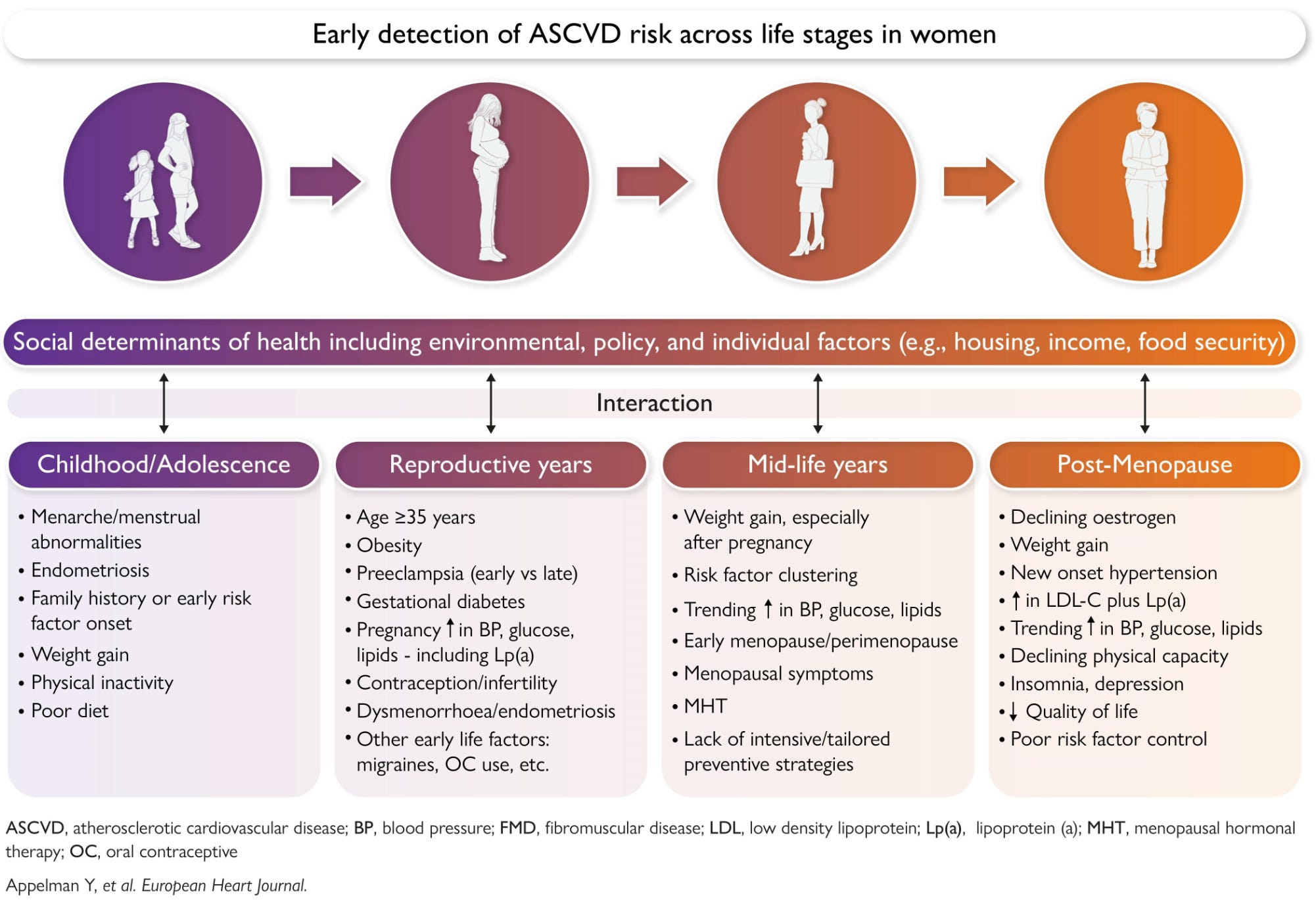
A dozen years ago, I shared the story of my friend’s wife, “Lisa,” in a blog post entitled “Dealing With The (Cardiovascular) Cards You’ve Been Dealt.”
There have been some interesting developments in Lisa’s case since then which will be educational for patients pondering how to best reduce their cardiac risks.
Along the way we will discuss unique risk factors in women, differing approaches to diagnostic imaging, and the debate on hormonal therapy.
We’ll use Lisa’s case as a launching point. Below is a lightly edited version of her initial presentation from 2014 combined with an update from 2021.
The skeptical cardiologist was in Atlanta recently visiting his Life Coach (LCOSC). Oddly enough, the wife of the LCOSC (who I’ll call Lisa) had just undergone a coronary calcium scan and it came back with a high score. Most women her age (58 years old) have a zero score but hers came back at 204.
This was both perplexing and disturbing because none of the risk factors that we measure to assess risk of heart attack (like high blood pressure, diabetes, smoking, elevated cholesteroland obesity) were absent in Lisa.
The CT scan for calcium (discussed by me in more detail here) focuses entirely on quantifying the intense and very specific kind of x-ray absorption from calcium. T
The three-dimensional resolution of the scan is such that the coronary arteries which supply blood to the heart can be accurately located and the amount of calcium in them very accurately and reproducibly added up.
Calcium is not normally in the arteries and only accumulates as atherosclerotic plaque builds up over time.
The build up of fatty plaque (atherosclerosis) is the major cause of coronary artery disease (CAD, sometimes termed coronary heart disease (CHD)) which is what causes most heart attacks and most death in both men and women in the U.S.
I entered Lisa’s numbers into the online MESA calculator to see how she compares to other white 59-year-old women.
The calculator tells us that 2/3 of 59-year-old women have a zero calcium score.
In contrast, only 1/3 of men aged 59 years have a zero calcium score
A score of 203 is higher than 95% of white females aged 59 years and higher than 81% of white males that age.
Although the 95th percentile is a good place to be for SAT scores it is not for atherosclerosis. This means substantial amount of fatty atherosclerotic plaque has built up in the arteries and puts the individual at significantly greater risk for heart attack and stroke.
A calcium score of 100-300 confers a 7.7 times increased risk compared to an individual with similar risk factors with a zero calcium score.
Most of the risk factors that we can measure to assess one’s risk of heart attack were absent in Lisa. Her cholesterol levels had risen in the last 10 years but when I entered her numbers (total cholesterol 221, HDL 68) into the ASCVD risk estimator her 10 year risk came back at 2.5%.
This is considered low and no cholesterol lowering therapywould be advised by current guidelines.
The only clue that her cardiologist would have that Lisa has advanced premature atherosclerosis is that her mother had coronary heart disease at an early age, something we call premature CAD.
Her mom at the age of 62 suffered a heart attack and had a stent placed in one of her coronary arteries.
The occurrence of significant premature CAD in a parent or sibling substantially increases the chances that a patient will have premature CAD and the earlier it occurred in the parent or sibling the higher the risk.
Some of this excess risk is transmitted by measurable risk factors such as hypertension and hyperlipidemia and some through lifestyle factors but the majority of it is through genetic factors that we haven’t fully identified.
A large Swedish study found that adopted men and women with at least one biological parent with CHD were 1.5 times more likely to have CHD than adoptees without. In contrast, men and women with one adoptive parent were not at increased risk.
Since 2007 an intense project to identify genetic factors responsible for CAD has been underway at multiple academic centers. Thus far 50 genetic risk variants have been identified. According to Dr. Robert Roberts
” All of these risk variants are extremely common with more than half occurring in >50% of the general population. They increased only minimally the relative risk for coronary artery disease. The most striking finding is that 35 of the 50 risk variants act independently of known risk factors, indicating there are several pathways yet to be appreciated, contributing to the pathogenesis of coronary atherosclerosis and myocardial infarction. All of the genetic variants seem to act through atherosclerosis, except for the ABO blood groups, which show that A and B are associated with increased risk for myocardial infarction, mediated by a prolonged von Willebrand plasma half life leading to thrombosis”
(Shortly after writing this in 2014, it became clear that Lipoprotein (a) level was the most important single genetic factor conferring risk of ASCVD. When Lisa’s Lp (a) was measured it was elevated.)
The standard approach to estimating risk fails in about 25% of individuals as it does not accurately convey the high risk of the patient with family history and it overestimates risk in many elderly individuals who have an excellent family history.
It is in these patients that testing for the actual presence of atherosclerosis, either by vascular screening or coronary calcium is helpful.
Simultaneous with assessing these patients for subclinical atherosclerosis with imaging techniques I check three key biomarkers
Lipoprotein (a) (a highly atherogenic, inherited marker that is not measured in standard lipid panels)
Apolipoprotein B (apoB, now recognized as our single best measure of atherogenic dyslipidemia)
High-sensitivity CRP (the most studied and useful measure of inflammation)
An apoB particle is the basic unit of injury to the arterial wall. The more apoB particles within the lumen of the artery, the greater the trapping of apoB particles within the arterial wall, the greater the injury to the arterial wall. The more apoB particles are reduced by therapy, the less the injury to the arterial wall, the greater the opportunity for healing. Moreover, nowadays apoB can be measured accurately and inexpensively. Thus, apoB integrates the information from the conventional lipid panel and, therefore, unifies, amplifies, and simplifies our understanding of the role of the apoB lipoprotein particles in atherogenesis.
For many individuals there are clear-cut lifestyle changes that can be implemented once advanced CAD is identified: cigarette smoking cessation, weight loss through combinations of diet and exercise with resulting control of diabetes,
However, many patients like Lisa, are non-smokers, living a good lifestyle, eating an excellent diet with plenty of fresh fruit, vegetables, fish and healthy oils and without obesity or diabetes.
There is no evidence that modifying lifestyle in this group is going to slow down an already advanced progression of atherosclerosis.
Patients like Lisa have inherited predisposition to CAD, it is not due to their lifestyle.
Lisa’s cardiologist suggested she get a copy of Dr. Esselstyn’s book “Prevent and Reverse Heart Disease”. This book, based on the author’s experience in treating 18 patients with advanced CAD espouses an ultra low fat diet.
The author declares that “you may not eat anything with a face or a mother (meat/poultry/fish)” and bans full fat dairy products and all oil (“not even a drop”). I critiqued this diet and its poor evidence base in an article entitled “The Incredibly Bad Science Behind Dr. Esselstyn’s Plant-based Diet.”
Such “plant-based diets” (codeword for vegan or vegetarianism) lack good scientific studies supporting efficacy and are extremely hard to maintain long term.
There is nothing to suggest that Lisa’s long term risk of heart attack and stroke would be modified by following such a Spartan dietary regimen.
Her cardiologist did recommend two things proven to be beneficial in patients with documented advanced CAD: statins and aspirin.
Taking a statin drug will arrest the atherosclerotic process and reduce the risk of heart attack.
An aspirin is now indicated since significant atherosclerosis has now been documented to be present as I’ve discussed here.
Comments
Nothing yet. Say the first thing.
Sign in to join the conversation.