
Although Europe appears to in the grips of a brutal heat wave and multiple fires, the skeptical cardiologist and his team1 is heading there in a week.
The Skepcardashians is our preferred moniker.
We will be engaging in medical historical journalism, endeavoring to uncover fascinating tidbits of information on some of the major pioneers in science/medicine/surgery in locales like London, Cornwall, Edinburgh, Lisbon and Porto for three weeks.
During that time expect a lighter posting schedule unless by some miracle I am able to put together a few great articles before I leave.
One article I promise will be on one of the most fascinating individuals in the annals of science, Humphrey Davy (1778–1829), who was born in Penzance which was then “a tiny seaside town, remote and isolated in the extreme southwest of rural England, dependent largely on fishing and the business of the local tin mines2.”.
Davy didn’t discover nitrous oxide but he spent a lot of time inhaling it and recording its effects on himself and his friends
A few months after he started the experiments Davy began to allow others to partake, at first his patients but then also perfectly healthy subjects chosen from his circle of family and friends, including the heir to the Wedgwood pottery empire, the future compiler of Roget's thesaurus, and the poets Robert Southey and Samuel Taylor Coleridge. He asked all the participants to write down their experiences, descriptions which ended up forming more than 80 incredibly entertaining pages in his Researches, Chemical and Philosophical (1800)
And you can read those details in his actual book, here.
Or in the very entertaining essay “O, Excellent Air Bag!”
Davy’s report combined two mutually unintelligible languages — organic chemistry and subjective experience — to create a groundbreaking hybrid, a poetic science that could encompass both the chemical causes of the experience and its philosophical consequences
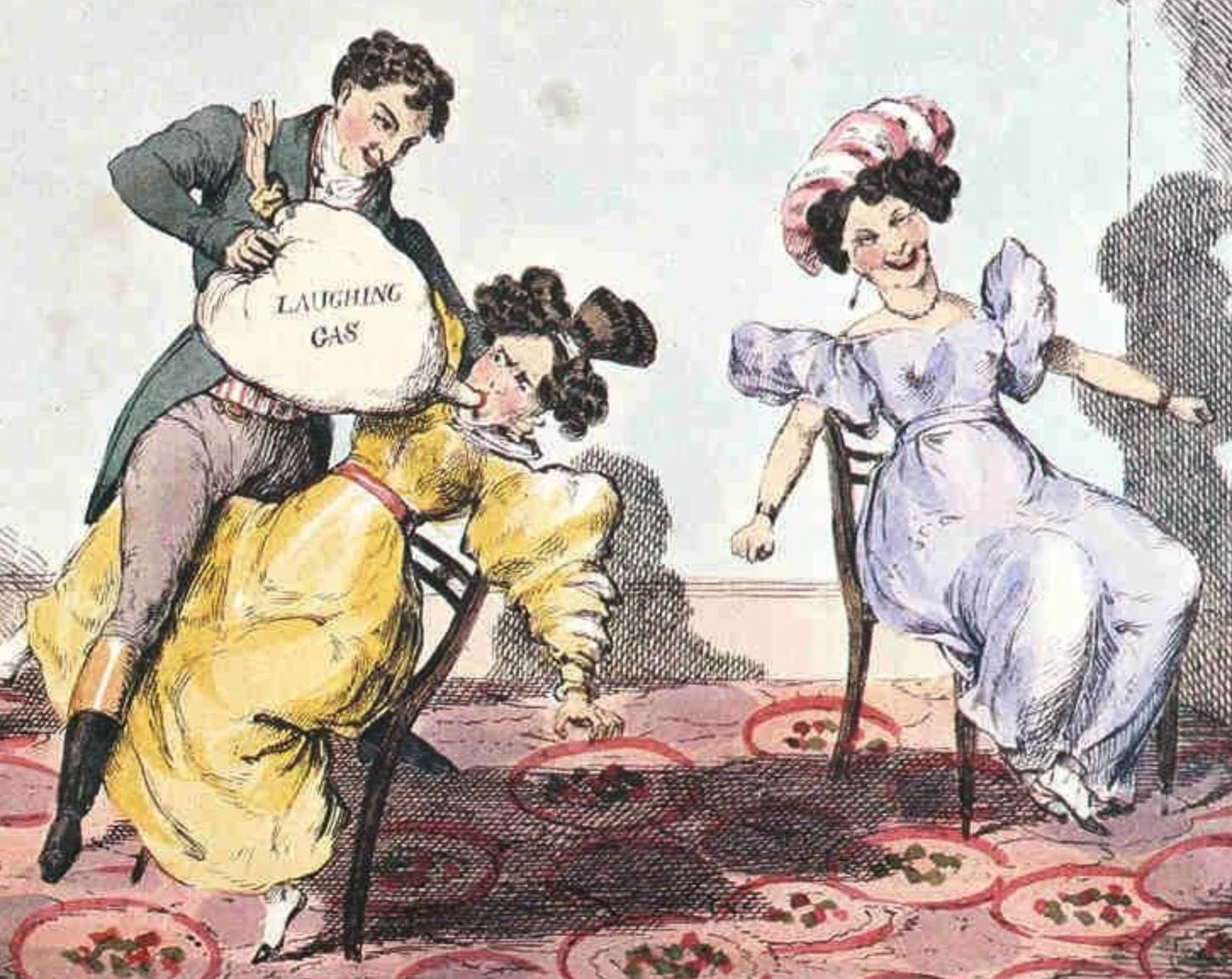
Davy recognized the analgesic properties of nitrous oxide but it wasn’t used as an anesthetic until 40 years later. Meanwhile laughing gas parties became all the rage with Romantic poets and intellectuals.
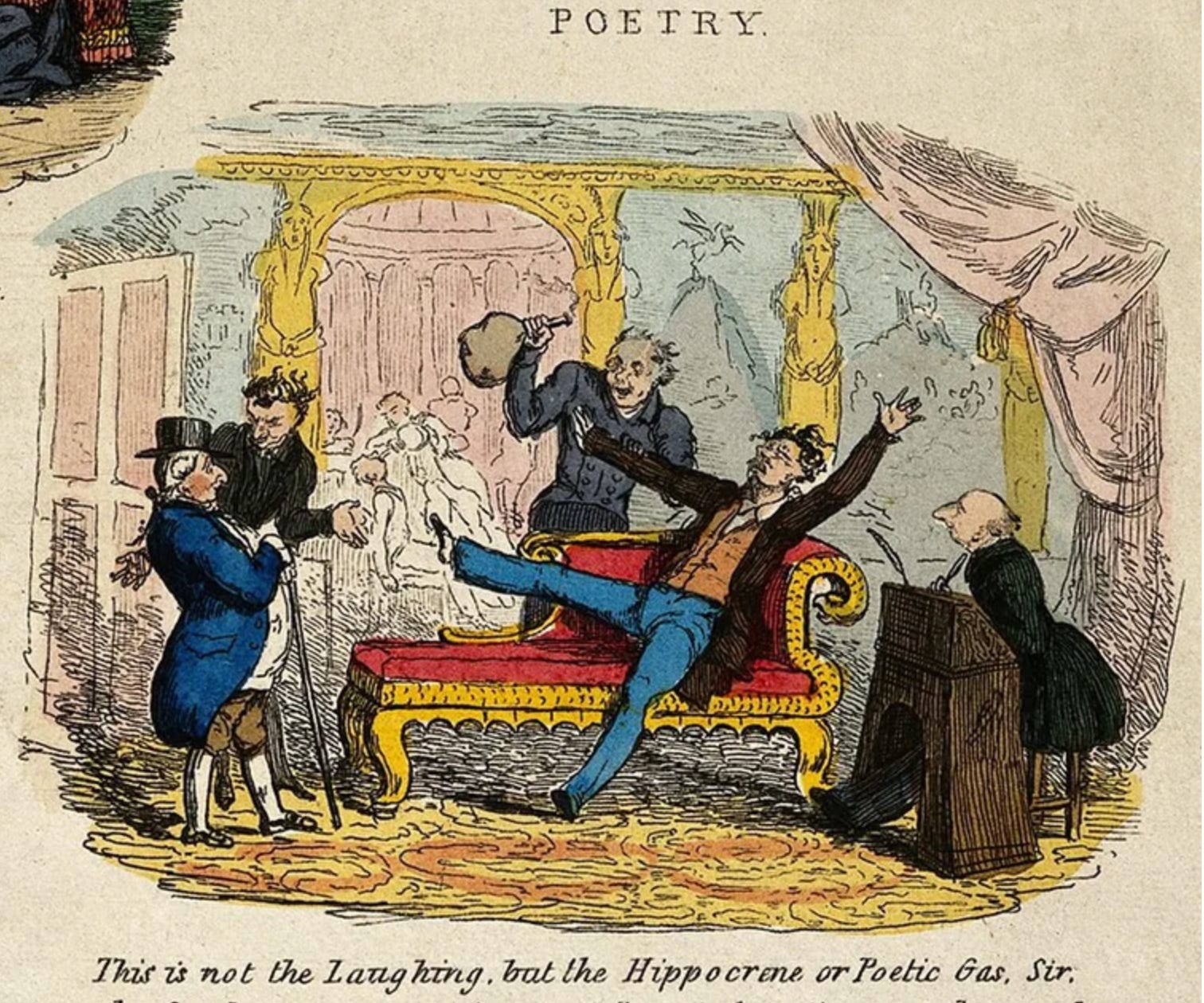
Here we see Davy administering his “prescription for scolding wives.”
We’ll be spending a week in Davy’s Cornwall, lodging in the Penwith peninsula with our time split between St. Ives and Penzance.
To understand what Cornwall is like now, we’ve been watching a very entertaining series on Amazon Prime entitled “Rick Stein’s Cornwall”, wherein we follow the charismatic chef as he talks to us while driving his large jeep down very narrow Cornish roads.
Often he will visit a farm or winery or tea plantation, collect items of food and then prepare what is always a delicious concoction from the local ingredients.
Thus, it is a unique combination of travelogue and cooking show presented by a lovable bloke who absolutely adores Cornwall.
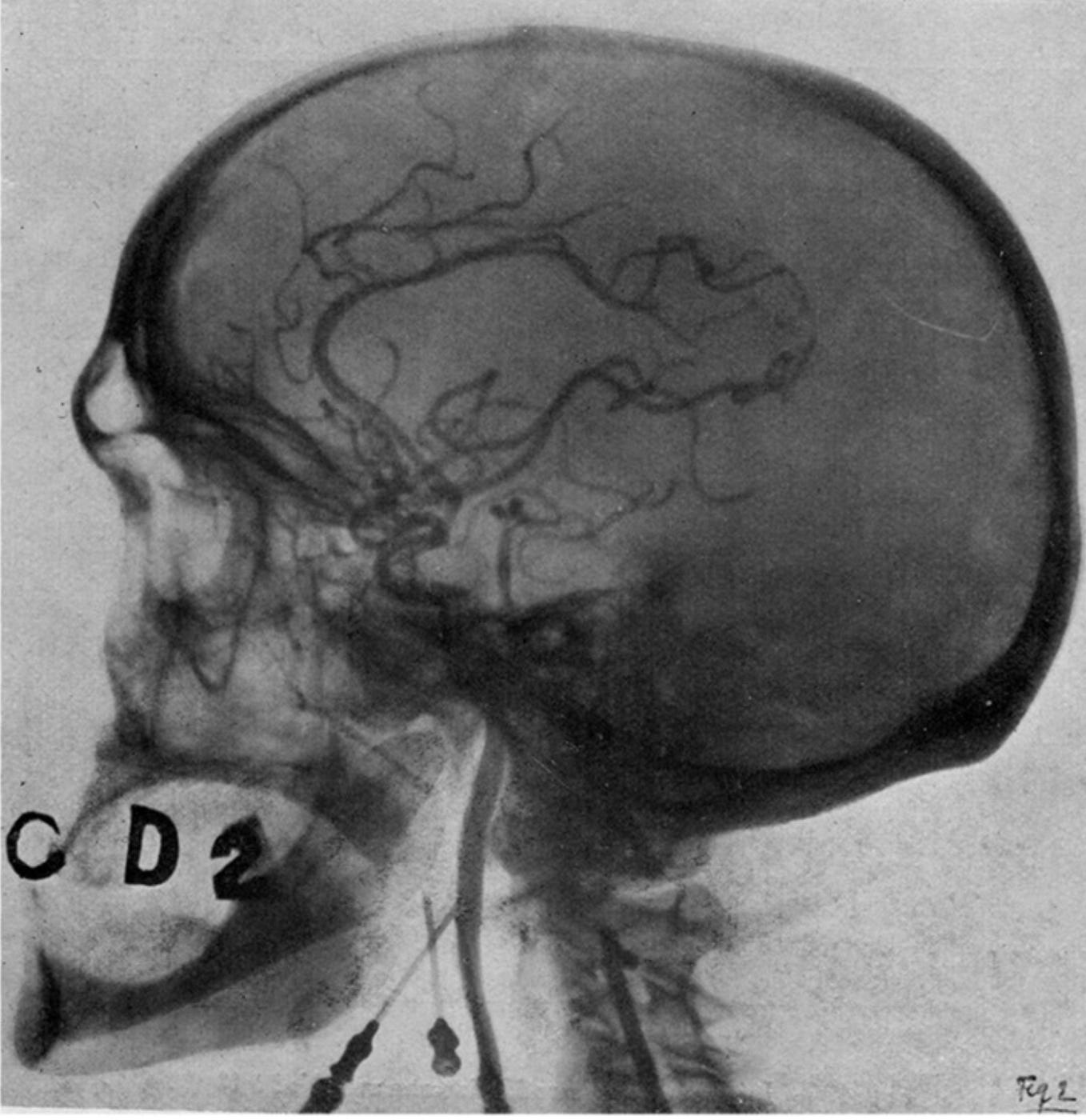
In Portugal we will be on the trail of Egas Moniz (1874–1955), who developed and pioneered the clinical use of cerebral angiography. “which, until 1975 (when computed tomography, CT, scan was introduced in the clinical practice), was the sole diagnostic tool to provide an imaging of cerebral vessels and therefore alterations due to intracranial pathology
Here’s the first cerebral angiogram performed on a corpse in 1927.
Writing in honor of Moniz on the 90th anniversary of his discovery, the author noted:
“Despite his tremendous contribution in modern brain imaging, Egas Moniz was awarded the Nobel Prize in Physiology or Medicine in 1949 for prefrontal leucotomy, the neurosurgical intervention nowadays considered unacceptable.”
He was nominated 3 times for the Nobel Prize for his cerebral angiography work, which remains incredibly important not only for its role in neuroimaging but as a precursor to coronary angiography,
He never won the award for that immense contribution to medicine.
How ironic is that??!
If you have firsthand experience of and/or recommendations for the Skepcardashians during their time in Europe please drop them in the comments below.
Ceticamente seu,
-ACP
Consisting of the former Eternal Fiancee’, Geo (made famous in my articles as the man formerly on the statin fence and now straddled on the BP treatment fence) plus my mother-in-law, Wendy. who, it appears, has not been the subject of any skeptical cardiologist articles.
From the excellent book on the Romantic-era scientists, “The Age of Wonder” by Richard Holmes, one-third of which is devoted to a detailed description of Davy’s life and scientific accomplishments. The medical connection here is from Davy’s early work with nitrous oxide at the Pneumatic Institute in Bristol and with his invention of the safety lamp for miners.
Comments
Nothing yet. Say the first thing.
Sign in to join the conversation.