
The skeptical cardiologist began a series on the cardiac downsides of too much exercise 2 months ago with a question
Whereas moderate volumes of exercise are associated with lower cardiac events, evidence from many different areas suggests that high volumes of exercise actually can increase the risk of abnormal heart rhythms, structural cardiac abnormalities, and aortic root enlargement.
In particular, there is concern for an increased rate of coronary calcification and atherosclerosis in male Masters endurance athletes compared to less active peers with a non-linear (U-shaped) association between lifelong exercise volumes and the prevalence of CAC >100 Agatston units.
It’s not clear what is driving this increase in plaque but several mechanisms have been proposed including
(A) alterations in coronary hemodynamics,
(B) transient increases in circulating parathyroid hormone (PTH) levels,
(C) increased generation of reactive oxygen species (ROS) leading to oxidative modification of low-density lipoprotein (LDL),
(D) inflammatory cytokine release, and
(E) testosterone effects
Recently, I came across a fascinating research letter that attempts to shed more light on possible mechanisms for one of the most-feared consequences of too much exercise: excess calcified coronary plaque
This brief report used information from standard coronary CT angiograms to assess inflammation in the fat surrounding the coronary arteries in marathon runners.
Let me provide a brief background before I delve into the adipose tissue.
The 2025 European Journal of Cardiology review (“Coronary atherosclerosis in athletes: emerging concepts and preventive strategies”)
nicely summarizes the evidence-base
recent cardiac imaging studies raise the possibility that long-term, high-volume, high-intensity endurance exercise may actually accelerate rather than reduce coronary atherosclerosis.
Appropriately, the authors use the phrase “raise the possibility” which reflects the uncertainty in an area where the data is scant.
The scant evidence in this area is all observational.
To give this topic a very personal (and therefore more engaging, at least for cyclists) touch, the review begins with the case of a 44-year-old Tour De France cyclist who developed chest pain with exertion and was subsequently found to have a high-grade stenosis of his LAD coronary artery.
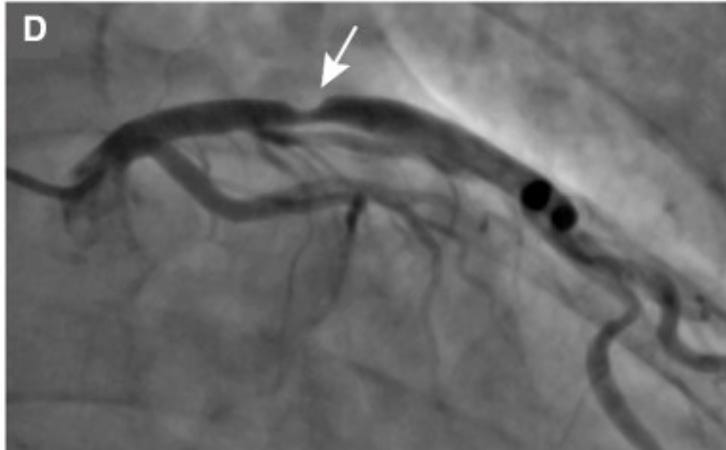
This elite cyclist had normal lipid profile, no family history and no discernible risk factors for coronary artery disease.
It helps emphasize a crucial point
No matter how much you exercise (or otherwise engage in perfect diet and lifestyle behaviour) you can still be at risk for coronary artery disease with its attendant risks of heart attack, sudden death, and angina.
The review provides this figure, a plot of exercise versus CAD by imaging
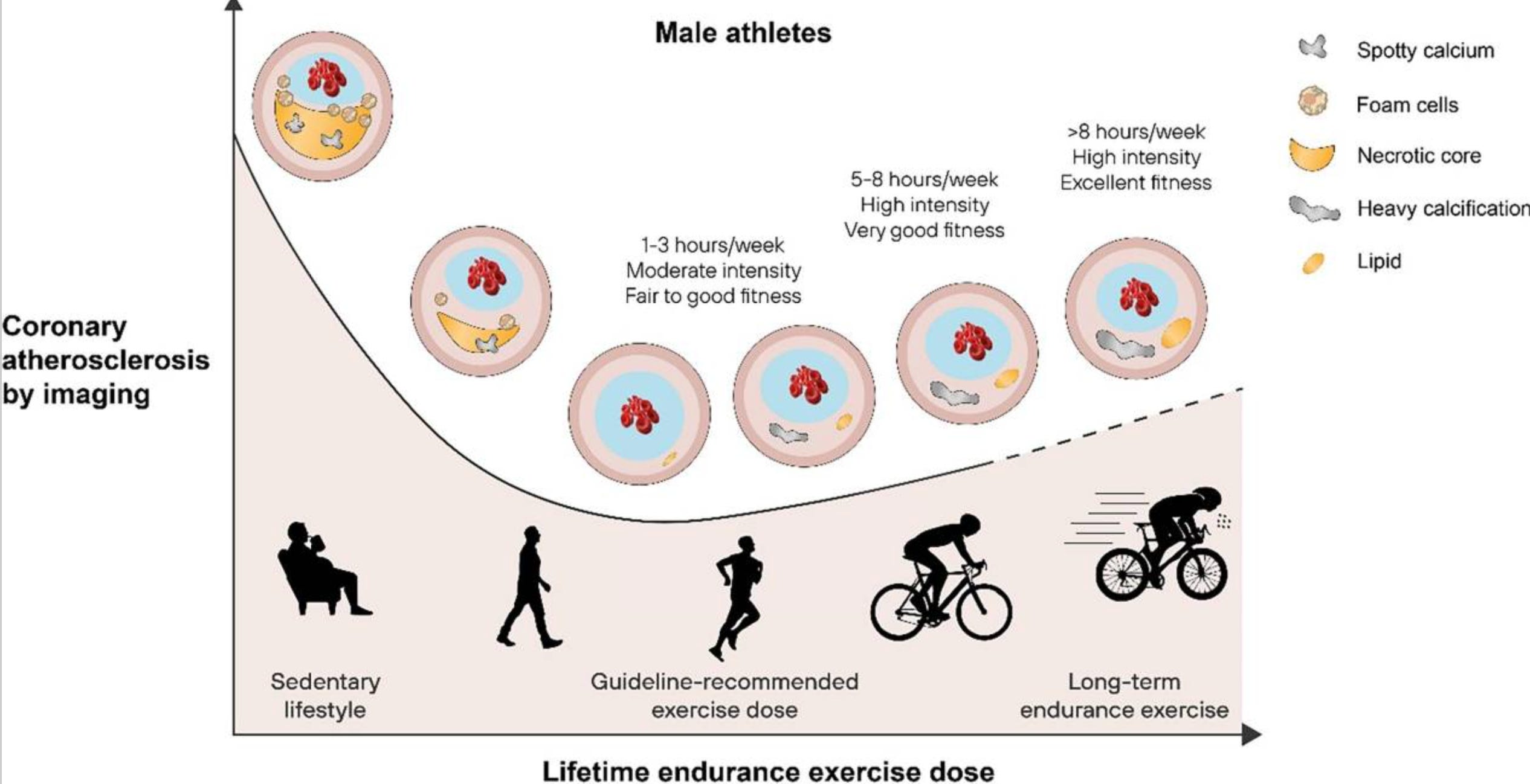
I like that there are no numbers on the x or y-axis. I think this is appropriate because the data are not sufficient to justify more precision.
The x-axis is the lifetime endurance exercise “dose”. This can be thought of as the product of hours per week of exercise times the intensity of exercise.
On the y-axis is coronary atherosclerosis (e.g., coronary plaque) determined by an imaging technique (typically in these studies from coronary CT angiograms)
Note that this only refers to male athletes.
The graphic indicates that if you are sedentary, we tend to find (all other risk factors held constant) a higher build-up of high-risk plaque (yellow necrotic-core) compared to those who do a moderate amount of exercise.
But as the dose of endurance exercise approaches and exceeds 8 hours per week, studies show a buildup of more calcified plaque and total plaque compared to those moderate exercisers.
The result is a reverse J-shaped curve (similar to the one we saw for overall mortality previously.
The cut-off of >8 hours per week (480 minutes) is similar to >3,000 MET-min/week or, equivalently,>450 minutes/week of vigorous exercise — roughly 60–75 minutes/day of hard training, or the training load of a serious endurance athlete.
What mechanism is responsible for this paradoxic increase in coronary plaque?
Comments
Nothing yet. Say the first thing.
Sign in to join the conversation.