
Last December, I decided to check a blood test on myself that the NY Times covered a few days ago in an article entitled “Alzheimer’s Blood Tests Offer New Promise to Diagnose and Predict the Disease” 1(free gift link here).
I had been worrying intermittently about cognitive decline and developing dementia since I found out (via 23 and Me) that I was an Apo E 4 carrier several years ago.
An increase in my inability to remember obscure song names prompted me to delve more deeply into what was in store for my mental function.
The NYTimes article points out that
Currently, experts do not recommend the blood tests for people who do not have cognitive impairment, except to help screen them for eligibility to participate in clinical trials of potential Alzheimer’s therapies. That is partly because there are still questions about the accuracy of making such predictions in cognitively healthy people. The researchers and other experts added that predicting risk should also include other factors, among them age, genetics and other health conditions.
Indeed, primary doctors and neurologists are not recommending you get these tests.
They are available only through a doctor’s order.
Quest offers a set of these labs it calls Quest AD.
I added the order on to my regular labs under the diagnosis of forgetfulness (R41.3: Unspecified memory loss, forgetfulness, or "Other amnesia") and to my surprise my insurance covered it.
Although Quest billed me for over a thousand dollars ($1238.22 to be exact), after adjustment it cost 73$.

Here are the key results
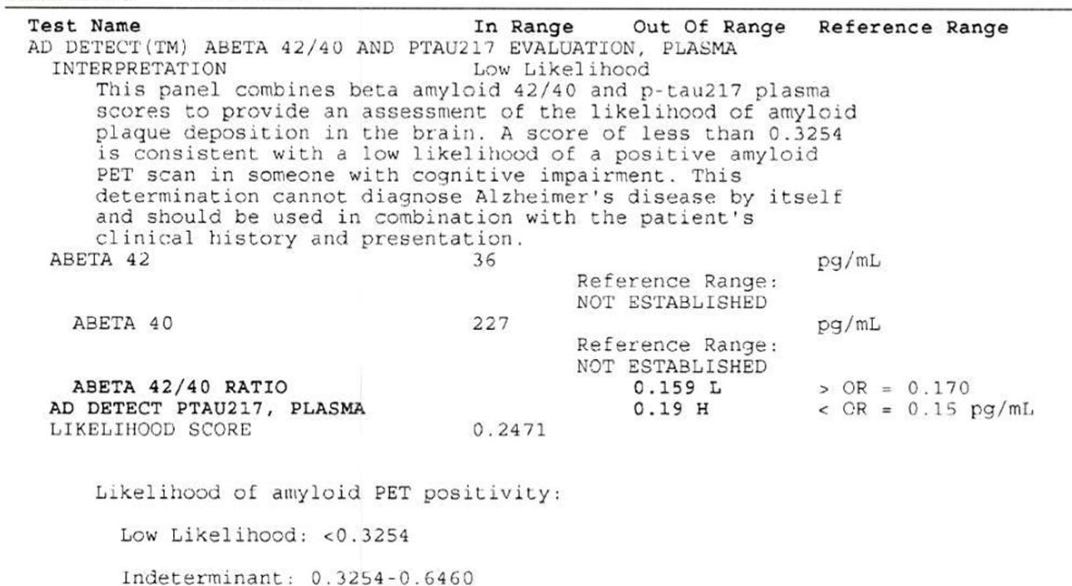
- Aβ42: 36 pg/mL; Aβ40: 227 pg/mL — these are the raw amyloid-beta peptide concentrations.
- Aβ42/40 ratio: 0.159 — this falls within the normal range (reference cutoff ≥0.170 for “out of range”). A ratio closer to or above the reference suggests less amyloid sequestration in the brain, though this value is borderline low.
- p-Tau217: 0.19 pg/mL — slightly above the cutoff of 0.15, indicating mildly elevated phosphorylated tau, which can reflect early tau phosphorylation even before significant amyloid accumulation.
- Composite Likelihood Score: 0.2471 — classified as “Low Likelihood” (<0.3254), meaning I have a very low likelihood of having a positive (abnormal) amyloid PET scan of my brain
These blood tests were evaluated in a 2024 JAMA Neurology article
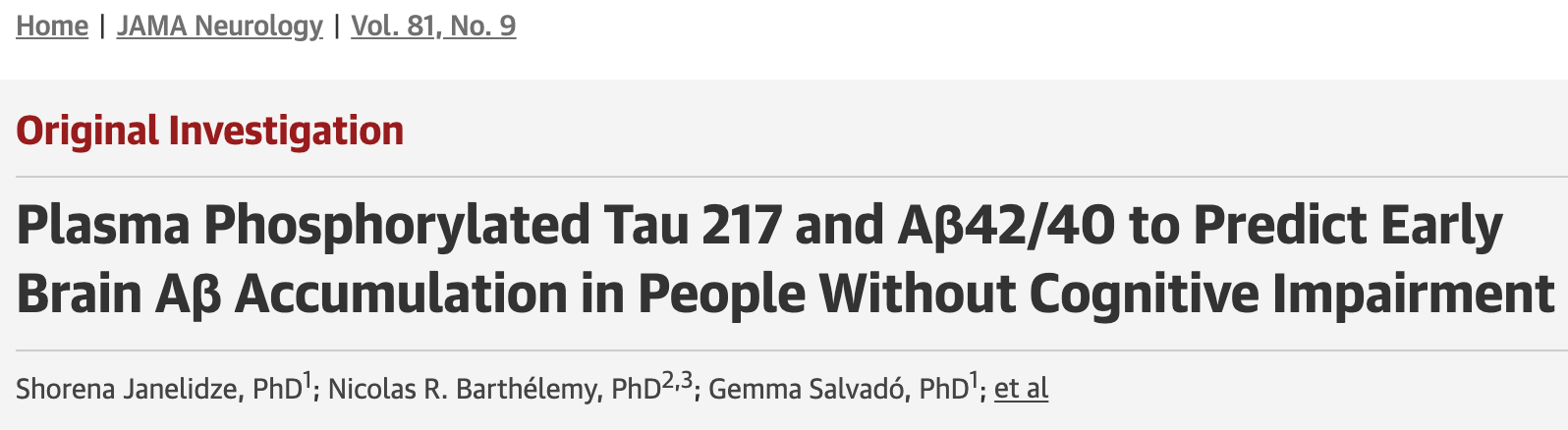
The authors suggested a role for such testing in asymptomatic individuals for the purpose of identifying participants in Alzheimer prevention trials
After their success in slowing cognitive decline in symptomatic AD, lecanemab and donanemab are currently being tested in secondary prevention trials such as AHEAD 3-45 and Trailblazer-ALZ3, respectively, that enroll asymptomatic people with biomarker-evidence of brain Aβ pathology. However, it is likely that the greatest effects of Aβ-lowering treatments would be achieved through primary prevention in individuals with normal brain Aβ levels who are at a high risk of accumulating Aβ pathology. The results of the present study highlight the potential utility of plasma %p-tau217 and Aβ42/40 for identifying individuals to be included in such trials.
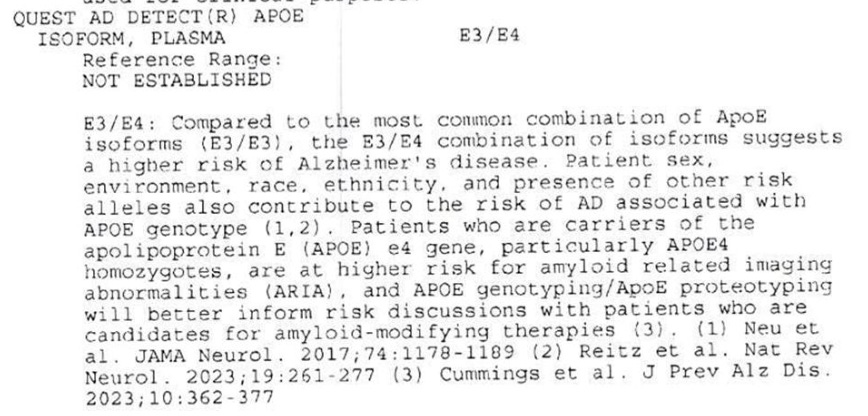
Quest AD also measures plasma ApoE isoforms, a major genetic risk factor for dementia
The ApoE isoforms in my blood, not surprisingly, corresponded to the genes I had previously known about. I am E3/E4.
Hussein Yassine is the Volke Endowed Professor of Neurology at USC and Vice Chair. He directs the Center for Personalized Brain Health and has a special interest in APOE ε4, lipid metabolism, and dementia risk.
If you have any interest in dementia risk or are an ApoE4 carrier I strongly recommend you subscribe to his excellent Substack.
His recent article on this topic is outstanding
Of note he feels p-tau217 is a research tool, not a clinical test.
To repeat the core message: this blood test is not ready for ordering on a healthy person outside of research. Official guidelines recommend against it in routine care, and even the JAMA study’s own authors describe their findings as useful for research and trial design, “not yet precise enough to guide individual prognosis.”
What is a very high p-tau217 good for today? Mainly, identifying good candidates for prevention trials, exactly how it’s used in the trials described above. It is not a trigger for a specific medical decision, because there’s no approved treatment yet that a healthy person’s blood result would unlock. The general advice for someone with a high result, manage vascular risk factors, stay physically and mentally active, sleep well, avoid excess alcohol, is the same advice anyone at elevated risk should already be getting, biomarker or not. Being “eligible for a trial” and “needing a different care plan” are not the same thing, and it’s easy to blur the two. Larger, more representative studies, and clearer genetics- and lab-specific calibration, are still needed before that changes.
Within Dr. Yassine’s Substack article, he discusses the significance of elevated p-tau217 in ApoE4 carriers and links to “The Mayo Clinic Study of Aging public tool (the Mayo CACR calculator) that turns an actual p-tau217 number, plus age, sex, and genetics, into a personalized curve.
Plugging my numbers into the calculator yielded these sobering estimates
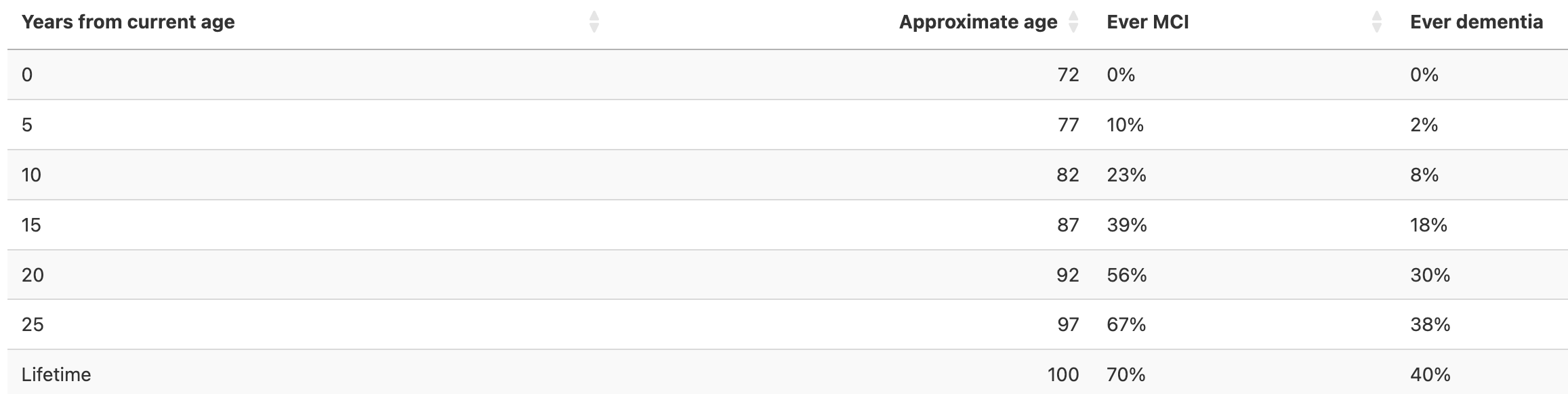
My chance of being demented at age 92 years is 30%.
Comments
Nothing yet. Say the first thing.
Sign in to join the conversation.