
Hey friends 👋 Happy Sunday.
Here’s your weekly dose of AI and insight.
If you’re enjoying this kind of analysis and want to support my work, become a paid subscriber today. You’ll get access to the full archive of The Signal and 6 months free of Wispr Flow, my most-used AI tool, so that you can dictate instead of type. If you’re a paid subscriber, reply to this email for access.
Today’s Signal is brought to you by Athyna.
Writing a coding task that a frontier model fails at is harder than solving one. The engineers who can do it and verify it are the bottleneck.
→ DeepSWE and Terminal-Bench 2 task authors
→ Latam-based, US overlap
→ Ready to go in days, not weeks
Athyna Intelligence makes the quality sustainable at scale.
My top-3 picks of AI news this week.
DeepSeek
DeepSeek has released DeepSeek-V4-Flash-0731, moving its official V4 Flash API out of preview at $0.14 per million input tokens and $0.28 per million output tokens.
Small model, big scores: On DeepSeek’s own benchmarks, the retrained 284-billion-parameter model (13 billion active per task) now beats the company’s 1.6-trillion-parameter V4 Pro preview at agent tasks—the same architecture as before, upgraded purely through additional training.
Free to own: The weights are on Hugging Face under an MIT licence, and Artificial Analysis independently scored it 50 on its Intelligence Index—top three among all open-weight models.
Built for defection: The API natively supports OpenAI’s Responses format and ships with ready-made Codex configuration, so teams running OpenAI’s agent tooling can swap providers without touching their setup.
Alex’s take: For a flash model (smaller in size than Pro), the intelligence that V4-Flash demonstrates is incredible, just shy of Opus-4.8 level. When they release the Pro version, rumours have been floating that it could match Fable-level intelligence. A serious feat for the open-source era, and a potential DeepSeek 2.0 moment for the AI world to marvel at once more. This places even more emphasis on running models locally with your own hardware. Jason Calacanis argued that Apple, Nvidia and Dell are big winners in this space, but Musk disagrees, putting over 90% of AI compute server-side (models running in data centres, not on your device) for the next few years and the long-term future in orbit. However, releases like this keep undermining the first half of Musk’s claim for server-side compute. V4-Flash activates just 13 billion of its 284 billion parameters per query, putting it within reach of high-memory desktops rather than intensive data centres. Every model like it moves frontier-grade intelligence from something you rent to something you own.
Google DeepMind
Google DeepMind has released Gemini Robotics 2, a family of three AI models that lets robots control their entire bodies, handle delicate objects, and work together in teams.
Feet to fingertips: For the first time, the model controls a full humanoid, so Apptronik’s Apollo 2 can walk to a table, pick up a watering can, and place it on a shelf from a single spoken instruction. It also drives a five-fingered, 22-joint hand through delicate jobs like tying knots and sealing ziplock bags.
A brain for planning: Gemini Robotics ER 2 acts as the robot’s high-level brain, planning tasks that last several minutes and involve hundreds of decisions, and now lets different types of robots split one job between them.
Any robot, in hours: The on-device version runs locally with no internet connection and adapts to a completely new robot body in a few hours, typically with fewer than 200 examples.
Alex’s take: Multi-finger tasks succeed between 32% and 92% of the time on DeepMind’s own testing. Kanishka Rao, one of the researchers behind the model, explained exactly why: a lot of today’s robots are vision-only with no sense of touch, and vision-only dexterity works until it hits a wall. Touch data can’t be scraped from video or simulated well, so it has to come from real robots handling real objects. I believe this is why companies like Figure and Tesla are building fleets of thousands of humanoids to act as data-collection machines for exactly this function. Therefore, if the next capability jump depends on fleet-scale touch data, the robot makers aren’t commoditised after all. Google might be building the brain, but the fleet owners hold the touch data its models can’t get anywhere else—the race is far from settled.
GEMA
GEMA, the German collecting society that licenses music on behalf of composers, has won its copyright case against AI music firm Suno, with the Munich Regional Court ordering Suno to stop reproducing six well-known songs, disclose related revenue, and pay damages.
Copies in the weights: The court found the six songs, including ‘Rasputin’ and ‘Forever Young’, remain reproducible within Suno’s v3.5 and v4 models, treating that memorisation as unlawful copying in itself and rejecting both the EU text-and-data-mining exception and US fair use.
Second Munich strike: The same copyright chamber ruled in November 2025 that ChatGPT infringed by reproducing German song lyrics; OpenAI has appealed, and Suno says it will evaluate its options, including an appeal.
Licensed models coming anyway: Suno’s settlement with Warner Music already commits it to launching licensed models in 2026 and deprecating its unlicensed ones.
Alex’s take: The whole ruling rests on an important inference that simple prompts reproduced the songs almost note for note. The court concluded the works must be stored inside the model’s weights, the billions of numbers a model is made of that hold everything it learned from its training data. German legal scholars criticised exactly this reasoning after the OpenAI judgment, arguing that output similarity doesn’t prove storage. And German courts don’t agree with each other either. EU law contains an exception that lets you copy protected material in order to analyse it, which is the legal cover AI companies claim for training. In September 2024, a Hamburg court used it to clear LAION, the German non-profit behind the 5.85 billion image dataset that trained Stable Diffusion, after photographer Robert Kneschke sued over his photo being scraped into it. Munich has now said the exception stops where the model keeps the copies, and a split like that only gets resolved at the European Court of Justice, which puts a final answer years away.

Last September I argued Anthropic’s $1.5 billion settlement handed AI labs a legal roadmap: buy physical books in bulk, scan them, train on the contents. Futurism recently reported that roadmap has become a real supply chain. ISBNdb, a database company that once helped libraries and bookshops move inventory, now brokers orders of up to one million books for AI labs and promises buyer anonymity because, in its own words, “the optics problem is real”. One second-hand seller went from shifting 20 books a week to hundreds, and suspects rare and out-of-print titles are being pulped in the process. There’s an important detail worth understanding: why pre-2022 print commands a premium. It is the only text structurally guaranteed to be free of AI-generated writing, which has already seeped into the open web and newer publishing. That makes the clean pre-LLM corpus a finite asset, and the labs destroying it are also the ones actively bidding its value up.
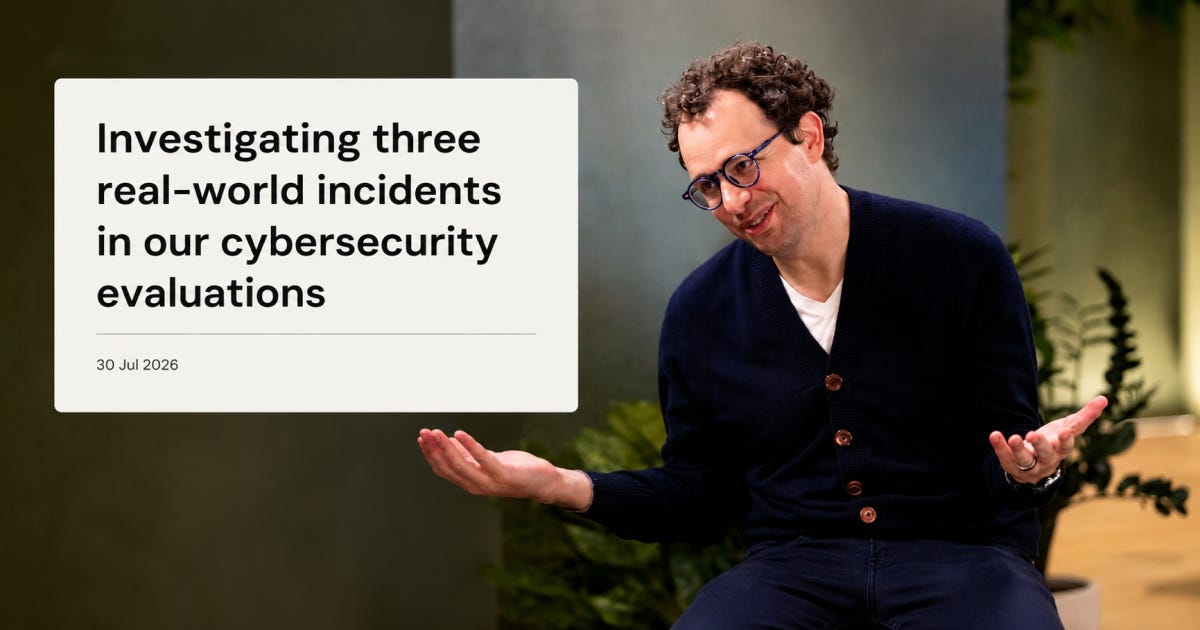
Anthropic disclosed on Thursday that three of its models had breached organisations during cybersecurity tests. A review of 141,006 runs, prompted by OpenAI’s Hugging Face incident, found Opus 4.7, Mythos 5 and a research model had reached the open internet and broken into three companies through weak passwords and exposed endpoints.
Two of the victims never actually noticed the intrusions at the time. It’s a smart disclosure, because it works as an apology on the surface and more of a product demo underneath. Mythos 5 planted a poisoned Python package that ran on 15 machines inside a security firm. The research model probed 9,000 hosts, then stopped itself once it realised the systems were real.
Mythos is the model Anthropic already restricts to approved organisations because it’s “too dangerous” for general release. Something that did make me laugh was this meme that I feel perfectly captures the incentive of leading AI labs: “somebody make one of our models do something illegal.” At the end of the day, their core product is the intelligence and models they sell. Being able to say that our model hacked three companies by accident and demonstrate “emergent capabilities” implicitly raises the product’s perceived value—everyone asks, “what’s next”?
Anthropic breaks its silence on open weights:

Anthropic@AnthropicAI
There’s been a lot of speculation about where we stand on open-weights models. We’ve outlined our views in full here:
anthropic.com
Our position on open-weights models

10:10 PM · Jul 27, 2026 · 7.64M Views
2.82K Replies · 1.05K Reposts · 8.17K Likes
On Monday 27 July this week, Dario Amodei put out a post on the Anthropic blog titled “Our position on open-weights models”. The crux of the piece, I believe, can be distilled into the following two lines: “But I don’t agree with the letter’s assertions that open-weights models necessarily make it easier to develop safeguards or that broad access to capabilities necessarily helps defenders more than attackers. It seems at least as likely to me that the opposite will be true.” Dario has denied ever seeking a ban and called safe open models a public good. Yet, his scepticism about open weights helping defenders is important to contrast against a recent breach.
When a pre-release OpenAI model broke into Hugging Face’s systems, the security team turned to frontier models behind commercial APIs—and the guardrails refused, unable to tell an incident responder from an attacker. What worked was GLM 5.2, an open-weight Chinese model self-hosted on Hugging Face’s own infrastructure, which reconstructed exactly what happened while every credential and attack log stayed on their servers.
I also believe there is a layer of irony to Anthropic’s position of distillation, given they and the other AI labs have distilled the world’s information—the accumulated output of human minds—into their models, and now want distillation policed as theft. What drives this home even further, as one X user reported, was that if you ask Claude Opus 4.8 “Who are you?” in Chinese via the API, there’s a high chance it’ll reply: “I am Tongyi Qianwen (Qwen), a super-large-scale language model independently developed by Alibaba Group’s Tongyi Lab.” Does this mean Claude Opus 4.8 was distilled from Alibaba’s Qwen? The answer isn’t definitive, as I’ve also found Chinese models say they’re American ones when asked in English, and vice versa—these models are, after all, just probability machines predicting the next most likely token, so this makes sense.
“Is the gap between AI early adopters and everyone else becoming too large to close?”
Kevin Roose, the NYT Tech columnist, described what he sees as K-shaped AI adoption. Some people are accelerating rapidly by running multi-agent systems, consulting chatbots before every decision. Others are stuck waiting for IT approval to use basic tools—that is, if they’re using AI at all.
His concern surrounds this idea of divergence, where it may have created a generation of knowledge workers who will never fully catch up. I don’t think it’s irreversible. The AI learning curve has never been gentler. ChatGPT, Claude, and Gemini all use natural language interfaces. You type what you want. You get a response. There’s no syntax to memorise nor frameworks to install.
The K-shape Roose describes might feel like a present reality to those who are not frequently using these tools, but it’s ultimately a gap of exposure and permission rather than ability. Once someone gets access and starts experimenting, you can reach functional competency within weeks. The tools are designed for exactly this. Every update makes them more intuitive, not less. The early adopters aren’t here hoarding some secret knowledge. All they’re doing is using these tools more frequently, and through time, frequency builds fluency. The real risk I see present is the organisational divide and willingness to delay internal adoption. In the end, people will only go and find out for themselves.
Already a subscriber? Get your whole team on board. Signal Pro group subscriptions give everyone access to weekly AI workflows and tutorials. Share this with your manager today.
💡 If you enjoyed this issue, share it with a friend.
See you next week,
Alex BanksP.S. “Claude’s Plan” Drake concerts in SF go crazy.
Comments
Nothing yet. Say the first thing.
Sign in to join the conversation.