
An increasing amount of profits and exits are being created by the biggest firms in the world using your funds. Today I want to go more in depth in regards to the usage of pension and insurance funds to fund the missing liquidity big institutions and companies need.
Without knowing it, your money has been used to fund their gain.
I started noticing this pattern earlier this year, and SpaceX is what made it undeniable.
For a decade, SpaceX was liquid exactly twice a year, capped, company-priced tender offers where employees and early holders sold slivers of their stake to a curated list of approved buyers. No public price discovery, just Elon Musk and his CFO setting a number. That number went from $175 billion in December 2023 to $800 billion by December 2025, the share price doubling in five months on no news except demand.
In February 2026 SpaceX merged with xAI at a $1.25 trillion valuation, and in June it IPO’d: $75 billion raised, the largest offering in history, opening above $1.7 trillion.
What actually got my attention wasn’t the number itself but how a company could IPO with such huge multiples, who would be interested in buying?... The answer was based on the float.
SpaceX listed with roughly 3 to 4% of its shares freely tradeable, and Nasdaq had already agreed to admit it to the Nasdaq-100 after just fifteen trading days, weighted at five times its real float, specifically so index funds would start buying immediately instead of waiting for the float to grow on its own.
Around a quarter of the IPO itself was bought by index funds on day one.
Pension funds objected on the record before the listing even happened, Railpen and the Council of Institutional Investors, joined by more than a dozen of the council’s member funds, wrote to SpaceX flagging exactly this dynamic, and were overruled by their own mandates.
If a stock is in the index, you own it, whether or not you’d have chosen to.
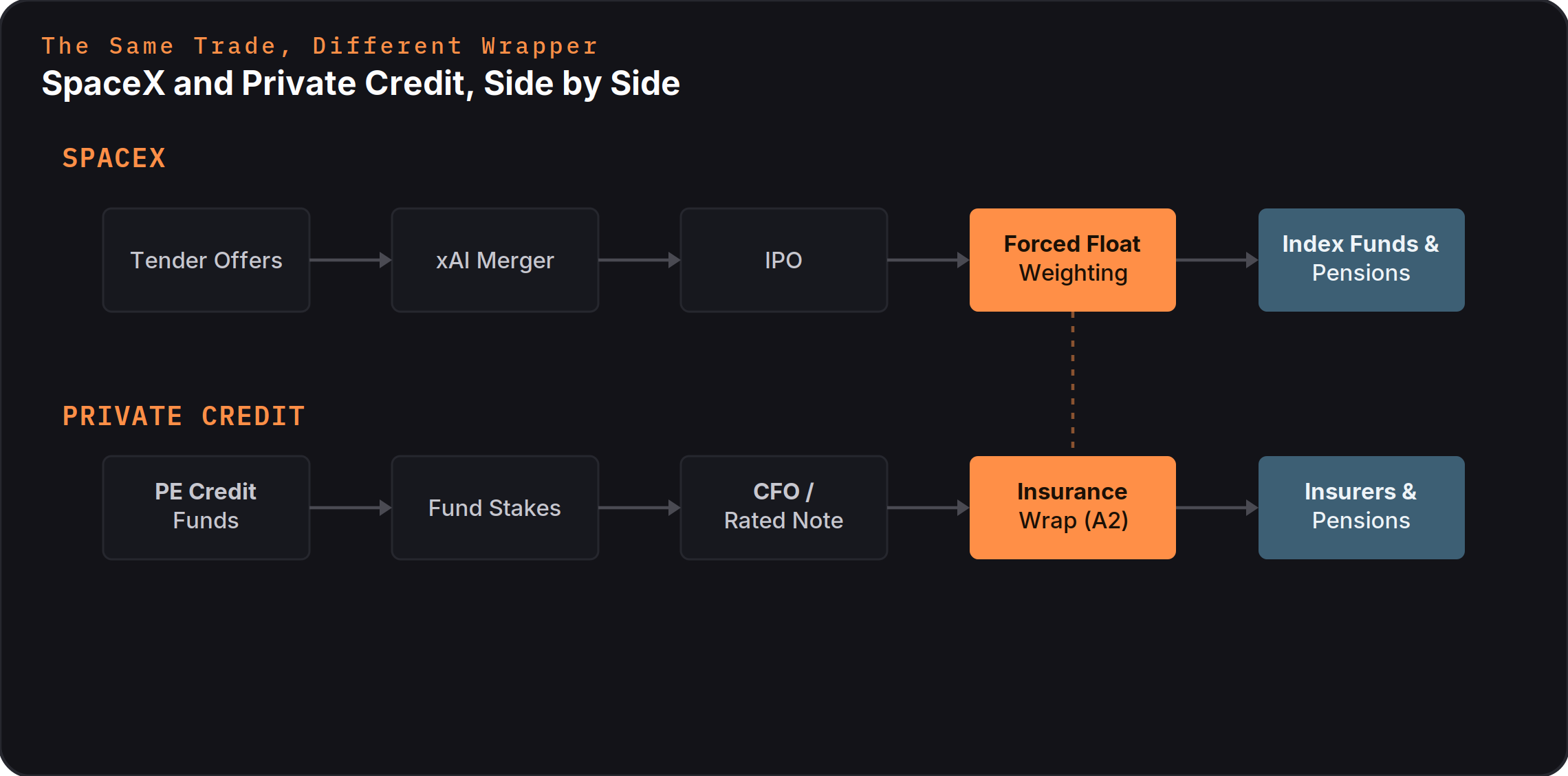
That's the same trade this piece is about, run through a different wrapper. A decade of insiders pricing their own exit in private, followed by a listing engineered to pull passive capital in faster than the float would justify on its own, so the people who built the position first get to leave through buyers who never really got a choice.
Private credit is doing the same thing with a rating instead of an index seat.
On April 7th, 2026, UBS started shopping a bond to a short list of sophisticated investors.
At first glance the pitch looked routin, a bundle of stakes in eight private credit funds, repackaged into $500 million of notes. Investors who read past the cover page found something stranger: $375 million of those notes carried a target rating of A2 from Moody’s.
That rating had almost nothing to do with the credit quality of the underlying loans, and everything to do with a guarantee written by Nationwide Mutual Insurance.
Three months later, when Bloomberg wrote up the wider trend on July 19th, they called the pitch “worthy of a double take.”
This is the story of that double take, and why it rhymes with one we’ve all heard before.
More on SpaceX and its IPO here:
Every dollar an insurer holds against its policyholders carries a price tag. State regulators, through the NAIC’s risk-based capital framework, force insurers to set aside capital against every asset on the balance sheet, sized to how risky that asset looks. It functions as a tax on risk-holding.
Buy a $100 million equity stake in a private credit fund directly, full exposure, full upside, full downside, and the tax runs roughly 30%. That’s $30 million of capital sitting idle. Not earning a spread. Not backing new policies. Just existing, as a cushion against a bad outcome regulators are betting will eventually arrive.
Every structure Wall Street has rolled out over the last two years exists to shrink that $30 million, without shrinking the $100 million of actual exposure sitting underneath it.
To the structuring we go.
Run the same $100 million of private credit exposure through three different wrappers and the regulatory bill moves dramatically, while the underlying risk doesn’t move at all.
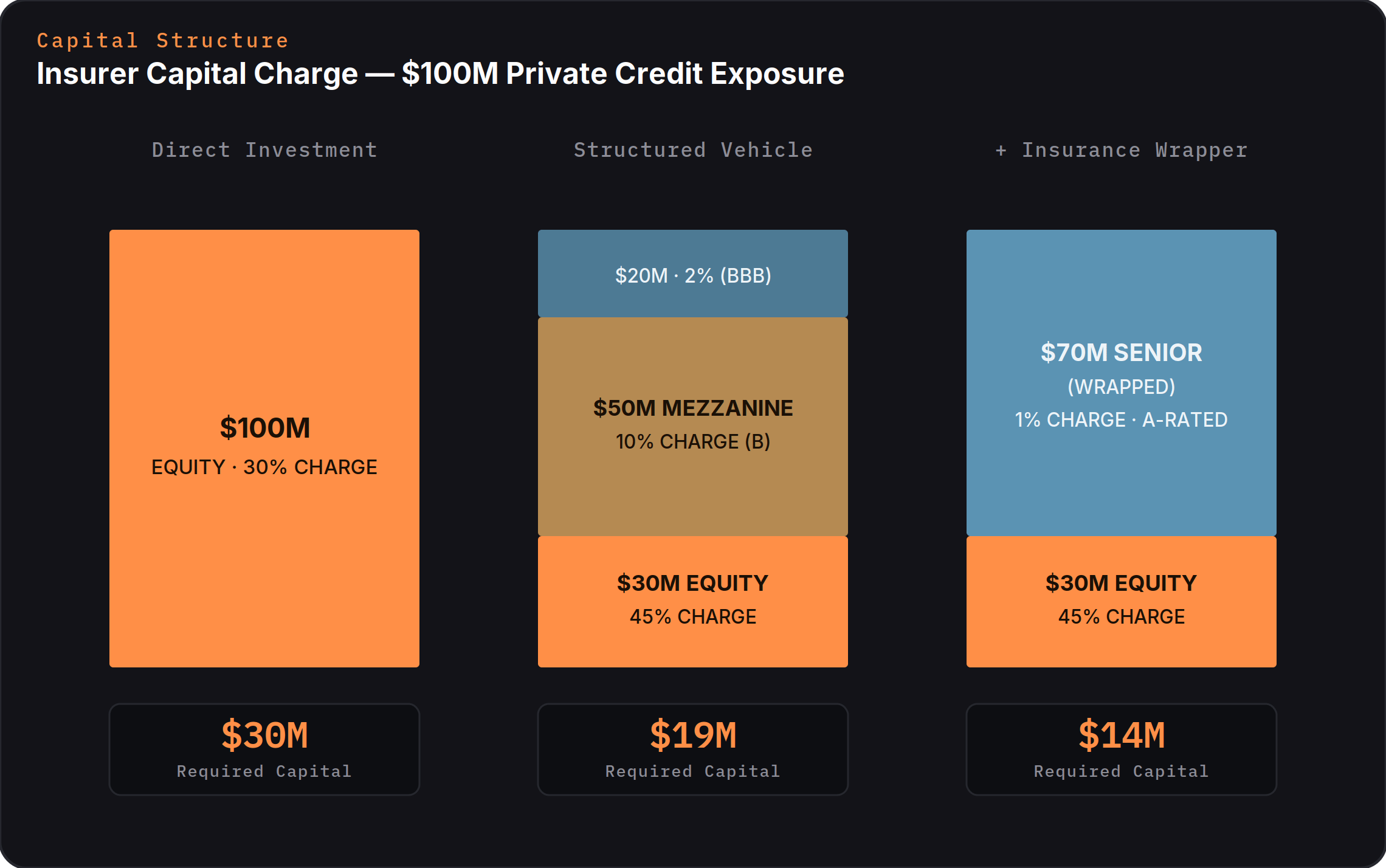
$30M → $19M → $14M. Same $100M of underlying risk in every column, a 53% cut to required capital, achieved through tranching and a single insurance wrapper.
Direct investment. The insurer buys the equity stake outright. $30 million charge, 30% of principal.
Structured vehicle. Route the same $100 million through a vehicle sliced into three tranches, $30 million of first-loss equity, $50 million of B-rated mezzanine debt, $20 million of BBB-rated senior debt. Losses hit equity first, so it still carries a 45% charge. But the mezzanine only needs 10%, and the senior debt needs just 2%. Blended, the total drops to $19 million.
Structured vehicle with an insurance wrapper.
Take that senior tranch, now $70 million, combining the old mezzanine and senior pieces, and have a third-party insurer guarantee it against loss. The rating agency stops grading the loans and starts grading the guarantor.
Nationwide’s credit quality gets substituted onto the notes, the wrapped tranche is treated as A-rated, and its charge falls to roughly 1%. Add the $30 million equity layer at 45%, and the total capital bill lands at $14 million.
$30 million. $19 million. $14 million. The same $100 million of risk sits underneath every version, a 53% cut to the capital bill, achieved entirely through paperwork.
None of this happens in a vacuum. Private equity has spent four straight years unable to sell what it owns.
Bain’s 2026 outlook put buyout distributions at 14% of NAV last year, the second-lowest level since the depths of the 2008 crisis. Roughly $3.8 trillion sits unrealized across 32,000 portfolio companies, with average hold periods stretching toward seven years.
Limited partners promised liquidity in five years are still waiting in year seven, and general partners need cash flowing back before they can raise the next fund.
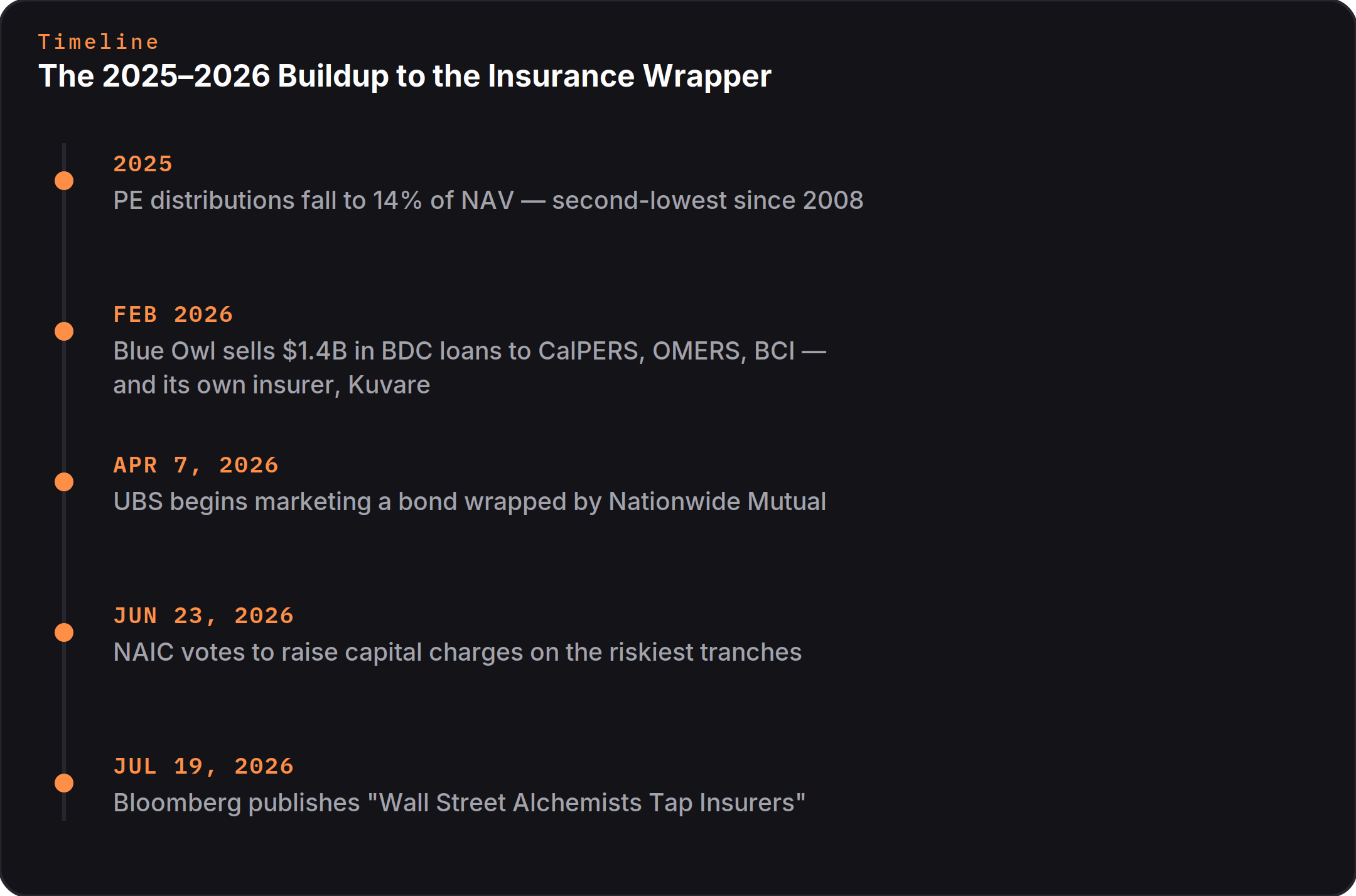
Five months, one playbook: the same liquidity pressure that built NAV loans and continuation vehicles now runs through insurance wrappers.
So the industry built substitutes.
NAV loans, borrowing against a fund’s existing portfolio instead of selling it, run close to $150 billion outstanding, with Goldman, JPMorgan, Macquarie, HPS and Ares all in the business.
GP-led secondaries, mostly continuation vehicles that let a sponsor roll an asset into a new fund it also controls, hit $115 billion in 2025, up 53% year-over-year and now nearly half of total secondary-market volume.
The insurance wrapper is the newest valve on that list, and arguably the most powerful, because it doesn’t just create liquidity. It moves the risk off the balance sheet that originated it and onto one that didn’t.
Repackaging bad assets into a higher credit rating asset and reselling it to profit… Ring a bell?
In February 2026, Blue Owl sold $1.4 billion of loans out of its own business development companies at 99.7 cents on the dollar. Among the buyers: Kuvare, the insurer Blue Owl itself acquired in 2024. Barclays flagged the deal as a potential template, one that shifts assets from BDCs levered around 1x into CLO and insurance structures levered closer to 9 or 10x, tightening the links between a manager, its funds, and its own captive insurer with every repetition.
Comments
Nothing yet. Say the first thing.
Sign in to join the conversation.