
Good morning everyone,
First let me start by thanking all of you that are following along this journey and have decided to dedicate part of our weeks and months to reading these extended blogs.
I had been itching to write longer format for a while now and decided that the book launch might be the perfect occasion to write again given the amount of questions that arose. Funny enough I did the book to answer many questions but more were left unanswered through it as people poked in every direction for more precise information.
Over the next few blogs, most likely with topic changes along the way to address more technical questions, I will try and answer all questions that were asked, mainly through twitter but others I received per email, text, calls and more.
Trading is dynamic, you have to stay flexible within your approach to risk to win. First, if you stick to one strategy for an extended time period without adjustments, the market will punish you for it. Market conditions move. The way price behaves shifts. Strategies that worked once become broken. What stays is your understanding of core concepts.
Risk management is the umbrella. But the most important thing in trading overall is understanding expectancy, making sure the balance between win rate and risk reward favors you, and that you’re not hiding tail risk. A parabolic short with adds looks good until it doesn’t. A martingale equity curve feels smooth until you’re blown up.
Over time, the most important thing is staying adaptable to the market in front of you. The small-cap short strategy I detailed in the book, the mid-cap long swing, the long-term investing approach, they’re all the same at the core. I wanted the most risk-adjusted path forward to grow the account without risking maximal failure. The expression of that thought was data-backed strategies that let me deploy risk management tools in a way that compounded.
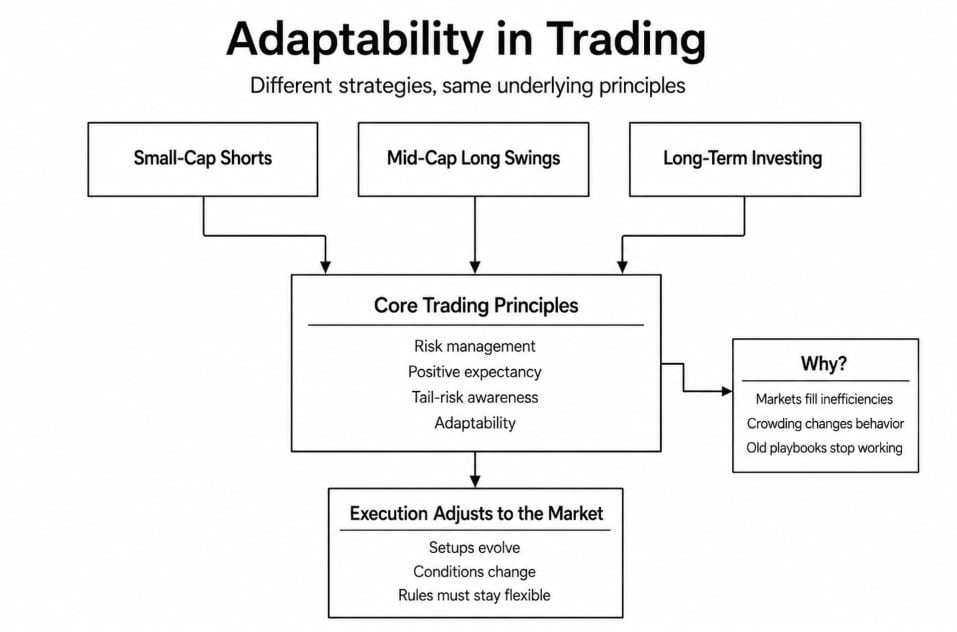
Don’t stick to one strategy. Stick to the trading principles you’ve built along the way as you evolve.
The market fills inefficiencies. Whenever you find something that works very well, there’s a high chance you’re looking at either massive tail risk or an inefficiency that hasn’t been picked up yet, maybe because the space is too small for bigger players, or there are structural barriers (locates, tools, filings requirements, geography) that keep them out.
Comments
Nothing yet. Say the first thing.
Sign in to join the conversation.