
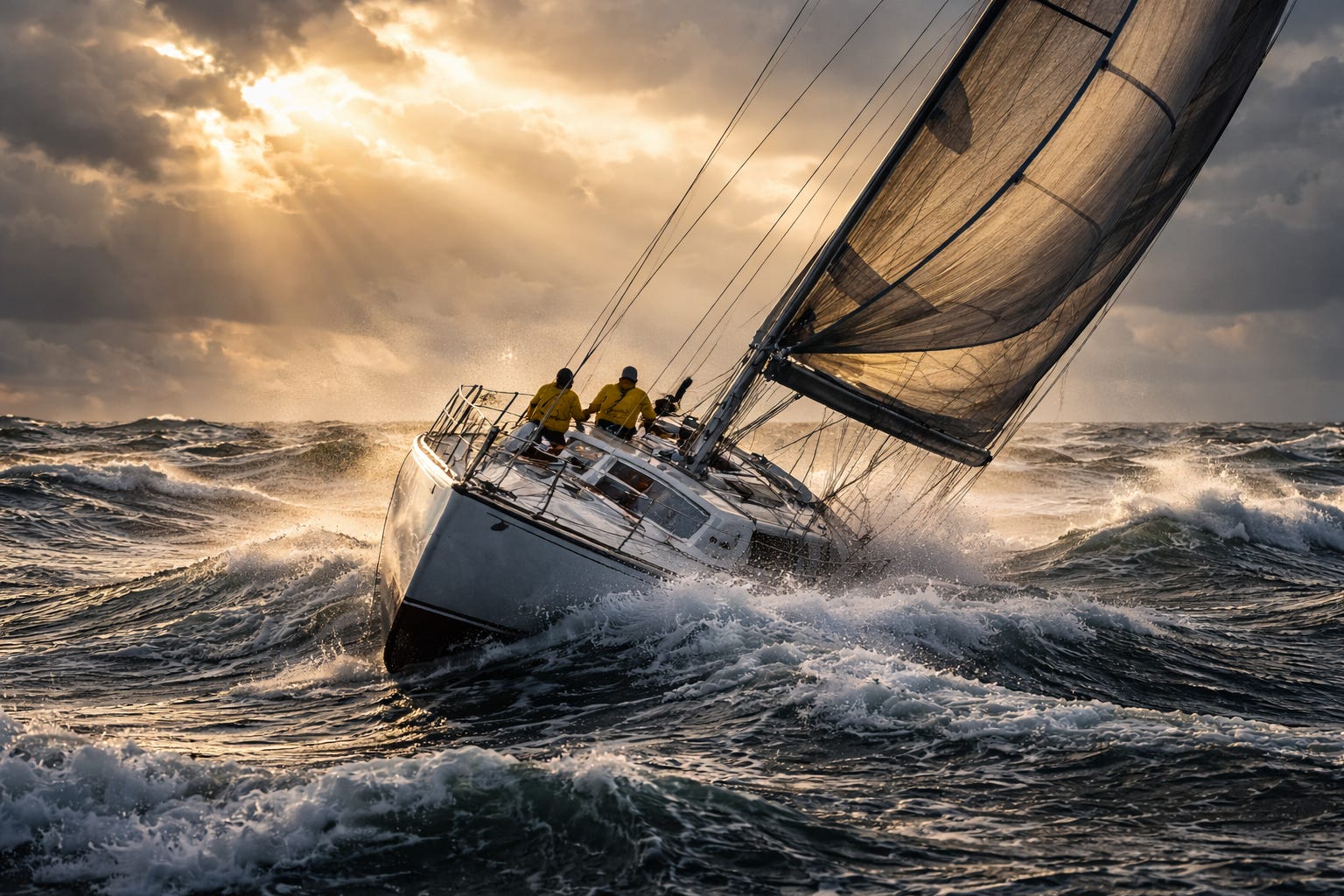
The first time I felt the boat truly come alive beneath me, I could not see what was doing it.
The Bay was restless but not violent, the afternoon light catching the chop in flashes of silver. I had the main trimmed too tight. The boat felt heavy, reluctant. I eased the sheet a few inches. The sail rounded, softened, and then the hull leaned harder into the water. The wheel pressed into my palm. We accelerated.
Nothing visible had changed.
The sky looked the same. The water looked the same. And yet something invisible had filled the canvas and turned stillness into motion.
That is the first theological experience I remember having as a sailor—not a thought about God, not a prayer, but a sudden awareness that I was being moved by something I could not see.
Ancient people must have felt that long before they named it.
Long before weather maps and forecasts, there were human beings standing on shorelines watching the surface of the sea darken under gusts. They saw grass bend before storms arrived. They heard wind before they felt rain. Eventually, some of them lifted fabric or hide into that moving air and discovered that it could carry them.
If it filled your sail, you moved.
If it died, you drifted.
If it turned violent, you survived or you did not.
What word do you give to something that powerful and invisible?
In the opening lines of Genesis, before light, before land, before life itself, there is water and darkness. And then a phrase: Ruach Elohim hovering over the waters.
The word Ruach is slippery. It means wind. It means breath. It means spirit. It is air in motion. Later theology would refine it into something distinctly supernatural. But at its root, Ruach is wind.
Imagine hearing that text not as a modern theologian but as an ancient herdsman or fisherman. Before order, there was wind over water. Before form, there was motion. Before creation took shape, something moved across chaos and stirred it.
Anyone who has stood on a shoreline in rising wind knows the image. Still water lies flat and opaque. When wind passes over it, patterns appear. Ripples form. Waves build. Motion makes form visible.
That does not require superstition. It requires attention.
When I sail, I do not see the wind. I see its consequences. I see the sail luff when I point too high. I see telltales stream when I find the right angle. I see the boat heel and feel the keel bite when the breeze strengthens. The wind itself remains invisible, but it is written everywhere in tension and motion.
Early humans lived in that same condition of reading consequences. They did not have anemometers; they had skin and sound and survival. They felt breath leave a dying body and understood that life had departed. They felt wind roar down valleys and understood that something larger than themselves was moving.
The leap from wind to spirit was not irrational; it was experiential. Breath equals life. Wind equals power. Therefore wind carries life. Therefore wind must be sacred.
Across cultures, the overlap persists. The Hebrew Ruach. The Greek pneuma. The Latin spiritus. Breath and spirit entwined in language itself. When something invisible sustains you at every moment, it is difficult not to see divinity in it.
And yet, out on the water, the wind is not moral. It does not bless me for trimming well or punish me for mistakes. It obeys pressure gradients, solar heating, planetary rotation. The afternoon wind on the Bay builds because inland valleys heat faster than the ocean, drawing air through the Golden Gate. Large systems curve because the Earth spins beneath them. The mechanisms are intricate and beautiful. The wind is not will; it is relationship.
Knowing this has not diminished my sense of wonder. It has altered it.
When I first began sailing, I treated wind almost adversarially. Too much was dangerous. Too little was frustrating. I overcorrected and gripped the wheel too tightly. Gradually, as I learned to read the water’s texture and subtle shifts in direction, something changed. I stopped trying to conquer the wind and started cooperating with it. You cannot command it, but you can align with it. You trim sails to its angle. You choose courses that harness rather than resist. You reef early instead of late.
There is humility in that shift. The wind does not exist for me. My boat moves only insofar as I adapt to something larger than myself.
Perhaps that is what the ancient writers were trying to express—not a cosmic personality hovering like a ghost over the ocean, but the intuition that before anything solid existed, there was movement. Energy. Breath-like force shaping potential into pattern.
In that sense, Ruach Elohim may be less about a supernatural being and more about a profound recognition: invisible forces shape visible worlds.
The ancients personified what they experienced because personification is how the human mind organizes power. A storm devastates a coastline; it feels like anger. A steady breeze carries you safely home; it feels like favor. Without meteorology, the line between force and will is thin.
But even as science has replaced mythology, the underlying experience remains. I still stand at the helm feeling the boat respond to something I cannot see. I still watch whitecaps march across the surface before the gust reaches me. I still listen to rigging hum in rising wind and feel both small and exhilarated. The explanation has changed. The awe has not.
A sail does not create power; it redirects it. Shaped precisely, it converts air in motion into forward thrust. The keel resists sideways drift, allowing progress. Rudder and hull, sail and line, all working together to translate the invisible into the tangible.
There is something profoundly human about that. We do not worship the wind. We participate with it.
Standing on deck in strong wind, you feel pressure against your body. Clothing snaps. The boat leans and your muscles respond. It is impossible not to feel alive. Perhaps that is why wind and spirit became intertwined. Both are felt most intensely in motion. Both resist containment. Both are essential yet unseen.
The mistake was not in feeling reverence. The mistake was in concluding that reverence required personhood behind the force.
Wind does not love me. It does not judge me. It does not know me. And yet it carries me across water with a power that predates humanity by billions of years. It sculpts dunes and drives weather systems that sustain ecosystems. It is part of a planetary dance between sun and sea.
If I imagine the author of Genesis standing on a shoreline, watching wind churn dark water before dawn, I can feel the resonance. Before order, there was motion. Before land emerged, there was stirring. It is not scientific language, but it is a poetic intuition aligned with something real: structure arises from energy. Form emerges from movement.
Late in the afternoon, as the wind begins to ease, there is a moment when the Bay softens. The whitecaps fade. The boat stands upright again. You feel the change immediately, though you cannot see what has shifted.
I think this is what our ancestors felt when they spoke of spirit departing. Breath leaves. Wind dies. Motion ceases. Something essential is gone. They reached for language equal to that experience and found Ruach.
Out on the water, as the last of the breeze carries me toward harbor, I do not feel the need to worship it. I do not need to call it divine. But I do feel the immensity of forces that shape this planet and the improbability that I can harness them with cloth and rope.
The sail curves. The hull slices. The wake trails behind like a signature written in water. I cannot see what moves me, but I know it is there—ancient, invisible, indifferent, magnificent.
The first writers called it Ruach Elohim. I call it wind.
Either way, it fills the sail.
And standing there, feeling the boat lean and surge beneath me, aware of invisible power translated into motion, I am left with something that requires no supernatural explanation to be overwhelming.
Awe.
Comments
Nothing yet. Say the first thing.
Sign in to join the conversation.