
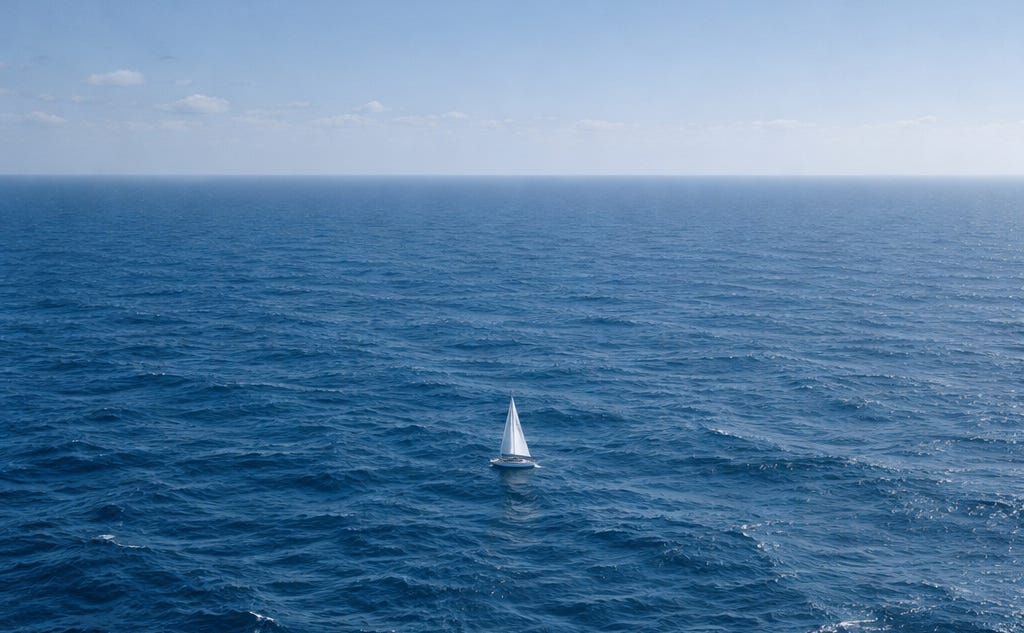
There was a time when the sea was a god, or at least when it was easier to imagine that it was. When lightning struck a mast or a rogue wave swept a man overboard, the human mind did what it has always done in the face of danger and uncertainty: it assigned agency. The storm must be angry. The calm must be merciful. The safe arrival must be favor. It was not foolishness. It was what you do when you lack better information.
But sailors, perhaps more than anyone else, slowly became students of something else, not divine temperament, but natural pattern.
Long before theology systematized the cosmos, mariners were already decoding it. Polynesian navigators crossed the Pacific by reading swells refracted off islands too distant to see, by memorizing the tilt of stars along the horizon, by noticing the flight paths of birds returning at dusk. Viking helmsmen watched cloud formations and wind lines the way later generations would watch weather radar. Mediterranean traders learned which seasonal winds rose reliably and which harbors offered shelter when they did.
They did not conquer the sea. They listened to it.
That distinction matters. Listening is different from appeasing. It is different from commanding. It is the beginning of partnership.
Every beginning sailor learns the first hard truth quickly enough: you cannot sail directly into the wind. It is not a moral rule, not a punishment for arrogance. It is physics. If your destination lies dead upwind, you tack. You zigzag at angles that seem inefficient to the impatient eye. Why not go straight there? Because straight there is impossible. Progress comes indirectly.
You do not command the wind. You trim the sail.
That small act, easing a sheet an inch, tightening it slightly, watching the telltales flutter and then stream, becomes a kind of embodied philosophy. The sail is not a weapon. It is a translator. It converts invisible motion in the atmosphere into forward movement across water. The wind remains indifferent. The sail adapts.
And somewhere in that exchange lies a metaphor for how humans live best within the natural world.
For much of history, sailors prayed. Of course they did. When the alternative to understanding is chaos, supplication feels rational. But over time, something shifted. Barometers revealed that pressure drops precede storms. Swell direction changes before a front. Tides are calculable, governed by the gravitational dance of moon and sun. The Golden Gate floods and ebbs not because it favors you or rejects you, but because it must.
The sea is not moral. It is patterned.
That realization does not eliminate awe. If anything, it deepens it. Awe shifts from submission to personality toward appreciation of complexity. If a storm is anger, you appease it. If a storm is pressure differential, you reef early. And reefing early is empowerment.
I did not step onto my boat with that kind of empowerment. I stepped on with uncertainty disguised as confidence. At first, every sound felt ominous. A sudden heel felt like a rebuke. The crack of a block under load sounded like the beginning of failure. When a gust hit harder than I expected, it felt personal, as though the wind were testing me.
I reefed too late and scrambled to correct it. I overtrimmed and wondered why the boat slowed. I misjudged current and found myself crabbing sideways toward a channel marker. Sometimes I motored when I could have sailed, too unsure to trust the invisible forces around me. Other times I insisted on sailing when prudence would have suggested patience.
Each mistake was not evidence of cosmic displeasure. It was evidence of ignorance. And ignorance, unlike divine wrath, can be reduced.
Gradually, almost without noticing when the change occurred, I began to read more than I reacted. I could feel weather helm building before it became strain. I noticed that ebb against wind stacks the chop in ways that demand humility. I saw darker patches on the water signaling gusts before they reached me. I learned that easing the main just enough to let the airflow reattach along the leech would add half a knot without drama. The boat would settle. The wake would narrow. The sound would change.
The sea had not softened. I had improved.
That may be the clearest lesson sailing offers to anyone inclined toward a non-theistic reverence: the world does not need to change its disposition toward you for you to flourish within it. You need to understand it.
Modern sailing makes that lesson even more vivid. A sextant once required disciplined observation of stars and careful calculation at a chart table. Today a chartplotter overlays GPS data, AIS targets, tide vectors, and depth contours in glowing color. The tools have changed, but the principle has not. The sextant was never magic; it was geometry. The chartplotter is not prophecy; it is satellite triangulation and computational mapping.
Neither replaces understanding. The sailor who blindly trusts the instrument without grasping the underlying system is vulnerable. Batteries fail. Signals drop. Software glitches. The ocean remains.
In that sense, modern sailors stand in continuity with ancient ones. The means of reading the world have improved, but the posture remains the same: attention, humility, adaptation. We do not transcend nature. We collaborate with it.
There is a romantic narrative that sailors conquer the sea. Anyone who has felt a sudden forty-knot squall or watched a horizon disappear into gray knows how hollow that metaphor is. You do not conquer a force that can lift you and drop you at will. You design within its constraints. Ballast counters gravity; it does not eliminate it. The hull displaces water; it does not banish it. The sail harnesses wind; it does not subdue it.
Everything about a sailboat is an exercise in balance rather than dominance.
Yet culturally, we are drawn to metaphors of control. We speak of mastering markets, defeating disease, conquering nature. Sailing strips those illusions quickly. You can scream at the wind; it will not care. You can ignore tide tables; the current will not adjust. You can pretend a front is not building; the barometer will not rise out of courtesy.
Reality is not offended by your ignorance. It simply continues.
There is something profoundly liberating in that indifference. If the sea is not judging you, then your failures are not moral verdicts. They are feedback. If the wind does not favor you, then your successes are not blessings bestowed. They are alignments achieved.
One of the most quietly powerful moments under sail is almost invisible. You adjust the main slightly. The telltales stream evenly. The heel stabilizes. The knotmeter ticks up. Nothing supernatural has occurred. You have aligned cloth, wind, hull, and water in a configuration that allows energy to flow efficiently.
The satisfaction that follows feels, in its own way, sacred. But it is sacred without supernaturalism. It arises from the experience of cooperating successfully with reality.
Sailing also reshapes character. Arrogance fades quickly offshore. Curiosity becomes survival. Calm under changing conditions is not an optional virtue but a necessary one. You learn to anticipate rather than react, to rely on crew rather than isolate yourself, to admit mistakes early rather than defend them.
These are not theological virtues. They are adaptive virtues. The sea does not reward belief. It rewards preparation.
In this way, sailing mirrors the broader human story. Thunder was once a god. Disease was once a curse. Famine was once punishment. Over time, we learned to read currents instead of omens. Meteorology replaced appeasement. Medicine replaced sacrifice. Agriculture replaced ritual pleas for rain. The shift did not drain the world of wonder; it relocated wonder into intelligibility and responsibility.
If disease is a demon, you pray. If disease is bacterial, you develop antibiotics. Once you recognize that outcomes are governed by discoverable systems, responsibility shifts to you. Knowledge becomes obligation. If I know how wind interacts with tide, I cannot blame the sea for my poor planning. If we know how our actions alter climate systems, we cannot blame the weather for our collective consequences.
Pattern recognition leads to moral maturity.
As I have grown more comfortable on the water, I have also grown more comfortable with a world that does not need to love me in order for me to love it. The sea is vast, the wind indifferent, the tide ancient and unbothered by my schedule. Yet within that indifference, there is room for competence, for learning, for joy.
I no longer feel that the boat is testing me. It is simply responding. When I trim well, it moves well. When I misjudge, it resists. The feedback is immediate and honest.
And that honesty is enough.
We do not need the universe to be personal to find meaning within it. We need it to be intelligible. We need it to be consistent enough that learning matters. Sailing offers a daily rehearsal of that truth. You improve not by pleading with the wind, not by imagining intention in the tide, but by observing more carefully and adjusting more skillfully.
You trim the sail. The boat responds. You tack patiently. You advance.
And somewhere between the gust and the adjustment, between the swell and the steadying of the helm, a quiet form of reverence takes shape, one rooted not in fear or supplication, but in understanding.
Comments
Nothing yet. Say the first thing.
Sign in to join the conversation.