
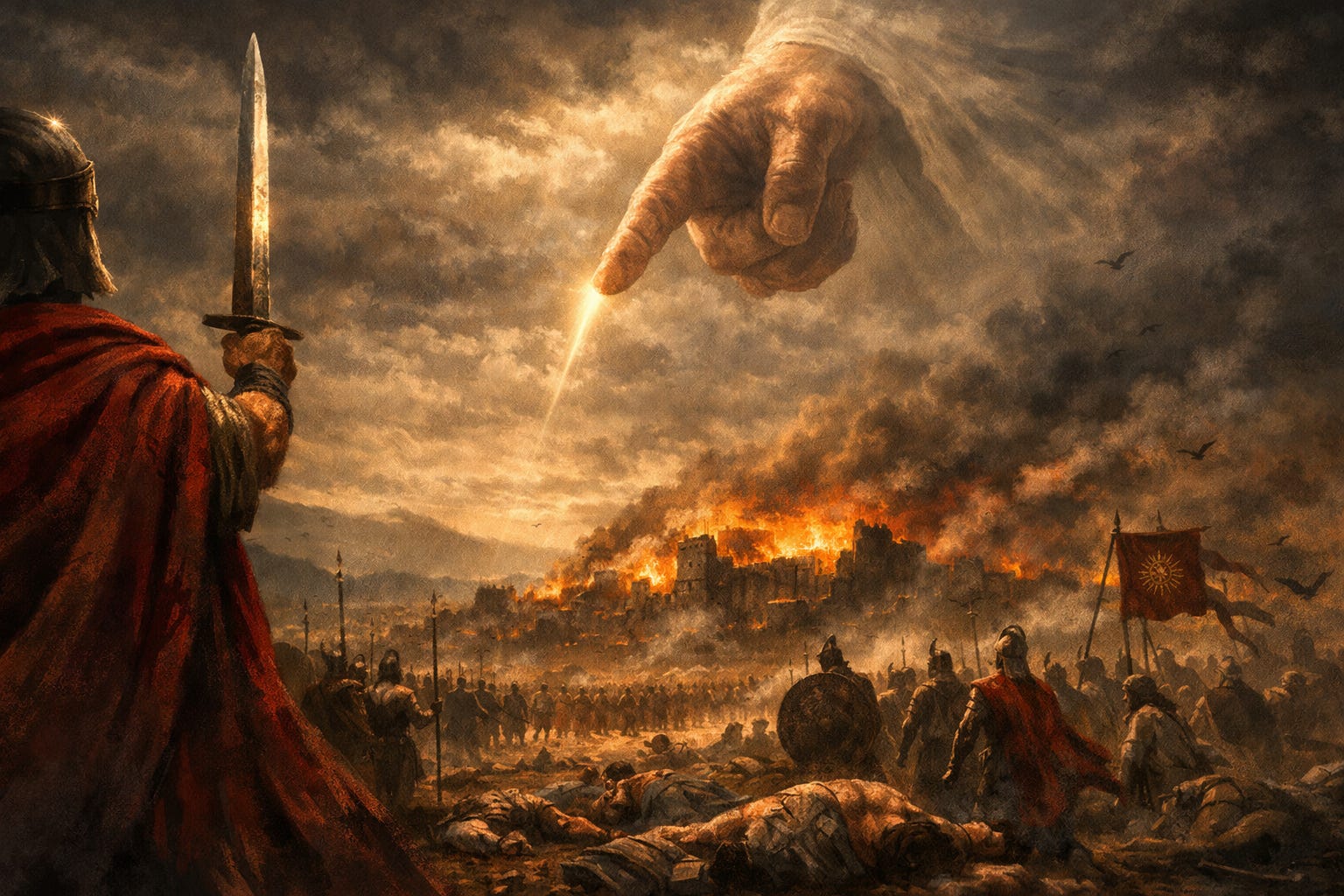
There is a particular comfort in not having to decide what is right. It is the quiet relief of certainty, the sense that somewhere above the noise of human disagreement there exists a clear and final answer. For much of human history, that answer has been imagined as descending, from the divine to the ruler, from the ruler to the people, carrying with it the weight of unquestioned authority. This is what might be called vertical morality: a system in which moral truth flows downward, defined not by deliberation or consequence, but by its source.
It is not difficult to understand why such a system endures. It offers clarity in a world that is often ambiguous. It binds communities together under a shared moral language. It removes the burden of moral uncertainty, replacing the anxiety of choice with the reassurance of obedience. In a vertical framework, one does not need to wrestle with competing goods or unintended consequences. One needs only to listen, to receive, and to follow.
And yet, within that same clarity lies a quiet and persistent vulnerability.
Vertical morality does not claim that everything commanded from above will be good. It claims something more subtle and more consequential: that whatever is commanded from above is, by definition, good. The distinction is easy to miss, but it changes everything. In such a system, morality is not something we evaluate; it is something we inherit. The authority of the source becomes the justification for the act. And because the system defines goodness in terms of authority, it lacks any internal mechanism to question that authority when it errs.
This dynamic becomes especially visible in the biblical narrative itself, and nowhere more starkly than in the Book of Joshua. In its telling of Israel’s conquest of Canaan, entire cities are described as being “devoted to destruction”, men, women, children, and animals alike. Jericho falls, and nothing that breathes is spared. Ai is taken, and its population is put to the sword. The text offers little in the way of moral argumentation for these acts. There is no extended justification grounded in human suffering, no appeal to proportionality or restraint. There is, instead, a consistent refrain: these actions are carried out because they were commanded.
For many modern readers, these passages are deeply unsettling. They seem to stand in sharp tension with contemporary moral intuitions about the value of human life and the limits of justified violence. And yet, within a vertically structured moral framework, the tension is often resolved not by questioning the command, but by reaffirming it. The violence is not denied; it is explained. It is not re-evaluated; it is contextualized. It is, ultimately, accepted as righteous, not because of what it does, but because of who ordered it.
One hears, even today, the familiar reasoning: it was acceptable because it was God’s will. The moral weight of the action is transferred upward, away from the act itself and onto the authority behind it. What would otherwise be condemned as atrocity is reframed as obedience. The suffering described in the narrative does not disappear, but it is rendered morally secondary to the fact of the command.
This is not an isolated interpretive move. It is a direct expression of the underlying structure of vertical morality. When goodness is defined by authority, the evaluation of consequences becomes optional, even unnecessary. The system does not require that we ask whether an action is harmful in any human sense; it requires only that we identify its source. Once the source is established as legitimate, the moral question is considered settled.
What is revealed in the Book of Joshua, then, is not simply a troubling episode in an ancient text. It is a clear example of how a vertical moral framework operates under strain. Faced with actions that conflict with deeply held intuitions about justice and compassion, the system does not generate a critique. It generates a justification. It cannot say, “This command was wrong,” because to do so would be to undermine the very basis on which morality is defined. Instead, it says, in effect, “If it was commanded, it must be right.”
From this foundation, it is only a short step to the political doctrine known as Divine Right of Kings, in which earthly rulers derive their authority directly from God. The logic is seamless. If God defines what is moral, and if the king is God’s chosen representative, then the king’s commands carry moral weight. To oppose the king is not simply to challenge political authority; it is to stand against the moral order itself. Dissent becomes not just rebellion, but sin.
What makes this structure so powerful is not simply that it elevates authority, but that it fuses authority with morality. It removes the space between them. In doing so, it transforms obedience into virtue and dissent into vice, regardless of the content of the command. The moral question shifts. It is no longer “Is this right?” but “Who has said it?” And once that shift occurs, the evaluation of the act itself becomes secondary, even irrelevant.
This is where the vulnerability of vertical morality becomes clear. Because it defines goodness by authority, it cannot meaningfully critique that authority. It has no internal standard by which to say, “This command is wrong.” It can only say, “This command was not truly from the authority,” or else accept the command as good. The system is, in this sense, ethically non-falsifiable. It cannot recognize its own failure from within.
The consequences of this are not always visible in moments of stability, when authority aligns, more or less, with widely shared human intuitions about fairness and harm. In such cases, vertical morality can appear not only functional, but deeply reassuring. It provides a shared framework, a sense of order, a moral vocabulary that binds communities together. But its true nature is revealed in moments of tension, when authority diverges from those intuitions, when commands are given that conflict with empathy, with reason, with the lived experience of human suffering.
In those moments, a system grounded in vertical morality faces a choice it is not equipped to make. It cannot easily reject the command without undermining its own foundation. And so, more often than not, it resolves the tension in the only way available to it: by reinterpreting the command as good.
This is how moral inversion becomes possible. Harm can be reframed as necessity. Cruelty can be recast as justice. Loyalty to authority becomes the lens through which all actions are understood. The question is no longer whether an act causes suffering, but whether it aligns with the will of the one who commands. In this way, vertical morality does not guarantee immoral outcomes, but it creates the conditions under which immorality can be justified without contradiction.
This dynamic is not confined to ancient texts. It continues to surface wherever authority is treated as the source rather than the subject of moral evaluation. In contemporary political life, one can observe patterns in which leaders are framed as uniquely chosen, necessary, or even divinely appointed. Within such frameworks, actions that might otherwise provoke moral concern are defended, minimized, or reinterpreted, not on the basis of their consequences, but on the basis of who has enacted them.
The phenomenon is visible in the rhetoric and support surrounding figures like Donald Trump, where for some, allegiance to the leader becomes intertwined with a broader moral narrative. The specifics of the leader matter less than the structure of the relationship. When authority is elevated in this way, moral evaluation can become secondary to loyalty. Actions are filtered through identity, through alignment, through the perceived necessity of the figure at the top of the hierarchy.
To observe this is not to single out one individual or one group as uniquely susceptible. It is to recognize a recurring pattern in human societies. Wherever moral authority is concentrated and insulated from critique, the same dynamics emerge. The system encourages trust over scrutiny, obedience over evaluation, certainty over reflection. And in doing so, it creates a space in which harmful actions can be absorbed into the moral framework rather than challenged by it.
What is at stake here is not the rejection of authority altogether, nor the claim that all guidance from above is inherently suspect. Human societies require leadership, coordination, and shared norms. The question is not whether authority exists, but how it relates to morality. When authority is treated as the origin of moral truth, it becomes difficult, if not impossible, to hold it accountable. When authority is instead treated as subject to moral evaluation, it remains within the scope of human judgment.
This distinction is subtle but profound. It shifts morality from something received to something engaged. It restores the role of human experience, empathy, and reasoning in the evaluation of actions. It allows individuals and communities to say, with legitimacy, that a command, even one issued from the highest authority, can be wrong.
Such a shift does not eliminate uncertainty. On the contrary, it reintroduces it. It places the burden of moral reasoning back where it has always, in practice, resided: within human beings themselves. There is no longer a final, unchallengeable source to which one can defer. There is only the ongoing task of evaluating actions in light of their consequences, their coherence, and their impact on others.
This is, perhaps, why vertical morality remains so appealing. It promises an escape from that burden. It offers a world in which right and wrong are already decided, where the weight of moral responsibility can be transferred upward. But in doing so, it also removes the very capacity that allows a society to recognize and correct its own injustices.
A moral system that cannot question authority cannot prevent wrongdoing. It can only absorb it. It can only reinterpret it. It can only, at best, shift the locus of responsibility from the individual to the hierarchy. And when that happens, the language of morality remains intact, even as its substance begins to erode.
The danger of vertical morality, then, is not that it always leads us astray. It is that when it does, it gives us no reliable way to know.
Comments
Nothing yet. Say the first thing.
Sign in to join the conversation.