
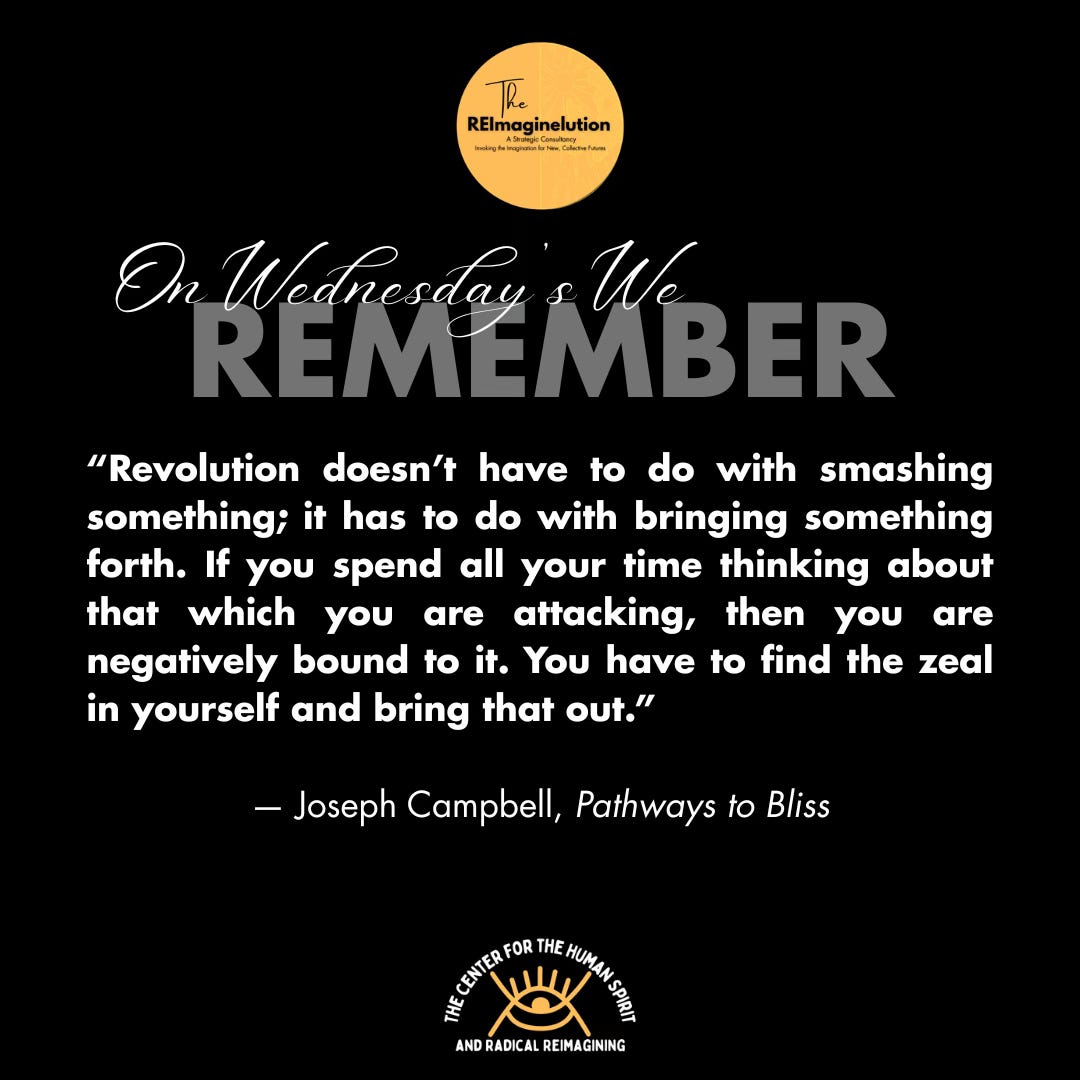
“Revolution doesn’t have to do with smashing something; it has to do with bringing something
forth. If you spend all your time thinking about that which you are attacking, then you are negatively bound to it. You have to find the zeal in yourself and bring that out.”
— Joseph Campbell, Pathways to Bliss (p. 104)
We need a revolution. A revolution of values, of relationship, of language, of our understanding of cosmic interconnectedness, and most importantly, a revolution of the imagination—a reimaginelution. As Joseph Campbell reminds in Pathways to Bliss, revolutions call forth. Like the imagination, revolution is concerned with projecting new futures and generating new possibilities. They are less concerned with tearing down and more focused on building, reconstructing, transforming, and being: transfigured.
I have long rested on the belief that we are micro-revolutions always in the making. We are products of past decisions living in the present moment projecting futures that are not yet, but certainly can be if we wed imagination to action. Do we have the courage for it? Do we have the courage to bring forth that which is within us (and generative)? Do we have the courage to make revolution, which is always rooted in love?
Love. Thich Nhat Hahn reminds us that words get sick and we have to heal. Today, the word love is suffering from a grand malady. Love, in the West, has become a dangerous word. And it is dangerous if you understand that it “comprises a revolutionary act” (Robinson-Morris, 2019, p. 72). Love is a decision and is always political.
Why is he talking about love so much? Well, because love or what we do not love shapes what we are able to see or not see. In my consulting practice and organizing work, I often bring people back to a single question: What have you been conditioned to not see? The answer to this question, as you can imagine, begins to expose the contours of what one is able to project as possible. It can confine or liberate the imagination. What one loves or does not love shapes pits of despair or mountains of hope, and often sees the two through an inverted lens.
Grace Lee Boggs, the Chinese American organizer, who I come back to often reminds in Organization Means Commitment (1972) that revolution
means more than just protesting oppression but also projecting a vision that encourages grassroots creation of positive alternatives designed to create more human humans, transformative organizing involves doing the work of loving each other in ways that seem ridiculous if we only think of revolutionary change as masses of people mobilized to make demands on the state. (p. 3)
Boggs continues,
Because our historical reality has been shaped by the actions of human beings who have internalized the contradiction between technological overdevelopment and human underdevelopment, even if we protest so effectively that we acquire state power, if we don’t change our ways of thinking and relating to one another, we will only further develop this contradiction with new people in charge. These changes must be rooted in love. (p. 3)
The goal here of revolution is the development of new types of relationships rooted in love: recognition, respect, care, affection, and challenge. Revolutions, then, political, social, and personal are practices of love and of the imagination informed by the past, situated in the present, but pulling from the complete field of possibility we call the future.
To Bring Forth. Transformation—that which we wish to bring forth—is the center of all revolutionary struggle. To bring forth is not merely to create, but to reveal what has been waiting beneath the sediment of fear, domination, forgetfulness, and imposed limitation. It is the sacred act of making visible that which already dwells within us, within our communities, and within the cosmos itself.
The ancient saying from the gnostic Gospel of Thomas teaches: “If you bring forth what is within you, what you bring forth will save you. If you do not bring forth what is within you, what you do not bring forth will destroy you.”
This is not simply an individual psychological observation; it is an ontological and spiritual claim, which suggests that human beings carry unrealized possibilities, undiscovered truths, and latent capacities that seek expression. To suppress them is to participate in our own diminishment and to bring them forth is to participate in our own liberation.
African philosophy has long understood this principle. Among many African traditions, personhood is not a fixed possession but an unfolding achievement. As we learned last Wednesday, in an Ubuntist philosophy one becomes through relationship, responsibility, and participation in the life of the community. Existence is not a static state but a continual process of emergence. Therefore, to bring forth is to enter the work—the cosmic dance—of becoming more fully human.
Similarly, the Akan notion of Sankofa reminds us that bringing forth often requires retrieval. We must return to recover what has been lost, stolen, obscured, or forgotten; however, we must not get stuck in the past. Yes, the future cannot emerge apart from the wisdom buried in memory combined with an unrestrained imagination to access the field of possibility. What is brought forth is frequently not something new but something ancient waiting to be remembered. Even more, because time is not linear, what is brought forth might just be is a remembrance of the future.
Likewise, many African cosmologies understand reality as animated by vital force. Life seeks expansion. Spirit seeks full expression and creation itself is unfinished and invites participation. We are not spectators to existence but co-creators within it. Perhaps, in this understanding, to bring forth is to answer creation’s invitation.
The Black Imagination. For Black people—in particular, however, bringing forth carries an additional significance. It becomes an act of resistance against what I often call the plantation of the imagination. Systems of domination survive by convincing people that they are less than they are, capable of less than they can become, and destined for less than they deserve. Colonization operates not only upon land and labor but upon possibility itself. To bring forth, therefore, is to refuse the imposed limits of the dominant imagination.
It is to recover Black brilliance where others have only seen deficit. It is to cultivate futures where others have only imagined decline. It is to create freedom before freedom fully arrives.
This is why imagination matters so deeply to me. The access to our imaginative capacity is our ability and the faculty through which latent realities become visible. We come to understand this more as we study the great social and liberation movements, which all began as something brought forth from the interior life before it became visible reality in the physical world. The civil rights movement, anti-colonial struggles, Black intellectual traditions, movements for justice and human rights all have their nascent beginnings in collective acts of bringing forth.
Today, we are being called more than ever before for our generation to bring forth, to make (r)evolution—that is, to make the practice of love—irresistible.
I ask each of you and continue to ask myself:
Will we have the courage to bring forth in the face of fear? To offer wisdom in the trickery of confusion? To bring forth beauty and hope in the presence of despair
Are we willing to do the hard work of bringing forth wholeness and community in systems of fragmentation? Will we practice freedom under the weight of domination?
Will we not only imagine, but be and bring forth love to affirm our humanity, project new possibilities, and join in the unfinished work of creation?
It is up to each of us to answer according to our own conscience and capacity, but remember the words from the gnostic Gospel of St. Thomas, “If you bring forth what is within you, what you bring forth will save you. If you do not bring forth what is within you, what you do not bring forth will destroy you.”
Bring it forth.
May we bring forth that which is good.
May you bring forth revolution.
May you imagine higher.
May you think deeper.
May we project new possibilities for the common good, together.
Be of good courage.
No posts
Comments
Nothing yet. Say the first thing.
Sign in to join the conversation.