
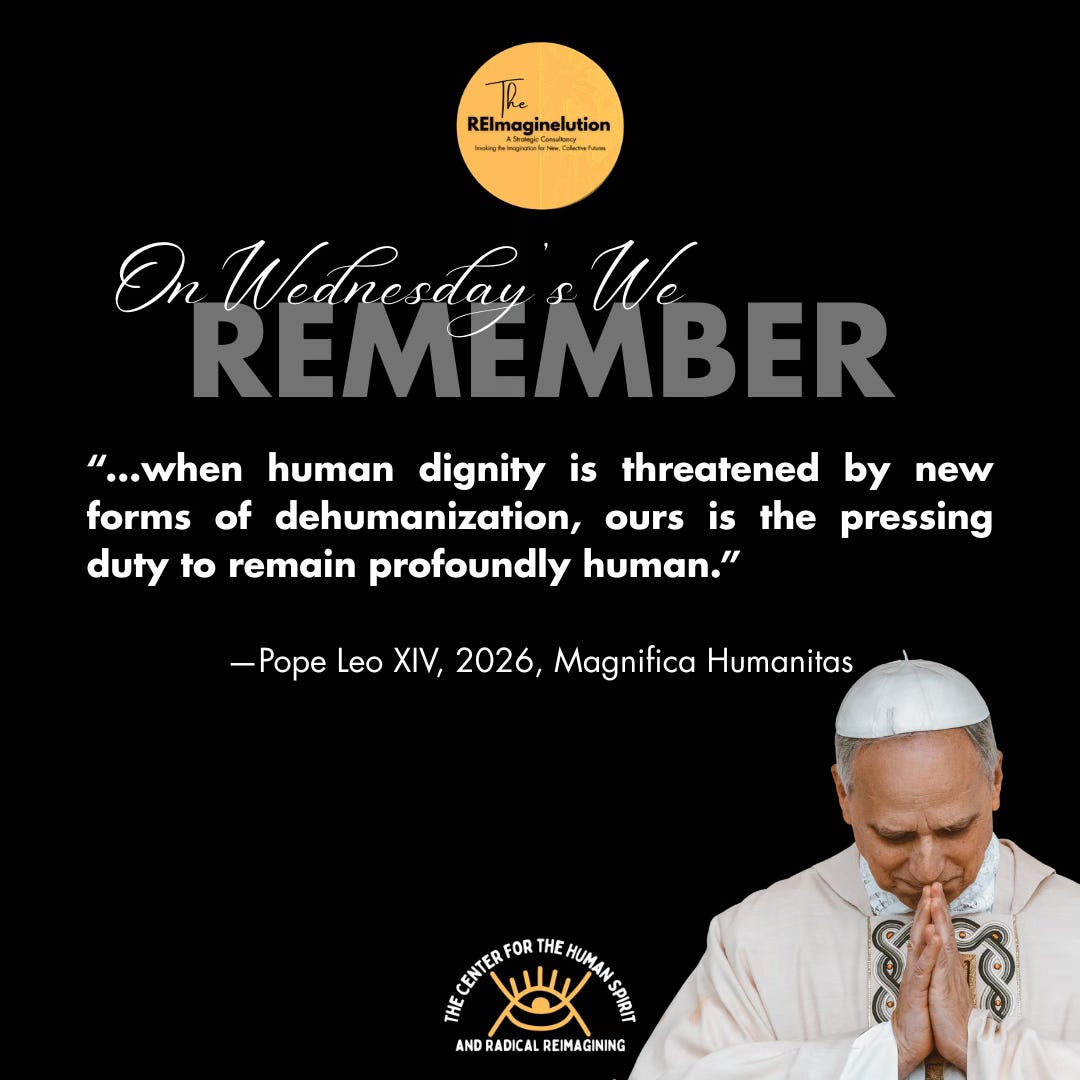
“In the era of artificial intelligence, when human dignity is threatened by new forms of dehumanization, ours is the pressing duty to remain profoundly human.”
—Pope Leo XIV, 2026, para 15
There are historical moments when a question emerges from beneath the noise of the world and demands our attention with renewed urgency. Not because the question is new, but because humanity has wandered so far from its center that the question becomes unavoidable again.
Pope Leo XIV’s encyclical, Magnifica Humanitas, arrives in such a moment.
At the heart of the encyclical is a profound concern: that technological advancement without moral, spiritual, and communal formation may lead us toward a deeper dehumanization. The Pope warns against a world where artificial intelligence, economic systems, digital architectures, and cultures of domination erode human dignity and fracture our collective imagination. He asks humanity to “remain human” amid accelerating technological transformation and an ever-growing decline of human dignity and care for our common home.
What does it mean to be human in an age that is forgetting humanity? Are we forgetting humanity or are we forgetting that we are only human together?
For nearly two decades, my own scholarly and spiritual work has revolved around a singular question: What does it mean to be a human being?
That question animated my work in Ubuntu and Buddhism in Higher Education: An Ontological Rethinking. It continues to shape my work through the Black Catholic Flourishing Initiative, The REImaginelution, The Center for the Human Spirit and Radical Reimagining and my broader commitments to human flourishing, radical imagination, and liberatory education.
I have long believed that the crises we face are not simply political, technological, or institutional crises. They are ontological crises; they are crises of being. We have forgotten how to be human together. And perhaps even more dangerously, we have forgotten how to imagine ourselves human together in ways that are generative and life-giving.
One of the most important insights in Magnifica Humanitas is the recognition that the technological question is ultimately a human question. Pope Leo XIV reminds, “No computational system, however sophisticated, can create a heart that gives itself, or a conscience that discerns good from evil.” That line could easily stand beside Ubuntu philosophy’s insistence that personhood emerges through relationship and mutual recognition.
Ubuntu reminds us: Umuntu ngumuntu ngabantu
Umuntu ngumuntu ngabantu or “a person is a person through other people.” Ubuntu is most commonly translated as “I am because we are.” This is not sentimentality or mush. This is ontology; it is communal being perpetually unfolding in collective becoming—interconnected and always engaged in the cosmic dance of ecological kinship. Ubuntu and Buddhism both challenge the illusion of the isolated self—the myth that humanity exists as atomized individuals competing for dominance, productivity, visibility, or consumption. Both traditions insist that our lives are radically interconnected. Both warn that suffering emerges when we forget this interconnectedness with humanity and our ecological kin.
All signs point to a collective dementia or, perhaps, an amnesia of our interconnectedness made visible throughout the last millennium and we are feeling deeply the impacts of this severe forgetfulness.
Trained as a scholar of higher education, through the book I situate my original analysis there. In the West, higher education has largely been organized around epistemology: what we know, produce, accumulate, and credential. But our age reveals the insufficiency of knowledge, absent wisdom, absent ethics, absent humanity, absent a shared vision informed by the collective moral imagination.
There is no doubt, we have built astonishing systems of information while simultaneously losing the capacity for communion. We are more connected technologically and more fragmented spiritually; more visible digitally and more unseen humanly. Loneliness has become endemic. We are more informed, but less generatively transformed. The antidote to this fragmentation is the move toward wholeness or what I term holonic assemblages—that we are one and that we may all be one.
This is why I argued that higher education must become concerned again with “being-becoming” or rather with who students are becoming in relation to themselves, others, the earth, and the sacred. This argument, while centered in the system of higher education, extends—I believe—to all of society. As I wrote then,
imagine the world we would live in if higher education were primarily concerned with being-becoming, becoming consciousness, becoming more-human, becoming just society, and becoming radical love. Imagine higher education as an environment where communalism, dialogue, respect, dignity, and learning over knowledge acquisition thrive. A Buddhist and Ubuntu-hued onto-educational philosophy of higher education offers such possibilities. (Robinson-Morris, 2019, p. 159)
Replace higher education with society and one has the potential to usher in an ontological transformation that will necessarily catalyze structural transformations. We know that as the being-of-beings is transformed, so too must the systems and institutions we inhabit.
Pope Leo XIV asserts the central challenge before us is not merely whether humanity can build intelligent machines. The ultimate question is whether humanity can remain humane while doing so.
My imagination tells me that it can, but can the collective imagination release itself from its ideological grips long enough to glimpse it?
One of the most compelling sections of Magnifica Humanitas addresses what Pope Leo XIV calls “communication and the collective imagination.” This language struck me deeply because so much of my work has centered on the necessity of cultivating liberatory collective imagination. You know I love the imagination, which I often say, is how we tap into cosmic consciousness or the mind of God. This is the generative view. I remind people that the imagination is multidirectional—repressive and oppressive policies, humanity’s historical failures and atrocities are all born of what I would classify as the retrogressive imagination—and it takes the same amount of energy to imagine what is generative as it does to imagine what is retrogressive. The difference is intention and attention.
Oppression does not merely function structurally or materially. It also functions imaginatively. The first thing to go in any oppressive system, I believe, is the imagination. We know systems of domination colonize the imagination first to constrain what people believe is possible and narrow our sense of the future.
Pope Leo XIV calls on the media and tech industries to begin communicating the truth, to offer hope, to extend images of flourishing contrary to the media we consume today that convinces communities that suffering is natural or that reduces humanity to utility, productivity, and consumption. Artificial intelligence, algorithmic culture, and digital capitalism now possess unprecedented power to shape consciousness itself. The “architecture of visibility,” as the encyclical names it, increasingly determines whose humanity is recognized, whose suffering matters, and which futures become imaginable.
This is not simply a technological issue, the Pope Leo rightly points out, but a spiritual and moral issue. Advanced technology is here and is evolving everyday, so the question before us is not whether technology exists. The question is: what vision of humanity is being encoded into our technologies, institutions, and imaginations? And who gets excluded from that vision?
When I wrote Ubuntu and Buddhism in Higher Education, I sought to challenge the dominant assumptions underlying modern higher education and Western notions of the self. I argued that universities should not merely produce workers for economies or consumers for markets. They should cultivate fuller human beings capable of compassion, solidarity, justice, and collective flourishing.
While it felt like this work, initiated over a decade ago would never take root, I have clung to my favorite phrase in sacred scripture: “But when the fullness of time had come” (Galatians 4:4). What I have come to learn, in the words of Pope Leo, is “what matters most is not occupying positions of power or defending cultural strongholds, but initiating good processes and enabling them to mature” (para. 25).
Today, that argument feels even more urgent in light of the attacks on higher education and the systems’ retreat while under threat.
We are witnessing: the commodification of education, the erosion of democratic life, widening loneliness and alienation, algorithmic fragmentation, racialized inequality, ecological crisis, and the displacement of human meaning by systems of extraction and optimization.
Against this backdrop, Ubuntu and Buddhist thought offer not simply critique but possibility. And the role of the intellectual is to always project (new) possibilities. These philoso-praxes invite us toward the possibilities of: relational humanity, contemplative awareness, communal responsibility, ethical interdependence, and a deeper reverence for life itself.
Pope Leo XIV’s encyclical similarly calls humanity toward solidarity, communion, and the safeguarding of human dignity against systems that threaten to instrumentalize human life. The resonance, in my opinion, is striking and I found myself highlighting whole paragraphs and offering questions back to the text.
Both works insist that humanity cannot survive if we continue reducing persons to data points, labor units, consumers, or technological appendages. Both insist that human flourishing requires more than efficiency. And both insist that we must recover the sacredness of human becoming and remember our shared humanity.
At its core, my work has always been animated by the possibility of engendering more humanizing relations mediated through an ethic of love. For me, this means cultivating ways of being together rooted in: dignity, reciprocity, compassion, accountability, imagination, and love. A politics of possibility and (more than-) human becoming.
To be clear, I do not mean shallow inclusion or institutional performance or performative neoliberal diversity rhetoric, but genuine human encounter. Human encounter across difference allows us to each meet the other in their fullness to discover, in fact, that there is no other. This re/humanization requires much more than policy reform; it requires transformation in consciousness, imagination, and relation. I argue, in Ubuntu and Buddhism in Higher Education, that it mandates a complete reconceptualization of subjectivity and personhood.
This is why education matters. This is why spirituality matters. This is why philosophy matters. This is why community matters. And as an educator, this is why the humanities—especially in this technological age—matter most profoundly. Pope Leo moves us away from popular media’s deepest question whether or not machines can or will have the ability to think to the soul’s deepest question: Can human beings and all of humanity remember how to love, imagine, discern, do justice, practice mercy, and build communities of belonging as this technology proliferates?
“Yet, despite this downward spiral, we can also glimpse a great part of humanity that is striving to remain human and working to build the holy city of coexistence and peace. All too often, we are unwitting builders and clumsy architects of this city, capable of generous gestures but lacking an overall vision. This building project is slower, less visible and less spectacular, and awaits a better understanding and greater coordination so that it may become the conscious and clear responsibility of every community, from families to States, and the relations between Nations. It is this prospect of commitment, this construction site of hope, that we call the “civilization of love”. (Pope Leo XIV, 2026, para 185)
Pope Leo XIV writes that humanity stands at a crossroads between constructing “a new Tower of Babel” or building a world where human dignity and communion remain possible—‘a civilization of love’. I believe that crossroads is already here.
And so the question returns again: What does it mean to be a human being? Not in the abstract, not in theory but concretely in classrooms, communities, institutions, digital spaces, economies, and daily life. The answer cannot emerge from technology alone nor from economic markets nor from institutions and systems disconnected from moral imagination.
Ubuntu teaches us that our humanity is shared. Buddhism teaches us that our lives are interconnected. The Gospel proclaims to us that dignity is inherent within every person and that every captive will be set free. Each of them encourages us to practice a politics of humanity and ecological kinship that evoke the potentialities of people, reminds us of our shared responsibility, and, in a nod to Steve Biko, cultivates a shared vision and a more human face.
May we remember our shared humanity.
May we imagine higher.
May we resist fragmentation and welcome wholeness.
May we remain human.
Be of good courage.
No posts
Comments
Nothing yet. Say the first thing.
Sign in to join the conversation.