
For the past couple of weeks since the release of Pope Leo XIV’s long awaited first encyclical, Magnifica Humanitas, we have been overwrought with articles, press coverage, and comments about the pontiff’s apology for the Church’s role in approving, promoting, and not standing in opposition of the human enslavement. The whole encyclical opens several lines of very necessary dialogue. Yet for Black Catholics, in particular, I believe we are too easily placated by words and soothed by acknowledgement, while never mandating those same words to be made flesh and dwell among us.
I offer, perhaps, an unpopular commentary.
Pope Leo XIV writes in paragraph 176,
In the development of her doctrine, the Church has gradually come to a deeper awareness of the gravity of these issues. It is true that past events cannot be judged anachronistically, as though the moral criteria that matured over time had always been available. Yet neither can we deny or diminish the delay with which both society and the Church came to denounce the scourge of slavery. In antiquity and the Middle Ages many individuals and even ecclesiastical institutions had slaves. Already in the early modern period, the Apostolic See of Rome, responding to requests from Sovereigns, intervened several times in order to regulate and legitimize forms of subjugation, and, in certain cases, the enslavement of “infidels.” It was only in the nineteenth century that a formal, absolute and universal condemnation of slavery was clearly articulated, notably under Pope Leo XIII. This development offers a clear example of the Church’s growth in understanding the perennial truths of Revelation that she safeguards. Although there was not always consistency in practice — given that slavery was long tolerated before being unequivocally condemned — there has been a continuous affirmation throughout history of the dignity of every human being, created in the image of God, even if it took eighteen centuries for its full incompatibility with slavery to be explicitly recognized. This constitutes a wound in Christian memory, one from which we cannot consider ourselves detached. It is impossible not to feel deep sorrow when contemplating the immense suffering and humiliation endured by so many in stark contrast to their immeasurable dignity as persons infinitely loved by the Lord. For this, in the name of the Church, I sincerely ask for pardon.
What we did not explicitly hear is the Pontiff acknowledging that the wealth of the Catholic Church, just as in America, Portugal, Brazil, the Netherlands, and too many other countries to mention, has been produced on the backs of African people kidnapped from their homelands and forced into labor under grueling conditions. What we did not hear was a call for material institutional reparations. What we did not hear, in a way that was strong enough, were the lingering and continued impacts of “this wound” which has remained unhealed and bleeding from generation to generation.
While Pope Leo XIV called the faithful, global systems, and the world into the practice of Catholic Social Teaching and shared humanity; and called to institutional Church to undergo an examen of institutional consciousness—it did not read strongly enough how Church structures will and should be transformed in the wake of this writing. I believe this is where our attention should truly be focused.
Yes, thank you. And now, how will you, the institution, and systems acting upon us be transformed? More pointedly, how will the Church reconcile her actions and complicity in the historical and on-going assaults on Black and African-diasporic life in America and across the globe?
Further, I am not even certain the words—a supplication for pardon—amounted to an apology because the wound has never healed; it continues to gape, weep, and suffer fresh assaults with new weapons and false ideologies of white and Christian supremacy. However, what I am certain of is this: the best apology is changed behavior.
As an aside, recognizing the historical nature of his words, I do want to acknowledge and applaud the first American pontiff’s courage in finally publicly bringing to the universal Church its complicity in the human slave trade. In fact, our American born Pontiff crosses a threshold that previous papal statements refused to breach by explicitly addressing the Holy See’s own role in legitimizing slavery for centuries. Of course, I questioned if a request for pardon was the same as an apology—let’s explore.
A Pardon Vs. An Apology
A pardon precedes a request for forgiveness and frequently functions as an apology. An apology is an act of moral acknowledgment. It involves the recognition of wrongdoing, acceptance of responsibility, expression of remorse, and affirmation of the dignity of the person harmed. In philosophical terms, an apology is principally concerned with truth, accountability, and moral repair. I am currently reading Paul Ricoeur’s work on memory and imagination. Ricoeur asserts that the memory duty is directly linked to justice—corrective and restorative. As Paul Ricoeur argues, the work of memory and ethical responsibility requires the truthful naming of harm before any restoration of relationship can occur (Ricoeur, 2004). Similarly, Hannah Arendt views the acknowledgment of wrongdoing as essential to human plurality and the possibility of beginning anew through action and speech (Arendt, 1958).
A request for pardon, however, moves beyond acknowledgment toward an appeal directed to the moral agency of the offended party. It asks, not demands, for release from the moral debt created by the offense. Unlike an apology, which can be offered unilaterally, pardon depends upon the freedom of the one who has been harmed. As such, pardon belongs not only to the sphere of justice but also to the realm of mercy, gift, and relational transformation: forgiveness.
Reading this through the philosophy of an apology and the work of Jacques Derrida, in On Cosmopolitanism and Forgiveness (2001), we learn that genuine forgiveness only concerns that which is and/or appears unforgivable. If forgiveness is granted only when an offender has repented, changed, compensated for the harm, or satisfied conditions of justice, then forgiveness becomes part of a political or therapeutic process of reconciliation. For Derrida and in the practice of the Christian faith, however, pure forgiveness is radically unconditional; it forgives precisely what cannot be excused or justified. He writes that forgiveness must remain “heterogeneous” to calculation, exchange, or reciprocity.
Consequently, Derrida distinguishes forgiveness from reconciliation. Reconciliation seeks the restoration of relationships, social harmony, or communal unity. It is often conditional, negotiated, and oriented toward future coexistence. Forgiveness, by contrast, is an event that exceeds political settlement and cannot be reduced to a strategy of conflict resolution. Reconciliation may occur without forgiveness, and forgiveness may occur without reconciliation. The two should not be conflated.
From this perspective, an apology is an act of ethical responsibility; a request for pardon is an appeal to the possibility of forgiveness; and reconciliation is a further, distinct process involving the reconstruction of relationship. The offender controls the apology. The offended party controls pardon. Reconciliation, when it occurs, emerges from a mutual and often lengthy process of rebuilding trust, repairing harms, and creating the conditions for a renewed future. While the Church can apologize for slavery, it cannot grant itself forgiveness. It can only ask for it.
Leo asks for forgiveness and moves us into the realm of reconciliation—changed behavior and reclamation of right relationship—in paragraphs 177-181, where he begins to both name the new forms of enslavement and colonialism and calls us to shared responsibility via the Social Doctrine of the Church. He asks us, in paragraph 181, to imagine and work toward
institutions capable of regulating without stifling, and protecting without taking over; by businesses that recognize work and dignity as measures of success; by intermediary organizations and educational communities that rebuild trust and relationships; and by citizens who cultivate responsibility, moderation, discernment and a sense of truth. Only in this way can innovation genuinely serve integral human development, rather than becoming a source of exclusion and dominance. And only in this way can the promise of progress be recognized as authentic, because it is measured against the inviolable dignity of every man and woman.
One might say that Leo has clearly entered the territory of apology and petitioned for pardon, but whether reconciliation has begun depends upon how, we—descendants of the enslaved, Black Catholics, African-descended peoples, and other affected communities receive the apology and what concrete ecclesial actions follow it.
From the perspective of Black Catholic theological ethics, the distinction we have tried to make is crucial. An apology addresses memory and responsibility. A request for pardon addresses moral relationship, while reconciliation raises questions of justice, repair, institutional change, and the creation of new forms of solidarity. The first two are evident in Magnifica Humanitas; the third remains an ongoing ecclesial and moral task.
Demanding Changed Behavior &The Black Catholic Flourishing Initiative
Repair. Justice. Institutional change. The creation of new forms of solidarity.
If we take very seriously the distinctions made between apology, pardon, and reconciliation, then the most important and galvanizing question is not whether the Church has apologized for its role in human enslavement, but whether or not this apology is accompanied by metanoia, a genuine conversion or move toward being differently.
If, what I believe is true, that Pope Leo is calling us, the Church, and the world into a process of transformational reconciliation while simultaneously supplicating for forgiveness, then we have some reparatory demands that we should be making as a collective. Some of which have already begun in the United States like truth-telling about African enslavement and Catholic institutions.
We should demand Black Catholic flourishing and the flourishing of marginalized communities which Gospel centers. We should demand shared authority and not performative inclusion. We should demand that words be met with action that meets the needs of the people according to their own understanding of what those needs are and their wisdom in how those needs are best met. To say another way, we should be demanding a move from charity to justice, and from remembrance to repair. We should all be demanding changed behavior of the institution over the applause of inspiring words while transformative action toward realized human dignity remains immovable.
This, I believe, is where our attention and collective social imagination should be actively engaged: in the “so and now what, together?”
The Black Catholic Flourishing Initiative
For the past two years, 15 Black Catholic scholars, theologians, national thought-leaders, administrators, lay and religious have gathered to address the issue of Black and Catholic flourishing in the United States. Guided by listening and learnings from gatherings of the US Black Catholic community and the work of the then-10 Black Bishops of the US Church in their 1984 document, What We Have Seen and Heard, they have worked to discern an agenda for Black and Catholic flourishing at all levels of Church and society for the common good.
Just as Pope Leo has done in the encyclical, our work began with telling the unvarnished truth about what Black Catholics faced and continue to face in the US Church. Beginning with the generational impacts of enslavement and its legacy—centuries of systemic racism, sexism, underinvestment, cultural erasure, and institutional neglect that have limited the ability of Black Catholic communities to thrive.
The US Church falls square in the center of Pope Leo’s indictment and should be convicted by his call to an institutional examen of conscience. However, what Black people have long understood is that while transformation requires truth-telling, it needs a clear philosophy of transformation, principles, practices, leadership, and action. It requires accountability and concerted collective action.
Our work over the last two years has culminated in the crystallization of a vision for Black Catholic Flourishing, a Framework for Flourishing, a clear philosophy of Black and Catholic transformation for the common good, and a muti-level action plan for community and ecclesial transformation. This work will be presented, in brief, publicly at the Knights of Peter Claver National Conference this July.
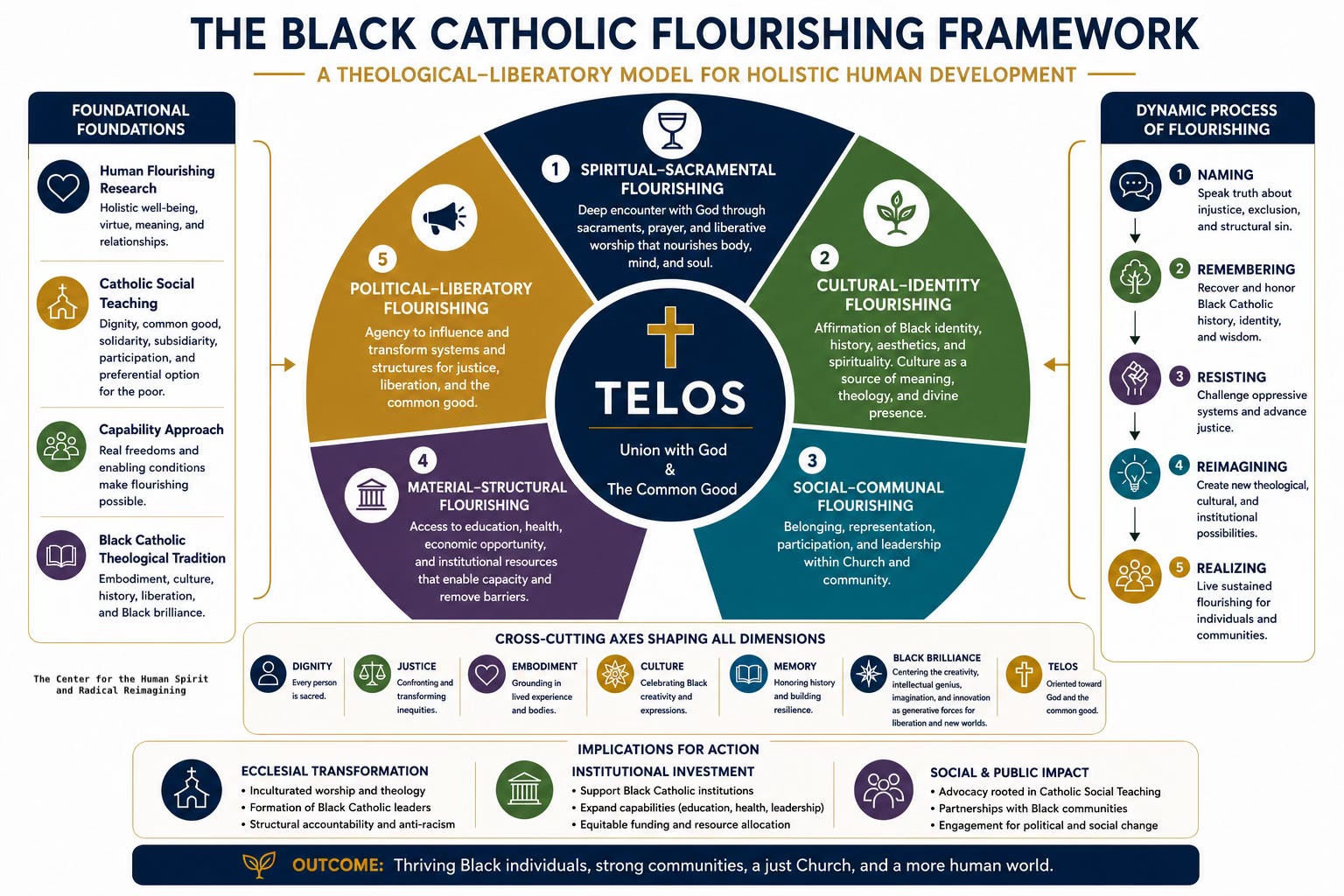
Understanding what Black communities have long experienced the consequences of social systems organized around exclusion, dispossession, surveillance, exploitation, and racial hierarchy. The Black Catholic Flourishing Initiative therefore situates Black flourishing as a moral imperative for both Church and society.
The Initiative understands flourishing not as individual achievement disconnected from community, but as collective liberation rooted in spiritual wholeness, material wellbeing, ecological sustainability, cultural memory, democratic participation, intergenerational care, and institutional transformation.
Guided by the Gospel and inspired by the Ancestors, the Black Catholic Movement, and reinvigorated by Magnifica Humanitas, which calls the Church to safeguard human dignity amid rapidly changing technological, political, and economic realities, The Black Catholic Flourishing Initiative affirms that human beings are never reducible to markets, algorithms, demographics, or systems of extraction. Rather, every person bears the imago Dei and must be encountered as sacred. The Initiative seeks not incremental inclusion into unjust systems, but the cultivation of a new social imagination rooted in solidarity, justice, belonging, moral courage, and collective thriving.
The question now is not whether the institution of the Church will hear us, the question is whether we, as Black and Catholic people, have the courage with God’s grace to imagine higher and the fortitude to both do the work of transformation and be ye transformed by the renewing of our minds?
The Black Catholic Flourishing Initiative is anchored in The Center for the Human Spirit and Radical Reimagining in partnership with FADICA Catholic Philanthropy Network.
No posts
Comments
Nothing yet. Say the first thing.
Sign in to join the conversation.