
I am a Galvestonian. I was born and raised on Galveston Island, Texas and I have been celebrating Juneteenth since before I can remember.
The first formal celebration on the Island (read: the first celebration formally recognized and attended by white and Black audiences) was held in 1979 at Ashton Villa, the historic home where General Gordon Granger read General Orders, No. 3, the order that freed the enslaved in Texas nearly three years after President Lincoln declared the Emancipation Proclamation. The 1979 formal celebration followed the passage of a bill authored by Rep. Al Edwards which officially made June 19th Emancipation Day an official Texas state holiday.
Growing up Juneteenth was a community celebration filled with a parade, pageant, time on Seawall, and so much barbeque that you couldn’t get the smell of smoke and smoked meat out of your nostrils for at least a week. It was a family celebration that felt like a special secret because on our tiny little island, the white population had no clue what was happening or want to join in—it was our own celebration of the Ancestors, our resilience, the beauty of having been born Black, and of the wonderfully surprising rhythms of the human condition.
Since 2021, when the Juneteenth National Independence Day Act was signed into law with much fanfare, I have written or spoken about the power of this day pre-2021 before we commodified a day meant for community; a meant just for us. Not because it was a completely awful idea for Juneteeth to be recognized by the nation, but because there is already so little that we have that is just for us and because I already knew that it would fall prey to an American pathology: white-washed hollow symbols over solid substance.
This year, in particular, with the intentional rollback of hard won civil rights, denial of equity, and downright blatantly discriminatory policies coming out of the nation’s capitol that has been reinforced by systems and institutions alike coupled with the America’s semiquincentennial celebration of independence—this Juneteenth must help us to remember the real meaning of freedom, regain the practice of community, and the necessity of the collective Black imagination: that rests in freedom and is always unfolding toward collective liberation.
Freedom is a practice that is shared and dismantles oppressive power that dominates. I will resist the urge to take us through a philosophical explanation of the concept of freedom. I would recommend finding and reading The REImaginelution’s “Freedom Friday” posts on Instagram and LinkedIn.
I recently listened to Van Lathan and Rachel Lindsay’s podcast, Higher Learning. I thought it was a very necessary conversation. Here is what he said:
Transcription Here:
A lot of our brothers and sisters don’t actually wanna be free; they wanna be white. And the difference between being free and being white is freedom is something you share and whiteness is oriented around domination. Now, if you ask people, “Do you want to be free?” The question is: What does freedom mean to you?
A lot of times when whiteness or when you talk about freedom on the right—they’re talking about freedom from not having to go into the bathroom that Trans people use; not having to go into the bathroom that Black people use. The freedom to be away from, what they believe, are the dregs, the undesirables of their society. They want to have freedom to live exactly the life that they want to live without anybody else’s perspective being considered. That’s freedom to them.
Now, if you have learned that version of freedom and what you want—if you are a Black man or Black woman—is the ability to dominate somebody. To be a shot caller; to call shots and do all that stuff—you do not want to be free, you want to be white.
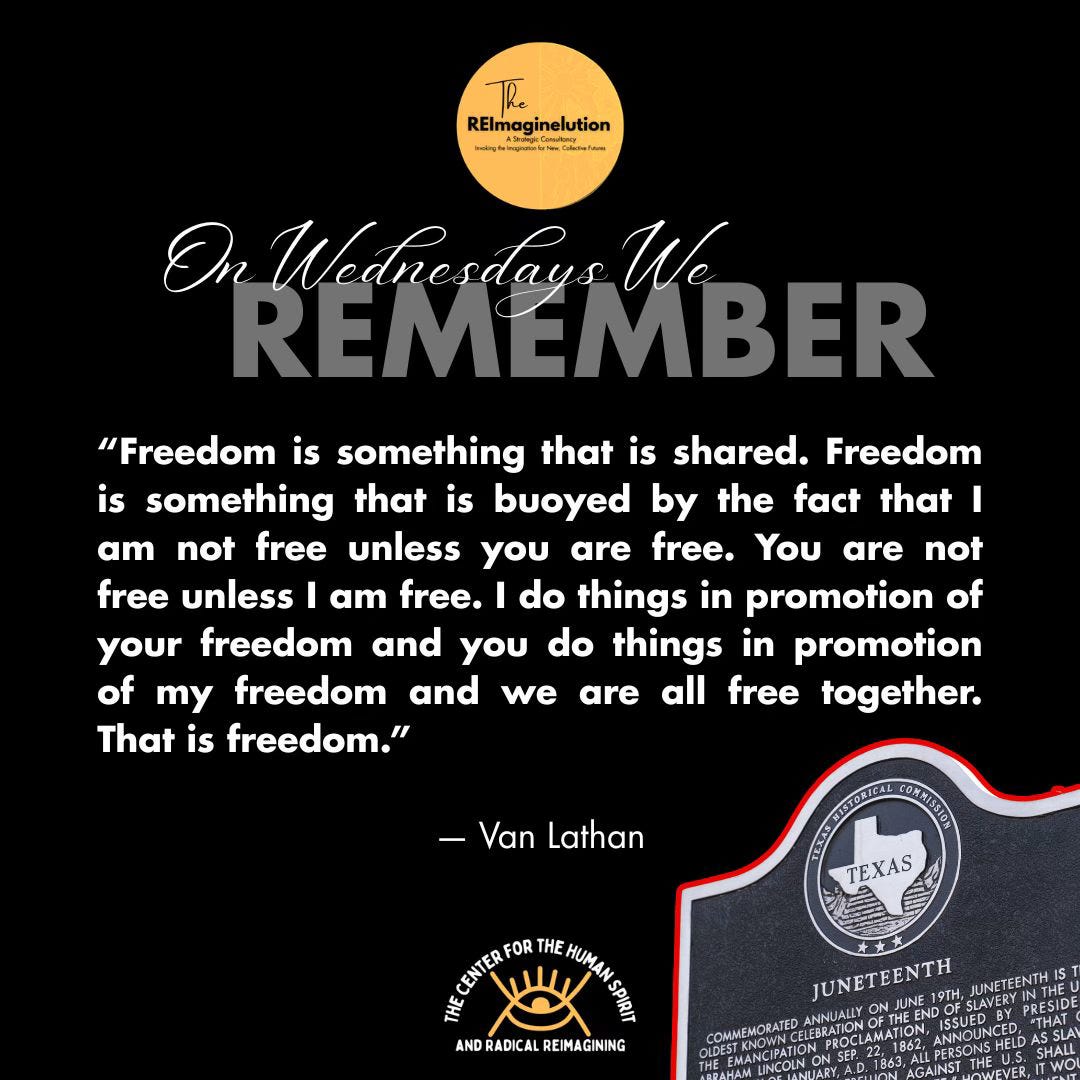
Freedom is something that is shared. Freedom is something that is buoyed by the fact that I am not free unless you are free. You are not free unless I am free. I do things in promotion of your freedom and you do things in promotion of my freedom and we are all free together. That is freedom.
Of course, Lathan does not mean that a person wants to literally be white. He speaks of what I call white ideological indoctrination or what bell hooks called “white supremacist capitalist patriarchy”.
In a need to be included, recognized, and respected by potentially unrespectable people, have we learned to forget the real meaning of freedom?
For our Ancestors, freedom meant release from the yoke of bondange and escape from a brutal system of domination that denied their innate humanity, endarkened brilliance, and their everyday and historical contributions to birth and evolution of human civilization. It meant the telling of ontological truth in the face of a perpetuated ideological lie.
In agreement with Lathan, we no longer understand the meaning of freedom, which means that we damn sure do not know liberation. I offer my thoughts below on freedom in six movements.
Freedom is not solely a political declaration or a release from physical restraint. While freedom is a place, it is more than a destination, more than a document, a date on a calendar, or a law passed in the legislature. While we have come to think of it as a political designation, it is not something that can be granted to you by a system that was never designed with your full humanity in mind. It is not the mere absence of chains and it is certainly not unfinished. If we have learned anything from the ancestors who imagined in captivity to the organizers in the streets who brought collective imaginings into physical realities in this long and unbroken arc of human struggle, it is this: freedom is not a moment; it is a movement. It is a constant becoming that must be won over and over again.
I am certain that there are more or, perhaps, less but I think about freedom in six contemporaneous movements.
Movement I: Freedom is the Liberation of the Human Spirit
At its most essential, freedom is the liberation of the human spirit. The human spirit is that immeasurable, irreducible, inexhaustible force that animates every one of us and that no system, however brutal or refined, has ever been able to fully contain. The human spirit is always in pursuit of justice, always in motion, always engaged in a transformative process of becoming something more than what the world has tried to make it. This is the ground truth from which any honest reckoning with freedom must begin.
When I speak of freedom, I am not speaking only of political freedom, though that matters enormously. I am not speaking only of economic freedom, though the material conditions of people’s lives are sacred. I am speaking of something deeper; the freedom to be, to become, to inhabit the full range of your humanity without apology, without diminishment, without the constant negotiation of your worth. I am speaking of the freedom of the human spirit to breathe, to expand, to love, and to create. This is the freedom worth working for; worth living into. This is liberation, in my grandmother’s words, “to free one’s mind and soul, so your ass can follow.”
Movement II: Freedom Begins and Ends in the Imagination
Before strategy, before protest, and before policy—freedom begins in the imagination. This is perhaps the most essential and most overlooked truth about the struggle for freedom and liberation. Everything that exists in the material world: every system, every institution, every structure of power and every structure of justice — first existed in someone’s imagination. Imagination is multi-direction, that is to say, it can be retrogressive and diminishing or it can generate and spur collective flourishing. The plantation was imagined before it was built. And so was the Underground Railroad.
This means that the first act of any oppressive system is always the same: it polices the imagination. It shuts down any thought of what could or must exist for people to become more free, more whole. It tells you that the way things are is the way things must be. It narrates inevitability where there is only choice and insists on the permanence of arrangements that are, in truth, always contingent. The Ancestors knew this. From the first generation kidnapped, who knew the experience of freedom, to the last generation in bondage, the subsequent generations that suffered under Jim and Jane Crow, to the current generations resisting James Crow, Esq; they all imagined freedom and defined it for themselves and generations accordingly.
This is why I have said, and will keep saying, that more than knowledge, more than money, more than power, what we need is the imagination. As Albert Einstein understood, knowledge is limited to what we already know and understand, while imagination embraces the entire world and all there ever will be to know and understand. Imagination allows us to think beyond what has already been thought. And it is only by thinking beyond what has been thought that we can begin to build beyond what has been built.
Freedom, then, requires a reimaginelution — a revolution of and by the imagination. Not the imagination as fantasy or escape, but the imagination as a disciplined, radical, collective act of projection: the ability to perceive what is not yet, to invent what must become, and to co-create it, together.
Movement III: Freedom is Relational and Rooted in Ubuntu
I have spent years sitting with the southern African philosophy of Ubuntu, whose wisdom has never been more needed than it is right now. Ubuntu teaches us something simple and profound: I am because we are. My humanity is not separable from yours. My freedom is not achievable without yours. What diminishes you, diminishes me. This is not diminishment as metaphor, but as ontological fact.
This understanding reshapes what we mean by freedom entirely. In the Western liberal tradition, freedom has too often been imagined as something belonging to the individual or the solitary self, liberated from constraint, maximizing its own potential in competitive isolation. However, that is not freedom rather it is loneliness dressed in philosophical clothing.
True freedom is communal. It is the freedom of the We: a collective state in which every person belongs, every person matters, and every person’s flourishing is understood as a shared project and a shared responsibility. Freedom is not realized when some of us are free while others remain trapped in systems designed to exclude, diminish, and dispose of them. It is realized only when our communities and institutions align their policies and practices toward the full inclusion of every human being thereby creating cultures of genuine belonging and mattering for all.
For me, this means that the freedom of the most marginalized among us is the truest measure of the freedom of all of us. And it means that those who are free, in whatever partial or conditional sense they currently enjoy freedom, are called to use that freedom in service of the liberation of those who are not. Ubuntu, our shared humanity, demands this of us.
Movement IV: Freedom Requires Inner Work
There is a dimension of freedom that justice movements have sometimes neglected, to their cost: the interior or contemplative dimension. You cannot externally liberate what is internally still colonized. As we wrote in Contemplative Practices and Acts of Resistance in Higher Education: Narratives Toward Wholeness, this is not a criticism, but an invitation.
What I call contemplative justice is precisely the cultivation of the inner witness: that capacity to observe the movements of one’s own heart, to recognize how oppression and colonization have shaped not just the systems around us but the assumptions, fears, and self-images within us. It is the active development of a critical consciousness that can see the world as it is, name it clearly, and refuse to be governed by it in silence.
Contemplative practice—how we come to self through deep, active, embodied engagement with oneself and with the world—is not a retreat from the work of liberation. It is the foundation of that work. Practice is, as I have come to understand it, the cultivation of home within yourself and within the world: a rootedness in your own being and in your profound interconnectedness with all living things that cannot be taken from you, regardless of what systems try to do. That is a form of freedom that no legislation can give you and none can take away.
This is the freedom that the Ancestors knew; that God herself was their nearest ancestor and that there was nothing in the known and unknown Universe that was connected within a cosmology that valued balance.
While interior freedom alone is not sufficient in the long struggle for liberation, it is necessary. The person, the community who had done its inner work and who has cultivated contemplative justice within themselves as a way of being together brings something irreplaceable to the collective consciousness. Moreover, they bring to their respective communities: clarity, steadiness, compassion, and the rare ability to tell the truck with conviction and love.
Movement V: Freedom is a Process of Being-Becoming
My scholarly work has centered a question I believe we are all, at some level, always asking: What does it mean to be a human being? I have come to believe that human beings are not fixed, finished things nor are we products to be measured and deployed. We are, to borrow from the philosophical traditions that have shaped my thinking most deeply, beings-in-process always caught up in a state of becoming, always unfolding, always more than what any single moment can capture.
Freedom, understood in this light, is not a state to be achieved and then maintained in the common ways we think of maintenance. It is a dynamic, open-ended, sometimes painful, often beautiful process of becoming more fully and authentically human. It is the ongoing journey of what I call being-becoming: a movement of the self and of the community through time, shaped by love, grounded in dignity, oriented toward justice, and made whole in communion.
This means that becoming free cannot be rushed, it cannot be outsourced, and must be seen as the only morally acceptable and real outcome within our systems and institutions. Becoming free must be practiced, daily, individually and collectively. It is enacted in the choices we make about how to be with one another, how to structure our institutions, how to raise our children, how to grieve, how to celebrate, how to resist. Every act of genuine care is an act of becoming free. Every act of honest reckoning is an act of becoming free. Every time we choose, against the pressure of a dehumanizing world, to see and treat another person as fully, irreducibly human—we are practicing freedom.
Movement VI: Freedom is Fueled by Love and Always Oriented Toward Flourishing
I have said it before and I will say it again: like revolution, freedom is not a one-time event and it is always fueled by love. Not sentimentality. Not the soft, unchallenging kind of love that asks nothing and changes nothing. I mean the fierce, prophetic, reciprocal, world-remaking love that sees the full humanity of the person in front of you even when, especially when, the world has told you not to. This, I believe, is the love that compelled Harriet Tubman back across the line. The love that held movement communities together through unimaginable loss. The love that refuses to let injustice be the last word. The love that dreamed you and I into being in the imagination and hearts of our Ancestors, who prayed that their faith would be made flesh.
Freedom oriented by this love is always pointed in the same direction: toward flourishing. Not merely survival and not the absence of the worst. But the full, generous, abundant flowering of human possibility for every person, in every community, across every generation. It is the vision of a world in which all people thrive, in which systems serve human dignity rather than devour it, in which difference is understood not as a threat but as the generative gift it has always been.
In Beloved, Toni Morrison wrote that the only grace we can have is the grace we can imagine. I believe the same is true of freedom. We can only build as far as we can first envision. This is why the work of imagination is not preliminary to the work of freedom, I believe, it is the work of freedom. To imagine, collectively and rigorously, a world in which we are all free is not a luxury; it is the most urgent task before us.
Taken together, these six movements move us toward freedom—its practice and embodiment, toward becoming-free together on our collective expedition toward liberation. The very first step is realizing that one is held in chains visible and invisible and a desire that they be loosed.
When the very freedoms we declare are so fundamental to us as a people and nation have been repealed and are under threat, let’s use this Juneteenth and the celebration of the nation’s semiquincentennial to re-evaluate our collective and personal understandings of freedom.
While celebrating the Ancestors and the many accomplishments that the descendants of the formerly enslaved have achieved in this country and across the diaspora, take a moment to turn your attention and imagination to the generations to come and what we wish for them to inherit from us. Let this not be the time in our grand epoch, that fails to remember that freedom is toward, with, and an active unfolding toward our collective flourishing and highest human good.
Happy Juneteenth!
May we resist.
May we be free and know it.
May we know liberation.
May we imagine higher, think deeper, and project new possibilities together.
May we all be well.
No posts
Comments
Nothing yet. Say the first thing.
Sign in to join the conversation.