
The future belongs to the imaginative. I do not know who first said those exact words, but I know they are true.
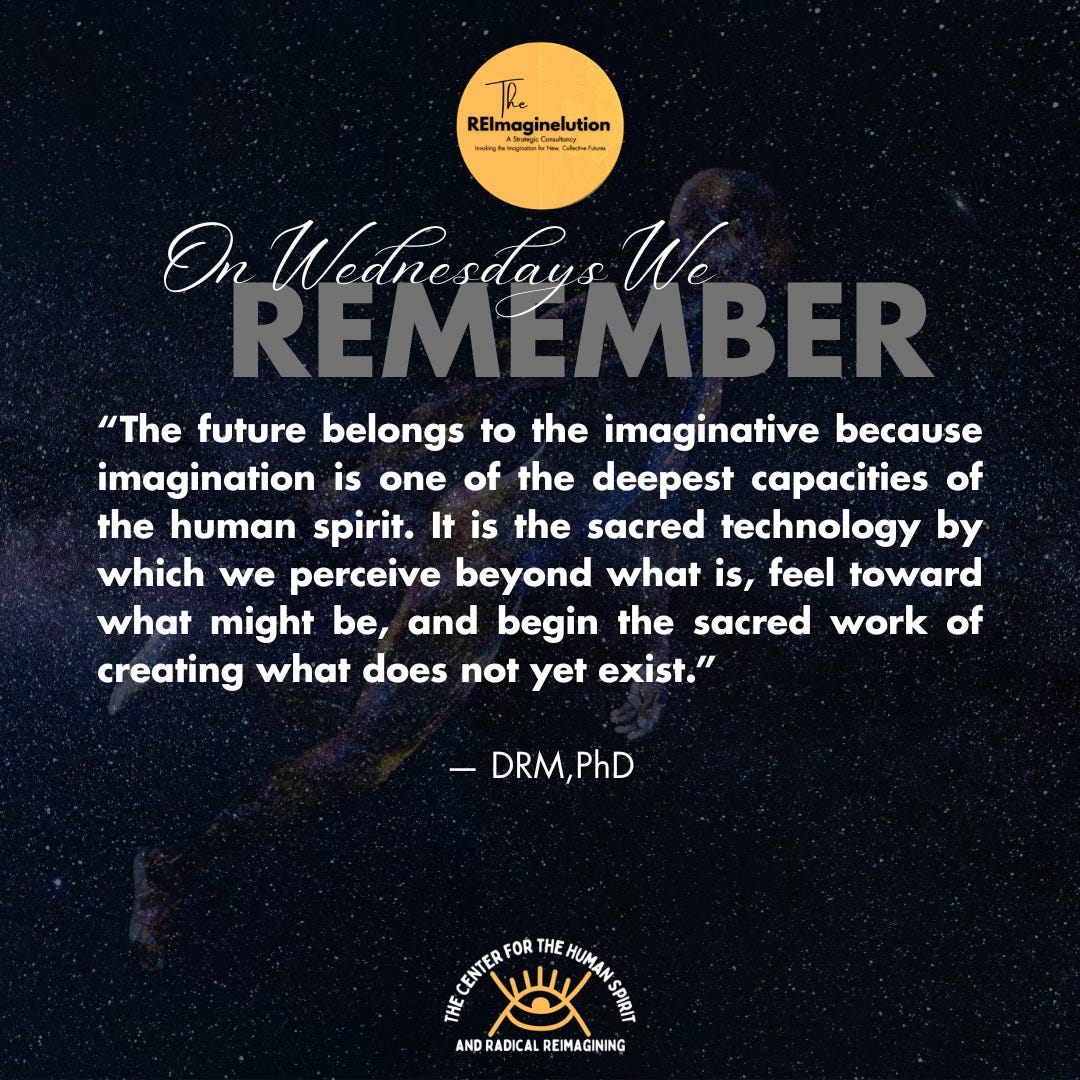
As I find myself constantly reminding scholars and clients, the statement is true for me not because the imagination is whimsical or fanciful nor because it offers escape from the world as it is. And certainly not because imagination is merely a private exercise in dreaming. The future belongs to the imaginative because imagination is one of the deepest capacities of the human spirit. It is the sacred technology by which we perceive beyond what is, feel toward what might be, and begin the sacred work of creating what does not yet exist.
I have long believed that imagination is among the most powerful forces available to us in the struggle for justice, liberation, and human flourishing. More than knowledge, policy, or mere critique. Yes, we need all of those things and, as a scholar-academic, we need sober and critical analysis mediated in historical truth. If the last year has taught us nothing, it should have demonstrated the need for strategy, discipline, and institutional courage. However, if we do not have imagination, that is if we cannot project beyond the terms of the world as it has been handed to us then we are sure to remain trapped inside the architecture of other people’s dreams, other people’s fears, and other people’s limitations.
Oppression understands this deeply.
Every oppressive system, whether brutal and explicit or polished and institutional, attempts to colonize the imagination first. It narrows the field of possibility and tells us that the world as it is is the world as it must be. It teaches us to confuse accommodation with peace, domination with order, and survival with flourishing. Most dangerously, it persuades us that the horizon is fixed; and convinces us that our role is to adjust, endure, and make ourselves legible to structures that were never designed with our full humanity in mind.
But imagination interrupts all of that. The imagination is a disruptive force. Imagination is how we remember that the world is not finished.
Imagination is how the enslaved imagined freedom before there was a map to it. It is how Black folk, in every generation, have conjured beauty under pressure, life under siege, and joy in the middle of grief. It is how our Ancestors knew that bondage was not the truest story of who they were. It is how they saw themselves not through the eyes of empire, but through the eyes of God, through the eyes of dignity, through the eyes of an ontological truth no plantation, no law, no lie could finally erase.
To imagine—to engage in the practice of prophetic hope—is to refuse captivity of the spirit. And if I have learned anything from Ubuntu, it is that the work of imagination is never solitary. It is always generated, elevated, and expanded in community.
Imagination + Ubuntu
Ubuntu teaches us that I am because we are and that my humanity is bound up in yours. My becoming is tied to your becoming. My flourishing cannot be built upon your diminishment. This is not simply a moral claim; it is an ontological one. It is a truth about the nature of being itself. We do not come to ourselves alone. We do not become human in isolation. We are made, unmade, and remade in relationship.
This matters because imagination, too, is relational.
The dominant culture often treats imagination as individual genius—the possession of the exceptional mind, the artist, the entrepreneur, the visionary leader standing alone at the edge of the crowd. But the Black imagination has always known better. The imagination is communal, and is carried in testimony, ritual, memory, music, movement, and story. We know it is cultivated in kitchens and sanctuaries, in classrooms and beauty shops, in protests and porches, in whispered prayers and public declarations. It is shared across generations and refined in struggle. It is deepened by grief and made radiant through love.
If this is true and I believe it is, then the future, then, does not belong merely to those who can invent. It belongs to those who can imagine, together. Even more, it belongs to those who can remember the future together.
The future belongs to communities capable of seeing one another clearly enough to build worlds where all can belong. It belongs to people courageous enough to ask not only ‘What do I want?’ but what do we owe one another? What does our shared humanity require? What would it mean to create institutions, relationships, and communities ordered toward the flourishing of all?
This is where Ubuntu and imagination meet.
Ubuntu refuses the lie that freedom is domination. It refuses the thin, impoverished understanding of freedom as the right to accumulate, exclude, hoard, or stand over. Ubuntu reminds us that the deepest freedom is shared freedom; that I am not free unless you are free. That your suffering diminishes the horizon of my humanity and that liberation, if it is to be liberation at all, must be collective.
The imagination co-joined with communal action is what allows us to build toward that collective freedom.
Imagination helps us ask better questions:
What would a school look like if it were actually organized around the flourishing of children rather than the management of bodies?
What would a church look like if it truly believed every person bore the image of God in full?
What would leadership look like if it were rooted in service, contemplative depth, and the courage to tell the truth?
What would philanthropy look like if it trusted Black communities not merely as recipients of aid but as bearers of wisdom, architects of possibility, and stewards of futures not yet seen?
What would it mean to build institutions that did not merely include people but were transformed by their presence?
These are not abstract questions. They are the necessary questions of anyone unwilling to mistake the present arrangement of things for the limit of what is possible. And still, imagination requires something of us—discipline, honesty, inner work, vulnerability, openness.
I have often said that the imagination is not escapism nor is it a retreat from reality but a deeper encounter with it. The moral and liberatory imagination demands that we tell the truth about the past and face the present without anesthesia. It requires contemplative courage—the capacity to sit still long enough to discern what in us has been colonized, what fears govern us, what assumptions about worth, scarcity, power, and belonging we have internalized from the world around us. Here is the rub: if our inner world remains captive, our outer work will always mirror that captivity.
Coming Home to Yourself: Contemplative Practices
This is why contemplative practice matters to me so deeply and I’ll write and talk about it until I no longer have breath. The cultivation of the interior life is an act of creation allowing for space where the human spirit can breathe again. It is, for me too, an act of re-membering; to remember that there is a self beneath performance, beneath fear, beneath the scripts handed to us by systems of domination. Practice allows us to come home to ourselves; to become intimate with one’s own soul and, in that intimacy, recover the capacity to imagine otherwise. Contemplation does not remove us from the struggle. It roots us in it differently. It steadies the spirit. It refines perception. It makes courage sustainable. It makes sustained resistance a bearable state of being.
Now, there is a risk. Taking a risk always requires courage to both make the first step and experience the intended and unintended consequences of the result of the risk-taking. Therefore, courage is necessary because imagination can be costly.
To imagine beyond the sanctioned boundaries of the present is to risk being misunderstood by those invested in things remaining as they are. To imagine publicly is to challenge the inevitability of domination. To insist that another world is possible is to expose the moral poverty of this one. That is why education, which Fredrick Douglass reminds, makes a man unfit to be a slave and imagination has always been dangerous in the hands of oppressed peoples. It is because once people can see beyond the lie, they become harder to govern by it. The imagination is world-making, reality shifting, and I believe how we tap into the mind (frequency, energy) of the primordial power of the Universe—the mind of God.
This is, in many ways, the work of reimaginelution—catalyzing our imagination capacity by enjoining life, leadership, scholarship, spirituality, and community to love, truth, and action to remake the world, reclaim our right to define reality differently, and refuse inherited frameworks that deny our shared humanity. The imagination alone is not enough.
If the future belongs to the imaginative, it belongs especially to those whose imagination is accountable to love. By love, I do not mean sentimentality, mush, or the shallow performance of niceness. I mean the fierce love that insists on dignity, the courageous love that tells the truth, the disciplined love that builds what it longs for; and the communal love that understands no one gets free alone—we are one.
I believe this love is what turns vision into responsibility and orients the future toward flourishing rather than conquest. Flourishing is the full flowering of human life in right relationship—with self, with others, with the Earth, with God, with the deepest truth of who we are. Flourishing is the capacity of individuals and communities to live with dignity, meaning, joy, belonging, and purpose. It is what becomes possible when systems align with humanity rather than against it. As human beings, it is what we owe one another.
So yes, the future belongs to the imaginative. The future belongs to the imaginative because the imaginative are the ones willing to become otherwise. We are the ones willing to hear the groaning of the world and answer not only with analysis, but with artistry; not only with resistance, but with reconstruction; not only with outrage, but with disciplined hope. We are the ones willing to ask, over and over again:
What else might be possible here?
What has not yet been tried?
What forms of life remain unborn because we have not yet had the courage to imagine them?
What would love build if fear were no longer in charge?
What have I been conditioned not to see?
These are the questions that keep the future open. In a world increasingly organized by cynicism, cruelty, extraction, and forgetting, perhaps our task is not merely to defend what remains of our humanity, but to imagine it more fully. Our task is to remember that the human spirit was never meant only to solely endure, but it was meant to create.
May we be people of disciplined imagination.
May we refuse the colonization of the spirit.
May we imagine in the direction of justice.
May we build in the direction of love.
May we remember that my humanity is bound up in yours.
And may we have the courage to believe that the future—if it is to be worthy of us—must be imagined together.
No posts
Comments
Nothing yet. Say the first thing.
Sign in to join the conversation.