
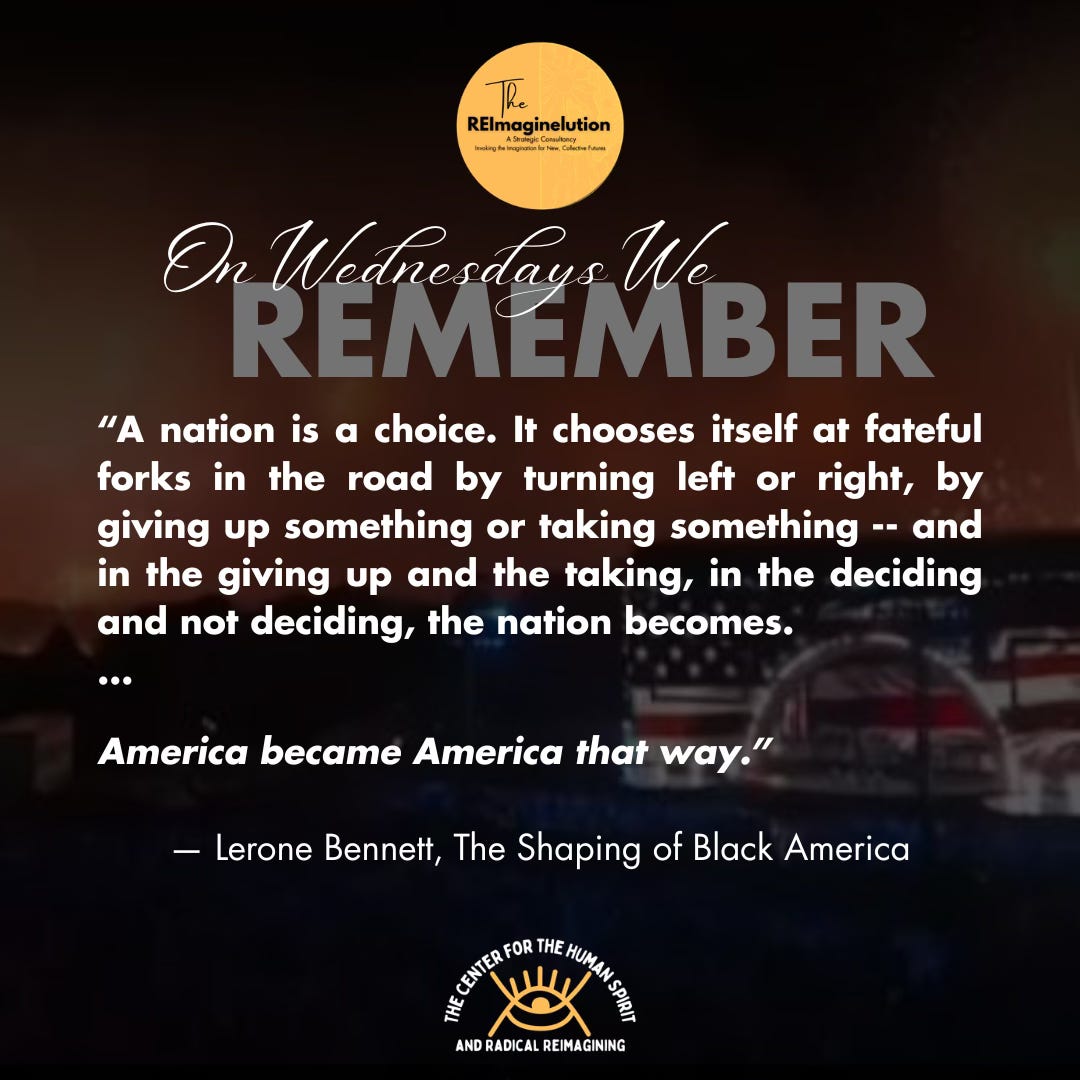
“A nation is a choice. It chooses itself at fateful forks in the road by turning left or right, by giving up something or taking something -- and in the giving up and the taking, in the deciding and not deciding, the nation becomes. And ever afterwards, the nation and the people who make up the nation are defined by the fork and by the decision that was made there, as well as by the decision that was not made there. For the decision, once made, engraves itself into the landscape, engraves itself into things, into institutions, nerves, muscles, tendons; and the first decision requires a second decision, and the second decision requires a third, and it goes on and on, spiraling in an inexorable process which distorts everything and alienates everybody.
America became America that way. Fork by fork, step by step, option by option, America or, to be more precise, the men who spoke in the name of America decided that it was going to be a white place defined negatively by the bodies and the blood of the reds and the blacks.”
—Lerone Bennett, The Shaping of Black America
[Originally published in Ebony, vol. 25 (August, 1970), pp. 71-77}
Last week, the country celebrated the nation’s 250th anniversary of the Declaration of Independence. I, like many others, observed it in silence. Not because we do not love our country and not because we are not patriots. I think Black Americans are the truest patriots, because born on this soil, yet treated like third-class citizens—we continue to hold America to the promises of its idea. I reflected on the idea of America, in light of the absolute dumpster fire we are currently experiencing.
While enjoying my weekly Friday margarita, I wrote:
My God, we have a lot of work to do. In the midst of all the pain and anger, I have to find the beauty, because beauty too is method.
Here is the beauty that abides with me: This country is founded on an idea—an unrealized idea—that began in the imagination, the collective imagination of the founding fathers and mothers. The expression of that idea, for many, has been a nightmare. But, but, if we do nothing well—we imagine and re-imagine in every epoch, in every age, and in every generation this idea of democracy. As I often warn, the imagination can be generative or it can be retrogressive.
Some have chosen the latter, while the former cries out to be heard. And it will be heard.
We must reimagine this country or languish in its demise. Keep fighting, keep working, keep resisting until we have a “democracy” that works for us all.
These are some more of my thoughts.
There are moments in the life of a people that invite more than celebration; they summon examination, require discernment and demand that we ask not merely where we have come from, but who we have become and, perhaps more importantly, who we are still capable of becoming.
This nation’s 250th anniversary is one such moment that should have been a grand pause for us all to stop, reflect, and imagine, generatively and collectively.
The semiquincentennial was marked by fireworks, parades, patriotic speeches, and not so carefully curated remembrances of the nation’s founding. Yet anniversaries, if they are to be more than commemorations of the past, must also become occasions for moral reckoning. They invite us to stand at the intersection of memory and possibility, where history becomes less an object of nostalgia than a catalyst for imagination.
The question before us, therefore, is not whether the United States has endured for two and a half centuries. Nations survive even while empires decline, and political systems implode. The more searching question is whether we possess the moral courage to choose the kind of nation we wish to become over the next 250 years.
A nation is never merely inherited, but is always a choice—a set of decisions that either rise to the ideals or buckle under the weight of a constraining ideology.
Few scholars have expressed this truth more powerfully than historian Lerone Bennett, Jr., who observed in 1970 that “a nation is a choice.” It chooses itself, he argued, “at fateful forks in the road,” becoming what it is through the decisions it makes, the possibilities it embraces, and the possibilities it abandons. Those decisions do not disappear into history. Rather, they become embedded in the institutions we construct, the landscapes we inhabit, the habits we cultivate, and even the ways we understand ourselves. Each choice narrows or expands the range of future possibilities, requiring still more choices until the accumulated weight of those decisions begins to feel inevitable.
America became America in precisely this way, he says. Fork by fork. Law by law. Election by election. Institution by institution. Ideological supremacy over communal flourishing. As Bennett reminds us, those who spoke in the name of America repeatedly chose to construct a nation in which whiteness became the normative measure of belonging while Black and Indigenous bodies became the negative space against which citizenship, humanity, and freedom were defined. This was not an accident of history. Nor was it an unavoidable consequence of the times. It was a succession of political, economic, theological, and cultural choices whose consequences continue to reverberate through our schools, neighborhoods, courts, churches, markets, and collective imagination.
If nations are built through choices, then they may also be transformed through choices. This is the conviction that lies at the heart of democratic hope.
Too often, conversations about democracy become confined to elections, institutions, or constitutional procedures. These are indispensable, but they are insufficient. Democracy is not merely a governmental arrangement. It is a moral practice; the ongoing work of deciding who belongs, whose dignity matters, whose stories are remembered, and whose flourishing is considered indispensable to the common good. At its best, democracy is not simply the distribution of power, but the cultivation of shared responsibility.
This is especially true within a multiracial democracy, where diversity is frequently treated as a demographic reality rather than embraced as a civic vocation. The American experiment has long struggled to reconcile its universal aspirations with its particular exclusions. We proclaimed liberty while institutionalizing enslavement. We celebrated equality while dispossessing Indigenous peoples. We praised opportunity while constructing systems that ensured its unequal distribution. The contradiction has never been incidental to our national story; it has been one of its defining features. And yet contradiction need not become destiny.
We must understand that history records our choices; it does not imprison us within them.
What would it mean, then, to choose differently? What might flourishing look like if it became the organizing vision for America’s next chapter?
Flourishing asks questions that economic indicators cannot answer. Gross domestic product can measure production but not belonging. Stock markets may reflect financial confidence while communities fracture beneath the weight of loneliness, violence, and despair. Technological innovation may accelerate while trust deteriorates. Military strength may expand even as civic life weakens. The creation of a federal department simply named, ‘War’ is a direct indication of how far we have flown from collective flourishing.
A flourishing society measures itself differently. A flourishing society asks whether every child encounters institutions that affirm rather than diminish their humanity. It asks whether neighborhoods cultivate relationships instead of isolation. Whether schools educate citizens as well as workers and whether healthcare restores wholeness rather than merely manages illness. It asks whether housing communicates dignity rather than disposability. And it for sure asks, whether public policy enlarges the conditions under which every person can live a meaningful life.
These are not peripheral concerns. They, in my opinion, are the very substance of democratic life or what John Dewey called our associated mode of living or our moral way of shared living for the collective good.
Human flourishing insists that justice is more than the repair of injury, but rather the intentional cultivation of conditions in which life, hope, creativity, and possibility can take root across every community. Justice concerns not only what we prevent but what we enable.
Let’s put our moral imaginations into practice for a moment.
Imagine an America where every significant public decision is evaluated through a single, searching question: Does this expand the capacity for human flourishing?
Imagine cities designed not simply for efficiency but for encounter—for community.
Imagine educational systems that teach history with sufficient honesty to produce wisdom rather than defensiveness.
Imagine economic structures that reward innovation without sacrificing solidarity.
Imagine healthcare grounded in prevention, community, and human dignity rather than profit alone.
Imagine religious communities that become schools of reconciliation instead of sanctuaries for ideological certainty.
Imagine political leadership measured less by electoral victory than by its capacity to cultivate trust across difference.
These are not just feeble imaginings; they are real possibilities. Possibilities that are neither romantic fantasies nor naïve idealism, but choices awaiting our consent.
I have said and written over and over again, the greatest crisis confronting American democracy may not be polarization itself but the erosion of our collective imagination. We have become remarkably skilled at describing the world as it is while losing confidence in our capacity to imagine what it might yet become. We see it all too often, cynicism now masquerades as sophistication while resignation presents itself as realism. We continue to confuse permanence with inevitability. Meanwhile, history teaches us otherwise.
A solid study of history with a keen eye reveals every significant expansion of democracy first appeared impossible. You want an example, you say? I have plenty, but I’ll give you three.
The abolition of slavery required imagination before it required legislation.
Women’s suffrage and equal rights required imagination before it required constitutional amendment.
The Civil Rights Movement required imagination before it transformed law.
This is the type of imagination that I call muscular hope, an active move toward a collective, moral vision that seems impossible until it is accomplished and proves that all things are possible for them who are willing to work toward it together.
Every democratic advance began as an act of moral imagination that refused to confuse inherited reality with ultimate possibility. The future has always belonged to those capable of imagining beyond the boundaries of the present.
As a Black American and as a scholar, I understand flourishing not merely as a political aspiration but as a theological commitment. Every person bears the image of Great Spirit. Every community possesses gifts necessary for the common good. Human dignity is never earned; it is recognized. The measure of any society, therefore, is found not in how successfully it rewards the powerful but in how faithfully it safeguards the humanity of those most vulnerable to exclusion.
Putting on my ubuntugogical hat, we know that flourishing is never an individual accomplishment; it is always a communal achievement. No person flourishes while entire neighborhoods remain abandoned. No community or society secures lasting peace while others endure perpetual insecurity. No democracy remains healthy when belonging and mattering becomes the privilege of some rather than the inheritance of all. Our futures are profoundly interconnected whether we acknowledge this truth or resist it, we remain bound to one another.
Perhaps, as we now sit on the other side of the celebrations, this is the invitation of America’s 250th year: to rediscover interdependence, to deepen democracy, and not merely remember our founding, but choose our future.
Bennett’s insight remains as urgent today as when he first penned it. Nations continue to arrive at forks in the road and each generation inherits decisions it did not make while simultaneously confronting choices only it can make. The road ahead is never predetermined; rather it is shaped by what we are willing to relinquish, what we are prepared to embrace, and whom we are courageous enough to include within the circle of our moral concern.
The next chapter of the American experiment will not be written by history alone. It will be written by our choices. And we have some choices to make, together.
Will we continue to organize society around fear or around hope? Scarcity or abundance? Domination or shared flourishing?
The next 250 years have not yet been decided. Let me write that again, the next 250 years have not yet been decided nor have the next four. Both are awaiting people willing to imagine differently.
Democracy, both the idea and practice, are not ultimately sustained by constitutions, elections, or institutions alone. It is sustained by citizens who choose, again and again, to become the kind of people capable of creating the nation they wish to inhabit.
Because a nation, like hope, like justice, like love, is always a choice.
The only question that remains is this: What choice will you make? What choices will we make together now?
No posts
Comments
Nothing yet. Say the first thing.
Sign in to join the conversation.