
July 4, 2026
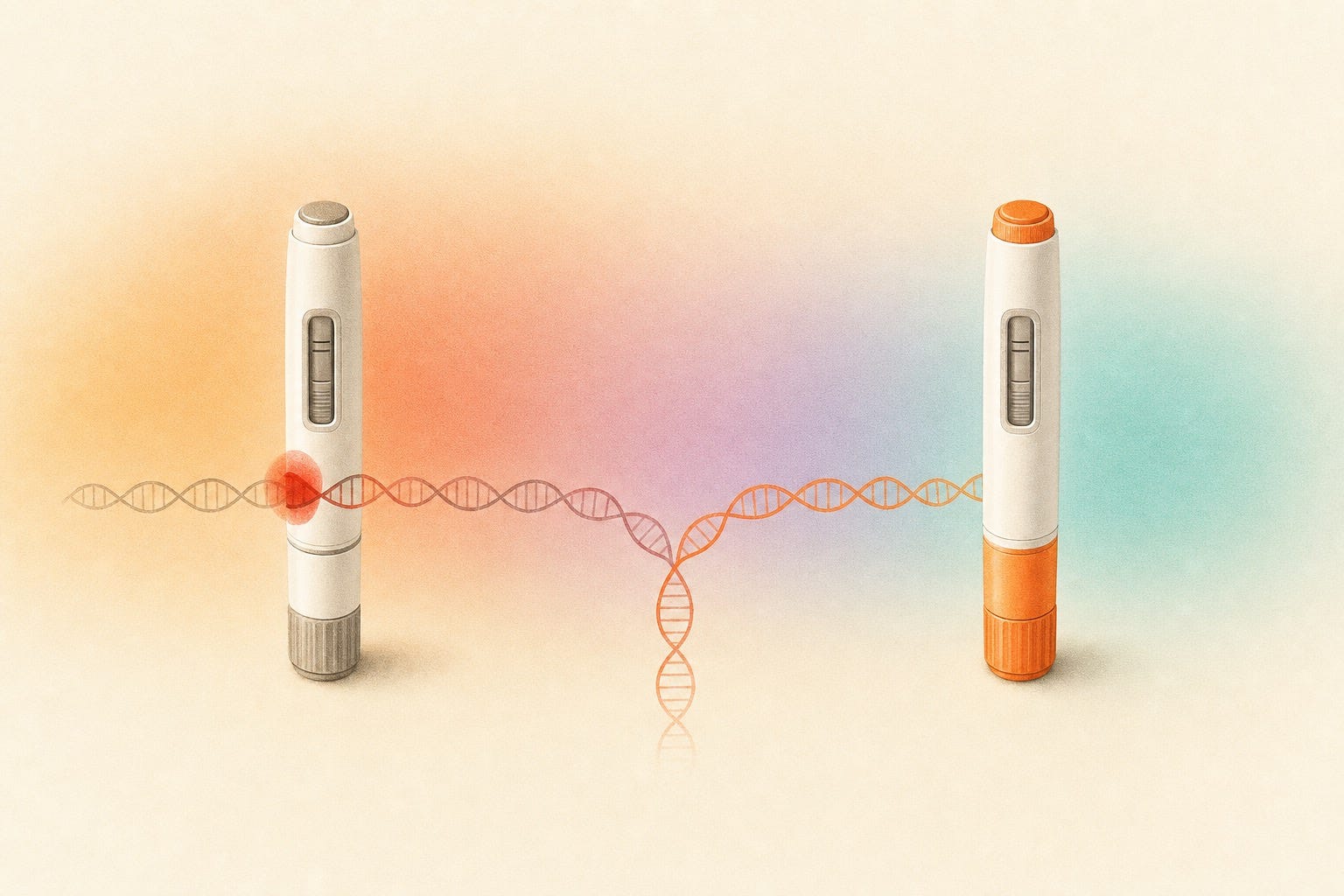
If Mounjaro makes you throw up and a friend on Ozempic feels fine on the same class of drug, the difference may not be your willpower, your diet, or how fast you titrated. It may be one letter in a gene called GIPR. In April 2026, the 23andMe Research Institute published a genome-wide study of 27,885 people on GLP-1 medications in Nature. It found that a single common variant in the GIP receptor raises the odds of vomiting by about 83 percent, and that the effect shows up only on tirzepatide, the molecule in Mounjaro and Zepbound. On semaglutide, the molecule in Ozempic and Wegovy, the same variant shows no measurable effect. This is why, what it does and does not mean for switching drugs, and the strange fact underneath it: nobody fully understands the receptor at the center of the story.
Sometimes it isn’t your gut or your grit. Sometimes it’s one letter in one gene.
Somewhere right now, someone a few weeks into Mounjaro is bent over a bathroom sink, phone in the other hand, typing the most honest version of the question into a search bar:
why does mounjaro make me throw up but not ozempic
They did everything the leaflet said. Smaller meals. Nothing greasy. Water first. The mornings are still a negotiation with the sink. And a friend who started Ozempic the same month feels nothing but the appetite quietly switching off, no drama, no nausea. Two people, two pens, one of them sick.
The internet answers that search in one voice: go slower, eat blander, give it time. The advice is not wrong. It is aimed at the wrong level. It treats the symptom and never touches the reason one of you is sick and the other is not. There is a better answer now. It starts with a receptor almost no patient has heard of, runs through the DNA of nearly 28,000 people, and ends somewhere strange: nobody, including the companies making billions off this receptor, fully agrees on what it does.

“Some people get nauseous” undersells the scale of this badly.
In the pivotal obesity trials behind Wegovy, the branded 2.4-milligram dose of semaglutide, 44 percent of patients reported nausea and 24 percent reported vomiting, against 16 and 6 percent on placebo. That is the number the FDA made Novo Nordisk print on the label. Nearly half of people on the drug feel sick. A quarter actually throw up. Gastrointestinal complaints are, by a wide margin, the single most common reason people abandon these drugs.
And the split between who sails through and who spends the morning at the sink is enormous, and until recently unexplained. That is the gap the rest of this piece is about. The numbers below are the whole finding at a glance; everything after them is the explanation.
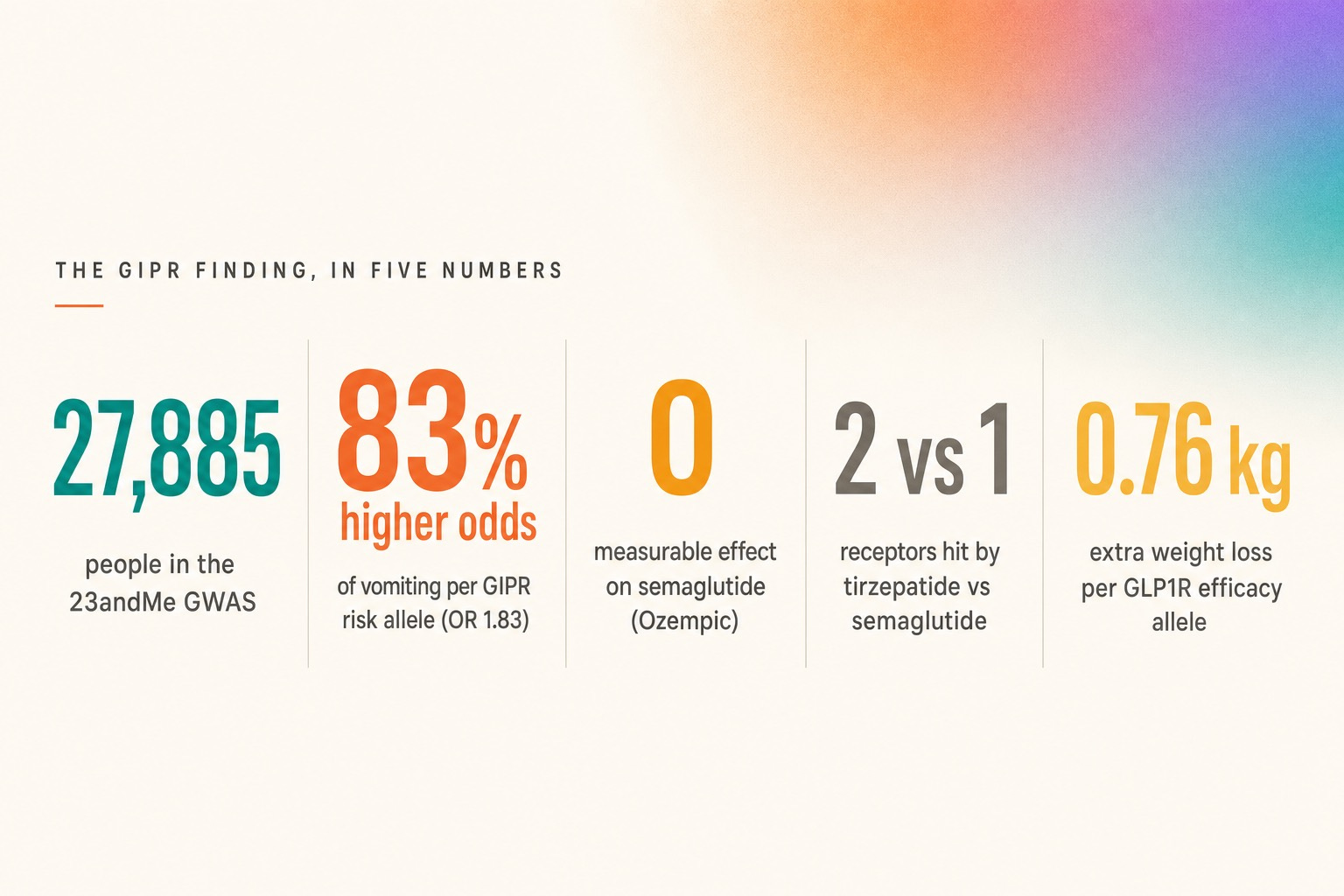
The finding at a glance: 27,885 people, ~83% higher odds of vomiting per GIPR risk allele on tirzepatide only, no measurable effect on semaglutide, two receptors versus one, and a separate 0.76 kg efficacy variant. Each is unpacked below.
Give the standard playbook its due, because it works for most people.
Nausea and vomiting on these drugs are dose-dependent and titration-dependent, which is why every one of them ships with a fixed, multi-week dose ladder that starts low and climbs slowly. Zepbound opens at 2.5 milligrams a week for a month, a dose the label calls initiation-only, then steps up to 5 and rises in 2.5-milligram increments no faster than every four weeks, to a maintenance dose of 5, 10, or 15. Wegovy runs a five-step version: 0.25 milligrams, then 0.5, then 1, then 1.7, and the 2.4-milligram target only at week 17. Both labels say plainly that the schedule exists “to reduce the risk of gastrointestinal adverse reactions,” and that the symptoms cluster during the climb and ease off after. Most people walk up the ladder and settle. The proof is in the quit rates: despite nausea near 44 percent, only about 4.3 percent of Wegovy patients actually stop the drug for a gut-related reason. (A widely repeated claim that 6.8 percent quit for gut reasons misreads the label; that is the all-cause discontinuation number, and the gut-specific one is 4.3.) Feeling sick and quitting are very different numbers.
But that whole framework describes the average patient on the average ladder. It cannot explain the split you actually care about: two people, same drug, same dose, same careful four-week climb, and one is fine while the other cannot keep food down. Dose is a lever everyone can pull. It is not the thing that decided you would be the one at the sink. “Nausea,” treated as one lump, hides the real structure. It is not a side effect spread evenly across everyone. It is a small group having a very different reaction, for a reason that lives upstream of anything you can eat.
That upstream reason is what the 23andMe study went looking for.
On 8 April 2026, in Nature, the 23andMe Research Institute published “Genetic predictors of GLP1 receptor agonist weight loss and side effects” (volume 653, pages 770 to 775). It scanned the DNA of 27,885 people who had taken GLP-1 medications and asked one question: do the genetics of the people who lose the most weight, or who get the sickest, differ from everyone else’s? A study that size is only possible because 23andMe sits on one of the largest research-consented genetic databases anywhere, a detail that will matter more than it looks by the end.
A genome-wide association study, or GWAS, is a wide net rather than a targeted guess. Instead of picking a gene in advance, it compares millions of positions across the genome, in thousands of people at once, and lets the signal announce itself. The bar for a real hit is deliberately punishing: “genome-wide significance” means a P-value below 5 x 10 to the minus 8, set that low precisely because the scan tests roughly a million positions at once and you have to survive all of them. The tradeoff is that GWAS finds associations, not proven causes, and it runs on whatever phenotype you feed it. Here the phenotype was self-reported, people telling 23andMe in surveys how much weight they lost and whether the drug made them sick. Hold that in mind as a yellow flag, not a red one.
Two positions lit up, both clearing that bar by one to two orders of magnitude. One explained who lost more weight. The other explained who threw up. They landed on two different genes, and telling them apart is the whole point of what follows.
The vomiting signal did not land on GLP1R, the receptor these drugs are named for. It landed on GIPR, the gene for the other incretin receptor. (An “incretin” is a gut hormone that spikes insulin after you eat; GIP, glucose-dependent insulinotropic polypeptide, is one of the two big ones, and almost no patient has heard of it.)
The index marker was a variant called rs71338792, tied to the vomiting side effect at genome-wide significance (P = 4.2 x 10 to the minus 9, odds ratio 1.84). It rides in near-perfect linkage with a second variant, rs1800437, which the authors name as the likely cause. “Linkage” just means the two sit so close together on the chromosome that they are almost always inherited as a pair, so tagging one tags the other. The correlation between them was r-squared 0.99, about as tight as genetics gets.
That causal candidate, rs1800437, is a single-letter change in GIPR. It swaps the 354th amino acid of the receptor from glutamic acid to glutamine, written p.Glu354Gln. The G version (glutamic acid) is protective, with an odds ratio of 0.546. The C version (glutamine) is the risk version, and its odds ratio is simply the reciprocal, one divided by 0.546, which comes to 1.83. The paper prints it exactly that way.
One letter, flipped. That is the entire genetic story of who ends up at the sink.
An odds ratio of 1.83 means the odds of vomiting are about 83 percent higher for each copy of the risk letter you carry. That phrasing matters, because it is the easiest number in this story to garble. “83 percent higher odds” is not the same claim as “83 percent more likely.” Odds and plain probability only track each other when an event is rare, and vomiting on tirzepatide is not rare. Here is what the odds ratio actually works out to:
Illustrative, not a prediction. Say vomiting on tirzepatide runs about 1 in 10 for people without the risk version. One copy of the risk allele nudges that to roughly 1 in 6 (about 17 percent). Two copies, to roughly 1 in 4 (about 27 percent). Real and meaningful, and a good deal smaller than “nearly double” makes it sound. And it is a population average, not a forecast for any one person.
The GIPR signal appeared only in the people taking tirzepatide. In the authors’ exact words, “no evidence of effect was observed within the semaglutide population.” The variant that makes Mounjaro a rough ride for some carriers does nothing measurable on Ozempic.
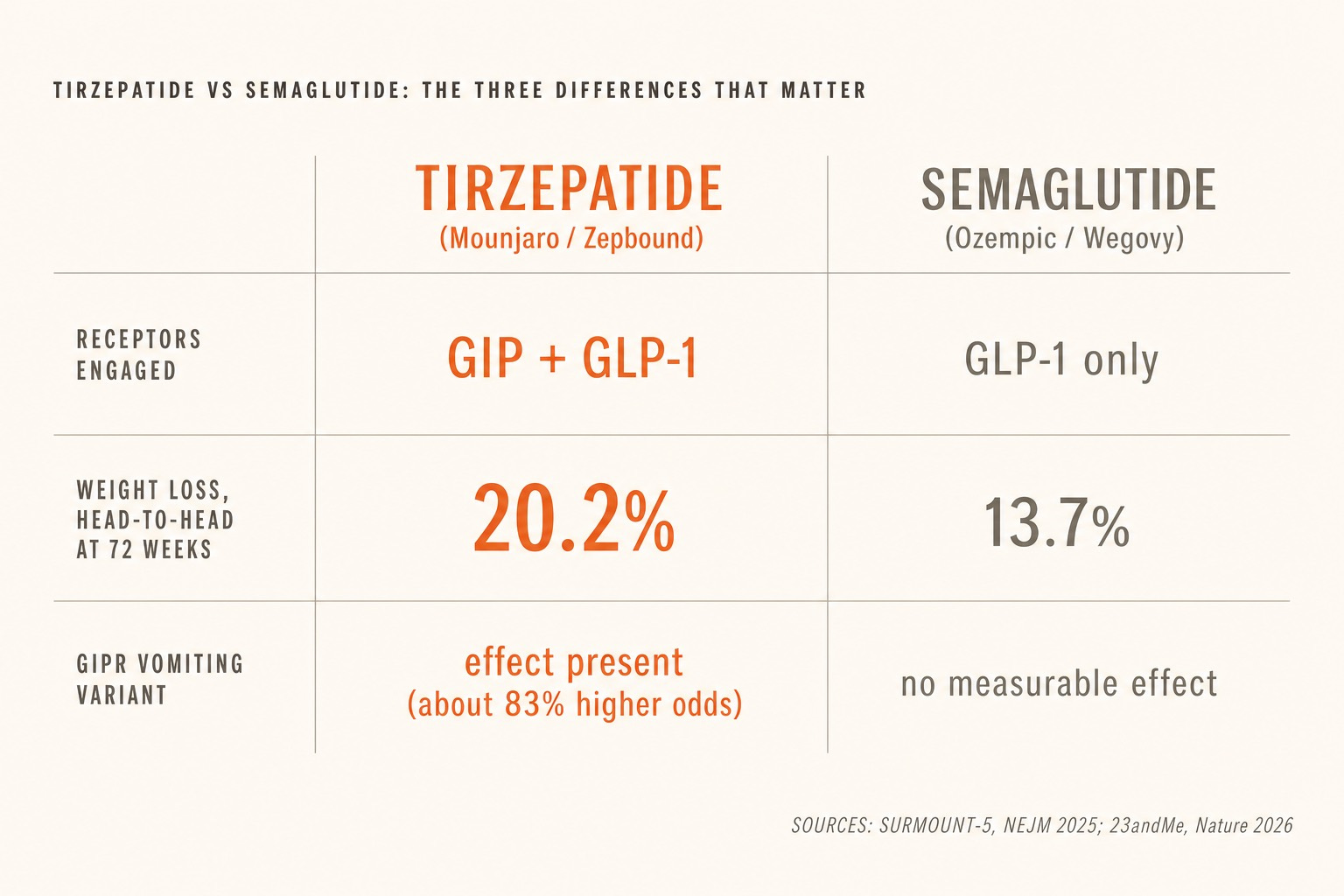
That is not a quirk of the dataset. It falls straight out of how the two drugs are built. Per its FDA prescribing information, tirzepatide “is a GIP receptor and GLP-1 receptor agonist.” It activates both incretin receptors at once. Semaglutide is a GLP-1 receptor agonist only. It never touches the GIP receptor. So a side effect routed through the GIP receptor is, by construction, invisible on a drug that has no way to reach that receptor.
The genome did not have to explain why Ozempic is spared. The pharmacology already did.
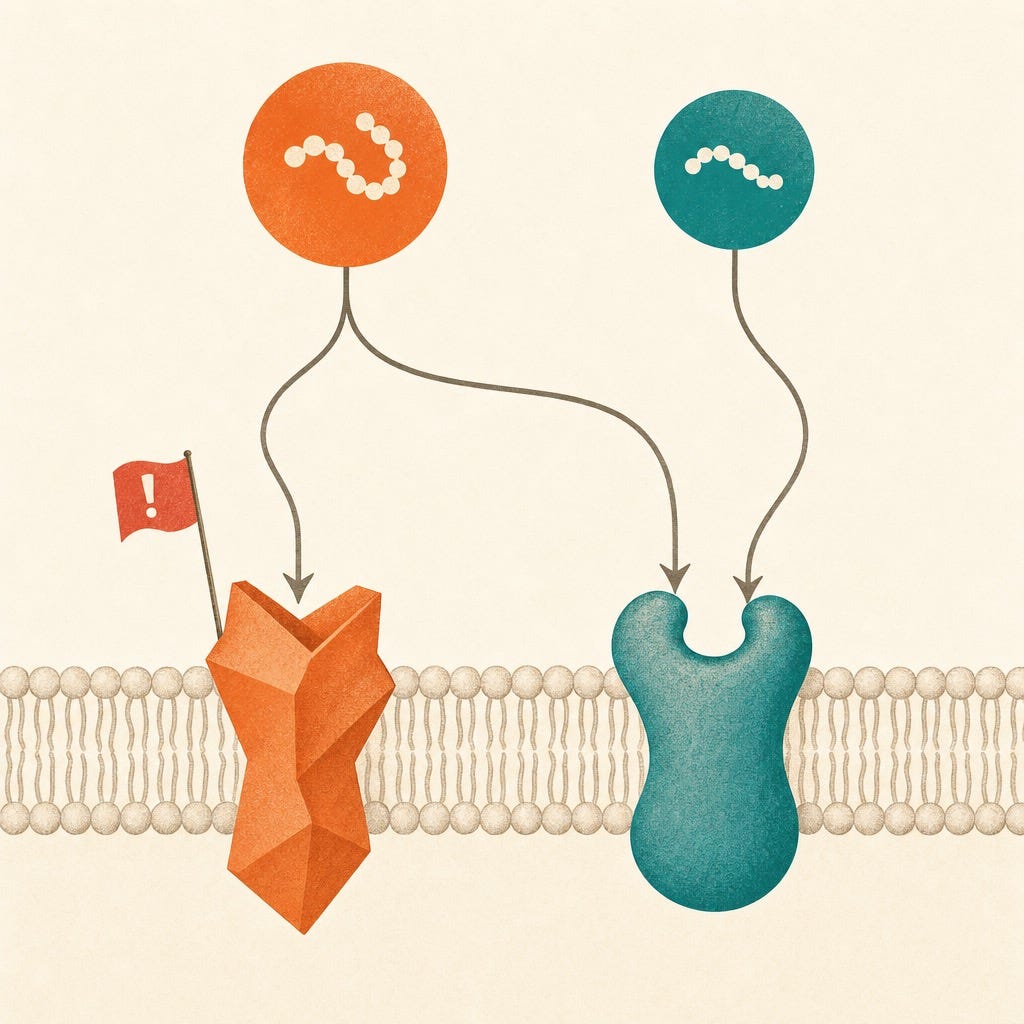
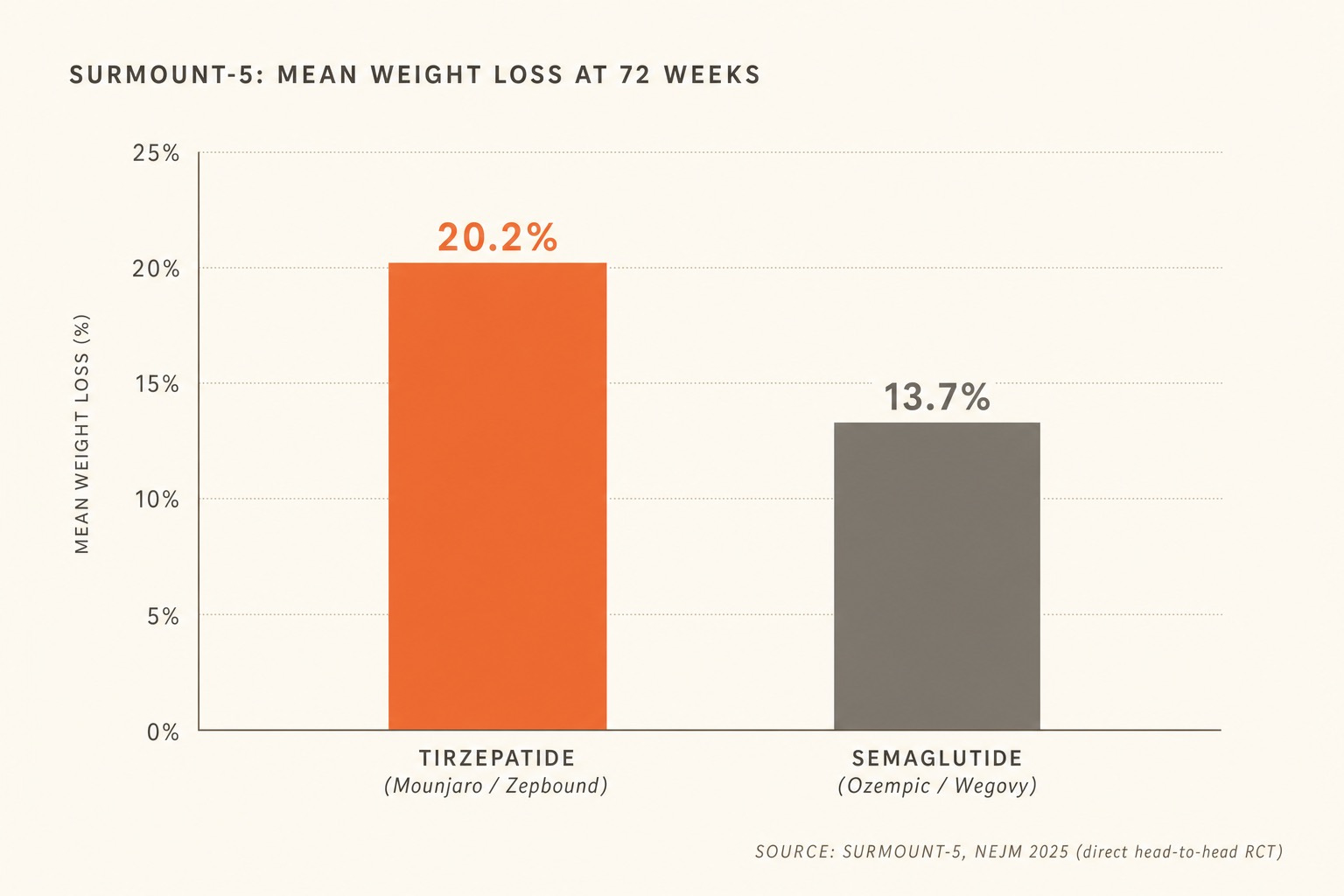
That second receptor is also why tirzepatide is usually the stronger drug. When the two were finally put head to head in the same trial, SURMOUNT-5 (New England Journal of Medicine, 2025, the top evidence tier), tirzepatide produced a mean 20.2 percent weight loss at 72 weeks against semaglutide’s 13.7 percent, in 751 adults with obesity but not diabetes. Those numbers track each drug’s solo trials, tirzepatide’s SURMOUNT-1 at 20.9 percent for the top dose and semaglutide’s STEP 1 at 14.9, with one caveat worth carrying: the head-to-head let each drug climb only to its maximum tolerated dose rather than forcing everyone to the ceiling, which is why its semaglutide arm landed a touch below STEP 1. Do not stack arms from separate trials as if the dosing matched. The extra receptor buys more weight loss. It also, in carriers of one unlucky variant, opens a door to the vomiting. Same architecture, two things coming through it.
If you are wondering whether this is you, the odds are not small.
The risk version of rs1800437, the C or glutamine allele, is common, not some rare mutation. Across the large gnomAD reference database its frequency runs about 19 to 20 percent worldwide, and it is not spread evenly by ancestry.
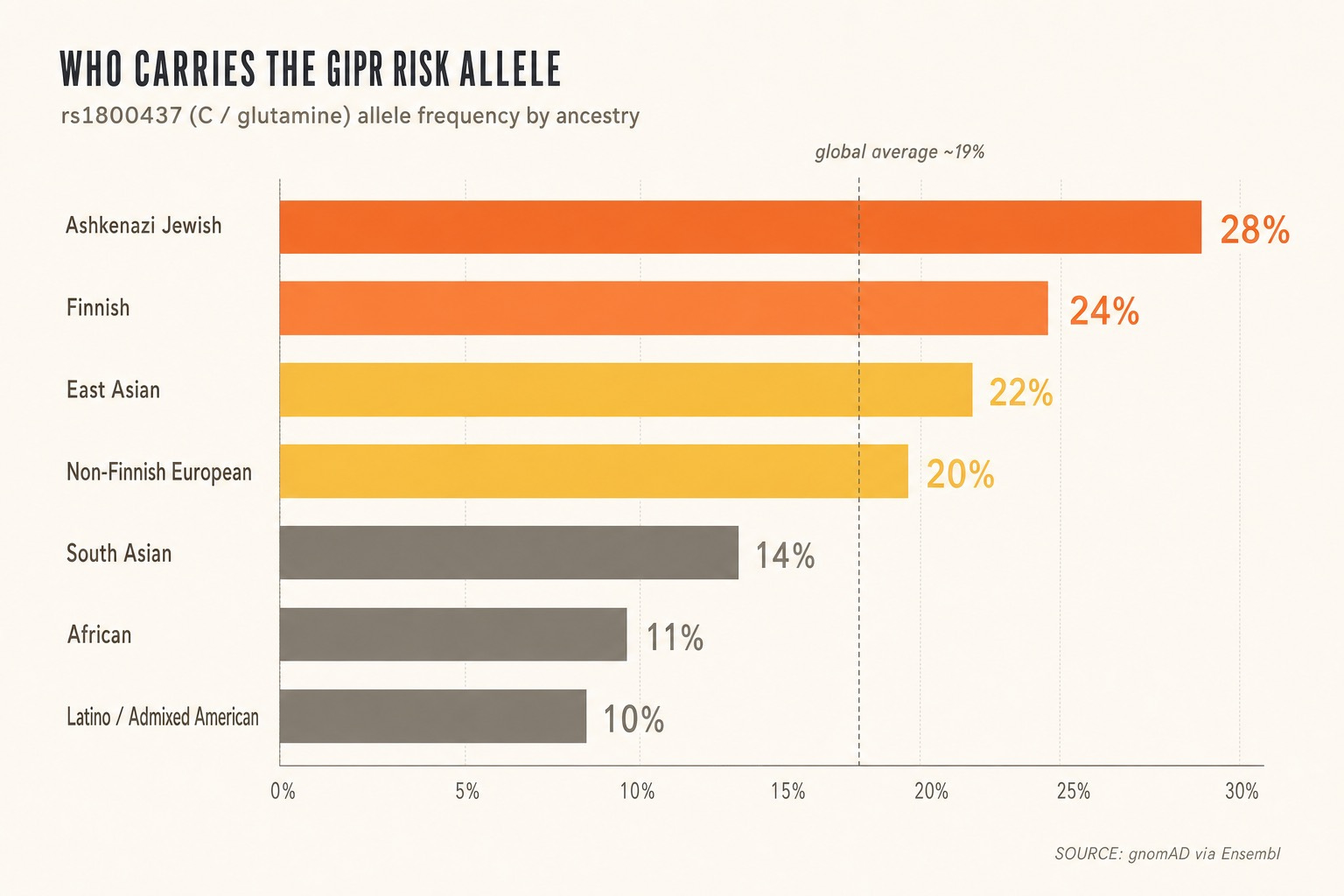
Because you carry two copies of every gene, a 19 to 20 percent allele frequency works out to more than one in three people worldwide carrying at least one risk copy, and closer to one in two in people of Ashkenazi Jewish ancestry. So this is not a curiosity affecting a handful of unlucky patients. A large minority of everyone on tirzepatide is carrying it.
Notice, too, that “risk allele” does not track the intuition about who these drugs are marketed to. The highest-frequency groups are Ashkenazi Jewish, Finnish, and East Asian; the lowest are African and Latino. A genetic finding that goes unexamined by ancestry can quietly become one that serves some patients better than others, which is a running problem in a field where most reference databases, and the 23andMe cohort itself, still skew European and self-selected. That leaves the estimate most precise for the groups already best served by genetic medicine, and least precise for those least served. Here the underlying variant is common across every group, but the point is worth stating out loud.
The vomiting variant was only half the study. The other half is about whether the drug works at all, and it lands on a different gene.
The efficacy signal hit GLP1R, and the variant, rs10305420, is a missense change (p.Pro7Leu, P = 2.9 x 10 to the minus 10) in the receptor’s signal peptide, the short molecular address tag that routes a freshly built protein, so the swap subtly alters how much working receptor reaches the cell surface. Each copy was worth an extra 0.641 percent of body-mass index lost, roughly 0.76 kilograms per copy. That is a nudge, not a switch: two copies is about 1.5 kilograms against the roughly 20 kilograms tirzepatide delivers overall, which is exactly why it barely moves the decision. We unpack that efficacy angle in the peptide pharmacogenomics guide. One contrast matters for this story, though: the GLP1R signal was tied to nausea across the whole GLP-1 class, not to one drug. Only GIPR was drug-specific. GIPR is the lever that flips depending on which molecule is in your pen, which is why the rest of this article stays on it.
Myth: tirzepatide hits the GIP receptor, so GIP must be what makes you vomit.
Fact: in animal studies, switching the GIP receptor on blocks nausea and vomiting rather than causing it (Borner and colleagues, Diabetes, 2021). The GIPR variant is firmly tied to more vomiting, but not because GIP “causes” nausea. How one amino-acid swap flips a broadly anti-nausea receptor is still unresolved.
The tidy version of this story would be that tirzepatide hits the GIP receptor, the GIP receptor drives nausea, so the GIP variant makes you sick. That version is wrong, and the head-to-head trial says so. In SURMOUNT-5, nausea was almost identical on the two drugs, about 44 percent on each. The clear gap was in vomiting specifically: 15.0 percent on tirzepatide against 21.3 percent on semaglutide, with about half as many people quitting for gut side effects, 2.7 versus 5.6 percent. The drug that hits both receptors was the one that made fewer people throw up. If GIP simply caused nausea, adding it should have made things worse.
The preclinical science explains why it does not. GIP receptors sit in the exact brain region that runs nausea and vomiting, the area postrema and nucleus tractus solitarius of the hindbrain, the “dorsal vagal complex.” (The area postrema is one of a handful of brain sites deliberately left outside the blood-brain barrier, so it can sample the blood directly for toxins. That is why it is the body’s poison detector, and why a drug injected into your belly can act on it at all.) You might expect a receptor there to trigger vomiting. It does the opposite. In the 2021 Diabetes study, Tito Borner and colleagues showed GIP receptor signaling “blocks emesis and attenuates illness behaviors” caused by GLP-1 activation, across three species including the musk shrew, an animal used because, unlike mice and rats, it can actually vomit. A follow-up traced a candidate circuit: GIP-receptor neurons in the area postrema, which sit right alongside the neurons carrying a separate nausea signal, appear to quiet the onward alarm to the next relay up the line. The authors called it, carefully, “a potential mechanistic explanation.” It was mapped in a related nausea model rather than the GLP-1 one, so it is a plausible bridge, not a closed case. None of this is idle trivia. It is part of the design logic behind the whole drug class: one argument for bolting a GIP agonist onto a GLP-1 drug is that the GIP arm may buy tolerability, taking the edge off the nausea and letting people climb to higher, more effective doses. Tirzepatide’s lower vomiting rate in the head-to-head is the visible echo of that idea.
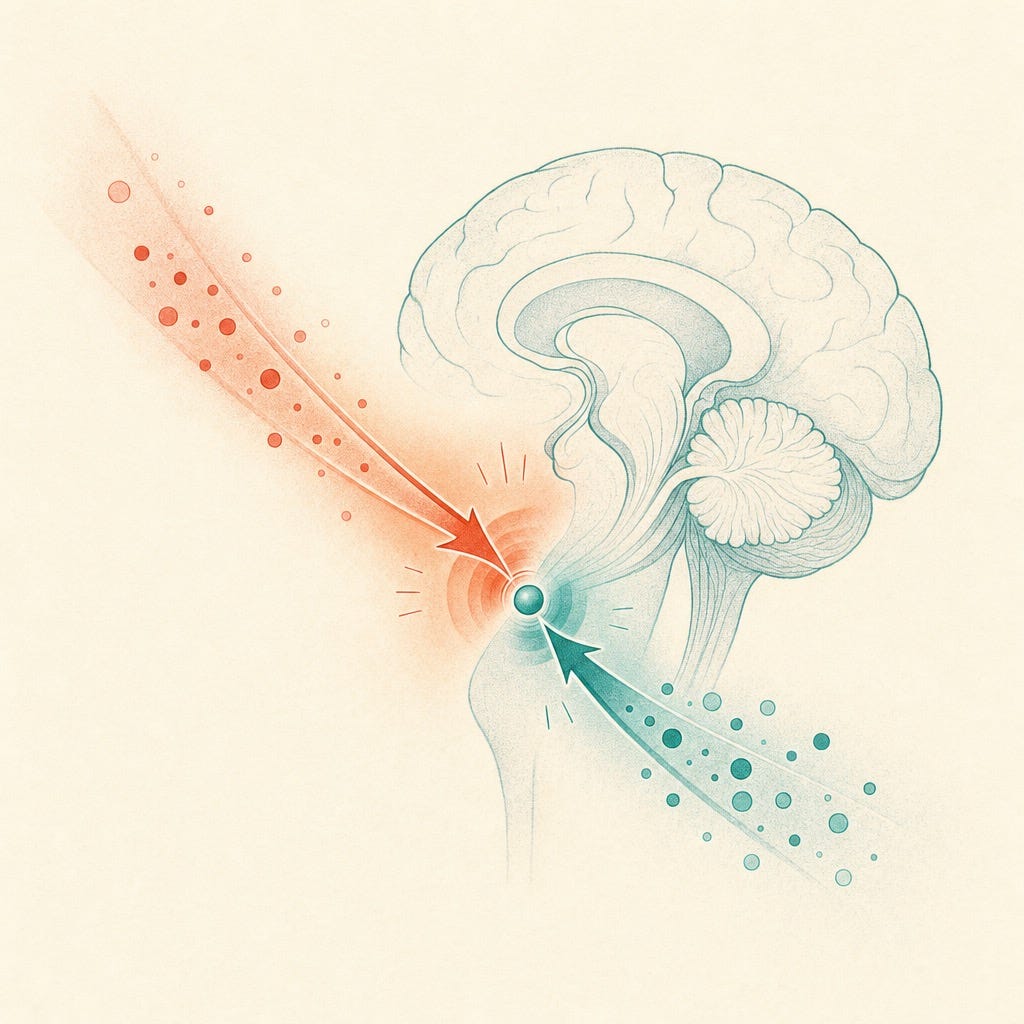
So both things are true at once. GIP signaling, broadly, turns the nausea center down. A specific version of the GIP receptor turns the vomiting up, and only on the drug that reaches it. The resolution is not that the study is wrong. It is that “the GIP receptor” is not one fixed object; it comes in slightly different versions, and p.Glu354Gln is one of them. The association and the drug-specificity are solid. How this one swap flips a broadly anti-nausea receptor is not something the paper resolves, and not something the field has resolved either. Which is where the whole obesity-drug industry is currently stuck.
Look at what the two leading companies are actually building.
Tirzepatide activates the GIP receptor. Amgen’s competitor, maridebart cafraglutide, brand-named MariTide, blocks it, combining GLP-1 receptor agonism with GIP receptor antagonism(New England Journal of Medicine, phase 2, 2025). And it works: mean weight loss of 12.3 to 16.2 percent across doses at 52 weeks, against 2.5 percent on placebo (intention-to-treat; the “up to 20 percent” figure in press coverage is a completer analysis, a more flattering way of counting).
Switch the receptor on, or switch it off. Either way people lose double-digit weight. The one thing nobody can tell you yet is why.
This is not a framing invented for an article. A 2025 review in Diabetes by Mette Rosenkilde and colleagues, which includes an Amgen scientist among its authors, states that the benefit is “seen with both GIP receptor antagonism and GIP receptor agonism, although the mechanisms underlying this apparent paradox remain unknown.” Unknown is a strong word for a scientist to sign.
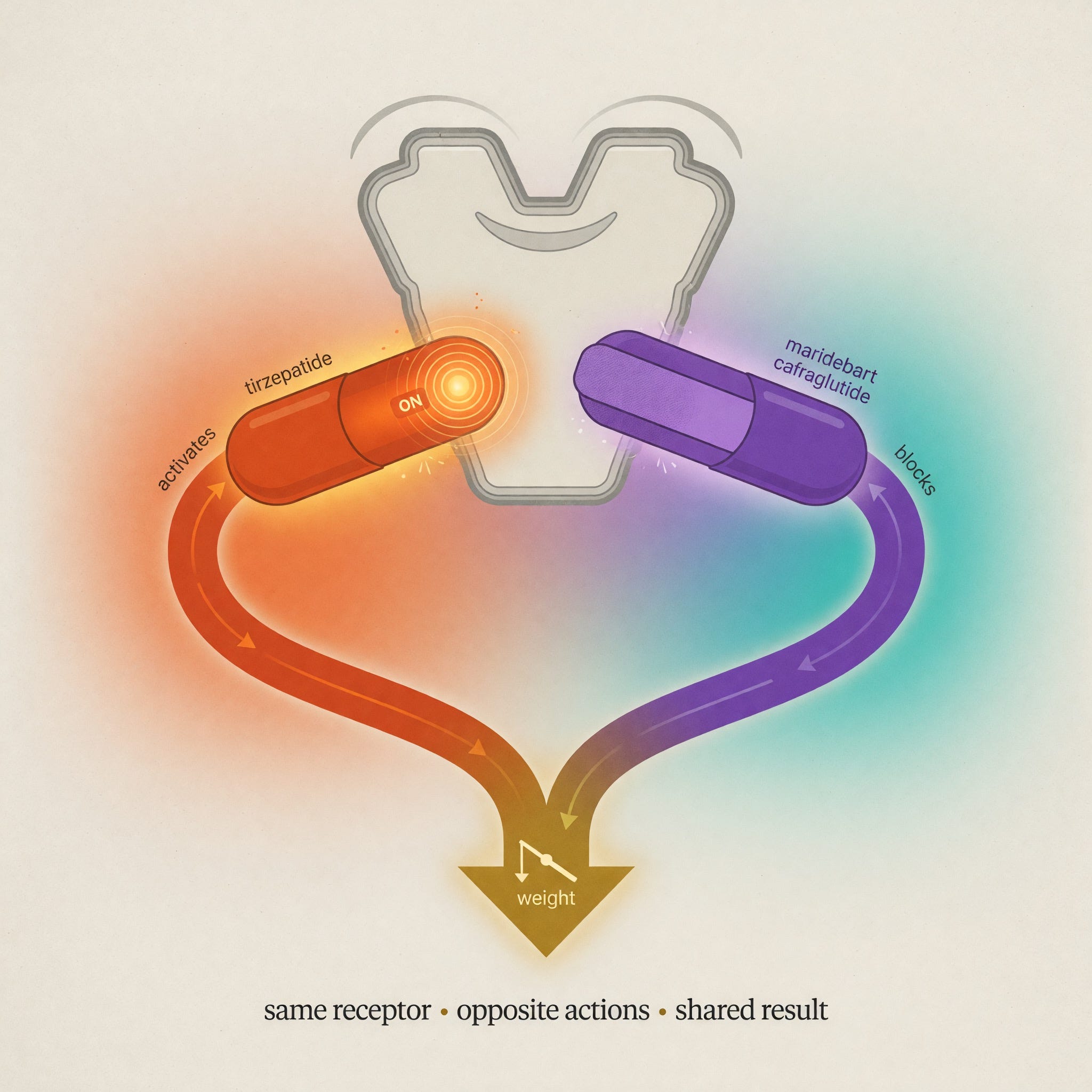
There is at least a shape to the mystery. GIPR is not confined to one place; it sits in the pancreas, in fat, in bone, and in the brain. In the pancreas it helps push out insulin after a meal; in fat it shapes how energy gets stored; in bone it slows breakdown. A drug that turns the receptor up everywhere and a drug that turns it down are not necessarily even fighting over the same tissue, so both can arrive at weight loss by different routes. And the leading reconciling idea, a hypothesis, not a settled answer, is that hitting the receptor hard and constantly eventually wears it down: chronic strong agonism desensitizes GIPR until a full-time agonist starts behaving like a blocker. The case for blocking, meanwhile, rests partly on human genetics, since people who inherit lower-functioning versions of GIPR tend to carry slightly less body weight. If that is right, “on” and “off” may be closer than they look. It is worth knowing that the vomiting variant itself points the same way. Long before the 2026 study, laboratory work in 2010 and 2014 showed that this exact change, E354Q, blunts the GIP receptor’s signaling and makes it desensitize faster. The same variant had already surfaced in earlier genome-wide studies of body weight, and in work on how the body handles glucose after a meal, so it arrived at the 2026 paper with a track record rather than as a stranger. That prior evidence is part of why the authors could name it the likely cause rather than a lucky neighbor, and it hints that the vomiting variant may be tangled in the same receptor behavior the whole field is trying to explain.
The nonprofit that published this study bought the DNA it studied out of its own bankruptcy, ten months earlier.
For most of its life 23andMe was a for-profit consumer genetics company, the spit-in-a-tube ancestry kit. Its research engine runs on scale: more than 11 million customers consented to let their genetic data be used for research, which is what makes a 27,885-person drug-response study possible in the first place. In 2025 that whole enterprise nearly vanished. 23andMe filed for Chapter 11 bankruptcy, its assets, including the database of millions of people’s DNA, went to auction, and the winning bid of 305 million dollars came from a newly formed nonprofit, the TTAM Research Institute, tied to co-founder and former chief executive Anne Wojcicki, who had stepped down as the company filed. TTAM now operates under the name 23andMe Research Institute. Regulators watched closely; reporting at the time described the Federal Trade Commission and multiple state attorneys general pressing that any buyer honor the company’s prior privacy promises.
None of that makes the science wrong. The paper is in Nature and the numbers hold up. But the result of the study is a report, “GLP-1 Medications: Weight Loss and Nausea,” sold to consumers through 23andMe’s Total Health service for 499 dollars up front and 199 a year. The company that discovered the variant is also the company that will, for a fee, tell you whether you carry it. Not a scandal, and arguably a nonprofit is a better home for 11 million people’s DNA than a company answering to a share price. Just a conflict of interest to hold in view, the way you would with any test sold by the people who ran the study behind it.
The following is educational context to bring to your prescriber, not a protocol to follow on your own. Any change between tirzepatide and semaglutide is a medical decision that belongs to you and a clinician who can weigh efficacy, side effects, cost, and your full history.
What to bring to your prescriber (questions, not a plan):
Do I carry the GIPR risk variant, and if so, does that change what you would recommend?
Does my vomiting look like the ordinary dose-and-titration kind that a slower climb or a longer hold at a lower dose could fix, or something more?
Would an anti-nausea medication get me through the escalation window without changing drugs?
If we consider semaglutide, how much weight-loss potency do I trade for my specific goal, and is restarting a dose ladder from the bottom worth it?
How do cost, insurance coverage, and supply compare for the two drugs in my case?
Go back to the friend on Ozempic who never once got sick. If you carry the GIPR risk version and you are vomiting on tirzepatide, you have a mechanistic reason, not just a hunch, to put semaglutide on the table: it targets the same appetite pathway through GLP-1 and never engages the receptor your genotype reacts to, so that specific trigger cannot fire. The trade is potency. In the head-to-head, semaglutide lost 13.7 percent to tirzepatide’s 20.2, so you would likely be swapping some weight loss for a calmer stomach.
Switching is not the only lever, either. Holding a lower tirzepatide dose for longer, or a short course of a standard anti-nausea medication through the escalation window, resolves the ordinary titration-driven sickness for a lot of people without giving up the stronger drug. The genetics do not override any of that. They add one variable to the weighing: the odds that your particular reaction is the kind a different receptor, rather than a slower climb, is what would fix.
Start with the biggest hole. This is one association study, built on what people typed into a survey, not on a clinician watching them get sick. The causal variant is a strong candidate, flagged by tight linkage and a real amino-acid change and decades of prior lab work, but “strong candidate” is not “proven mechanism,” and the mechanism actively resists the simple story, because GIP broadly calms nausea rather than causing it. An odds ratio is a population statement: many carriers tolerate Mounjaro fine, many non-carriers still feel sick, and most people who feel sick do not carry the variant at all. It is one letter, in one receptor, explaining one slice of one side effect.
For years the answer to this complaint was a shrug: ride it out, or quit. Now it has a receptor, a variant, a drug it rides on, and even a coming competitor built on the opposite bet. That is not a cure, and it is not a verdict. It is the first version of this question that a doctor can actually do something with. The person hunched over the sink did not have that yesterday.
One common GIPR variant (rs1800437) raises the odds of vomiting by about 83 percent on tirzepatide, and shows no measurable effect on semaglutide.
The reason is architecture, not willpower: tirzepatide engages the GIP receptor, semaglutide never does.
Counterintuitively, GIP signaling broadly calms nausea; why this variant tips the other way is unresolved.
It is common, roughly 1 in 5 gene copies worldwide, so more than a third of people carry at least one copy.
It is a sharper question to bring to a clinician, not a reason to switch drugs on your own.
Curious whether your genetics shape how you respond to GLP-1 drugs and other peptides? TPL Genetics is building a peptide response saliva genomics test designed to read and interpret the variants consumer ancestry kits leave buried in raw data and never report as a drug-response result, as insight to bring to your clinician, not a prescription. Our read is independent: we interpret published science for you, rather than selling you our own study’s result. Join the genetics waitlist for early access.
This article is for educational and informational purposes only. It does not constitute medical advice, diagnosis, or treatment. Genetic associations describe groups, not individuals, and a risk variant neither guarantees nor rules out any side effect for a given person. Do not start, stop, or switch any medication, including tirzepatide or semaglutide, based on this article. Decisions about GLP-1 therapy should be made with a licensed clinician who knows your full history. Any genetic testing should be interpreted by a qualified healthcare professional.
Part of the answer is how the two drugs are built. Mounjaro (tirzepatide) activates both the GLP-1 and the GIP receptors. Ozempic (semaglutide) activates only the GLP-1 receptor. The 23andMe study in Nature found that a common variant in the GIP receptor gene, GIPR, raises the odds of vomiting by about 83 percent, but only in people on tirzepatide. Because semaglutide never engages the GIP receptor, that particular genetic trigger cannot fire on Ozempic. Dose and titration speed still matter for everyone, but they do not explain why two people on the same drug and dose react so differently.
GIPR is the gene for the GIP receptor, one of the two “incretin” receptors that GLP-1-class drugs act on. The relevant variant, rs1800437, changes the 354th amino acid of the receptor from glutamic acid to glutamine (written p.Glu354Gln). The glutamine (C) version is the risk version for vomiting on tirzepatide, with an odds ratio of 1.83; the glutamic acid (G) version is protective. It is common, present in roughly one in five gene copies worldwide, so more than a third of people carry at least one copy.
No. An odds ratio of 1.83 means the odds of vomiting are about 83 percent higher per copy of the risk variant. Odds and everyday probability only line up when an event is rare, and vomiting on tirzepatide is common. In plain terms: if the baseline vomiting rate is about 1 in 10, one risk copy moves it to roughly 1 in 6 and two copies to roughly 1 in 4. Real and meaningful, and smaller than “83 percent more likely” sounds.
That is a decision for your prescriber. What the study adds is a reason to have the conversation: if you carry the GIPR risk variant and vomit on tirzepatide, semaglutide targets the same appetite pathway without engaging the receptor your genotype reacts to. The trade is that semaglutide is somewhat less potent on average (about 13.7 percent versus 20.2 percent weight loss in the head-to-head SURMOUNT-5 trial). And no trial has yet proven that switching stops vomiting in a specific person.
The opposite is closer to the truth, which is what makes this interesting. In preclinical studies, GIP receptor agonism reduces nausea and vomiting rather than causing it, and in the head-to-head trial tirzepatide actually had less vomiting than semaglutide (15.0 versus 21.3 percent). The GIPR variant is robustly associated with more vomiting in tirzepatide users, but why one amino-acid change tips a broadly anti-nausea receptor toward vomiting is unresolved. The association is solid; the molecular mechanism is not.
For some people, genetics is a real part of it. If you carry the GIPR risk version, your biology is tilting you toward the side effect on tirzepatide in a way that “going slower” cannot fully remove. But genetics is one input among several. Dose, how fast you titrated, what and when you eat, and other medications all still contribute, and most people who feel sick do not carry the variant. The variant helps explain the split between people; it is not the whole story for anyone.
The variant sits at rs1800437 in the GIPR gene, and it is included in 23andMe’s paid “GLP-1 Medications: Weight Loss and Nausea” report through its Total Health service. Some people can also locate the position in raw data from a consumer DNA kit, though standard ancestry kits do not present it as a drug-response result and interpreting it correctly takes care. Whatever the source, a result is a discussion point for a clinician, not a directive to change drugs.
Because nobody is sure which is right, and both work. Tirzepatide activates the GIP receptor and produces about 20 percent weight loss. Amgen’s maridebart cafraglutide (MariTide) blocks it and produced roughly 12 to 16 percent in its phase 2 trial. A 2025 review in Diabetes states plainly that weight loss is seen “with both GIP receptor antagonism and GIP receptor agonism” and that “the mechanisms underlying this apparent paradox remain unknown.” The GIP receptor is one of the most important and least understood targets in obesity medicine right now.
1. Su, Q.J., Ashenhurst, J.R., et al. “Genetic predictors of GLP1 receptor agonist weight loss and side effects.” Nature, 653:770-775, 2026. Published online 8 April 2026. nature.com/articles/s41586-026-10330-z (DOI: 10.1038/s41586-026-10330-z; PMID 41951734).
2. 23andMe Research Institute. “New 23andMe Research Institute Study Identifies Genetic Predictors for GLP-1 Weight Loss Efficacy and Side Effects.” Press release, 8 April 2026. 23andMe Media Center.
3. Aronne, L.J., Horn, D.B., le Roux, C.W., et al. “Tirzepatide as Compared with Semaglutide for the Treatment of Obesity” (SURMOUNT-5). New England Journal of Medicine, 393(1):26-36, 2025. DOI: 10.1056/NEJMoa2416394.
4. Jastreboff, A.M., et al. “Tirzepatide Once Weekly for the Treatment of Obesity” (SURMOUNT-1). New England Journal of Medicine, 387:205-216, 2022. DOI: 10.1056/NEJMoa2206038.
5. Borner, T., et al. “GIP Receptor Agonism Attenuates GLP-1 Receptor Agonist-Induced Nausea and Emesis in Preclinical Models.” Diabetes, 70(11):2545-2553, 2021. DOI: 10.2337/db21-0459.
6. Samms, R.J., et al. “GIPR Agonism Inhibits PYY-Induced Nausea-Like Behavior.” Diabetes, 71(7):1410-1423, 2022. DOI: 10.2337/db21-0848.
7. Jastreboff, A.M., et al. “Once-Monthly Maridebart Cafraglutide for the Treatment of Obesity: A Phase 2 Trial.” New England Journal of Medicine, 2025. DOI: 10.1056/NEJMoa2504214.
8. Rosenkilde, M.M., George, J.T., Véniant, M.M., Holst, J.J. “GIP Receptor Antagonists in the Pharmacotherapy of Obesity.” Diabetes, 74(8):1334-1338, 2025. DOI: 10.2337/dbi24-0027.
9. Campbell, J.E. “Targeting the GIPR for obesity: To agonize or antagonize? Potential mechanisms.” Molecular Metabolism, 46:101139, 2021. DOI: 10.1016/j.molmet.2020.101139.
10. Mohammad, S., et al. “A naturally occurring GIP receptor variant (E354Q) undergoes enhanced agonist-induced desensitization.” Molecular and Cellular Biology, 34(19):3618-3629, 2014. DOI: 10.1128/MCB.00256-14.
11. U.S. Food and Drug Administration. Zepbound (tirzepatide) and Wegovy (semaglutide) Prescribing Information. Zepbound label; Wegovy label.
12. 23andMe Holding Co. Form 8-K (Chapter 11 filing and TTAM asset sale), U.S. Securities and Exchange Commission, 2025. SEC EDGAR.
No posts
Comments
Nothing yet. Say the first thing.
Sign in to join the conversation.