
JULY 2, 2026

The Pharmacy Compounding Advisory Committee room, before the July 23 vote.
Seven times, in seven documents, the Food and Drug Administration’s own career scientists wrote the same word about seven of the most popular peptides in America: no. No on BPC-157. No on TB-500. No on KPV, Semax, Epitalon, Emideltide, MOTS-c. Each was nominated for a legal path into a compounding pharmacy. Each, in the agency’s own judgment, is unsupported by the evidence. On one of them, the reviewers reached for a phrase you almost never see in a federal safety review: the risk of a reaction that could be, in their words, “life-threatening and catastrophic.”
The agency posted those seven documents on June 29, quietly, with no press release, three and a half weeks before the committee that actually votes sits down at its table.
Here is what makes it a story instead of a memo. The people who get to overrule that no are, in large part, people who sell peptides for a living.
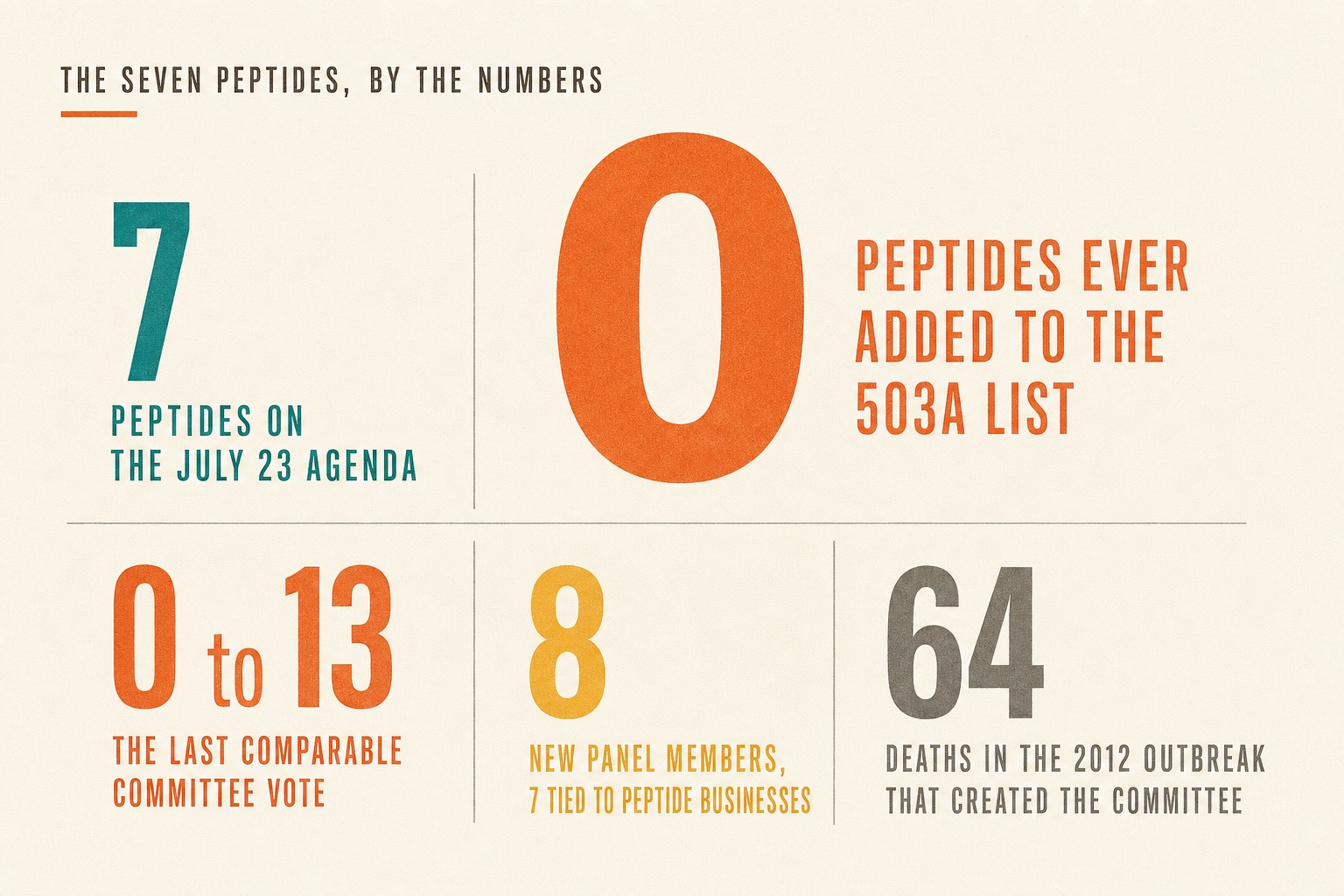
That is not an accusation. It is a roster. The advisory committee that meets on July 23 and 24 was quietly rebuilt over the spring of 2026 under Health Secretary Robert F. Kennedy Jr.’s Department of Health and Human Services. The panel that used to be chaired by a Duke anesthesiologist and staffed with university pharmacologists, the panel that had voted down every peptide ever put in front of it, now has no chair, no consumer representative, and eight new members drawn almost entirely from longevity clinics, hormone-optimization practices, and compounding pharmacies. Seven of the eight run or work for a business that prescribes, promotes, or dispenses the exact class of drugs they are about to judge.
The FDA’s scientists said no. The panel the FDA appointed to hear them was built to say yes. This is what regulatory capture looks like when it is written down.
We read the seven briefing documents, the roster and the résumés behind it, the court filings, the warning letters, the eleven-year voting record, and the letter a sitting congresswoman sent the Secretary. This piece makes both cases, for yes and for no, as strongly as their best advocates make them, because the real story is not that one side is foolish. It is that the two sides want opposite things, the science and the politics point in opposite directions, and the room where it gets settled was rebuilt to tilt toward yes.
Before any of it, two facts to nail to the wall, because almost every headline gets them wrong.
A vote here settles nothing on its own. An FDA advisory committee makes a recommendation. The agency “generally follows” it, in the FDA’s own words, but “is not legally bound to do so.” Even a unanimous yes does not put a single peptide into a single pharmacy the next morning. It starts a rulemaking process that historically takes months to well over a year.
And the seven peptides are illegal to compound today, right now, as you read this. When the FDA pulled them out of its “Category 2” bin in April, that did not make them legal. It only moved them back into the line to be considered. Anyone selling you compounded BPC-157 in July 2026 is operating outside the law, the same as they were in June.
Hold both of those. Now the fight.
Start with the document, because the document is the thing everyone is arguing about and almost no one has read.
The seven peptides on the agenda are BPC-157, nominated for ulcerative colitis; TB-500, for wound healing; KPV, for wound healing and inflammatory conditions; MOTS-c, for obesity and osteoporosis; Emideltide, better known as DSIP, for opioid withdrawal, insomnia, and narcolepsy; Semax, for cerebral ischemia, migraine, and trigeminal neuralgia; and Epitalon, for insomnia. Each is nominated in two chemical forms, a free base and an acetate salt, which is why the FDA keeps describing it as fourteen substances rather than seven.
The FDA evaluates each one against a four-part test written into the law: how well the substance is physically and chemically characterized, what is known about its safety, whether there is evidence it actually works, and how long it has a history of being compounded. On every one of the seven, the agency’s reviewers reached the same verdict, and the language barely changes from document to document. The intro brief states it plainly: “FDA is proposing that BPC-157 (free base) NOT be included on the 503A Bulks List.” The individual reviews close the door: the safety, effectiveness, and characterization data “weigh against” adding the substance.
The spine of the safety argument is immunogenicity, the risk that a foreign protein fragment provokes the immune system. On BPC-157, the reviewers wrote that “as a peptide with 15 amino acids that is administered through a parenteral or nasal ROA, BPC-157 may pose a significant risk for immunogenicity, potentially amplified by aggregation as well as potential peptide-related impurities.” That is the technical way of saying two things at once: the molecule itself might trigger an immune reaction, and the way it gets made in a compounding lab, with impurities and clumping, might make that reaction worse.
On the danger side of that reaction, the MOTS-c document contains the sentence that should be the headline: the consequences “may range from antibody responses with no apparent clinical manifestations to life-threatening and catastrophic reactions. Such outcomes are often unpredictable.” Not “side effects.” Life-threatening and catastrophic, and unpredictable.
It is worth being concrete about what “catastrophic” means, because the phrasing is easy to skim past. The near-term fear is anaphylaxis, a sudden systemic allergic reaction. The subtler and arguably worse fear is specific to peptides that imitate molecules the body already makes: an immune response trained against injected MOTS-c, a peptide your own mitochondria produce, or against TB-500, which mimics the natural protein thymosin beta-4, could in principle cross-react with your own version of it. Medicine has watched this exact failure happen, when a manufacturing change to the anemia drug epoetin provoked antibodies that shut down patients’ own red-blood-cell production. That precedent involved a larger protein, so it is an illustration rather than a match, but the mechanism is the one the FDA is worried about. Injection makes it worse two ways: it bypasses the oral tolerance the gut uses to wave through harmless proteins, and the aggregation the reviewers flagged presents the immune system with repeating patterns that are unusually good at breaking that tolerance.
The recurring theme underneath the immunogenicity worry is emptiness. On TB-500: “There is a lack of clinical and nonclinical safety information... FDA is particularly concerned about the absence of human data on drug products containing these substances administered via any route of administration.” On KPV: “insufficient data to conclude that KPV (free base) or KPV acetate do not present these risks. FDA is particularly concerned about the lack of any human data.” The reviewers are not saying these peptides have been proven dangerous. They are saying that after years of Americans injecting them, there is still almost no human safety data to look at, and you cannot approve what you cannot see.
Then there is the detail that turns the whole meeting slightly surreal. Every one of these seven peptides was nominated for the compounding list back in 2015, and every one of those nominations was later withdrawn by the people who filed them. The FDA is holding a formal scientific hearing on nominations that no longer exist. A footnote in the intro brief says it out loud: “This nomination was withdrawn by the nominator... However, FDA is electing to proceed with the presentation of BPC-157-related bulk drug substances... to the PCAC.” The agency is choosing to force the vote. Nobody with a product to sell is even asking for it on the record.
It helps to know what these seven actually are, because the names are marketing and the histories are older and stranger than the wellness internet lets on. BPC-157 is a fifteen-amino-acid peptide a Croatian group derived from a protein found in gastric juice and has studied for three decades, almost entirely in rats. TB-500 is a seven-amino-acid piece of a real protein, thymosin beta-4, sold under the name of the full protein it is not. Semax is a genuinely Russian invention, an engineered analog of a fragment of the stress hormone ACTH, developed in the Soviet Union and later approved in Russia for stroke and cognitive disorders while the United States never touched it. DSIP, despite its reputation as a Russian sleep peptide, was actually discovered in Switzerland in 1977, isolated from the blood of sleeping rabbits, and only later studied heavily in the USSR, which is where most of its human literature still sits, largely unreplicated in the West. Epitalon is the signature molecule of a Russian anti-aging theory, pitched to the FDA here not for longevity but for insomnia. MOTS-c is the genuinely strange one: a peptide encoded inside your own mitochondrial DNA, a gene hidden within a gene, that tunes metabolism through the AMPK pathway, discovered at USC in 2015 and nominated for obesity on the strength of mouse studies. KPV is a three-amino-acid tail of a hormone, the least famous of the group and, by the FDA’s account, the one with the thinnest human record of all. What they share is the shape of the evidence: intriguing biology, devoted users, and almost no controlled human trials. That is the gap the reviewers kept pointing at, one peptide at a time.
That is the “no” the panel is being asked to overrule. Now look at the panel.
Seven documents, one conclusion: the evidence weighs against all of them.

The Pharmacy Compounding Advisory Committee is not a household name, and it is not supposed to be. It exists because of a mass-casualty event.
In the fall of 2012, a compounding pharmacy in Framingham, Massachusetts, the New England Compounding Center, shipped contaminated steroid injections across the country. The result was one of the worst pharmaceutical disasters in modern American history: a national fungal meningitis outbreak that, by the CDC’s final count, sickened 753 people and killed 64. Congress responded in 2013 with the Drug Quality and Security Act, which created a new category of large-scale compounder and directed the FDA to build a careful list of which bulk ingredients pharmacies are allowed to compound with. The law also required the agency to convene an advisory committee and consult it before adding anything to that list. That committee is the PCAC. Its entire reason for existing is to be the expert brake between “a molecule is popular” and “a pharmacy may inject it into you.”
For years, it worked like a brake. The prior committee was chaired by Padma Gulur, an anesthesiologist and professor at Duke, and its voting members were university people: pharmacologists and physicians from Duke, Harvard, Johns Hopkins, the University of Connecticut, UT Southwestern. When peptides came before that panel, the panel said no, and it said no nearly every time.
The record is not close. In its 2019 final rule, after all the reviews and votes, the FDA placed a grand total of six substances on the compounding list. None was a peptide. In October 2024, the committee voted against L-theanine, ibutamoren, ipamorelin, and kisspeptin-10. In December 2024, it went further. On CJC-1295, a popular growth-hormone peptide, the certified transcriptrecords the designated federal officer reading the result into the record: “For the record, there are 0 yeses, 13 noes, and 0 abstentions.” Zero to thirteen. The panel then rejected AOD-9604 by eleven to one and turned down thymosin alpha-1 as well. In the entire history of this process, the number of peptides that have ever made it onto the final 503A compounding list is zero.
That is the base rate. History says the answer is no, and history is not ambiguous about it.
So the answer, if you want a different result, is not to change the science. It is to change the room.
Over the spring of 2026, the committee was reconstituted. The chair seat went empty and stayed empty. The consumer representative seat went empty and stayed empty. Eight new members were appointed as “special government employees,” each to a four-year term running to 2030. And the character of the panel flipped. Where the old committee was academics who studied drugs, the new one is, overwhelmingly, entrepreneurs who sell them. Reuters, counting the seats one way, reported that “seven of the committee’s 14 members have ties to businesses or clinics involved in peptide therapies.” The Associated Press, which broke the story with STAT on June 29, put it more bluntly: the new group “includes more than a half-dozen panelists who run clinics, online businesses or pharmacies specializing in peptides, which are often given alongside other unapproved therapies, including vitamin infusions.”
The old panel was built to weigh evidence. The new panel was built to represent an industry. Those are different jobs, and only one of them is what an FDA advisory committee is for.
One name at a time, because the financial interests here all lean the same direction, and that direction is the vote. The eight new appointees, at a glance:
Gabriel Alizaidy runs a wellness clinic that sells peptides and charges $500 for peptide consults.
Haleem Mohammed is chief medical officer of a men’s-health chain that sells peptide and testosterone injections.
Bobby Harshbarger is a state senator and a pharmacist at his family’s compounding pharmacy.
Asare Christian founded a clinic that markets “Peptide Therapy.”
Melissa Loseke founded a regenerative and longevity clinic.
Joshua Starbuck runs a concierge practice and holds a peptide-therapy certification.
Kris Wusterhausen founded a hormone-optimization and longevity clinic.
David Pope builds pharmacy billing software and sells no peptides at all.
Seven of the eight run or work for a business with a stake in a wider peptide market. One does not. Now the detail.
The reconstituted panel: an empty chair at the head, industry in most of the seats.

Dr. Gabriel Alizaidy is the scientific director of Maximus, an online wellness clinic that sells testosterone, peptides, and obesity drugs. According to the Associated Press, he “charges $500 for ‘peptide and hormone’ consultations, including advice on ‘where to safely get each peptide or compound,’” and “promotes BPC-157, GHK-Cu and other peptides to thousands of followers through his accounts on Instagram and TikTok.” The FDA issued his company a warning letter in June 2026 over its marketing of compounded GLP-1 drugs. He will now help vote on BPC-157. The AP reported he did not respond to its requests for comment.
Dr. Haleem Mohammed is the global chief medical officer of Gameday Men’s Health, a national chain whose clinics sell injections of testosterone, vitamins, and peptides. Gameday’s own website carries the disclaimer, quoted by the AP, that “compounded medications offered through our services are not FDA-approved, and the FDA does not verify their safety.” He too will help decide whether the FDA should verify their safety. He also did not respond to the AP.
Robert Harshbarger III, who goes by Bobby, is a Tennessee state senator and a pharmacist at his family business, Premiere Pharmacy, which compounds weight-loss, longevity, and pain medications. Here the reporting requires care, because there are three Harshbargers and only one of them is on the committee. The committee member is Bobby, the senator. His mother is U.S. Representative Diana Harshbarger, a Republican from Tennessee and herself a pharmacist, who on November 10, 2025, sent a letter to Secretary Kennedy urging the FDA to relax its peptide rules, writing that current policy “has driven patients to seek unregulated gray-market sources, exposing them to preventable risks.” His father is Robert Harshbarger Jr., who years ago pleaded guilty to substituting an unapproved drug from overseas for kidney-dialysis patients, lost his license, served time, and was later pardoned by President Trump. Three people, one family, one committee seat. Only the senator sits on the panel, and it is his family pharmacy and his mother’s advocacy that make his position notable, not his father’s record.
The pattern continues down the roster. Dr. Asare Christian founded Aether Medicine, a Pennsylvania clinic that markets “Peptide Therapy” alongside hormone optimization and regenerative medicine. Dr. Melissa Loseke founded the Re-New Institute, a regenerative and longevity clinic in Omaha, where she is president and chief medical officer. Dr. Joshua Starbuckfounded a concierge functional-medicine practice in Hawaii, and his own bio lists a “certification in Peptide Therapy” from a private performance institute. Dr. Kris Wusterhausen founded a hormone-optimization and longevity clinic in Texas and is a listed provider for a commercial hormone-pellet company. Seven of the eight new appointees, by our count and the AP’s, run or work for a business with a direct financial stake in a wider peptide market.
The eighth is the exception that proves the shape of the thing. David Pope is a pharmacist and a technology executive at a pharmacy billing-software company. He has no peptide clinic, no longevity practice, no product line. He builds pharmacy billing software. No clinic, no peptide line, no patients waiting on a yes. On a panel this size, he is a control group of one.
And then there is the member who may not be a member at all. A physician named Gerald Morris, who runs a regenerative-medicine and peptide clinic in Tucson, appeared on the committee roster as transcribed by trade outlets on July 1. But he is absent from the FDA’s own roster as updated on June 29, and the résumé document that would sit at his place in the sequence returns a broken link where every other member’s résumé loads. STAT, counting on June 29, found exactly eight new panelists, a total that matches the roster without him. It looks like a member was quietly removed somewhere in the last days of June, after the conflict-of-interest story broke. We cannot confirm why, and we are not going to pretend we can. But a committee that loses a member off the public roster in the same week its composition becomes a scandal is worth a sentence, and a raised eyebrow.
Members like these can serve. The law allows experts with financial interests to sit on FDA panels as special government employees, provided they file confidential disclosures, and provided the agency, where a conflict is significant, grants a waiver and explains on the record why the person’s expertise is worth the conflict. As of the June 29 roster, no such waiver documents were posted with the July meeting materials. We will find out at the meeting itself, when the conflict-of-interest statement is read aloud, how the FDA squares this room with its own rules.
Now the part that separates journalism from a hit piece. There is a real argument for reclassifying these peptides, and the people making it are not fools. If you only hear the capture story, you are being told half of it.
The strongest version starts with the Secretary himself. Robert F. Kennedy Jr. has been open, loud, and specific. On Joe Rogan’s show, he called himself “a big fan of peptides,” said he had “used them myself and with really good effect on a couple of injuries,” and made a legal argument that is more careful than his critics admit. The 2023 ban, he told Rogan, “was illegal because they’re not supposed to do that unless there’s a safety signal. And they didn’t have a safety signal. They’re not allowed to look at efficacy.” His point is procedural: the FDA is supposed to keep a compounding ingredient off the shelf because of a demonstrated safety problem, not because the agency is unimpressed by the efficacy data. If there was no specific safety signal in 2023, he argues, the ban skipped a step. There is a wrinkle he skips, though. That safety-signal argument is about the 2023 action that dropped the peptides into Category 2. The question in front of the committee now, whether to add them to the 503A bulks list, runs the four-part statutory test the FDA laid out, and that test expressly includes evidence of effectiveness. The efficacy question he says regulators are not allowed to ask is precisely the one the law puts on the table at this stage.
Kennedy also makes the harm-reduction case, and it is the strongest card the yes side holds. “With the gray market you have no idea if you’re getting a good product,” he said. “And a lot of this stuff that we’ve looked at is just very, very substandard.” He is right about that, and the data backs him up. A 2024 study in the Journal of Medical Internet Research bought illicit semaglutide off the market and measured its purity at between 7.7% and 14.37% against a claimed 99%, with bacterial endotoxin detected in every sample. A June 2026 analysis found that nearly 40% of peptide shipments in the first quarter came from illegitimate manufacturers. Chinese peptide and hormone imports doubled to $328 million in the first nine months of 2025. Two women were hospitalized in critical condition after peptide injections at a Las Vegas longevity conference. When millions of Americans are already buying these compounds from Telegram channels and “not for human consumption” websites, the argument that a licensed pharmacy would at least be cleaner is not crazy. It is the single best reason to want a legal lane.
The clinicians who use peptides make an expertise argument, too. Dr. Edwin Lee, an Orlando endocrinologist and peptide advocate, frames it as frontier medicine: “I’m really impressed with the regenerative properties of peptides. Someone had to be the first open-heart. Someone had to be the first transplant. This is kind of like the first part of medicine. We are kind of in that Wild, Wild West.” And there is a genuine point buried in the conflict-of-interest problem. The doctors who actually prescribe these compounds are, by definition, the ones who have watched patients take them. A committee of pharmacologists who have never once handled BPC-157 would carry its own blind spot. Representative Diana Harshbarger made the patient-access version of the case in her letter to Kennedy: FDA policy “significantly restricts compounding of these peptides, even where no FDA approved alternative exists, leaving patients without safe, regulated access.”
Even the compounding industry’s own trade group, which you might expect to want a clean yes, is asking for something more careful. Scott Brunner, the CEO of the Alliance for Pharmacy Compounding, has urged the FDA “to look at this not as an up or down vote, but to consider a middle path that does address a very real public health concern.” That is the responsible version of yes: not “let everyone compound everything,” but “build a regulated, guardrailed lane, with pharmaceutical-grade ingredients and real quality standards, so the demand that already exists stops being served by the gray market.”
Take all of that seriously. Real patients rely on these compounds. The gray market really is dangerous. A ban that pushes people toward Telegram is not obviously safer than a regulated pharmacy. That is the case for yes, and it deserves to be met on its merits, not waved away.
The case for no is the FDA’s own staff, and it is not built on snobbery. It is built on absence.
The reviewers did not write that these peptides are proven poisons. They wrote that after years of use, there is still almost no human data, and that the theoretical risk, immune reactions to injected foreign peptides made in impurity-prone conditions, is exactly the kind of risk you cannot rule out without the data that does not exist. On the science, that is a hard argument to beat, because you cannot answer “we don’t know if it’s safe” with a testimonial.
The outside experts who study these molecules land in the same place, and they are blunt. Eric Topol, the Scripps cardiologist, called the whole move “a disaster in the works. These peptides have no data to support their safety and efficacy.” Robert Steinbrook of Public Citizen made the logical point that no amount of enthusiasm can dodge: “There is no credible reason to believe that peptides that were deemed unproven or unsafe in 2023 are miraculously safe and effective in 2026... If there were convincing safety and effectiveness data, the findings would already be widely known.” Alexander Weber, a sports-medicine chief at USC who reviewed the peptide evidence, described the reality from the exam room: “Not a day goes by where I don’t have a number of patients asking me about peptides. My stock answer is that we just don’t have enough data to support their use.”
The most serious version of the no is not even about any single peptide. It is about what the process is for. Janet Woodcock, who ran the FDA’s drug center for decades, warned that creating an easier lane to market for unproven compounds “would be a disruption of the societal pact we have had since 1962 that drugs will be studied to see if they work before they are marketed in the U.S.” The 1962 reference is deliberate. That is the year, after thalidomide, that Congress required drugs to be proven effective, not just safe, before sale. Woodcock’s point is that the compounding pathway was never meant to be a side door around that requirement, and that turning it into one does not just affect seven peptides. It affects what “FDA-approved” is worth.
And underneath all of it sits the base rate. No peptide has ever cleared this process. The last panel looked at these same kinds of molecules and voted them down zero to thirteen. The science has not changed since December 2024. The only thing that has changed is the room.
Peter Lurie, a former FDA official who now runs the Center for Science in the Public Interest, said the quiet part directly: “Everybody knows the outcome that the secretary wants. I don’t believe for one moment that what’s going on here is an honest investigation of whether these products should be compounded.” He also named the incentive the whole system creates: “The Wild West is about to become wilder. I don’t see why one would take the path of a proper drug approval if there is now this less rigorous, alternative path to market.” That is the deepest version of the no. Not that these seven peptides are uniquely dangerous, but that the road being built for them is a road around the entire idea of proving a drug works before you sell it.
To be fair to the other side one more time, the government has an answer to the capture charge. An HHS spokesperson told the Epoch Times that “all committee members underwent the same ethics review and vetting process required of all FDA advisory committee members. Candidates that could not meet existing ethics requirements were removed from consideration.” That is the official position: the process was normal, the conflicts were vetted, nothing to see. Whether you believe it depends on whether you think a panel that is seven-eighths peptide sellers can vet its way to neutrality. But it belongs in the record, because the charge here is structural, not criminal.
The physician Owais Durrani drew the line as cleanly as anyone: “When a majority of new appointees have direct financial or clinical ties to peptide-selling businesses, that’s a structural conflict-of-interest problem, not a personal one. These aren’t accusations of bad faith. It’s the well-established reason FDA advisory panels are supposed to skew toward independent experts.”
Both cases, the yes and the no, keep circling the same fact, so it is worth looking at directly. While the FDA debates whether these peptides should be legal to compound, Americans are buying them by the millions from a market that answers to no one.
The market that exists today: an unlabeled vial and an envelope from overseas.

The scale is not small. Chinese exports of peptides and hormones to the United States doubled to $328 million in the first nine months of 2025, up from $164 million the year before. Direct-to-consumer pricing shows how normalized it has become: a vial of BPC-157 runs about $55, TB-500 about $160, sold openly on sites that print “not for human consumption” in gray type at checkout and ship it anyway.
The quality is exactly what you would expect from an unregulated market, which is to say it is a coin flip. The semaglutide study that measured a tenth of the labeled purity, with endotoxin in every sample, is the cleanest illustration, but it is not an outlier. Endotoxin is bacterial debris, a pyrogen, which is why sterile injectables carry strict limits on it: inject enough and it causes fever, a crash in blood pressure, and at the high end septic shock. A June 2026 analysis of 127 peptide shipments found that nearly 40% came from illegitimate manufacturers. Independent testing programs that sample the gray market routinely find products that are underdosed, overdosed, or contaminated. And the harm is not theoretical: two women were hospitalized in critical condition after peptide injections at a longevity conference in Las Vegas.
The government has occasionally made an example of someone. In 2021, a Kentucky compounder called Tailor Made Compounding forfeited $1,788,906.82, its entire 2019 revenue, and its owner was barred from the prescription-distribution business for life, after a guilty plea to distributing unapproved drugs including BPC-157, CJC-1295, DSIP, Epitalon, and Semax. The case is a reminder that compounding these peptides has never been a gray area to the Justice Department, whatever the wellness internet believes. But one forfeiture in a market measured in hundreds of millions of dollars is a speed bump, not a wall.
This is the fact that makes the debate genuinely hard, because it cuts both ways with equal force. The yes side points at this market and says: prohibition produced it, so bring the demand into a licensed pharmacy where at least someone is accountable. The no side points at the same market and says: this is what unproven injectables do when they get a tailwind, so do not put a federal stamp on the category and pour gasoline on it. Both are looking at the same $328 million and the same hospital beds and reaching opposite conclusions. What neither side can honestly claim is that the status quo is working. The 2023 ban did not end the market. It moved it further into the dark, and a yes in July would not clean it up either, because the legal supply chain to replace it does not yet exist.
Every regulatory fight has a company that stands to profit, and readers kept asking us about the biggest one, so we went looking at Empower Pharmacy. The short version, up front: Empower is not a hidden hand behind this vote. It is something more ordinary and more revealing, a company that wins if the door opens and has spent a decade failing the very safety standard it now invokes.
Empower, based in Houston, is one of the largest compounding operations in the country. It is one of a relatively small number of facilities in the United States licensed as both a 503A compounding pharmacy and a 503B outsourcing facility, and it operates at a scale the Houston Chronicle described as “rarely, if ever, seen in the compounding pharmacy industry,” dispensing nearly three million prescriptions in the first ten months of 2024 alone. When a legal pathway for compounded peptides opens or closes, a company like Empower is standing directly in the doorway.
And Empower has been the loudest corporate voice for opening it. In an April 16, 2026 blog post titled “Restoring Balance,” the company welcomed the FDA’s review, writing that the meeting “could reopen the door for licensed compounding pharmacies to prepare them. This is a step forward for patient access and safety... At Empower, this is the framework we operate in every day. As both a licensed 503A compounding pharmacy and 503B outsourcing facility, our processes are built around safety and consistency.”
But here is where the honest version departs from the conspiracy. Empower is not a hidden hand behind this vote. It did not nominate any of the seven peptides; the original nominators, back in 2015, were two other companies, and they withdrew. As of July 2, Empower had filed zero comments on the FDA’s docket for this meeting. Its name appears nowhere in the seven briefing documents. No reporting ties it to any panel member or to the Secretary. And it does not even currently sell the seven peptides under review. Its stake is structural, not product-specific: a yes validates and expands the entire 503A and 503B pathway that its business is built on. Empower wins if the door opens, but it is standing in the crowd cheering, not hiding in the wings pulling levers.
What complicates Empower is not a secret. It is the gap between the words “safety and consistency” and its own record. According to the Houston Chronicle’s review of more than 150 pages of regulatory documents, Empower has received four FDA warning letters and an untitled letter since 2017. An April 2025 warning letter cited “serious deficiencies in (Empower’s) practices for producing drug products intended or expected to be sterile, which put patients at risk.” The California Board of Pharmacy placed its license on probation in 2023 over adulterated injectable products. This is the company positioning itself as the safe, quality-controlled answer to the gray market, and it is worth holding both facts at once: the argument that regulated compounding beats Telegram is a good argument, and the largest company making it has a decade of documented quality problems.
Empower’s real war, in any case, is not over these seven peptides. It is over GLP-1s. The company has become a major compounder of tirzepatide and semaglutide, and Eli Lilly sued it in 2025, alleging in its complaint that Empower was mass-manufacturing untested tirzepatide at commercial scale, reportedly producing 70,000 drugs a week with automated equipment, and, in the complaint’s words, was “essentially conducting a mass testing experiment on consumers.” Empower’s founder and CEO, Shaun Noorian, framed the same business as patient advocacy: “Empower has stepped in to provide quality, affordable formulations for patients underserved by mass-market pharmaceutical companies.” In April 2026, a federal judge in Texas let the core of Lilly’s state-law claims proceed while dismissing others. And in the same window, the FDA moved to close large-scale GLP-1 compounding by proposing to bar semaglutide and tirzepatide from the 503B bulks list. That is the collision that makes the peptide fight urgent for a company like Empower: the compounded-GLP-1 gold rush is being shut off at exactly the moment the peptide question opens. When a lucrative product line closes, the industry needs the next one to open. The seven peptides are not that next line for Empower specifically, but the pathway they would validate is.
Suppose the panel votes yes on all seven, in defiance of the staff and the base rate. What actually happens? Much less than the headlines imply, and the compounding industry itself is the one saying so.
Even a yes is only a recommendation. The FDA would then have to write a proposed rule, take public comment, and issue a final rule, a process that has historically taken months to well over a year. In the nearly three decades this list has existed, only around ten substances have ever completed that rulemaking. A yes in July is the start of a long road, not the end of one.
And at the end of that road, the pharmacies still could not fill the prescriptions, because the raw material does not exist in legal form. Scott Brunner, the compounding trade group’s own CEO, put it plainly: “Even if FDA acted tomorrow, pharmacies would still have to turn away those prescriptions because they couldn’t acquire the compliant API to prepare the drugs.” There is no FDA-registered, pharmaceutical-grade, certificate-of-analysis peptide ingredient available at scale in the United States. The “research use only” powder that the gray market runs on is not legal to compound with. This is why Brunner keeps pushing a “middle path” rather than a clean yes: the honest pro-access position is not “flip the switch,” it is “build the pharmaceutical-grade supply chain first, then open the lane.” A yes without that infrastructure is a permission slip to make a drug nobody can legally source.
Telehealth would stay boxed in too. In the twelve months ending March 2026, the FDA sent more than eighty warning letters to telehealth companies for misleading marketing of compounded GLP-1 drugs. Nobody expects it to treat peptide marketing more gently. And the FDA has said nothing at all about a 503B pathway for peptides, which means even a 503A yes would not open the large-scale outsourcing lane that a company like Empower actually runs on.
So the practical stakes of the vote are strange. In the near term, a yes changes almost nothing and a no changes almost nothing; the gray market is the only real supply today, and it will stay the only real supply for a while either way. What the vote actually decides is the direction of travel, and the precedent. It decides whether the door is officially opening or officially staying shut, and whether an FDA advisory committee can be rebuilt to deliver a predetermined answer.
Which is why the smart-money read is not that the vote matters on its own, but that it is one move in a longer game, and the next moves are already visible.
Paul Knoepfler, a UC Davis stem-cell biologist who has been tracking the committee, laid out the sequence he expects: “I bet that overall PCAC will disagree with the FDA scientists on peptides on more than one occasion moving forward... Then I expect that RFK Jr.’s HHS will side with the PCAC and many unproven peptides will be made available. Compounding pharmacies and telehealth firms will profit.” That is the override scenario. The rebuilt panel gives Kennedy the recommendation the career staff would not, and the Secretary, who has all the authority here, accepts it. As Janet Woodcock noted about the office he holds, “He has all of the authority. The secretary can do anything they want.”
There are faster levers, too. The lawyers at Hyman, Phelps and McNamara, whose analysis has been the sharpest on the legal mechanics, pointed out that the statute may let the Secretary skip the committee entirely. The law says the Secretary “shall convene and consult an advisory committee on compounding unless the Secretary determines that the issuance of such regulations before consultation is necessary to protect the public health.” Read aggressively, that is a stroke-of-the-pen power to place peptides in the permitted category without any vote at all. It is an untested reading, and it usually gets invoked to remove dangerous substances quickly, not add unproven ones. But it exists on the page.
The catch is that every shortcut invites a lawsuit. Skip the committee, and you have handed opponents an Administrative Procedure Act challenge. Overrule your own scientists on thin evidence, and any final rule is exposed to the argument that it was “arbitrary and capricious,” the legal standard for a regulation that ignores its own record. This has already happened in miniature: a group of compounders sued the FDA in Texas over how it handled the peptide categories. The road to legal compounded peptides runs through litigation no matter which door the agency uses.
And it runs through Beijing. Peptides are made overwhelmingly in China, which is the sole source of roughly 41% of the key starting chemicals in American drug ingredients. Yanzhong Huang of Seton Hall named the contradiction at the center of the policy: “MAHA advocates want peptides more accessible and deregulated, which would expand demand, largely met by Chinese suppliers. Congress wants decoupling with Beijing. Opposing forces that are likely to create policy incoherence.” The same administration that wants Americans to have easier access to peptides also wants America less dependent on the country that makes them. Those two goals cannot both win.
Two roads out of the same building: the reviewers’ memo, and the panel’s vote.

Two things are genuinely unsettled, and they are the two worth watching.
The first is the vote itself. Anyone who tells you the outcome with certainty is guessing, including the analysts who expect an override. The base rate says no; the room was rebuilt to tilt toward yes; that tension resolves in a conference room at White Oak, not on this page. Watch the margins, and watch the conflict-of-interest statement read at the start of the meeting, because that is where the FDA has to explain, on the record, why a panel this full of peptide sellers is the right group to judge peptides. One thread to keep an eye on there: a regenerative-medicine physician named Gerald Morris appeared on transcribed rosters, then vanished from the live one with a broken résumé link where his should be, a quiet removal the agency has not explained.
The second is whether anyone builds the middle path. Scott Brunner’s version, real pharmaceutical-grade supply and quality standards before the lane opens, is the only position that takes both the demand and the danger seriously. It is also not on the agenda. The agenda is yes or no on seven substances, and the infrastructure that would make a yes mean anything is not scheduled.
Underneath both is the word the FDA’s own scientists used and the whole fight is trying to paper over: outcomes here are “often unpredictable.” That is the honest word for where the evidence sits. The yes side answers unpredictability with access, the no side with the 1962 pact, and neither can answer it with data, because the data is the thing that does not exist. The demand is real, the danger is real, and the room was rebuilt, all three at once, and the vote will not resolve any of them. It will only tell us whether the FDA’s own scientists can be overruled by the people who profit from overruling them.
The agency has already told us what its reviewers think. Seven times, in seven documents, they wrote no. In three weeks we find out who the FDA actually listens to, its scientists or its appointees, and the answer will say more about how this country regulates medicine than any single peptide ever could.
And there is one question none of the fourteen seats will take up, one that outlasts the vote. Even if the door opens and the supply chain someday catches up, how a given person metabolizes and responds to one of these peptides is not something a committee can settle. That is shaped by that person’s own biology, not by the Federal Register, and it is the kind of individual-response insight we built this company around. It will still be open on July 25, whichever way the hands go up.
The Pharmacy Compounding Advisory Committee is the FDA panel that recommends which bulk ingredients compounding pharmacies are allowed to use. It was created after the 2012 New England Compounding Center meningitis outbreak that killed 64 people. Its recommendations are non-binding, but the FDA “generally follows” them. On July 23 and 24, 2026, it is voting on whether seven peptides should be eligible for legal compounding under Section 503A. See our full breakdown of the July 23 agenda.
BPC-157 (nominated for ulcerative colitis), TB-500 (wound healing), KPV (wound healing and inflammation), MOTS-c (obesity and osteoporosis), Emideltide/DSIP (opioid withdrawal, insomnia, narcolepsy), Semax (cerebral ischemia, migraine, trigeminal neuralgia), and Epitalon (insomnia). Each is reviewed in two chemical forms.
Yes. In briefing documents posted June 29, 2026, FDA career reviewers concluded that the evidence “weighs against” adding each of the seven, citing immunogenicity risk and a near-total absence of human safety data. The agency wrote that consequences of an immune reaction could range up to “life-threatening and catastrophic reactions.”
No. All seven are currently illegal to compound. Removing them from the FDA’s “Category 2” in April 2026 did not authorize compounding; it only allowed them to be reconsidered. Any compounded peptide sold today is outside the legal framework, and gray-market products have repeatedly tested as impure or contaminated.
The committee was reconstituted in 2026 with eight new members, seven of whom run or work for businesses that prescribe, promote, or sell peptides, according to the Associated Press, STAT, and Reuters. The panel has no chair and no consumer representative. HHS says all members passed standard ethics vetting. Critics argue the issue is structural: a panel dominated by peptide sellers is being asked to judge peptides.
Empower, one of the largest US compounders, publicly advocated for restoring peptides to the legal compounding pathway and has a structural interest in the outcome. But it did not nominate the seven peptides, filed no comment on the docket, and has no documented link to any panel member. It is a beneficiary and an advocate, not a hidden hand. Separately, it faces FDA warning letters over quality and an Eli Lilly lawsuit over compounded GLP-1 drugs.
The vote is July 23 to 24, 2026. Even a yes does not take effect immediately; it would require a formal FDA rulemaking that historically takes months to over a year, and pharmacies could not source pharmaceutical-grade peptide ingredients legally even then. The vote sets direction and precedent more than it changes what is available tomorrow.
The Peptide List is independent, reader-supported, and does not sell peptides. We read the documents so you do not have to. If you want reporting the wellness industry and the compounding lobby will not give you, subscribe.
This article is for educational purposes only and is not medical advice. It reports on a public FDA advisory-committee process and on published, sourced reporting about that committee’s membership and about the companies named. Nothing here is a recommendation to use, buy, or avoid any peptide, and nothing here alleges illegal conduct by any named individual. Talk to a licensed physician about your own care.
No posts
Comments
Nothing yet. Say the first thing.
Sign in to join the conversation.