
July 24, 2026

On April 14, 2026, a compounding pharmacy in Florida called Wells Pharmacy Network filed a one-line document with the federal government. It was titled, without ceremony, “Withdrawal of Peptide Nominations on behalf of Wells Pharmacy Network.” The same day, a company called LDT Health Solutions filed its own, naming the compounds it no longer wished to put forward: “Emideltide (DSIP), BPC-157, Semax, Epitalon, GHK-Cu, and Melanotan II.” Between them the two companies pulled eighteen nominations off the table. The Wells filing ends, and this is verbatim, “Thank you for your consideration.” The FDA lodged its Federal Register notice announcing the July meeting the following day. One hundred days after that, the Pharmacy Compounding Advisory Committee sat down and voted on the withdrawn nominations anyway.
“These nominations were withdrawn, but because FDA is evaluating BPC-157 (free base) and BPC-157 acetate on its own initiative, FDA considered information submitted in these nominations as part of this evaluation.”
FDA review team, footnote 1, FDA Evaluation of BPC-157-Related Bulk Drug Substances, dated May 11, 2026
Read that footnote again, because it is the strangest sentence in a very strange week. The people who wanted these peptides on the list had stopped asking. The agency proceeded on its own initiative, wrote fourteen scientific reviews recommending against every single substance, convened a federal advisory committee, and then watched that committee overrule it twelve times out of fourteen.
By the time the gavel came down on Friday afternoon, six of seven peptides had been recommended for the list of substances American pharmacies may legally compound. Within hours the vote was being called a vindication. It is something considerably more interesting than that.
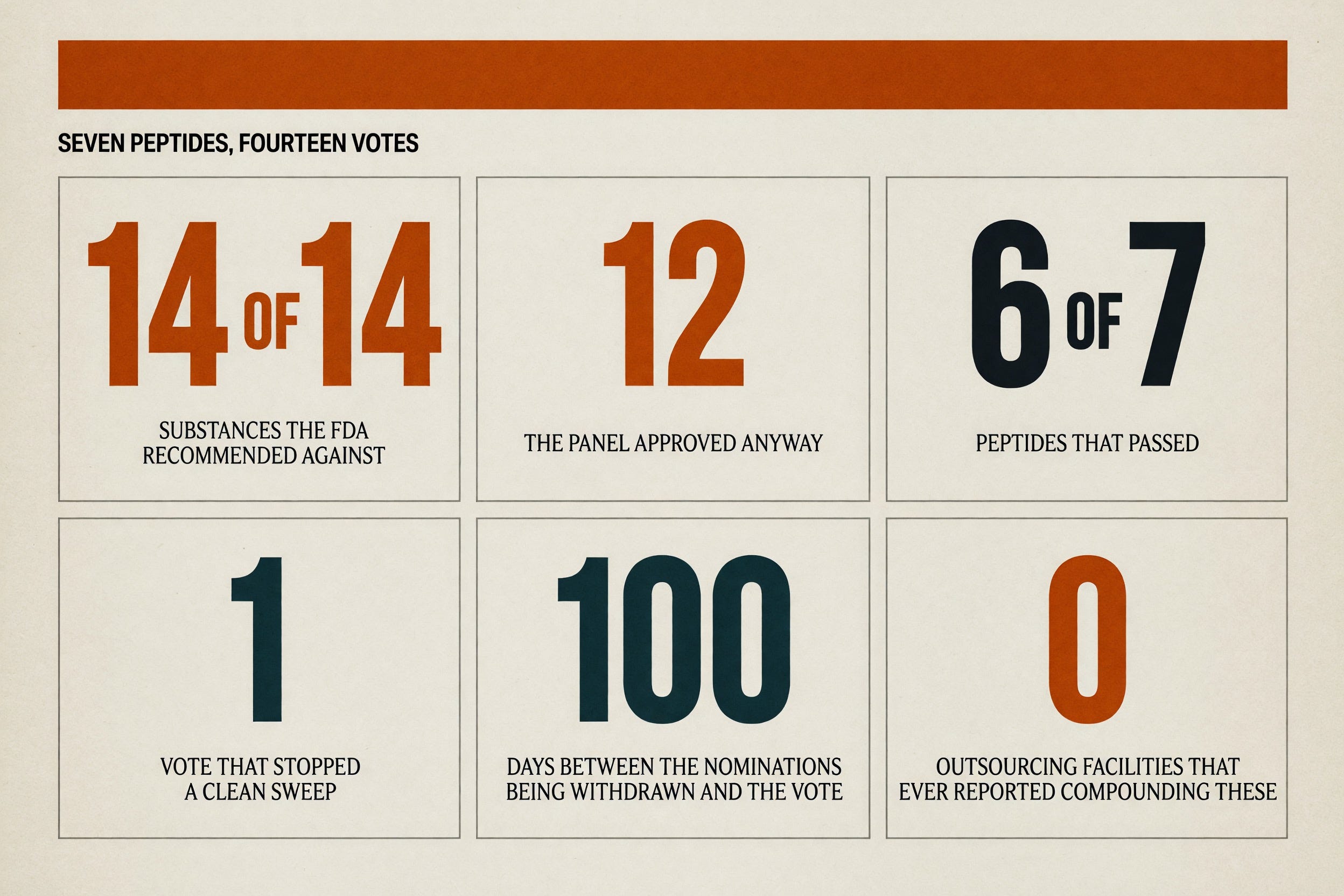
Here is the scoreboard, and it is worth sitting with the shape of it.
On Thursday the committee approved BPC-157 by 8 votes to 6, with one abstention. Then KPV, 8 to 6, one abstention. Then TB-500, 8 to 6, one abstention. Then MOTS-c, 7 to 5, with two abstentions. On Friday it approved Semax 8 to 5 with one abstention, and Epitalon 7 to 5 with one abstention. And then, on the last substance of the last day, it stopped. Emideltide, better known as delta sleep-inducing peptide, failed 6 to 7, with one abstention.
One note on that Epitalon figure, because outlets in the room split on it. MedPage Today and RAPS reported 7 to 5 with one abstention; MarketWatch and Fierce Pharma reported 7 to 4 with one abstention. FDA’s final roster seats thirteen voters on the Epitalon topic, which reconciles with 7-5-1 and not with 7-4-1, so that is the figure used here. We will correct against the transcript when it posts.
One vote. Change one mind in that room and the sweep is clean.
The FDA’s scientists had recommended against all of it. Not against some of it, which is how nearly every account of this week has framed the story. Against all of it.
The vote was structured as fourteen items rather than seven because the FDA insists that a peptide’s free base and its acetate salt are two different drugs, with potentially “different safety and/or efficacy profiles.” So the committee’s question document lists seven topics, each split into two votes: (a) the free base, (b) the acetate.
Open the agency’s introductory briefing document and go to the section headed Points to Consider. It is a numbered list, one through fourteen. Item one: “FDA is proposing that BPC-157 (free base) NOT be included on the 503A Bulks List.” Item two, the acetate: the same. Item three, KPV. Item four, KPV acetate. All the way down to item fourteen, Semax acetate.
Fourteen items. Fourteen recommendations against. A shutout.
The committee then voted to include twelve of them.
That gap is the story. Not the peptides, not the politics, not the press releases that went out within hours calling this a milestone for patient access. The gap between what the agency’s reviewers wrote down and what the room decided is the thing worth understanding, because everything that happens next in the American peptide market flows through it.
Before you can decide whether a substance belongs on a list, you have to know what the substance is. This turned out to be the hard part.
The question was asked out loud, at the meeting, by an FDA official. Russell Wesdyk, associate director for regulatory affairs in the agency’s Office of Product Quality Assessment, put it plainly: what is BPC-157? Some people believe it is a particular amino acid sequence. Others hold different opinions. “You will see many many different forms,” he said. “We can’t create quality standards until we actually know what it is.” Mai Tu, the senior pharmaceutical scientist who led the agency’s BPC-157 evaluation, backed him up, describing the peptide as not well characterized.
Wesdyk went further, in a line that deserves to outlive the meeting:
“There’s no way to know what the substance actually is, was or will be tomorrow because that name has no legal meaning.”
And then, on how unusual this was for the agency:
“We’ve never faced a problem of, ‘What is it?’”
That is not a rhetorical flourish from a critic. That is a career quality-assessment official at the FDA saying that in the ordinary course of regulating medicines, the agency has never before had to ask what the thing in front of it is.
The briefing documents show why. FDA’s reviewers wrote that the agency “has encountered multiple salts, and derivatives, including different active moieties, sold commercially under the same common name,” and that inconsistent naming “represent a safety risk for patients as they may be dosed with a different bulk drug substance” than intended. In plain terms: two vials both labelled BPC-157 may not contain the same molecule, and nothing about the label tells you which one you have.
There is a detail buried in the BPC-157 review that says more about the state of this field than any vote tally. The nomination packages contained no Certificate of Analysis for BPC-157 free base. So when the FDA needed basic physicochemical facts, solubility, stability, an example of what a certificate of analysis for this substance even looks like, it went and got them from retail peptide websites. The footnotes are right there in the agency’s own document: peptidesciences.com, cited twice, plus prospecbio.com and particlepeptides.com, each stamped “Accessed June 26, 2024.”
The United States Food and Drug Administration characterised a drug substance by shopping for it.
This is not a vibes exercise. Congress wrote the criteria into the statute, and for each substance the committee is meant to weigh four things: whether the substance is well characterised physically and chemically, what is known about its safety, what evidence exists for its effectiveness, and whether it has a history of being used in compounded products.
Take them in order, using the agency’s own findings, all of which sit in the BPC-157 evaluationand its companion reviews.
Characterisation. Covered above. For several of these substances FDA could not establish what the molecule reliably is.
Effectiveness. This is where the documents become uncomfortable reading for anyone who arrived certain. On KPV, the review team wrote that “the nomination did not include, and FDA has not identified, any clinical studies or human exposure data for KPV via any route of administration.” Not thin evidence. None.
On BPC-157, the single human randomised trial available to reviewers was presented only as a conference abstract, and FDA noted it lacked “information regarding the primary endpoint, inclusion/exclusion criteria, statistical methods, and post-treatment follow-up,” making the data “inadequate to support the efficacy” of the substance. The between-group difference was 1.6 points, with a confidence interval running from −4.84 to 1.62. That interval crosses zero, which is the statistical way of saying the study did not show the drug worked.
And then Semax, which produced the most remarkable finding in the entire package. The nominator submitted a study as supporting evidence. FDA read it and quoted the authors’ own conclusion back:
“no significant changes in TSEP were observed after a single intranasal administration of semax. This observation indicates that semax does not exhibit analgesic activity by itself.”
The agency’s summary is not that evidence was absent. It is that the available references “demonstrated lack of effectiveness.” The party asking for the substance handed the regulator a paper concluding it does not work.
Safety. The reviews are not empty here either, and what they contain is worse than silence. The only repeat-dose toxicity study of BPC-157 found, over 28 days in rats and dogs, “clinically relevant safety signals,” including altered clotting parameters in both species and liver-enzyme changes. On Semax, reviewers flagged that in mice it “potentiated amphetamine-induced dopamine release in the striatum,” noting that this is “a response typically induced by drugs of abuse such as cocaine.”
The Epitalon finding is the one longevity buyers should read twice. Epitalon is marketed on telomerase activation and telomere lengthening. FDA’s reviewers pointed out that this is the same mechanism implicated in cancer:
“chronic continuous exposures to epitalon, by virtue of upregulating telomerase and extending telomere lengths beyond the upper boundary limits for cells to become immortalized and cancerous, could result in carcinogenicity.”
The marketed mechanism and the theoretical harm are the same mechanism. That is not a reason to panic and it is emphatically not evidence that epitalon causes cancer in humans, which nobody has shown. It is a reason to notice that the thing being sold as the benefit is the thing the toxicologists are watching.
There is a further problem sitting underneath all of this, which is that for several substances FDA could not establish what had been nominated in the first place. On TB-500 the nominated substance was the free base, but the attached certificate of analysis was for the acetate; the CAS number, molecular formula and molecular weight belonged to the acetate; the molecular formula in the package matched neither form; and an alternative CAS number matched nothing at all. MOTS-c arrived the same way, a free-base identifier with an acetate certificate stapled to it. That is why each peptide got two votes rather than one. The paperwork was self-contradictory, so the agency evaluated both salts and let the committee decide on each.
On the TB-500 nomination form, in the box asking why a compounded drug is needed instead of an approved one, the nominator wrote four words: “no FDA-approved product available.” FDA’s reviewers contradicted that twice in their own document, in the effectiveness section and again in the safety section, noting that approved therapies for wound management do exist. Whether approved alternatives exist is one of the statutory balancing criteria, so this was not a quibble.
The MOTS-c nomination package itself is flagged “Restricted: Copyrighted” on the federal docket. The public cannot read what was asked for. Only FDA’s summary of it exists.

History of use in compounding. Across all seven substances, no registered outsourcing facility has ever reported compounding any of them to the FDA. For BPC-157 the reporting window runs from January 2017 to June 2025 and it is empty. On the federal record these are not established compounding staples.
One further piece of context, which is ours and not the agency’s. FDA’s BPC-157 evaluation names Tailor Made Compounding of Nicholasville, Kentucky once, as the pharmacy that compounded material used in a study. Separately, and not cited anywhere in FDA’s history-of-use analysis, that same company pleaded guilty in October 2020 in the Eastern District of Kentucky to unlawfully distributing unapproved new drugs including BPC-157, DSIP, Epitalon and Semax, forfeiting $1,788,906.82 in 2019 sales. We surfaced that case; the agency did not put it in front of the committee. Make of the omission what you like, but the two facts should not be blurred together.

Here is the finding that should have led every story about BPC-157 and appeared in none of them.
Across the entire recorded human experience of the compound, roughly eighty-one people in five studies, BPC-157 has been administered by rectal enema, by injection into a joint, by injection into the bladder wall, and intravenously. That is the list.
The two nominations between them asked to sell it as oral capsules, subcutaneous injections, nasal spray, rectal suppositories and transdermal cream.
FDA’s finding is one flat sentence: it found no studies administering BPC-157 to humans by any of the proposed oral, subcutaneous, nasal or transdermal routes. Not thin data for those routes. No data. Whatever is known about BPC-157 in humans, none of it describes the way it is actually sold.
Meanwhile the efficacy case for the single indication FDA was able to evaluate, ulcerative colitis, rests on one conference abstract from 2005. One page in Gastroenterology, volume 128, page A584. Fifty-three patients randomised, forty-six completing. No PMID. No DOI. Never published as a full paper in the twenty-one years since. That is the entire randomised human efficacy database for the most famous peptide in the world.
And FDA could only assess ulcerative colitis at all. The other three proposed uses in the nomination, Crohn’s, celiac and tendonitis, came with too little information for the agency to evaluate them.
Now the part that actually explains the outcome, and it is not the conflicts of interest.
Listen to how the emptiness of the file got used on the floor. Gabriel Alizaidy voted yes, disappointed at how incomplete the data was on the agency’s side. Josh Mailman voted nobecause he did not know what he was voting on. Same observation about the same record. Opposite conclusions.
That is the engine of the whole meeting. The weaker the evidence, the more forcefully the access argument lands, because a substance with no legal supply and no research pathway is precisely the substance patients are buying from strangers. Absent data becomes proof of neglect, neglect becomes urgency, and urgency becomes a yes.
Notice what that loop cannot do. It cannot be falsified by evidence, because the absence of evidence is what feeds it. A substance with good trials would not need this argument. A substance with no trials gets it for free. Run the logic to its end and the least-studied compound in any room holds the strongest claim on a vote, which is a strange place for a regulatory system to arrive.
None of which is a caricature. Nobody in that room was being cynical. It is a description of an argument that was there, on the record, doing work.
And it is testable. If the loop is real, the substance with the most human evidence should have been the most vulnerable of the seven, because it had the least neglect to complain about.
That is exactly what happened.
Somebody will tell you this week that these compounds have been used by hundreds of thousands of people with barely an adverse event on file, and that this constitutes a safety record. It does not, and you do not have to take our word for it, because the agency put the rebuttal in its own footnote.
From the epitalon review:
“Note the lack of reports for epitalon does not imply that the substance is safe or lacks toxicities; FAERS data have limitations. Reporting is voluntary. FDA does not receive all AE reports that may potentially occur with a product, especially for compounded products.”
That last clause is the whole thing. Compounders operating under section 503A generally do not have mandatory adverse-event reporting obligations. So the federal adverse-event database was never pointed at this market. A near-empty file for a compound with tens of millions of social-media impressions is not a finding about the compound. It is a finding about the plumbing.
The same holds for the compounding history. Across all seven substances, no registered outsourcing facility has ever reported compounding any of them to the FDA. For BPC-157 the reporting window runs from January 2017 to June 2025, and it is empty. These are not, on the federal record, established compounding staples. They are compounds with a large consumer market and almost no regulated footprint.
And when a signal does appear, it is worth reading closely. Among the small handful of BPC-157 reports in the system, one is a positive dechallenge and rechallenge, which is the strongest causal inference spontaneous reporting can produce: a patient developed symptoms, stopped the product and improved, restarted it and the symptoms returned. FDA’s assessment, verbatim:
“The AEs were likely due to the drug product considering that the AEs occurred upon rechallenge; however, because the product contained two peptides it is not possible to assess a potential relationship between BPC-157 and the reported AEs.”
Likely caused by the product. Not attributable to a specific ingredient, because the product had two peptides in it and nobody can say which one did it. That single sentence is a tidy summary of the entire category’s evidentiary situation.

TB-500 deserves a paragraph of its own here, because it is the widest gap between what is sold and what was ever tested. The nominator submitted three papers. None of them studied TB-500. They studied a related fragment or the full-length parent protein. The one experiment in the package that did involve the substance found it failed to do the thing it is marketed to do: no wound healing in scratch-wounded fibroblast cultures. And there is no nonclinical toxicity study of TB-500 at all. Not a reassuring one. None.
It passed 8 to 6.
Now the inversion, and it is the finding that should reorganise how you read this entire week.
Of the seven substances, exactly one was rejected: emideltide, delta sleep-inducing peptide, proposed for opioid withdrawal, chronic insomnia and narcolepsy. It went down 6 to 7.
Emideltide is, by the FDA’s own account, the best-documented compound of the seven. Human studies date back to 1981. It is the substance for which the agency conceded the clearest history of use in compounding. Where KPV had literally no human exposure data and BPC-157 had one null abstract, emideltide arrived with an actual literature.
The committee killed it.
We are not going to characterise the individual no votes on emideltide, and the reason is worth stating. Wire accounts attribute reasoning to several members, but the FDA’s webcast captions for the second day are badly degraded, rendering the agency’s own director as “Dr. Mary Tonhai” and epitalon as “epithelial alon.” In that record we could not locate one of the members quoted elsewhere at all, and the stated reasons we could find sit inside the Epitalon vote rather than the emideltide one. Rather than tell you why seven people voted the way they did on the strength of a bad caption track, we will wait for the official transcript.
What is not in doubt is the outcome. The substance with the deepest human record is the only one of the seven that lost, and it lost by one vote.
Whatever the committee was tracking across those two days, it was not a gradient of evidence. If it had been, emideltide would have been the safest yes on the board and KPV, with zero human data of any kind, would have been the easiest no. The votes came out precisely the other way around.
We should be careful about how hard to push that. The members who voted against emideltide gave evidence-based reasons and said so on the record, and none of them said they were punishing it for having a literature. The pattern is real; the motive is not something we can read off a tally. What can be said is narrower and still uncomfortable: the substance with the deepest human record is the one that lost, and nobody in the room appears to have found that odd enough to remark on.
There is a coda to the withdrawal story that belongs here. In a sworn declaration filed in July 2024, defending itself against Novo Nordisk in the U.S. District Court for the Middle District of Florida, Wells Pharmacy Network represented that it had stopped compounding with BPC-157 after the FDA moved the substance to Category 2 in September 2023, and that it would not resume unless the agency reversed course. Summarising that declaration in the February 12, 2025 order granting Wells summary judgment, Judge Anne C. Conway wrote that “Wells Pharmacy will not resume compounding with BPC-157 unless the FDA changes its position on the safety and efficacy of BPC-157 and adds it to the FDA Bulks List or the Category 1 Nomination List.”
Twenty-one months later Wells withdrew its nomination. Three months after that, a reconstituted advisory committee voted to do precisely the thing Wells had told a federal judge would bring it back into the business.
Start with arithmetic, because almost every account of this week got it wrong. On BPC-157 the tally was 8 yes, 6 no, 1 abstention. That is fifteen votes. The committee is routinely described as having fourteen members, and it does not have a fixed number at all: a core of standing members sat for everything, and additional temporary voting members were seated topic by topic. Brian Lee was seated for BPC-157 only. Others were brought in for KPV and TB-500, others again for Semax, another for emideltide. The room that voted on Thursday morning was not the same room that voted on Friday afternoon.
That matters for a reason beyond pedantry. Eight new members joined in the spring, six seated on April 19 and two on May 31. According to NBC News, all eight voted yes on BPC-157, KPV and TB-500. On MOTS-c, NBC reported, seven of them voted yes and one abstained.
Eight is also, precisely, the number of yes votes that carried each of those first three substances.
The composition, then.
Six of the standing voting members run peptide, longevity or wellness clinics: Maximus Health, Aether Medicine, the Re-New Institute, Gameday Men’s Health, Makena Health, The Resurge Clinic.
None of that is hidden. It is printed in the meeting materials, and several members named their own businesses openly during deliberations.
It would be easy, and lazy, to stop there and call it capture. The voting record does not cooperate with that story, and we will get to why in a moment. But the composition is a fact, it is material, and a reader deciding how much weight to give this recommendation is entitled to know that a substantial share of the people recommending these compounds work in businesses that offer them.
The most scrutinised member was Bobby Harshbarger, a Tennessee state senator whose family operates a compounding pharmacy and whose mother, a member of Congress, has lobbied Health and Human Services leadership on peptides. He also, for what it is worth, gave one of the clearest articulations of the pro-access legal argument heard over the two days.
The political framing this week has been sloppy in both directions, so here is the chronology, which is almost entirely public and tighter than is comfortable.
On February 27, 2026, Health and Human Services Secretary Robert F. Kennedy Jr. told Joe Rogan’s audience that the FDA would be moving on roughly fourteen peptides within a couple of weeks. On April 15 he posted the actual list to his official account: twelve named compounds. In the same post he pre-announced the venue and the timetable, saying FDA would bring them to the Pharmacy Compounding Advisory Committee at its next two meetings, beginning in July, “where independent experts will rigorously evaluate each substance on its scientific merits using full clinical, pharmacological, and safety evidence.”
The Federal Register notice for the July 23 to 24 meeting published the following day, April 16. Three days after that, on April 19, six new advisory committee members began their terms. Two more began on May 31.
The Secretary named the substances and announced the forum before that forum’s new majority was seated.
Precision matters here, because both loud versions of this story are wrong. Kennedy did not overrule a safety finding, and there is no document showing anyone instructed the committee how to vote. The peptides moved, in his own account, after the nominators withdrew, which is exactly what the docket shows. The crude “RFK ordered it” version does not survive contact with the paperwork.
But the milder version does not survive either. An agency does not usually convene a two-day federal advisory committee, write fourteen review documents recommending against every item, and put it all to a vote on substances that no petitioner is still requesting. Something has to explain why this meeting happened at all, and the only chronology on the table is the one above.
Note the phrase in the April post: independent experts, evaluating on scientific merits. That is a fair description of what was promised. Whether it describes a panel on which six standing members run peptide clinics, voting against the unanimous recommendation of the agency’s own reviewers, is a question a reader is entitled to answer for themselves.
An article that only quoted the skeptics would be a worse article and a less honest one. The case for approval was made by serious people, and at its best it is genuinely difficult to answer.
Start with the physician who is not on the committee at all. Jessica Duncan, chief medical officer of the telehealth company Ivím Health, which sells peptide therapy, spoke during the public comment period:
“Many of my patients are already using these drugs. They’re just getting them from the worst possible places. They come for a visit. They hold up a vial with no label, no dose, no ingredient list, something they ordered based on a video that they saw on their phone. They don’t know what they’re taking or how much.”
That is not a hypothetical. It describes a real and enormous population, and no vote on Thursday or Friday made those people stop.
Melissa Loseke, chief medical officer of the Re-New Institute in Omaha and a yes vote, made it concrete with a patient she had seen the previous week, whose product turned out to be laced with MDMA. Her full statement is worth reading on its own and we come back to it below.
Haleem Mohammed, chief medical officer of Gameday Men’s Health and also a yes, named the trade-off in the plainest language anyone used all week:
“As a physician, I have to make sure that I’m keeping patients as safe as possible. So when I look at something like saying no to this and pushing it to the gray market, am I doing greater harm? And that’s what I lose sleep at night over.”
That is the argument, and it is not stupid. The choice in front of the committee was never between compounded peptides and no peptides. It was between compounded peptides made by licensed pharmacies under state and federal oversight, and the same molecules bought from an Instagram ad and shipped from a jurisdiction with no oversight at all. David Pope, chief pharmacy officer at XiFin Pharmacy Solutions, put the yes case on BPC-157 in a single sentence: “I voted yes. It’s time to put this decision back into the hands of the patient, the physician, and the pharmacist.” He voted no on emideltide the following day.
If you believe regulation should meet people where they actually are, that argument has real force.
One caveat about that section, which we would rather state than have a reader notice. Every voice quoted above has commercial exposure to the outcome. Duncan is chief medical officer of a telehealth company that sells peptide therapy. Loseke, Mohammed and Pope all work in businesses that offer these compounds or dispense them. That is not a reason to discount what they said, and the clinical experience they describe is real. It is a reason to notice who was available to make the access argument at all, because the people best placed to describe patients buying unlabelled vials are, structurally, the people selling the labelled ones.
The one recorded yes rationale that does not run through a business model is the strangest of the lot. Gabriel Alizaidy, introducing himself as a clinical researcher, said he was “frankly disappointed at how incomplete the data was on the FDA side,” and that this is “what made me lean towards” a yes. Hold onto that, because it is about to become the most important sentence of the two days.
And here is the answer to it, made by people just as serious.
Brian Lee, an associate professor of medicine at USC’s Keck School, went at the evidence directly:
“I voted no. I think we do have to acknowledge that people perceive FDA decisions to place products on the [bulks] list as endorsement. So, you know, for effectiveness, we know that 30% of patients on placebo will have, you know, self-reported response or even objective response. Though I think that the data that we do have, the existing randomized data showing that BPC 157 may be no better than placebo and knowing that most important serious safety events like liver damage where there is potential concern here aren’t detected by self-report. So I think this endorsement can be potentially harmful and I cannot in good conscience vote yes.”
Read the first sentence again, because it is the hinge of the entire meeting. His objection was not that the drug is dangerous. It was that a government listing gets read as a government endorsement, and that thirty percent of people improve on nothing anyway. Every anecdote you have ever read about a peptide has to clear that bar before it means anything, and almost none of them are structured to.
Elizabeth Rebello, an anesthesiologist at MD Anderson, took the access argument apart on its own terms:
“I’m also concerned with the argument that patients are getting it anyway,” Rebello said after a later vote on TB-500. “That actually goes against the Hippocratic oath, which is do no harm and if we don’t know if we’re causing harm, that’s an issue.”
That is the counter nobody selling peptides wants to engage. “They will get it anyway” is an argument about harm reduction, and harm reduction requires knowing which direction the harm runs. If the compound does not work and carries a real toxicity signal, then a federal endorsement does not reduce harm. It scales it, and it attaches the government’s name to the scaling.
And then the quote that, for our money, is the single most damning sentence spoken in two days. It came from Josh Mailman, a patient advocate on the committee, president of the board of the Neuroendocrine Tumor Research Foundation, explaining his no vote:
“I’m voting on something here, but I don’t know what that something is. It’s kind of like a black box to me. And if someone can unblackbox it for me, it would really help.”
A voting member of a federal advisory committee, in the room, with the briefing package in front of him, saying he could not identify the substance he was being asked to approve. William Zamboni, a temporary voting member who directs the cancer pharmacokinetics facility at the University of Pittsburgh Medical Center, said the same thing more briefly: “There are too many unknowns about this product.”
If you want this week to be a simple story about industry capture, Melissa Loseke is your problem.
She voted yes, and she runs a clinic that offers peptides, which is exactly the profile the capture story predicts. Then listen to what she actually said, which no outlet printed in full and which the video record preserves:
“I actually would like to put my yes as a conditional. I would like to see some tighter restrictions with APIs from US-based pharmacies only, patient registries, mandatory side effects reporting. And just like Dr. Muhammad said earlier, 20 years ago, I made a promise to do no harm to my patients. And the way things stand currently, the patients, and I’m going to try not to get emotional, because probably two or three times a week, I’m trying to fix something that a chiropractor or a nutritionist did. But just last week, I had a patient whose research grade whatever that they got from some place that they brought to me to fix was laced with MDMA and ecstasy.”
She cast her vote as conditional, and asked for more regulation than the FDA had proposed: American-sourced ingredients only, patient registries, mandatory adverse-event reporting. Somebody voting to line their own pockets does not volunteer for a registry and mandatory side-effect reporting.
You can think she reached the wrong conclusion, and this article argues she did. It is much harder to argue she reached it cynically, and the clean-capture story cannot account for her at all.
The honest reading of this committee is messier and more human than either camp wants. Some members voted their financial interest. Some voted a genuine clinical philosophy about meeting patients where they are. Some voted the evidence and lost. And the resulting recommendation carries all three of those things inside it, indistinguishably.

We have spent the last several weeks reading this committee’s back catalogue for an unrelated story, which puts us in an unusual position to say what changed.
On June 8, 2022, this same Pharmacy Compounding Advisory Committee considered enclomiphene citrate, a testosterone drug nominated for the 503A bulks list by Empower Pharmacy, a compounder that sells it. FDA staff recommended against inclusion. The committee voted 4 yes, 8 no, zero abstentions. Members voting no cited a lack of efficacy evidence.
Same committee. Same agency posture. Same shape of nominator, a compounding pharmacy asking permission to make the thing it already makes. Opposite result.
The evidentiary gap between the two cases does not explain the reversal, and if anything it runs the wrong way. Enclomiphene in 2022 arrived with a completed Phase 3 program, a submitted New Drug Application, and multiple registered trials. KPV in 2026 arrived with, in FDA’s words, no clinical studies or human exposure data of any kind. The 2022 committee rejected the drug with the trials. The 2026 committee approved the compound with none.
What changed was not the science. It was the composition of the room, the political environment around it, and the volume of public demand pressing on both.
Almost every headline this week used the word “approved.” Nothing was approved.
The Pharmacy Compounding Advisory Committee makes non-binding recommendations. For any of these substances to actually join the 503A bulks list, the FDA must publish a proposed rule, open a public comment period, consider the comments, and publish a final rule in the Federal Register. That codified list lives at 21 CFR 216.23. Until a substance’s name appears there, its legal position has not moved by a single inch.
The agency is under no obligation to follow the committee. It has just spent fourteen documents explaining, at length, why it believes the opposite.
There is precedent for exactly that, and almost nobody has cited it this week. In a final rule published on February 19, 2019, FDA noted that this same advisory committee had recommended including a substance called tranilast, with a topical restriction, and then declined to do it. The agency’s language was blunt: advisory committee recommendations “are not binding on FDA. Rather, FDA considers the PCAC’s advice but makes an independent judgment.” Tranilast sits today in 21 CFR 216.23(b), permanently codified as a substance the agency considered and refused over its own advisers’ recommendation.
That is the precise shape of what could happen here. A panel says yes, the agency says no, and the Code of Federal Regulations records the refusal.
The base rate is worth holding too. In the entire history of this process, the 503A bulks list has been established once, with six substances, and never amended since. A single afternoon this week produced twelve recommendations. Whatever else it was, it was not business as usual.
So it is entirely possible that this vote changes nothing at all, and entirely possible that it changes everything, and anyone telling you today which way that goes is guessing.
What is true right now, with the gavel barely down: the legal status of BPC-157 is exactly what it was last Wednesday. Nothing you can buy today became more legal, more tested, or more likely to contain what the label claims because a committee of shifting size raised its hands in Silver Spring.
If you want to know what sophisticated money thought this week meant, watch what it did on the second day.
Hims & Hers, the largest publicly traded company positioned to sell compounded products at consumer scale, ran up on Thursday as the first approvals landed, touching an intraday high of $35.85 on roughly 32.6 million shares, about three and a half times its recent average volume. It closed well off that high. Then on Friday, after the committee handed down its single rejection, the stock closed at $28.09, down 14.2 percent. From Thursday’s high to Friday’s low it gave up more than a fifth of its value.
Six of seven passed. One failed. The rally died anyway.
Enhanced Group, the public vehicle for the Enhanced Games, ran the identical pattern, up sharply on day one and down double digits on day two. It had filed its S-1 registration statement on the morning of day one, describing the meeting as an important industry inflection point. That is the same filing we quoted at length in our piece on enclomiphene, for a different reason entirely.
The purest expression of the week was a Vancouver microcap called The Precision Peptide Company, whose ticker is, without irony, BPC. It issued a press release at seven in the morning on day two applauding the vote. Its over-the-counter line traded 567,396 shares on Thursday against 12,272 the day before, a forty-six-fold jump.
Read the tape honestly and it says something the headlines did not. The market did not price this as a green light. It priced a binary, got six sevenths of what it wanted, and sold anyway, because the participants who actually read the rulemaking timeline understand that a non-binding recommendation on a substance nobody can define is not revenue. It is a press cycle.
The list is long, and an article that pretended otherwise would be doing the same thing it is criticising.
We do not know what is in the vials. That is not rhetoric, it is FDA’s finding. The naming problem is real and unsolved, and it applies to the compounded supply as much as to the gray market.
We do not know the real safety record, and the apparent one is a measurement artifact.Compounders operating under 503A generally do not have to report adverse events. The agency said so itself, in a footnote to its epitalon review: “the lack of reports for epitalon does not imply that the substance is safe or lacks toxicities. FAERS data have limitations. Reporting is voluntary.” A small number of adverse event reports for a compound with tens of millions of social-media impressions is not evidence of safety. It is evidence of a reporting system that was never pointed at this market.
We do not know whether these compounds work. For most of the seven, the honest answer is not “the evidence is mixed.” It is that adequately powered human trials have not been run.
We do not know what FDA will do. The rulemaking has not started.
And we could not obtain everything. The full meeting transcript has not been posted. Our reading of member reasoning comes from the briefing package, the agency’s presentations, and contemporaneous reporting by outlets that were in the room. Where we quote a member, we quote what was reported; where we quote the agency, we quote its own documents. When the transcript posts, we will read it and correct anything this piece got wrong.
The rulemaking will take months or years, and in the meantime there will be a great deal of writing about what this week meant. Five questions will get you through almost all of it.
A vote, or a rule? A recommendation is not a rule. Until a substance is named in 21 CFR 216.23, nothing legal has changed, and any headline using the word “approved” for this week is wrong on its face.
Which substance, and which salt? This matters more than it sounds. The committee voted on free base and acetate separately because the agency considers them different drugs with potentially different safety profiles. A claim about “BPC-157” that does not say which form is a claim about two things at once.
What is the denominator? Roughly thirty percent of people improve on placebo, by the estimate one committee member cited during the BPC-157 session. Every testimonial you read has to clear that bar before it means anything. Almost none are built to.
Who is the source, and what do they sell? This applies to the enthusiastic coverage and to us. Six standing members of the committee run peptide or longevity clinics. The nominators were compounding pharmacies. We run a publication that covers peptides and sells a genomics product. None of that automatically invalidates anyone’s argument, and all of it is worth knowing before you weigh one.
Did anyone read the documents? FDA’s reviews are public and free. If a piece of coverage makes a confident claim about what the agency found and does not appear to have opened the file, treat it as a summary of other coverage, because that is almost always what it is.
We are going to be direct about our own position, because you should be able to weigh it.
This week produced two loud stories. One said the FDA had finally listened to patients and freed a class of medicines from bureaucratic capture. The other said a conflicted panel had steamrolled the agency’s scientists on behalf of an industry. Both were written fast, both were written to be shared, and both were mostly written from the same two press releases.
Neither of them told you that FDA characterised BPC-157 by reading a retail website. Neither told you that the Semax nominator submitted a study concluding Semax does not work. Neither told you that the one peptide the committee rejected was the one with forty-five years of human data, or that the nominations had all been withdrawn in April, or that a voting member said out loud that the substance he was voting on was a black box to him.
Those facts are not hidden. They are sitting in public documents that take a few hours to read. But almost nobody reads them, because reading them is slow and unglamorous and does not produce a headline within the hour.
That is the whole job. Not to tell you peptides are good, and not to tell you peptides are dangerous. To read the trial, the label and the filing, and then tell you what they say, including when what they say is inconvenient for a category we cover every day and for an audience that mostly wants good news.
The people in that room were not fools and they were not villains. They were asked an impossible question, about substances nobody could reliably define, on evidence that mostly does not exist, under real pressure from real patients who are already buying these compounds from strangers. Six of seven times they decided that a regulated supply beats an unregulated one. That may well be the right call. It is not, and this is the part worth holding onto, the same thing as the drugs working.
You are allowed to want better than a coin flip between a pharmacy and an Instagram ad. Getting there requires trials that have not been run and standards that do not yet exist, and no vote can conjure either.
Fourteen review documents, seven substances, two days, and almost nobody read the paperwork. The Peptide List reads the trial, the label, and the filing, not the press release. If you want the mechanism, the evidence tier, and the honest regulatory status of the compounds that actually matter, subscribe. We do the primary-source reading so you can decide on real numbers.
Educational use only. None of the substances discussed here is FDA-approved for any indication, and nothing written above is medical advice, a recommendation to obtain or use any compound, or an endorsement of any product or seller. An advisory committee recommendation is not an approval and does not change the legal status of any substance; inclusion on the 503A bulks list requires notice-and-comment rulemaking that has not begun. Safety and effectiveness data for these peptides are limited or absent, several carry documented preclinical safety signals, and compounded preparations vary by pharmacy. Decisions about any therapy belong with a licensed physician who knows your history. Where advisory committee members are quoted above, each quotation has been checked against the full video record of both days, using machine-generated captions of the FDA’s own webcast, alongside the agency’s published meeting materials. The FDA had not published an official transcript at the time of writing, and caption text is imperfect; any quotation that differs materially from the official transcript will be corrected when it appears.
No. An FDA advisory committee voted 8 to 6, with one abstention, to recommend that BPC-157 be added to the 503A bulks list, which governs what compounding pharmacies may legally make. That recommendation is non-binding. Actual inclusion requires the FDA to publish a proposed rule, take public comment, and publish a final rule. None of that has happened, and the agency’s own scientists recommended against inclusion.
Its legal status is unchanged from last week. Nothing about the vote altered what any pharmacy may lawfully compound today.
Seven substances across fourteen votes, split between each compound’s free base and acetate forms. BPC-157, KPV and TB-500 each passed 8 to 6 with one abstention. MOTS-c passed 7 to 5 with two abstentions. Semax passed 8 to 5 and Epitalon 7 to 5, each with one abstention. Emideltide, also called DSIP, was rejected 6 to 7 with one abstention.
Yes. The agency’s briefing document lists fourteen numbered “Points to Consider,” each stating that FDA proposes the substance NOT be included on the 503A bulks list. The committee voted to include twelve of the fourteen.
Because the ordinary process starts with someone formally asking. Wells Pharmacy Network and LDT Health Solutions both withdrew their peptide nominations on April 14, 2026. The FDA continued the evaluation on its own initiative and the committee voted in July on substances no nominator was still formally requesting.
No, and the committee was not asked that question. For several of these compounds the agency found no adequate human effectiveness data at all, and for one it found submitted evidence that concluded the compound does not work. A vote about which supply chain should make a substance is not a finding about whether the substance is effective.
The FDA decides whether to begin rulemaking. If it does, a proposed rule publishes in the Federal Register, a comment period opens, and a final rule follows at some later date. The agency may also decline to act, which is what it did after this same committee voted on enclomiphene citrate in 2022.
No posts
Comments
Nothing yet. Say the first thing.
Sign in to join the conversation.