
July 24, 2026

On July 23, 2026, a company preparing to sell shares to the public filed a registration statement with the Securities and Exchange Commission, and buried inside it was the clearest explanation of the American testosterone market anyone has written this year. Enhanced Group told its future investors that “while enclomiphene protocols are available in all U.S. states, TRT is limited to 35 U.S. states as of March 31, 2026.” Further into the same document it explained why: “TRT is the only product offered on our platform that is a controlled substance,” followed immediately by a discussion of the Ryan Haight Act. Testosterone is a Schedule III drug, and dispensing a controlled substance through a telehealth screen runs into federal law. Enclomiphene is not scheduled, because the FDA never approved it, because it lost. And so the drug that failed reaches fifteen more states than the drug that passed. You can read both sentences yourself in the filing.
“While enclomiphene protocols are available in all U.S. states, TRT is limited to 35 U.S. states as of March 31, 2026.”
“As of the date of this prospectus, TRT is the only product offered on our platform that is a controlled substance.”
Enhanced Group Inc., Form S-1, filed with the SEC on July 23, 2026
That is not a loophole somebody found. It is the market.
Four years of silence is not the same thing as approval.
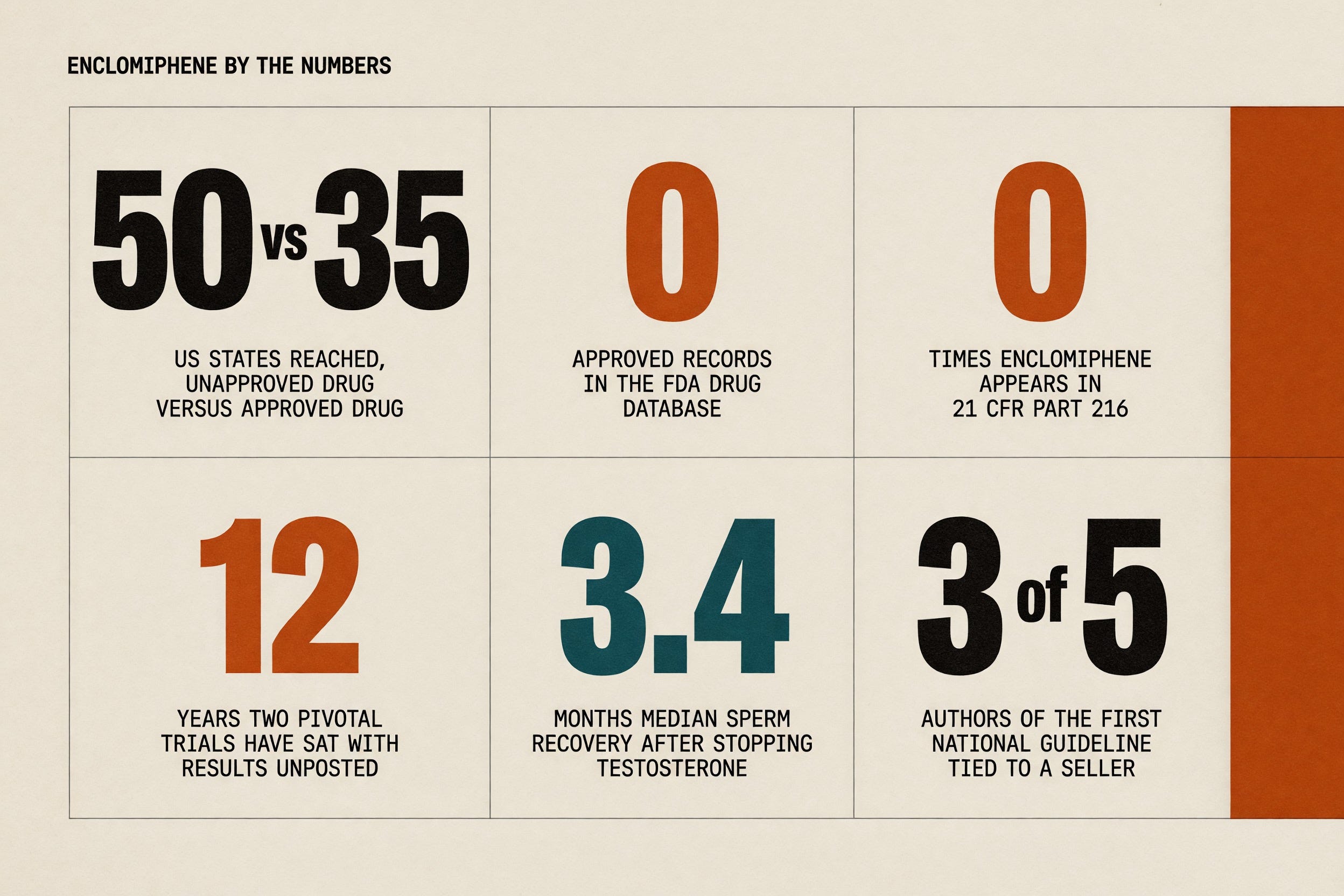
Enclomiphene citrate has stood in front of a regulator four separate times and lost four separate times. Four hearings. Four refusals. Four different reasons, and not one of them written into law. Its advisory committee was cancelled five days before it was to meet. It drew a Complete Response Letter from the FDA. Europe refused it outright. And in 2022 an FDA advisory panel voted it down again, this time on the question of whether pharmacies should be allowed to compound it at all.
And you can buy it this afternoon, on a subscription, from a company listed on the New York Stock Exchange.
Every consumer page about this drug tells the same five-beat story: testosterone shuts down your sperm, enclomiphene is the clean half of Clomid, it lifts testosterone while keeping the signal alive, it is not FDA-approved but a pharmacy can compound it, click here. Not one of them reads a regulatory document. This piece is about what those documents actually say, and about the far more interesting thing that happened after the last vote, which is nothing at all.
Start with the sequence, because almost every retelling of it is wrong in the same direction.
February 2015. The application. Repros Therapeutics submitted a New Drug Application on February 2, 2015, for the compound it was then selling to investors as Androxal. The FDA accepted it for filing on April 1, and by that announcement Repros had already dropped the brand, calling it “its enclomiphene citrate product candidate, formerly known as Androxal.” The indication it sought was narrower than anyone remembers, and the FDA wrote it out in full: NDA 207959, enclomiphene citrate 12.5 mg and 25 mg capsules, “for the proposed treatment of secondary hypogonadism in fertile men (men with more than 15 million sperm/milliliter (ml)), younger than 60 years of age with a Body Mass Index (BMI) over 25 kilograms (kg)/meters squared (m2)” (80 FR 50639). This was never an application to treat low testosterone generally. It was an application to treat obesity-associated low testosterone in men whose sperm was already fine.
October 2015. The meeting that never happened. Five days before its own advisory committee was scheduled to convene on November 3, the FDA cancelled it. The stated reason was questions about bioanalytical method validation that had surfaced late in the review, questions that “could affect interpretability of certain pivotal study data.” In plain terms: the agency developed a concern about whether the assays used to measure the drug in the pivotal trials could be trusted, and it pulled the meeting rather than hold it.
This is the fact the internet gets backwards. Enclomiphene’s approvability was never voted down by an FDA advisory panel. The panel was never allowed to sit.

December 2015. The Complete Response Letter. The FDA declined to approve. Its stated reason was not that the drug failed. It was that “based on recent scientific developments, the design of enclomiphene Phase 3 studies is no longer adequate to demonstrate clinical benefit.” The goalposts had moved during the review. Repros’ chief executive, Joseph Podolski, said so on the record and without diplomacy: the company was “disappointed that the FDA has taken this position without the benefit of an advisory committee recommendation.”
December 2016. The endpoint ruling. A year later the FDA convened its Bone, Reproductive and Urologic Drugs Advisory Committee to settle, in the abstract, the question that had killed the application. The meeting ran December 6 at the Tommy Douglas Conference Center in Silver Spring, and the agenda published at 81 FR 65658 named the subject exactly: acceptable endpoints for demonstrating clinical benefit in drugs meant to treat secondary hypogonadism while preserving testicular function.
The first voting question was written around the precise population Repros had applied for. For men whose hypogonadism is attributed to obesity, is raising testosterone into the normal range and preserving spermatogenesis, as measured by maintained sperm concentration, sufficient to establish clinical benefit? The committee said no. Sixteen to five, zero abstentions.
What the committee did not do is demand a pregnancy, and this is the part every retelling gets wrong, including the earlier version of this article. Asked next whether raising sperm concentration above a threshold would suffice for men with classic secondary hypogonadism and azoospermia or oligospermia, fifteen of the twenty-one members voted yes: thirteen for both conditions, two for azoospermia alone, against six no. Pregnancy as the required endpoint was a minority position with names attached to it. One member, explaining his no vote, said he “was in favor of pregnancy rates as an endpoint for these drugs.” That was a dissent, not the committee’s conclusion.
Then the third question, covering men with azoospermia or oligospermia who do not have classic hypogonadism. That is closer to the population enclomiphene was actually aimed at, and on that one the committee concluded nothing at all: two votes for the first option, none for the second, eight for the third, ten for the fourth, one abstention. A near-tie is not a ruling.
So the honest summary is narrower and more damning than “the FDA demanded pregnancies.” The committee rejected the exact endpoint Repros had built its program on, declined to hand it an easier one for its actual population, and left the question open. There was no bar to clear. There was no bar at all.
January 2018. Europe. The European Medicines Agency’s human medicines committee adopted a negative opinion on EnCyzix, the European name for enclomiphene, on January 25, 2018, and the marketing authorisation was formally refused that April. The committee gave two reasons. The four main studies, covering 588 patients, measured sperm production and testosterone but “did not look at whether EnCyzix would improve symptoms such as bone strength, weight gain, impotence and libido.” And there was “a risk of venous thromboembolism” with the medicine.
The detail nobody carries forward: four thromboembolic events occurred in enclomifene-treated patients, with none in either the testosterone arm or the placebo arm. The dissenting members parse them as “3 cases of DVT/PE and one fatal stroke,” so the fatality was an ischaemic stroke rather than a venous event. Every one of those four patients had independent risk factors, and the committee said plainly that “the exact magnitude of this risk remains unknown.”
And then the part no coverage of this drug has ever mentioned. Five committee members filed a signed divergent position, appended to the assessment report, arguing that the risks “are considered to be mitigated by the proposed product information” and that with appropriate risk minimisation “the benefit-risk balance of enclomifene is considered positive.” Five named people, on the record, on the losing side of a refusal that the American market has spent eight years not knowing happened.
January 2018, again. The part that kills the standard story. The received wisdom is that Repros ran out of money and folded, taking the program down with it. That is not what happened. The company was acquired. Insider equity settled on January 31, 2018, and Repros filed to deregister its stock with the SEC days later. You can read the filing history yourself under CIK 0000897075.
The buyer was Allergan. Allergan was subsequently absorbed by AbbVie. So the enclomiphene program did not die of poverty in a small Texas biotech. It was bought cheaply and shelved inside a company that was itself swallowed by one of the largest pharmaceutical firms on earth, where it has sat, untouched, for eight years.
June 2022. The fourth loss, and the strangest one. Enclomiphene came back to the FDA, but not through a drug company. It came back through a compounding pharmacy. Empower Pharmacy nominated enclomiphene citrate for the 503A bulk drug substances list, which is the list that governs what compounders may legally make. Empower sent its own Director of Medical Affairs and an outside urologist to argue for it.
The FDA’s own review recommended against inclusion. The Pharmacy Compounding Advisory Committee then voted: four yes, eight no, zero abstentions. Members voting no cited efficacy, not safety. One committee member’s yes was purely technical, resting on the fact that a USP monograph exists for clomiphene citrate, the mixture that contains enclomiphene, so the substance is at least adequately characterized.
Read the shape of that. The party that stood to profit from legal compounding is the party that asked the government to bless it. And lost.
Here is where every article about this drug stops, and where the actual story starts.
After the 2022 vote, the FDA did nothing.
Not “the FDA declined to act.” Not “the FDA denied the petition.” The agency simply never finished. As of the FDA’s own category list updated May 14, 2026, enclomiphene citrate sits in 503A Category 1: bulk drug substances under evaluation. Four years after a federal advisory committee voted it down eight to four, it is formally still being evaluated.
It is not in Category 2, which is where substances with significant safety risks go. It is not on the codified bulks list at 21 CFR 216.23(a), which is where approved substances go. And critically, it is not on 216.23(b) either, which is the codified list of substances the FDA has formally determined will not be included.
That last list is short. Search Part 216 of Title 21 of the Code of Federal Regulations and the word “enclomiphene” does not appear anywhere in it. I ran that check against the live eCFR while writing this paragraph, because it is the kind of claim that would be embarrassing to get wrong, and the result is unambiguous: the substance is absent from the inclusion list and absent from the exclusion list alike. The 2022 vote was never written into law.
So what is the legal basis for the enclomiphene in your medicine cabinet? Enforcement discretion. Not a rule, not a permission, not an approval. A decision by an agency not to act, which persists exactly as long as the agency continues not acting.
And the FDA has already told everyone what ends it. Its interim policy expressly terminates that discretion for any substance that becomes the subject of a final rule concluding it will be included on the 503A list, or not included. A single Federal Register final rule, in either direction, closes the American enclomiphene market on the day it publishes. The outcome the FDA’s own committee already voted for is the outcome that switches this off.
The entire industry is one unwritten rule away from zero.

The measure of how quiet that file is: search the Federal Register’s full history and exactly two documents mention enclomiphene, the most recent a meeting notice from 2022. That is four years of total regulatory silence carrying a market that a publicly traded company now books revenue against.
The mechanism deserves a plain explanation, because it is genuinely elegant and because the marketing distorts it in a specific direction.
Clomiphene citrate, the fertility drug prescribed to women for fifty years, is not one molecule. It is a mixture of two mirror-image forms: zuclomiphene and enclomiphene. They do different things and they leave the body at wildly different speeds. Zuclomiphene is the more estrogenic half and it lingers for weeks. Enclomiphene is the trans-isomer, the more purely anti-estrogenic half, and it clears fast. Separating them was the whole commercial idea: give a man only the half that does the useful work.
The useful work is a piece of misdirection played on his own brain.
Your hypothalamus monitors circulating estradiol as its signal that the testosterone system is running. Enclomiphene blocks the estrogen receptors it uses to take that reading. The hypothalamus concludes the tank is low and increases its GnRH pulses. The pituitary responds by releasing more luteinising hormone and follicle-stimulating hormone. The testes, receiving a louder instruction, make more testosterone and keep making sperm.
Set that against exogenous testosterone, which does the exact opposite. Inject it and the hypothalamus reads a high circulating level and stops pulsing. LH and FSH fall away. The testes stop receiving the instruction to do either job, and both jobs stop. The clinical name for the result is testosterone-induced secondary hypogonadism. The colloquial name is that TRT shuts you down.
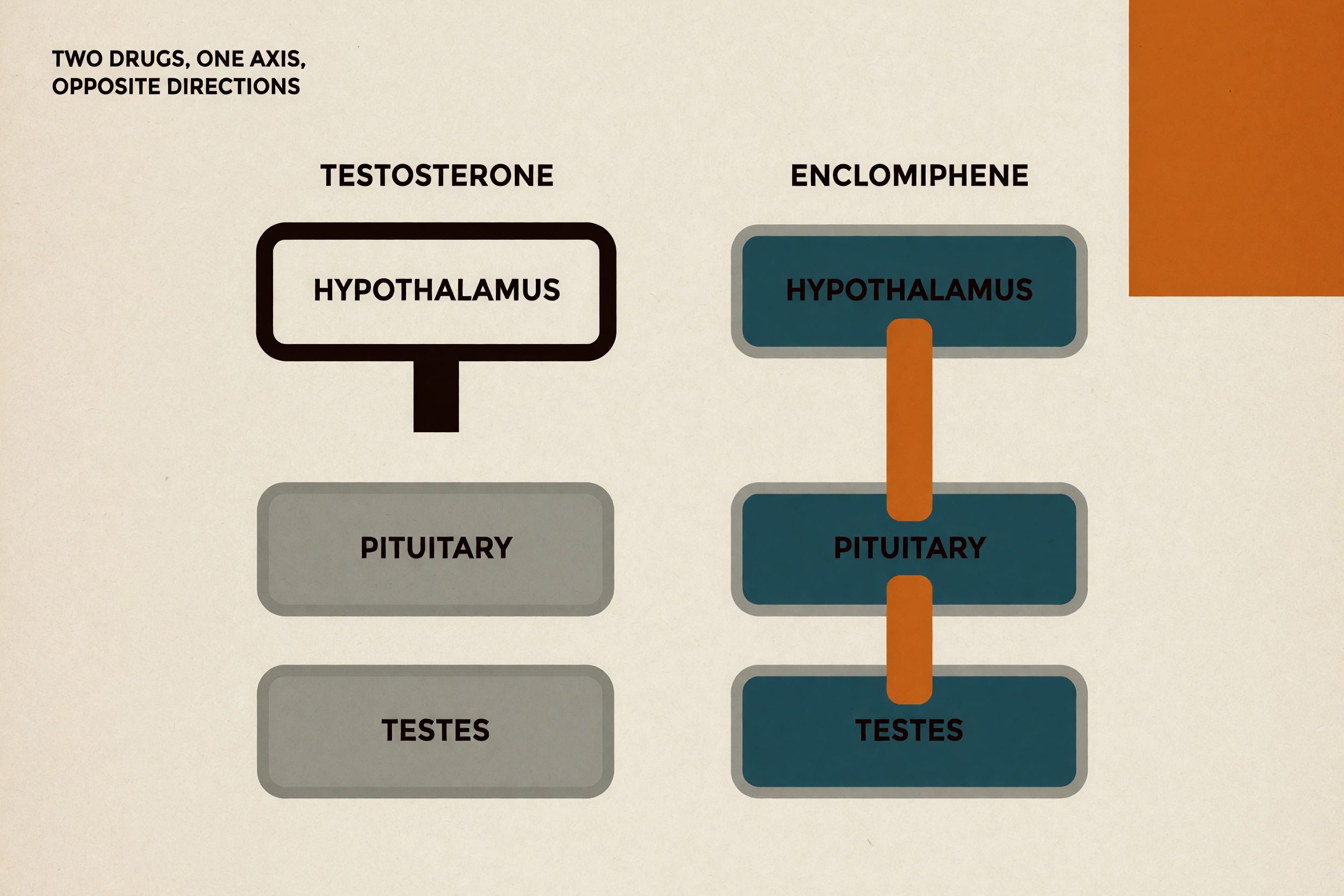
One drug replaces the output. The other raises the volume on the instruction. That difference is real, it is well documented, and it is the entire honest case for the compound.
Now watch what happens when you ask the evidence to prove the thing the difference implies.
Before the fertility argument can be evaluated, it needs the thing it is measured against: how badly does testosterone replacement actually suppress sperm, and how reliably does that come back?
The honest answer is stranger than the one circulating, and it is worth the detour.
There is no reliable published figure for how many men on prescribed testosterone replacement stop making sperm.
Not because nobody looked. Because everyone who looked was studying something else. Every widely quoted suppression percentage on the men’s health internet traces back to male hormonal contraception research, where healthy fertile volunteers were given 200 mg of testosterone enanthate by intramuscular injection every week for the express purpose of shutting their fertility down. In the World Health Organization’s multicentre contraceptive trials, 66.7 percent of non-Asian men and 89.2 percent of Asian men reached azoospermia by six months on that regimen (Task Force on Methods for the Regulation of Male Fertility, 1996). In a separate contraceptive study, Anderson and Wu found azoospermia in 18 of 33 men at 20 weeks, while the remaining 15 plateaued near 2.0 million sperm per millilitre rather than reaching zero (Journal of Clinical Endocrinology and Metabolism, 1996).
Read that population again. Fertile men. Supraphysiologic weekly doses. A study designed to produce the outcome it measured.
That is not the man sitting in a telehealth intake. He is hypogonadal, he is being dosed toward a normal range rather than past it, and no one has run the equivalent study on him. The percentage he actually needs has never been measured. What is established is the mechanism, which is why every clinician treats suppression as expected rather than possible, and why nobody serious disputes that TRT suppresses sperm production. What is not established is the magnitude in his population.
Recovery, oddly, is the better-characterized half. The largest pooled analysis, covering 1,549 healthy men across 30 studies with sperm output measured every month until it returned, found a median of 3.4 months to cross back over the 20 million per millilitre fertility threshold. Sixty-seven percent were back within six months, 90 percent within twelve, and 100 percent within twenty-four (Liu et al., The Lancet, 2006). Longer treatment duration slowed the curve. Older age, against every intuition, sped it up.
The same caveat applies and it does not go away: those are contraceptive volunteers with a median exposure under a year, not men five years into a cypionate protocol. There is no recovery dataset for that man either.
So the fertility case for enclomiphene is being argued in a space where both of the numbers that would frame it, how much suppression and how much recovery, are borrowed from a population that does not resemble the patient. This does not make the case wrong. It makes it unquantified, which is a different problem and a more honest one to state.
The load-bearing claim across this entire product category is that enclomiphene preserves fertility.
In May 2018 the FDA’s Center for Drug Evaluation and Research published a guidance for industry on establishing effectiveness for drugs intended to treat male hypogonadotropic hypogonadism (83 FR 23461, Docket FDA-2017-D-6759). On the question of sperm it is not ambiguous: “Changes in semen parameters (e.g., sperm count) alone are not sufficient for establishing efficacy.” The guidance gives three reasons. The third is the one this market needs to read: “Improvement in semen parameters does not ensure fertility.” For a drug that improves spermatogenesis, sponsors “could establish efficacy by showing improved fertility outcomes (e.g., pregnancy in the partner).”
Then read the sentence immediately after, because it makes the position worse for this drug rather than better. For drugs “that do not show an effect on spermatogenesis,” the agency writes, sponsors “could establish efficacy by showing improvement in other hypogonadal symptoms or signs.” That is the bucket enclomiphene’s own trial data puts it in, as the next section shows. A pregnancy endpoint is not the contemplated route for a sperm-neutral drug. Symptom benefit is, and symptom benefit is exactly what the 2016 committee had already declined to accept from this program.
The guidance is nonbinding and says so on every page. It is not a rule and anyone who calls it one has not opened it either. It is the agency putting in writing, eight years ago, what a sperm count is and is not worth as evidence about fertility.
No enclomiphene trial has ever measured a pregnancy. Not one.
So the commercial argument for this drug rests on a surrogate the agency put in writing was not sufficient, for exactly the reason the surrogate is being used. Sperm concentration is a number that moves. Whether a couple conceives is the question being asked. The agency said those are not the same question, and the market has proceeded as though it never spoke.
That is not a technicality. It is the difference between “your sperm count stayed up” and “you can still have a child,” and every man reading a telehealth landing page is being sold the second while the evidence supports, at most, a discussion of the first.
There is a specific paper the industry leans on. It is the one whose title promises testosterone normalisation while preventing oligospermia, and it appears as the citation on page after page.
Two things about it.
The first is authorship. Five of its six authors listed their affiliation as the Department of Urology at Repros Therapeutics, the company that owned the application. This is sponsor-authored work. That does not make it wrong, and it is not a scandal, but a reader who is told “a study found” deserves to know the study was written by the people selling the drug.
The second is the data underneath it. The registry entry for the underlying trial reports mean change in sperm concentration at three months. On the 12.5 mg arm it rose 8.2 million per millilitre, with a standard deviation of 233 across twelve men. On the 25 mg arm it fell 2.8 million per millilitre, with a standard deviation of 167 across nineteen men. Placebo fell 19.1, with a standard deviation of 93.
Look at those standard deviations against those effects. They run twenty to eighty times larger than the differences they surround. And the paper’s own reported finding on the endpoint that matters is that enclomiphene was statistically indistinguishable from placebo on the proportion of men who became oligospermic.
A sperm-neutral result is being sold as a sperm-protective one. The honest sentence is that enclomiphene does not appear to suppress sperm production the way exogenous testosterone does, which is a genuinely valuable property and a completely different claim from protecting anyone’s fertility.
Meanwhile, the two trials that were actually designed to answer the question have never been seen by anyone. ZA-304 and ZA-305 were the pivotal Phase 3 studies whose primary endpoint was the composite of normal testosterone and normal sperm concentration, which is precisely the thing the market sells. They completed in September and August of 2014. Neither has ever posted results. I queried the registry again while writing this: twelve years on, both records read completed, and both return no results. For contrast, the six-month open-label safety study ZA-300 from the same program did post its results, so this is not a case of a sponsor that never files. The two trials that would answer the commercial question are the two that stayed dark.
The data that would settle the argument exists. It has simply never been shown to anybody.
Now the part that inverts the story most consumer coverage tells, including the earlier version of this article.
The standard framing is that cash-pay testosterone clinics push injections because a patient on TRT is a patient for life, and enclomiphene threatens that. It is a tidy argument about greed and it is too easy. The price sheets say something sharper.
The molecule is not the product. Enclomiphene active ingredient runs a few dollars per patient-month at typical doses. A vial of generic testosterone cypionate runs about twenty to thirty dollars. Both drugs are, commercially speaking, free. What is being sold is the subscription, which is why one major platform prices enclomiphene and injectable testosterone on the identical ladder, and another prices both at exactly the same monthly figure. The margin was never in the compound. It is in retention.
Which means the revenue-maximising recommendation is not testosterone instead of enclomiphene. It is both. The same platform that charges roughly a hundred dollars a month for enclomiphene alone charges nearly two hundred for testosterone plus enclomiphene together. Adding the exogenous hormone to the protocol roughly doubles the platform’s revenue per patient. The commercial incentive does not point away from enclomiphene at all. It points at the combination.
And then there is how the drug is actually positioned. One platform’s own marketing copy describes enclomiphene as “a great option for younger men who aren’t ready for testosterone but want a boost.”
Not the alternative to testosterone. Not the fertility-preserving choice. The option for men who are not ready yet.
The clinical literature treats enclomiphene as the exit from lifelong exogenous hormones. The industry sells it as the entrance.
Then there is the mechanism that keeps him from leaving. Multiple platforms gate cheap add-on prescriptions, the erectile dysfunction and hair loss drugs men actually want refilled, behind an active hormone subscription. One sells them for a dollar, conditional on keeping the testosterone or enclomiphene plan open. Another bundles enclomiphene and tadalafil as a single dual-action product. A third throws the tadalafil in free with the protocol. Three independent companies arrived at the same retention device, which tells you it works. Cancel the hormone subscription and you lose the thing you were actually happy to be paying for.
None of this is unique to enclomiphene, and none of it is illegal. It is ordinary subscription commerce applied to endocrinology. It matters here only because it explains why the drug’s clinical positioning and its commercial positioning point in opposite directions, and why you should read the fertility argument on a product page as marketing until a physician who has seen your labs repeats it.
There is one more structure worth naming, because it sits directly on top of the clinical decision point. The lowest advertised monthly price at the largest seller exists only on a ten-month plan paid upfront and in full. The clinical literature says you assess response at week twelve. The patient has therefore paid for month ten before anyone knows whether the drug worked at month three. Shorter plans exist, at roughly $139 a month for five months and $199 a month for three, plus a lab kit charged separately. You will not find those on the product page. They live in a separate pricing guide, and the product page carries no plan selector at all, so the headline figure is the only number a prospective patient sees before starting an intake.
Which is the same pattern the drug’s whole history runs on. The information that would let someone judge the offer exists, it is public, and it is one click further away than the click most people make.
There is a question that sits underneath every sentence above and almost never gets asked on a product page: is the enclomiphene you would receive the same substance any of these trials evaluated?
Not necessarily, and for three separate reasons.
The first is that there is no reference product. An approved drug has a label, a manufacturer, a specified strength, and an assay somebody is legally accountable for. Enclomiphene has none of that, because the approval that would have created them never happened. What exists is a compounded preparation, made from bulk substance, to a prescription, by a pharmacy. Quality across that ecosystem varies, and the patient is implicitly accepting variance in what arrives.

The second is dose, where the consumer internet has quietly standardized on a range narrower than the clinical guidance supports. Nearly every enclomiphene page you will read, including the earlier version of this article, repeats 12.5 to 25 mg per day. The British position statement discussed below is materially wider: start lower, titrate upward, and go higher still in men who do not respond. A range repeated across a hundred marketing pages is not the same thing as a dosing guideline, and the fact that the pages agree with each other is evidence of copying, not of consensus.
Dose is also, in this market, a pricing tier rather than a cost driver. One seller charges three different monthly prices for three different strengths of the same molecule, a fourfold dose increase for roughly a fifty percent price increase, when the underlying active ingredient differential is a matter of cents per month. You are not paying for more drug. You are paying for a higher tier.
The third reason is the most concrete. Some products sold as enclomiphene are not enclomiphene alone. A case series published in Cureus in May 2026 described 15 men taking a compounded sublingual product containing enclomiphene citrate 25 mg alongside boron, vitamin C, spermidine, and a proprietary mineral oxide delivery system (Warren, 2026). Whatever that blend is, it is not the compound any pivotal trial evaluated, and a study of a drug whose entire premise is preservation of the hormonal axis is a strange thing to run without measuring the hormonal axis.
None of this makes compounded enclomiphene dangerous on its face. It makes any sentence beginning “the research says enclomiphene raises testosterone” do more work than it can carry, because the research was run on a characterized substance from a sponsor’s manufacturing line, and the thing in the envelope is something a pharmacy made from bulk powder last week.
It also explains a quieter asymmetry. When a man on a compounded preparation does not respond, there are now three candidate explanations rather than one: he is the wrong patient for the mechanism, the dose is wrong for him, or the preparation is not delivering what the label claims. An approved product with a specified assay collapses the third possibility. Compounding leaves it open, and no lab draw at week twelve can tell those three apart. That is not an argument against compounding, which serves patients no approved product reaches. It is an argument for knowing which pharmacy filled it and for treating a single disappointing result as ambiguous rather than conclusive.
For eleven years after the Complete Response Letter, no national medical society anywhere said anything official about enclomiphene. That changed in February 2026, and not in America.
The British Society for Sexual Medicine published a position statement in the World Journal of Men’s Health (Foster et al., 2026). Its verdict is cold. Promising, worth studying, but the society does not recommend routine use outside specialist settings, and says it should ideally be prescribed within research frameworks.
The first institutional verdict this drug has ever received points in precisely the opposite direction from where the American market is moving.
It also carries something worth sitting with. Three of the statement’s five authors, including the first author, list their affiliation as Menwell Limited, trading as Voy, Manual and H3 Health. You do not need to take my word for the affiliation; it is printed in the paper’s own author block, which you can read on the PubMed record linked above. Menwell is a commercial telehealth business in the United Kingdom, and its Voy site runs an enclomiphene marketing page.
The statement’s competing-interests section reads, in its entirety, that the authors have nothing to disclose.
Four months later, in the same journal, a cohort study from the same company declared the relationship properly, naming its authors as employees of Menwell Limited and describing the company as a provider of testosterone therapy services. Same company, same journal, same year, two different disclosure standards.
This is not an accusation of bad faith and it should not be read as one. Disclosure practice varies, journals apply their rules unevenly, and there are ordinary explanations for an inconsistency like this. But an investigative publication that notices it and says nothing is not doing its job, and a reader weighing the first guideline ever written about a drug is entitled to know who wrote it.
Two findings landed this year that a piece arguing for enclomiphene would rather not print.
A meta-analysis published in July 2026, pooling eleven studies and 1,512 patients, found no testosterone advantage for clomiphene over topical testosterone, an advantage for injectable testosterone over clomiphene, and the uncomfortable one: significantly worse libido on clomiphene than on testosterone.
Set that against the implicit promise of every page in this category, which is that you get the same testosterone, keep your fertility, and feel the same. The 2026 evidence says comparable testosterone against gel, worse against injections, and a possible cost in sexual function. That is a different offer.
And a second finding, from a real-world cohort of nearly seven thousand men at a fertility-conscious telehealth provider, describes what actually gets prescribed when a clinic knows exactly what these drugs do. The overwhelming majority received human chorionic gonadotropin alongside testosterone. A small fraction received a SERM alongside testosterone. SERM monotherapy, the strategy this entire article is about, accounted for roughly one percent.
Eighty-three men out of nearly seven thousand.
That number is a harder and better version of the business-model argument. Here is a provider that knows the biology, has the willingness, sells the product, and whose own medical director co-authored the position statement on the drug. And the axis-preserving monotherapy is a rounding error in its book. The interesting question is not whether clinics are greedy. It is why, even where every condition for prescribing this drug is met, almost nobody does.
I do not have a confident answer. Neither does anyone else writing about it, which is why nobody else mentions the number.
None of the above means the drug does nothing. It means the claims around it outrun the evidence for it. There is a real patient for whom this is a sensible conversation, and the way to find him is mechanical.
Low testosterone is one label laid across two entirely different failures. In secondary hypogonadism the brain has stopped asking: the hypothalamus and pituitary are underperforming while the testes remain capable. In primary hypogonadism the testes have stopped answering, regardless of how loudly the brain asks.
Enclomiphene only works on the first. It amplifies an instruction. If nothing downstream can act on the instruction, a louder one changes nothing.
The lab signature separates them cleanly. Low testosterone with low or inappropriately normal LH and FSH means the signal is weak and there is something to amplify. Low testosterone with high LH and high FSH means the brain is already shouting and the testes are not answering. Amplifying a shout accomplishes nothing.
Which yields a short and honest gate. This is a candidate conversation if the man has secondary hypogonadism confirmed on morning labs drawn more than once, if he wants to preserve fertility or simply keep the option, and if his testes still demonstrably work. Miss any of the three and the answer is a different drug.
Most men walk in asking how to get the number up. The more useful question, and the one that actually determines which drug belongs on the pad, is what the body still knows how to do on its own.
Five questions worth taking into the appointment. None of these are medical advice, and all of them are answerable by a clinician who has your labs in front of them.
What are my LH and FSH, not just my testosterone, and were they drawn in the morning on more than one day?
Given those numbers, is my low testosterone a signalling problem or a testicular one, and which of these drugs can actually act on that?
If I start this, what specifically are we measuring at week twelve, and what result would make you stop?
Which pharmacy compounds it, and what does the certificate of analysis for that preparation show?
If fertility is the reason I am here, what are we actually measuring, and what can this drug honestly promise about it?
The fifth one is the question the entire category avoids answering.
:::cta Know Your Hormone Axis Before The Appointment Our saliva genomics analysis reads the hormone-axis biology you were born with: aromatase conversion, binding globulin, receptor sensitivity. It is a baseline insight layer to bring to your physician, not a prescription, not a diagnosis, and not a prediction of how any drug will work in you. Order the saliva kit :::
This is where an article published by a company that sells a genetics test is supposed to tell you the answer is in your DNA. It is not, and writing otherwise would be the least defensible paragraph on this page.
Search the published literature for a pharmacogenetic study of clomiphene or enclomiphene response in men and you will not find one. The clomiphene pharmacogenetics that does exist is real, substantial, and entirely female: CYP2D6 genotype driving the formation of the drug’s active metabolites in healthy women volunteers, CYP2D6 and CYP3A variants tested against ovulation response in women with polycystic ovary syndrome. Not one of those studies enrolled a man.
And when researchers stopped describing associations and directly tested whether genotype could predict who responds, it did not. In 77 anovulatory women, genotype-based predictions matched the observed response 39 percent of the time, with a kappa coefficient slightly below zero (Robin et al., Frontiers in Endocrinology, 2021). A kappa at zero means the prediction carried no information beyond a coin flip.
One mechanistic thread does point straight at this specific drug, and it deserves stating precisely, because it is the honest version of the exciting claim. Clomiphene is a prodrug that CYP2D6 has to switch on, and the 4-hydroxylation producing the potent metabolites happens only on the (E)-isomer. The (E)-isomer is enclomiphene. The CYP2D6 bioactivation pathway is therefore the enclomiphene pathway (Mürdter et al., Human Molecular Genetics, 2012). What that means for a man swallowing this tablet has never been measured in a man.
So what does predict response? Measurements, not markers. Testicular volume and baseline LH carried the published predictor work. And the blood draw at twelve weeks remains the only instrument anyone has shown will tell you whether this is working in you specifically.
We sell a saliva genomics analysis. It is a baseline insight layer into inherited hormone-axis biology and it is genuinely interesting on its own terms. It is not a response prediction for this drug. Nobody’s is. We would rather write that sentence here than have you discover it on your own later.
The list is longer than the list of things we do.
Whether it preserves fertility in the sense you mean. No trial measured a pregnancy. The endpoint that was measured is one the FDA said in 2018 is not sufficient on its own for this exact purpose.
What happens after a year. There is no randomized controlled data past sixteen weeks. The longest controlled study ran fifty-two weeks and was not randomized: its comparison arm was made of men who had failed the entry criterion, so they started with markedly higher testosterone than the treated groups. That study has never been published in a peer-reviewed journal and its results have never been posted to the registry. A man planning to take this drug for twenty-five years is operating with no data at all.
The clot question. Four thromboembolic events, one fatal, against zero in both comparison arms, in patients who all carried independent risk factors, in a submission the European regulator refused partly on that basis, with two committee members dissenting. That imbalance is real and no incidence rate, ratio, or causal claim can be derived from it. Any specific enclomiphene clot-risk percentage you encounter online is invented.
Bone. Three datasets point three ways and no study used a randomized bone-density endpoint. This matters more than it sounds for a drug that blocks estrogen signalling in men, given what estrogen does for the male skeleton, and it remains genuinely unsettled.
Whether we would even know. Compounded drugs made under 503A carry no adverse-event reporting obligation. So a safety signal in the compounded enclomiphene population would be slow to surface, or might not surface at all. That cuts in both directions and honesty requires both sentences: the near-absence of reports is not evidence that the drug is safe, and it is equally not evidence that it is harming anyone.
The real-world response rate. The response figures quoted in clinical explainers trace back to selected trial cohorts, and non-responders in ordinary practice get re-routed to another protocol without entering any database. Treat any single quoted response percentage for this drug with suspicion, including the flattering ones.
And what I could not get. The BRUDAC meeting minutes. The full text of the pivotal comparison paper. The results of ZA-304 and ZA-305, which nobody has. I have not put a request for comment to the authors of the British position statement, and that should happen before anyone treats the disclosure observation above as more than an observation. An investigative piece that names what it could not reach is worth more than one that quietly writes around the gaps.
The smartest reader of this article will push back, and the objection is a good one.
Enclomiphene losing four votes does not prove enclomiphene does not work. It proves it was never shown to work by the standard the regulators chose to apply, which is a different statement. Its Phase 3 program was designed against an endpoint the FDA later decided was insufficient. That is partly a story about a company that guessed wrong on regulatory strategy and partly a story about an agency that moved its requirements mid-review, which the company’s own chief executive said out loud at the time. Plenty of drugs that work have lost votes. Plenty of compounds sold freely have far less evidence than this one. The men taking it and reporting that they feel better are not imagining it, and their testosterone genuinely rises.
All of that is fair, and I would concede every word.
What it does not do is convert an unfinished regulatory file into a permission. That is the actual subject here. The reason you can buy this drug in all fifty states is not that somebody weighed the evidence and cleared it. It is that a federal agency held a vote, lost interest, and never wrote down the result. The market that grew in that silence now includes a company on a public exchange telling its investors, in a document filed under penalty of securities law, that its unapproved product reaches more Americans than its approved one.
A drug can be worth taking and its legal footing can still be an accident. Both of those are true here, and the second one is the part nobody is pricing.

If the FDA ever finishes the sentence it started in 2022, it does not matter which way the ruling goes. Included or excluded, the enforcement discretion holding this entire market up ends on the day of publication.
Four years of silence is not the same thing as approval. It is just silence, and silence can stop.
The scariest claim about a drug and the truest claim about a drug are rarely the same sentence. The Peptide List reads the trial, the label, and the filing, not the clinic’s landing page. If you want the mechanism, the evidence tier, and the honest regulatory status of the compounds that actually matter, subscribe. We do the primary-source reading so you can decide on real numbers.
Educational use only. Enclomiphene is not FDA-approved for hypogonadism or for any other indication, and it holds no approved record in the FDA’s drug database. It is available in the United States only through 503A compounding pharmacies on individualized physician prescription, under enforcement discretion the agency can revisit. The scenarios, dose ranges, and monitoring frameworks described above are educational context for a conversation with a physician, not a protocol to follow. Decisions about low testosterone, fertility preservation, or any aspect of male reproductive health belong with a licensed physician who knows your history. The Peptide List saliva genomics analysis is an educational baseline insight layer into inherited hormone-axis biology; it does not predict response to enclomiphene or any other drug, no product does, and it is not a prescription, a diagnosis, or a substitute for clinical evaluation. Nothing written above is medical advice.
No. It holds no approved indication for anything. Queries against the FDA’s approved-drug database for the generic name, for the Androxal brand name, and for its application number each return no match at all. It reaches patients through 503A compounding pharmacies under enforcement discretion, which is the agency choosing not to act rather than the agency granting permission.
Compounded enclomiphene is currently lawful for a pharmacy to prepare against an individual prescription, and it is not a controlled substance. But that status rests on enforcement discretion rather than on a rule. The FDA’s own policy ends that discretion for any substance that becomes the subject of a final rule, whether the rule includes it or excludes it. No such rule has been written.
The 2015 Complete Response Letter did not say the drug failed. It said the Phase 3 program’s design was no longer adequate to demonstrate clinical benefit, given scientific developments during the review. The following year an advisory committee ruled on the underlying question and concluded that raising testosterone while preserving sperm production does not, by itself, establish clinical benefit.
It does not appear to suppress sperm production the way exogenous testosterone does, and that is a real and meaningful difference. Whether it preserves fertility in the sense most men mean is unproven: no trial has ever measured a pregnancy, and the FDA stated in 2018 that changes in semen parameters alone are not sufficient to establish efficacy.
They answer different questions. Enclomiphene can only work if the testes still function and the deficit is in the signal, which makes it a candidate for secondary hypogonadism. In primary hypogonadism it will not work at all. A 2026 meta-analysis found comparable testosterone against topical testosterone, an advantage for injections over clomiphene, and worse libido on clomiphene. This is a conversation for a physician who has seen your LH, FSH and morning testosterone, drawn more than once.
Nobody knows. There is no randomized controlled data beyond sixteen weeks, and the single fifty-two-week study was non-randomized, unpublished, and never posted. Indefinite use is common practice and it is not an evidence-based duration.
Not necessarily. Compounded preparations vary by pharmacy, and some products sold as enclomiphene are blends containing other ingredients entirely. One 2026 case series described a sublingual product combining enclomiphene with boron, vitamin C and spermidine in a proprietary delivery system, which is not the compound any trial evaluated.
No posts
Comments
Nothing yet. Say the first thing.
Sign in to join the conversation.