
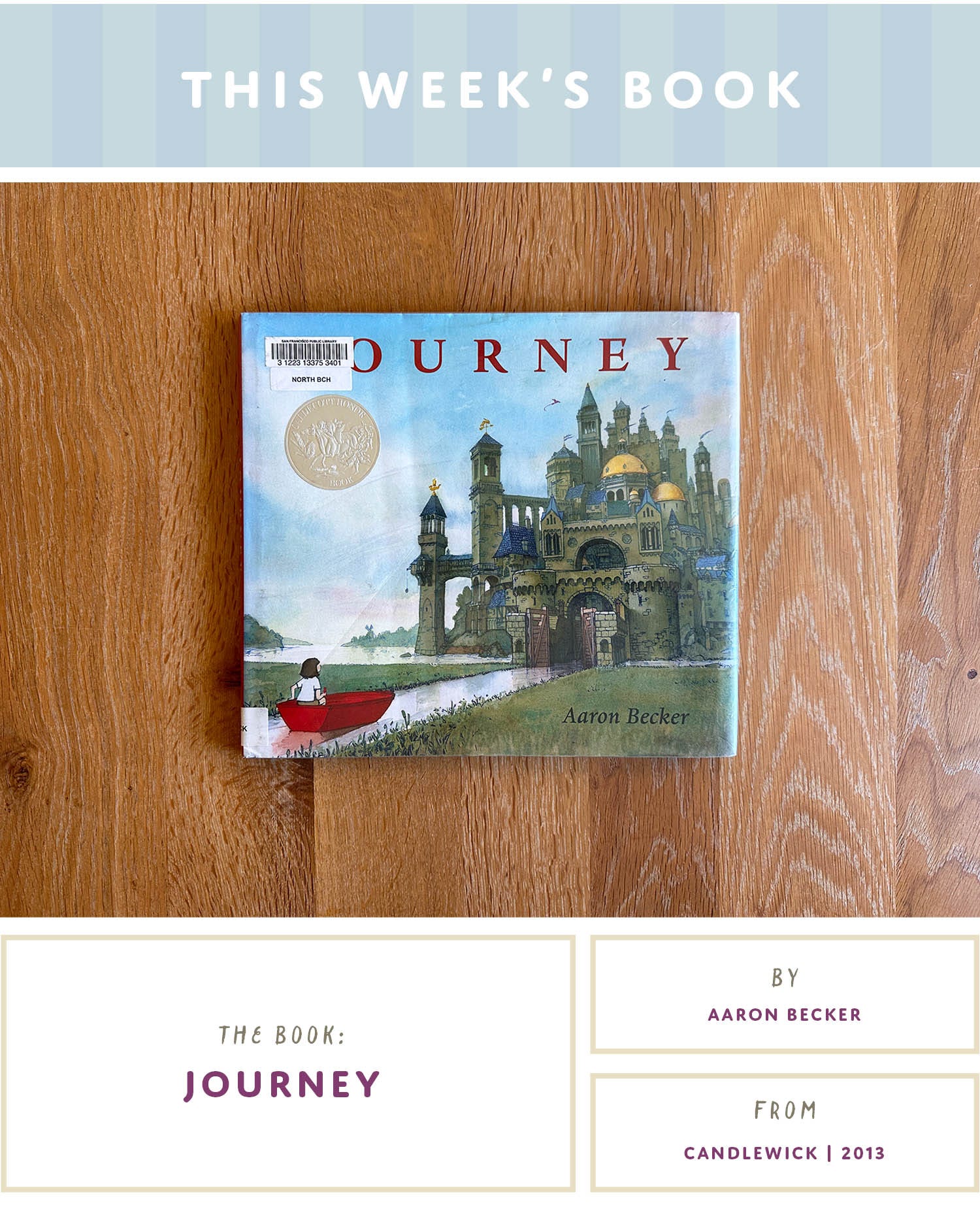
There they were, a trio of spines, all in a row: JOURNEY, JOURNEY, JOURNEY.
Huh, I thought to myself, What book could possibly warrant having three copies just at this library branch alone?
I pulled one out and began flipping, searching for the opening lines that would surely draw me in. Page turn and page turn and page turn, but…where were the words?
Oh wait. There are none.
Then I studied the pictures. Really studied them. And I realized JOURNEY was a picture book in a class of its own.
Lauded and beloved, JOURNEY is—remarkably!—the debut picture book from author/illustrator Aaron Becker. It’s the kind of book you have to have on your radar (if not your bookshelf), as it’s become a modern classic. So if you’re not familiar with it, start your imagination engine, and let’s take off on a journey…

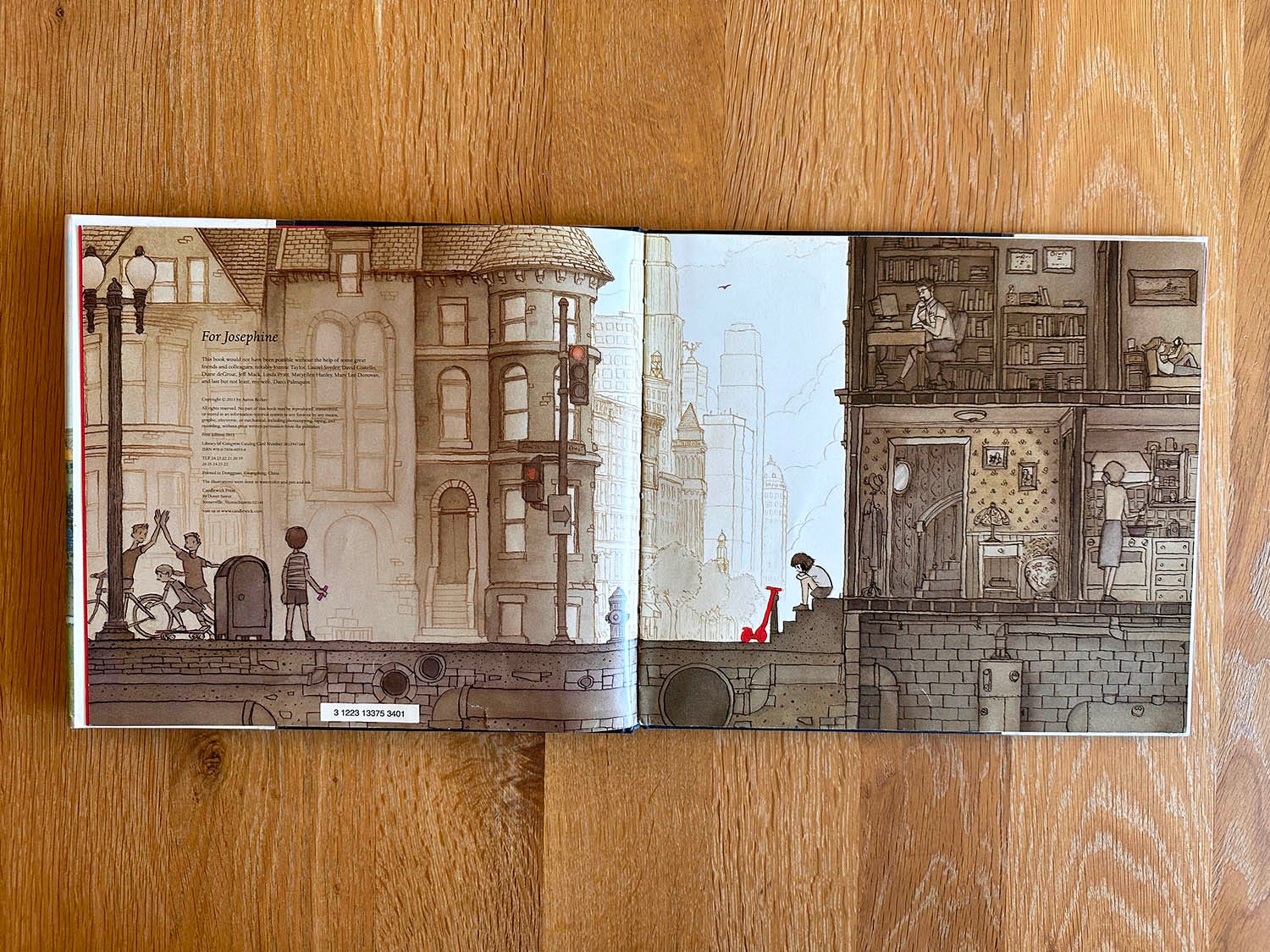
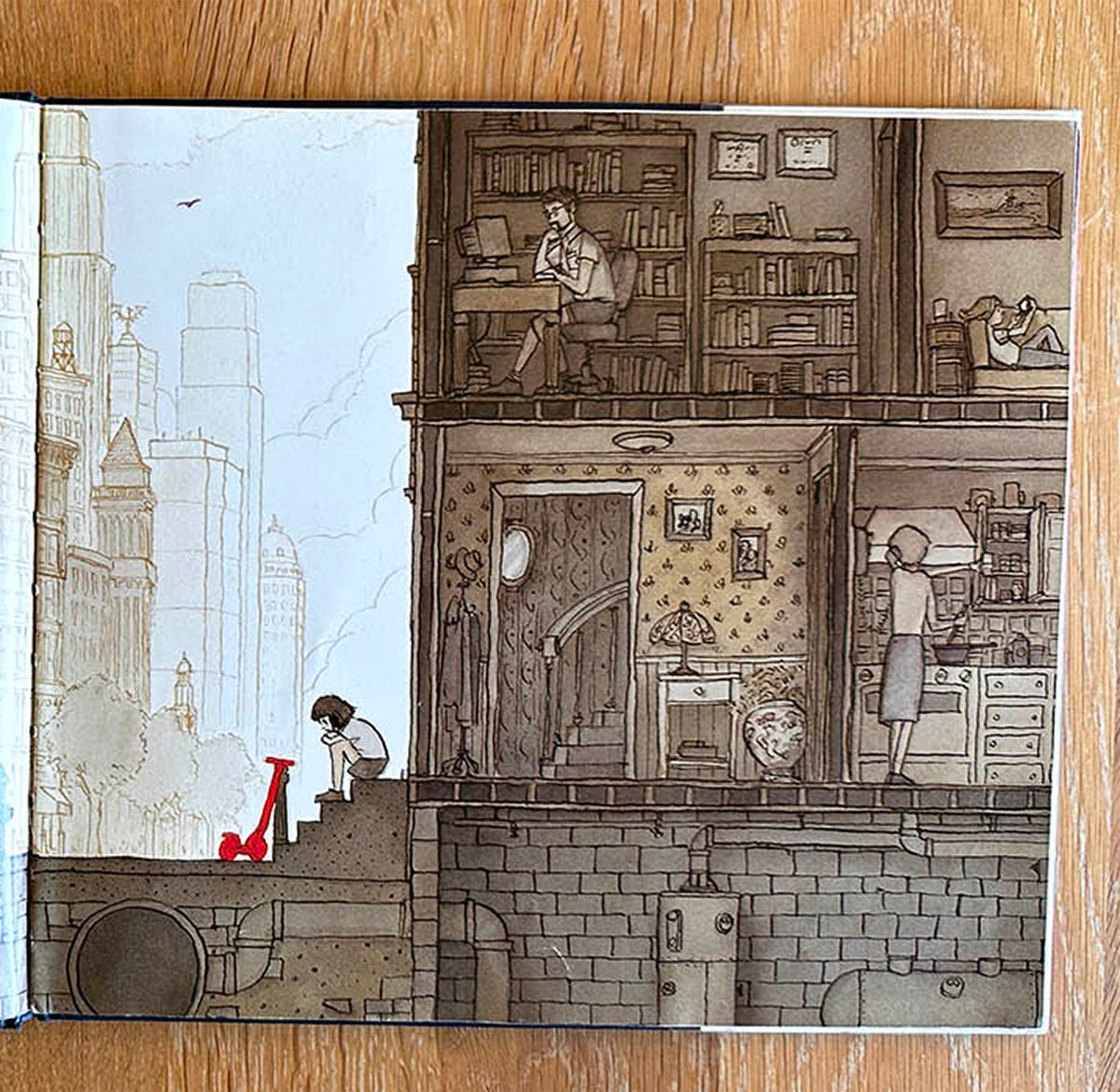
The story begins on the copyright page and what’s usually the title page, but here, with a full spread of action, cutaway illustration included. The girl—our main character—sits alone on her stoop, the brown-beige boredom of the day surrounding her. Neighborhood friends play in the street, but she’s not interested.
Inside, there’s more to the story:
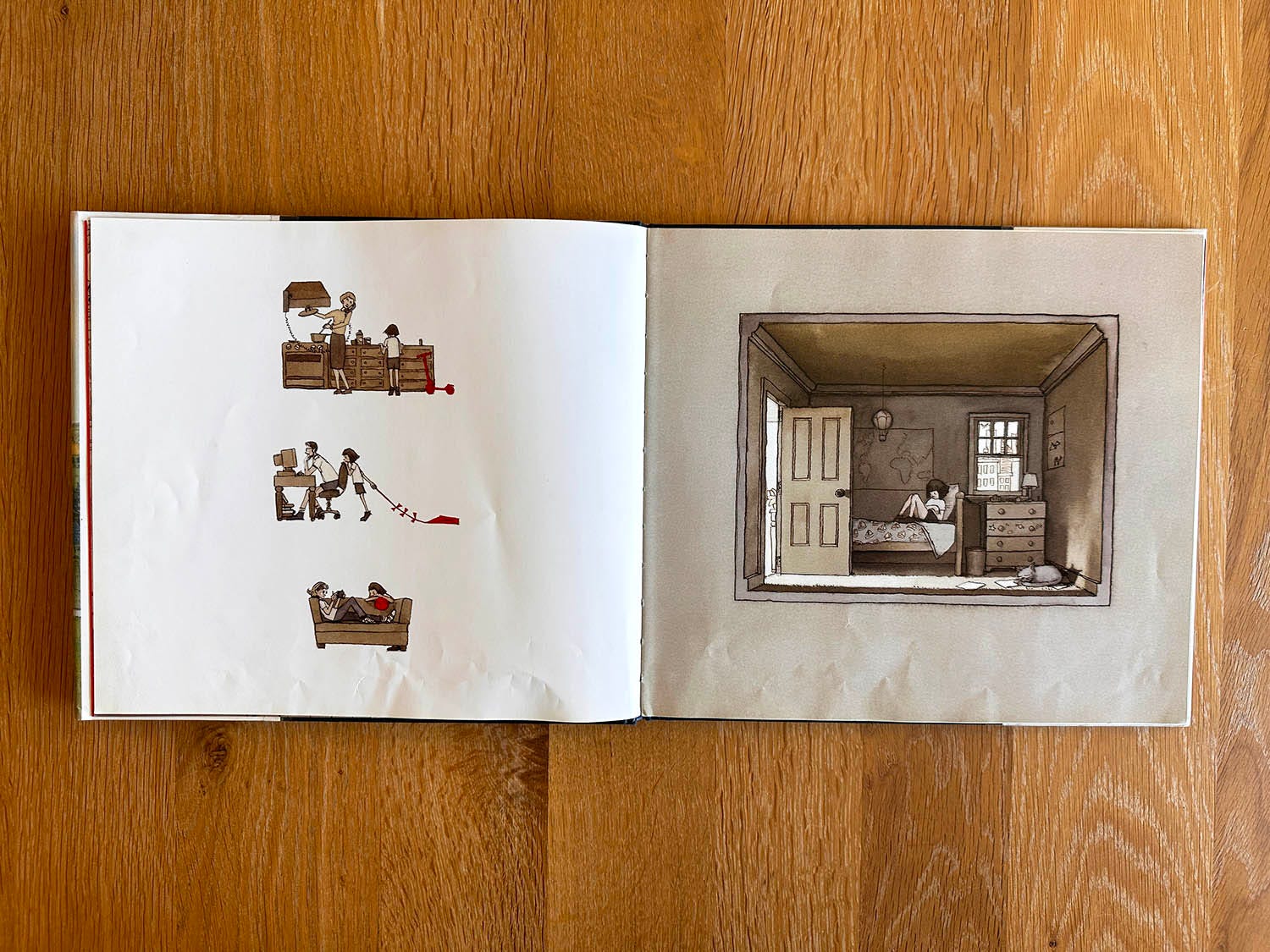
Mom is busy.
Dad is busy.
Sister, too.
She wants to play with her family, and while we can’t know why for certain, the fact that her family is her go-to indicates that perhaps she doesn’t have many friends in the neighborhood. So when the family’s busy, she’s on her own.
The first time I “read” JOURNEY a few years ago, the rich efficiency of this spread really struck me. Becker’s spot art pieces rendered in a simple palette quickly communicate what’s up. On the left, we see all the ways the girl wishes she could play: scooter, kite, ball. (Though as I write this, now I wonder—are these red toys imagined???) Her family is busy with no-fun tasks, the kinds of things that deserve a flat, cardboard brown wash.
And on the right, here she is in her room.
The room’s perspective is especially interesting. It is almost as if you are looking into a diorama. It is not just confining, it reads as a stage, a set piece. (A world this beige and boring? This can’t possibly be real life.)
Becker’s approach to this spread was super intentional. In an interview with StoryMakers, he told host Rocco Staino:
“
I wanted to pay homage to books like [Where the Wild Things Are, which] inspired me. This idea of a framed existence for a child in their room—it’s a sanctuary, yet Max in Where the Wild Things Are feels sort of confined, like it’s a prison, and loneliness for [the girl] is the same feeling.”
Study Where the Wild Things Are, and you’ll notice as the page turns go on, Max’s frames get larger and larger and larger, until they bleed over the gutter, frameless, and eventually become full bleed spreads.
Becker takes a same-but-different approach: When the girl’s cat awakens from its nap on the bedroom floor and saunters off, it reveals a secret—a red writing instrument. It’s the “key” to a doorway that takes her out of the frame, and into a brand new world. (I love how on a first read, this spread forces you to go back and study the art to catch all the little details on this page and the previous!)
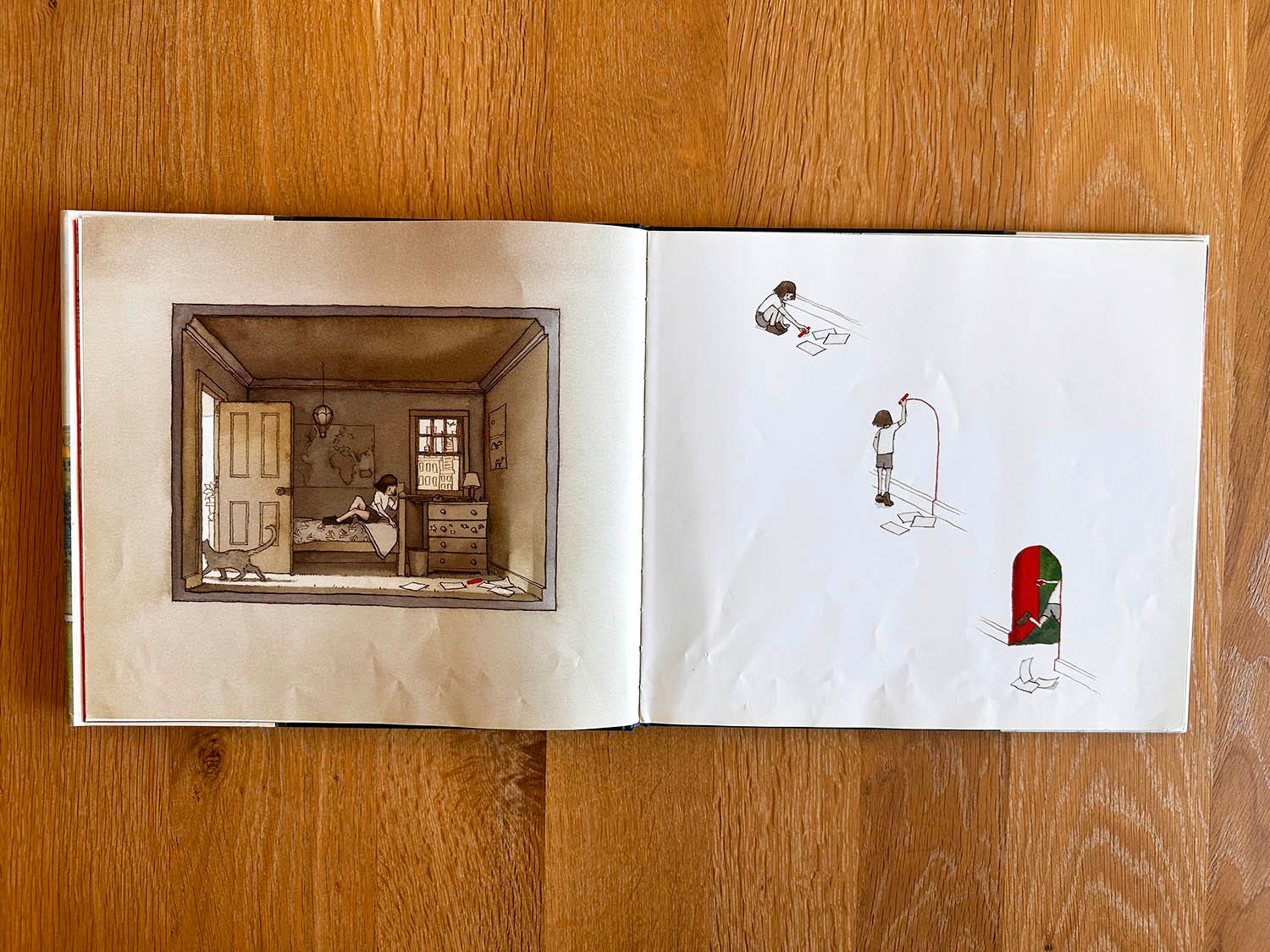
Now, what is the writing instrument? Chalk? Marker? Pen? Crayon? What do you imagine it is?
As Becker says in this wonderful narration, “the girl in this book is actually drawing with the thing that’s in your head. That’s how a wordless picture book works—you are telling the story.” How wonderful! It’s whatever you imagine it to be. Whatever you see in the story is, and thus, the story is different and personal to everyone who reads it.
Me? I imagine it as a glowing, garnet-red marker. So I’m going to call it a marker.
With the help of her magic marker, the girl’s drawn door leads her to…
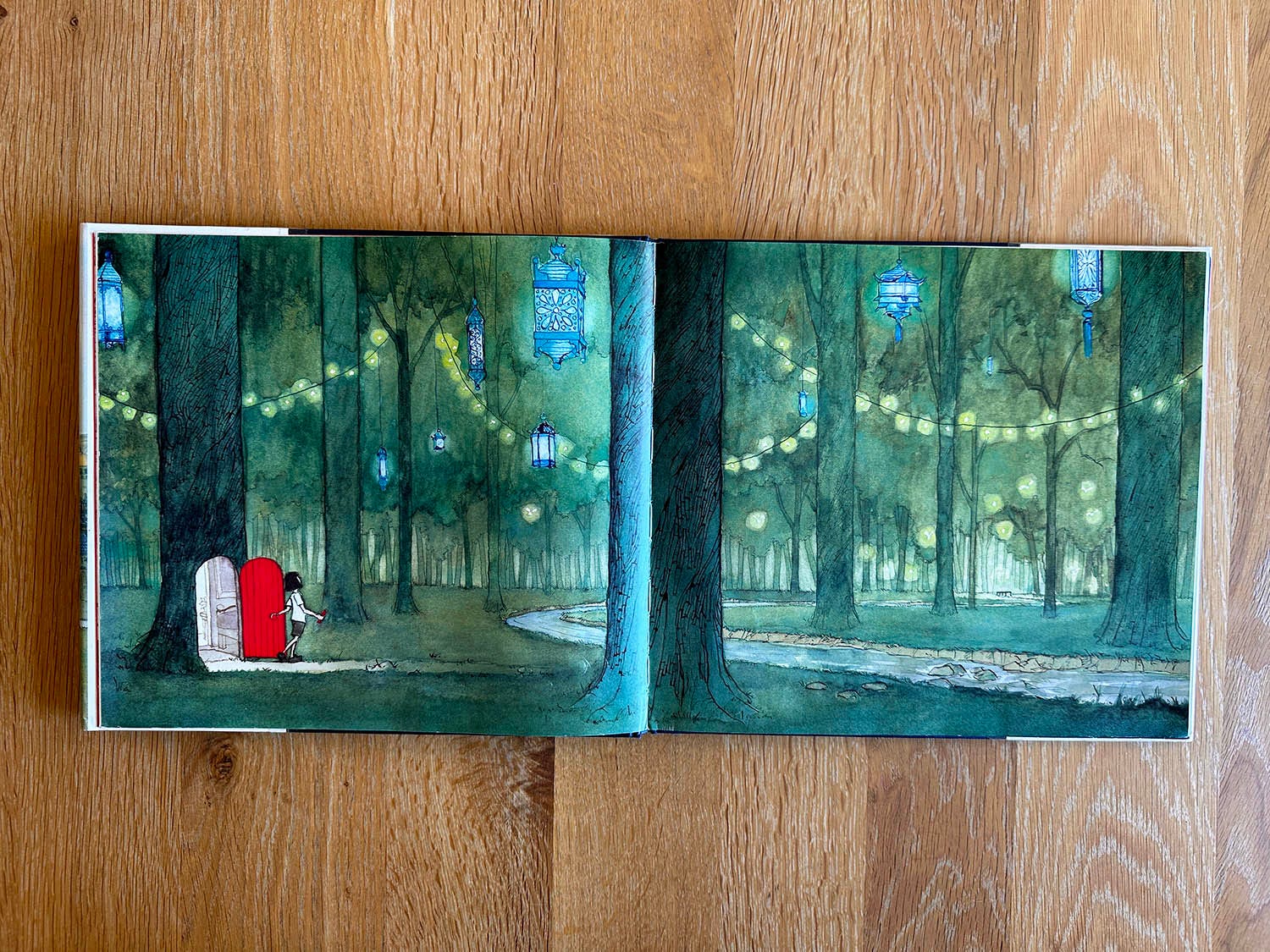
Someplace magical. An enchanted forest, full of color and wonder and adventure and fairy lights and endless curiosities.
Becker seems to tell us: In our imagination, the world becomes borderless, unbound.

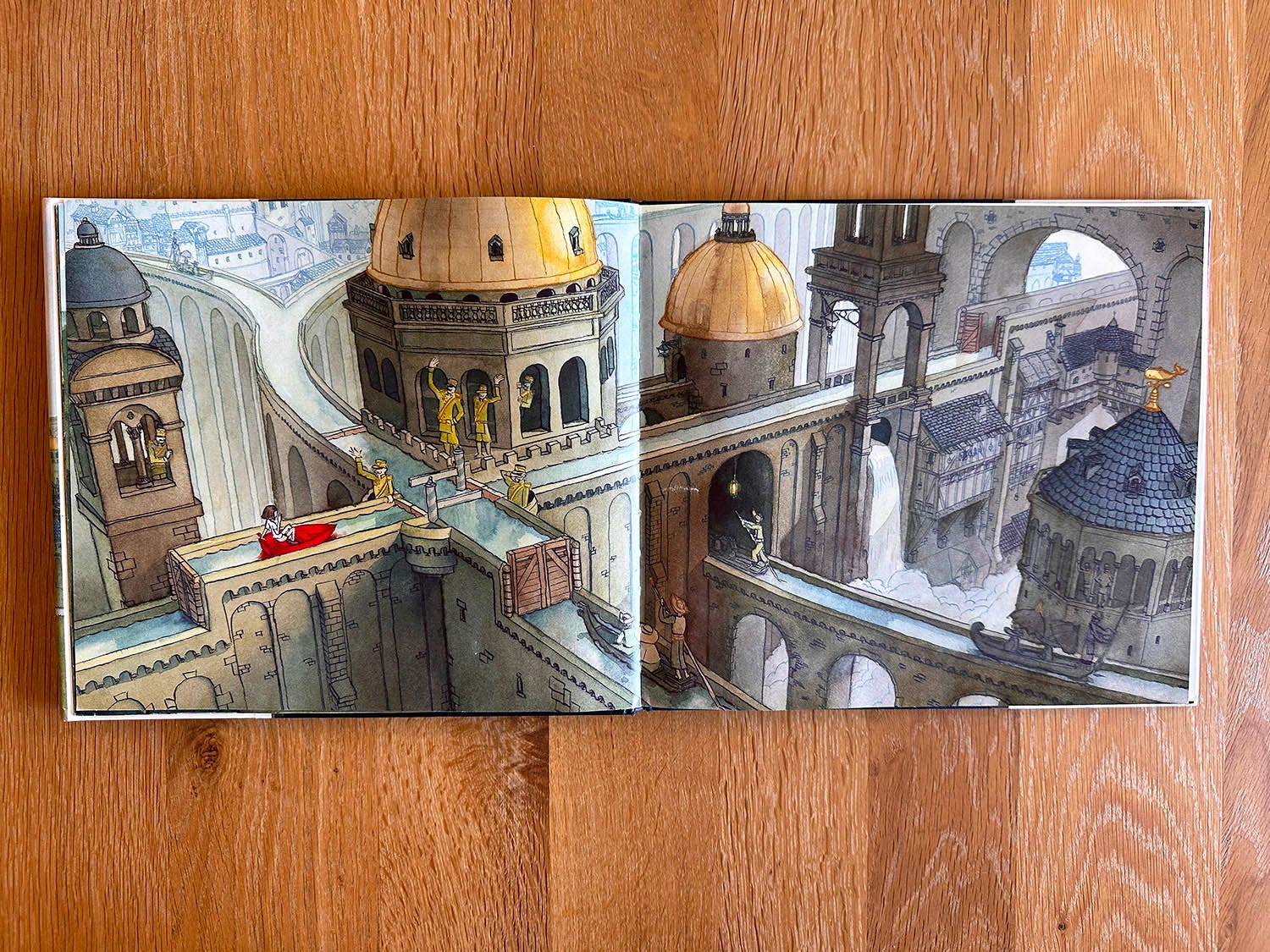
Realizing the power of her marker, the girl draws a small rowboat and drifts into a magical land named Pallonezia. Becker has said that the original inspiration for the palace was a visit his family took to Mont St. Michel when he was a boy, and the idea of a castle on a hill stuck with him. It’s funny how those childhood memories inform so much of our inspiration—and perception. Because for me, the labyrinthine pathways, stone facades and imposing domes reminded me of the world of Myst, a computer game from the 1990s. I grew up in a house where King’s Quest and Myst were on regular rotation, and there was something in Becker’s renderings—maybe the color wash, mixed with the intricacy and stateliness of the architecture?—that felt very Myst-like to me.
Notably, the girl’s boat is easy to spot in every spread, a vibrant, saturated pop of color that draws the eye immediately. Becker shared that while the rest of the spreads were colored with watercolor (the first time he’d ever worked with the medium, which is bananas!), the boat—and presumably all the girl’s red effects, including the hot air balloon below—were painted with gouache.
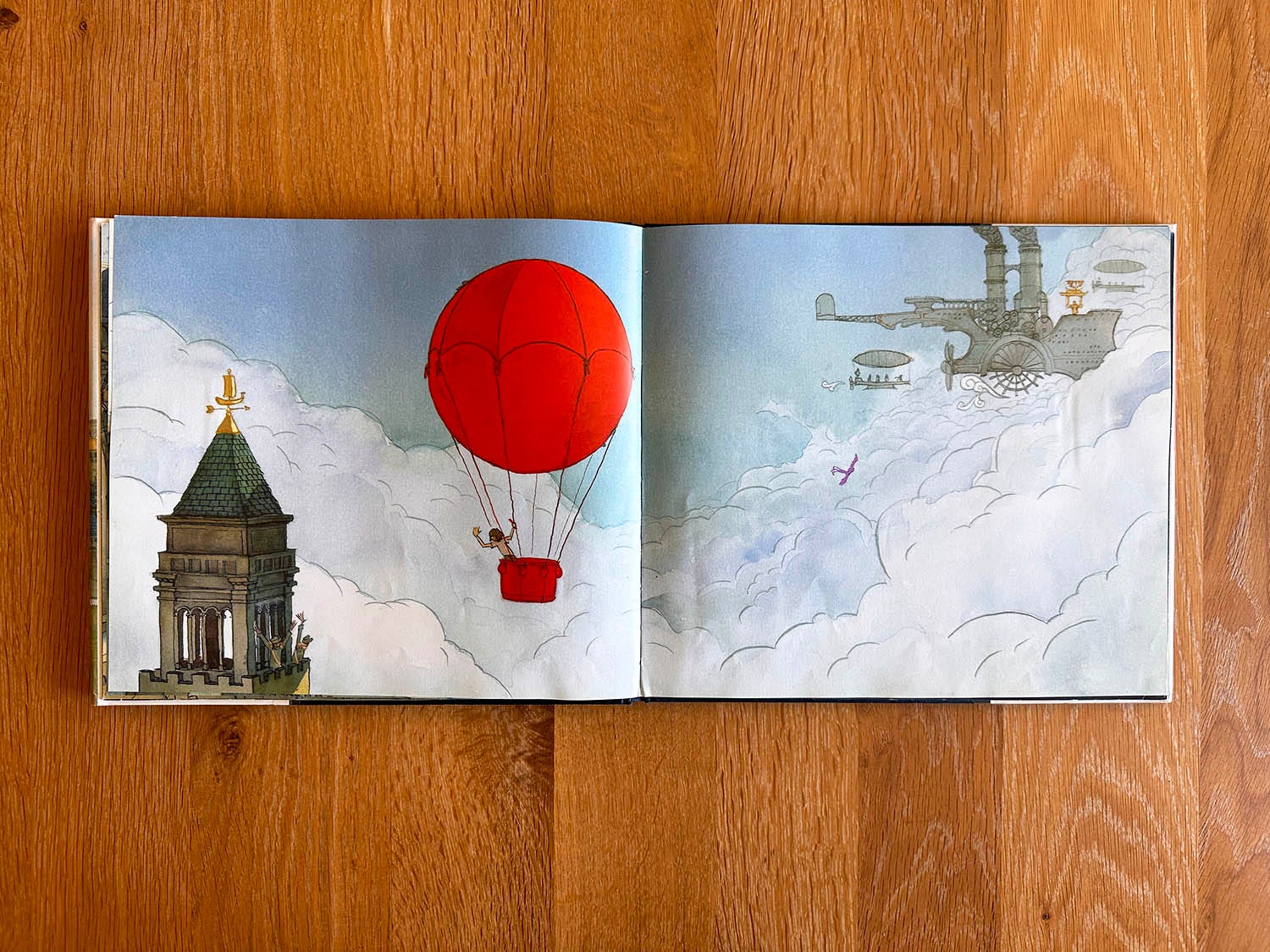
In all his interviews about JOURNEY, I listened closely for any mention of a broader metaphor behind the steampunk airship, home of the Big Bads in the story. Given his drawing—with an interesting mix of both modern/industrial and old timey styling—one could interpret some message about industry’s effect on art and beauty. After all, in a major plot point, the soldiers on the ship capture the majestic purple bird flying around the girl, and lock it in a gilded cage.
Does the girl recognize herself in the purple bird, a memory of how it felt when she was confined to her room? Newly free and unbound in this world, does she wish the same for her feathered friend?
(That’s what I like to imagine, anyway, and Aaron Becker said a wordless picture book can be whatever I interpret!)
So she does what any helpful kid would do.
She sets the bird free.
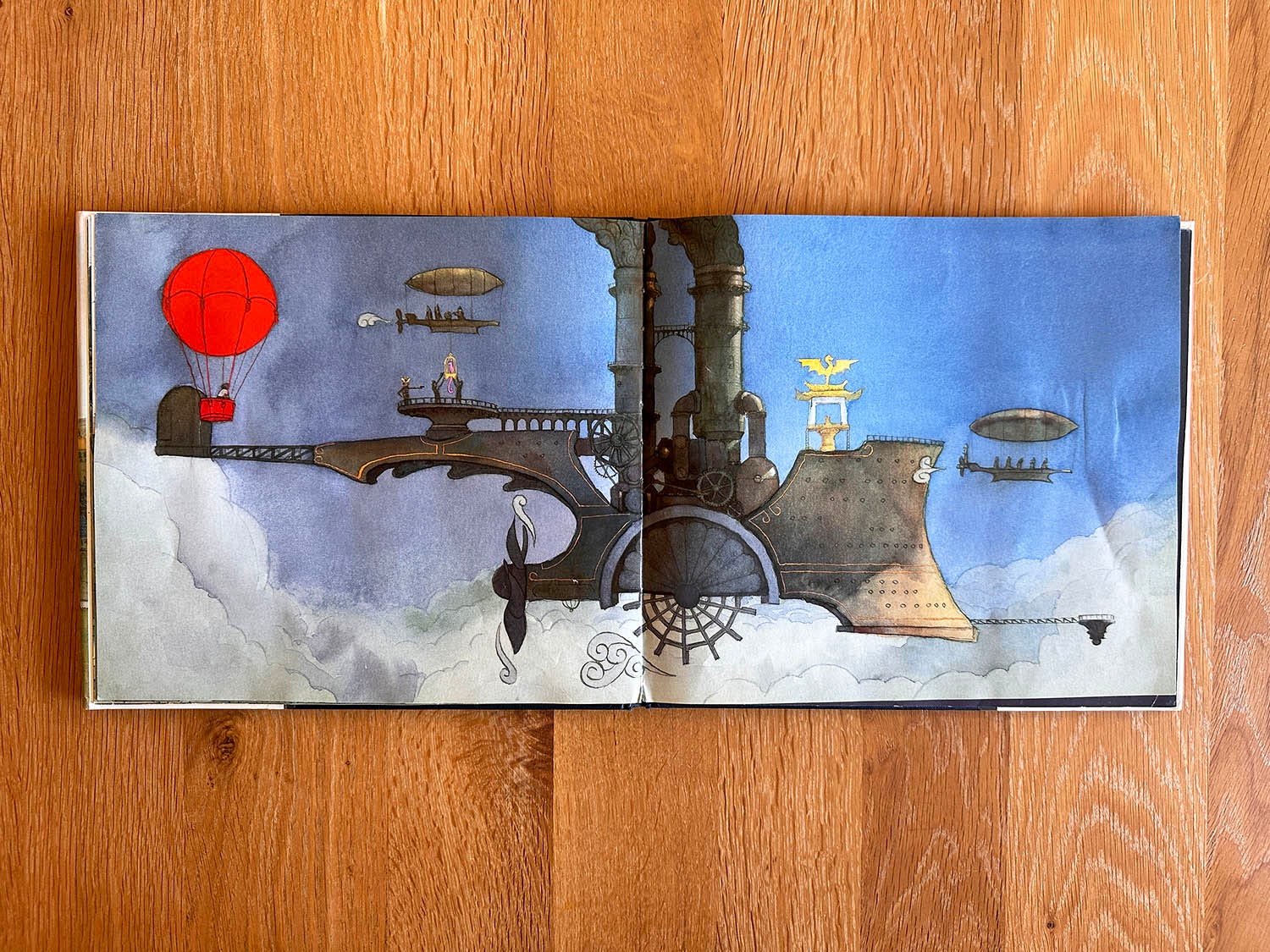

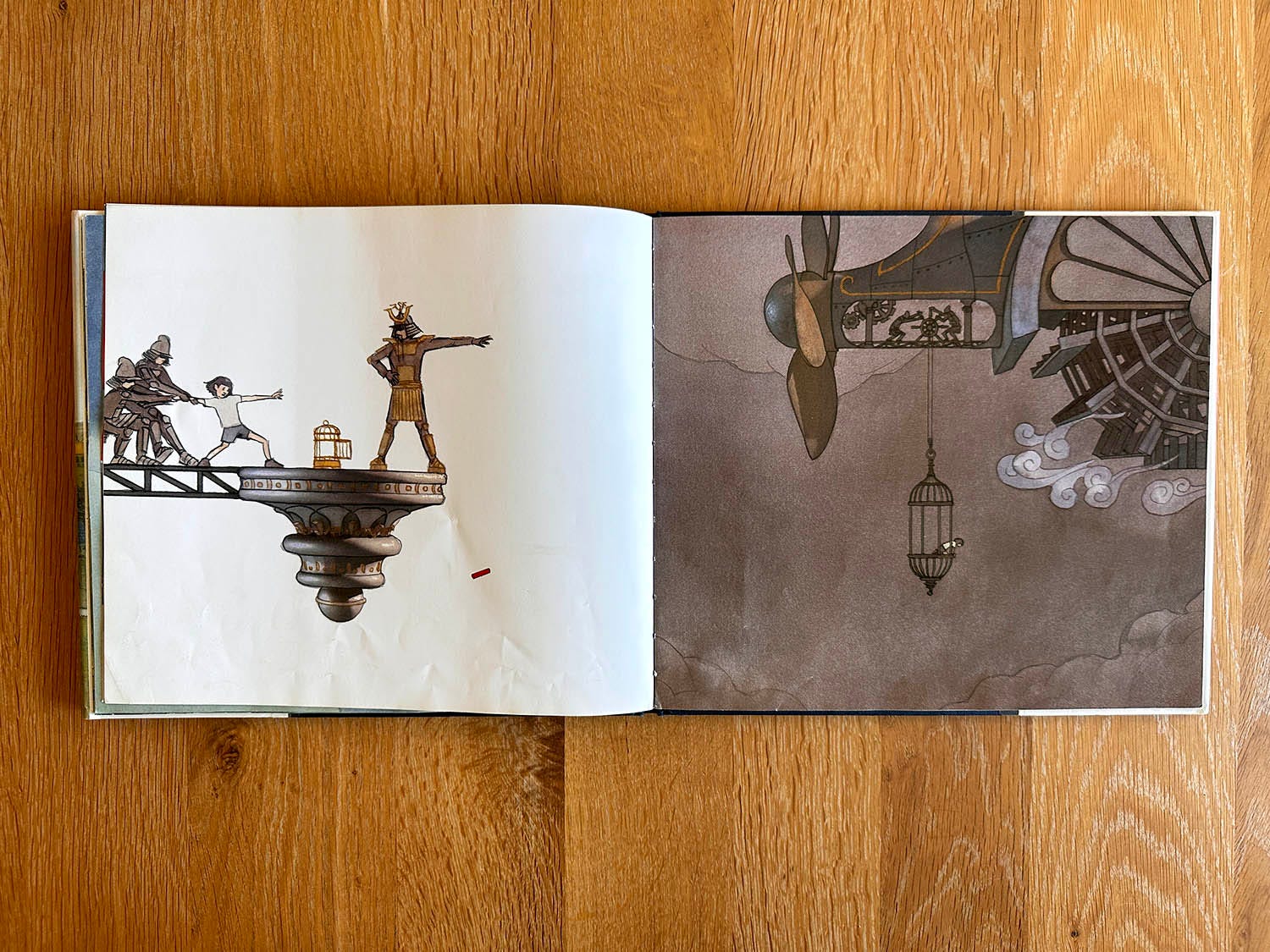
Cue the big, tense action spreads! Outraged by their foil, the soldiers capture the girl instead, toss out her magic marker, and put her in the cage.
How great is this drawing? In the lone art class I took in college (traumatic story for another day), the first drawing assignment was to draw tension. This, to me, is an incredible visual definition of tension. The horizontal lines—platform and outstretched arms—push the eye rightward, highlighting that sharp right-angle drop down down down as the marker falls. It’s great! And then on the right side, the precariousness of the cage dangling from the ship so high in the air—also tense! The girl is trapped!
But it always pays to help a friend…
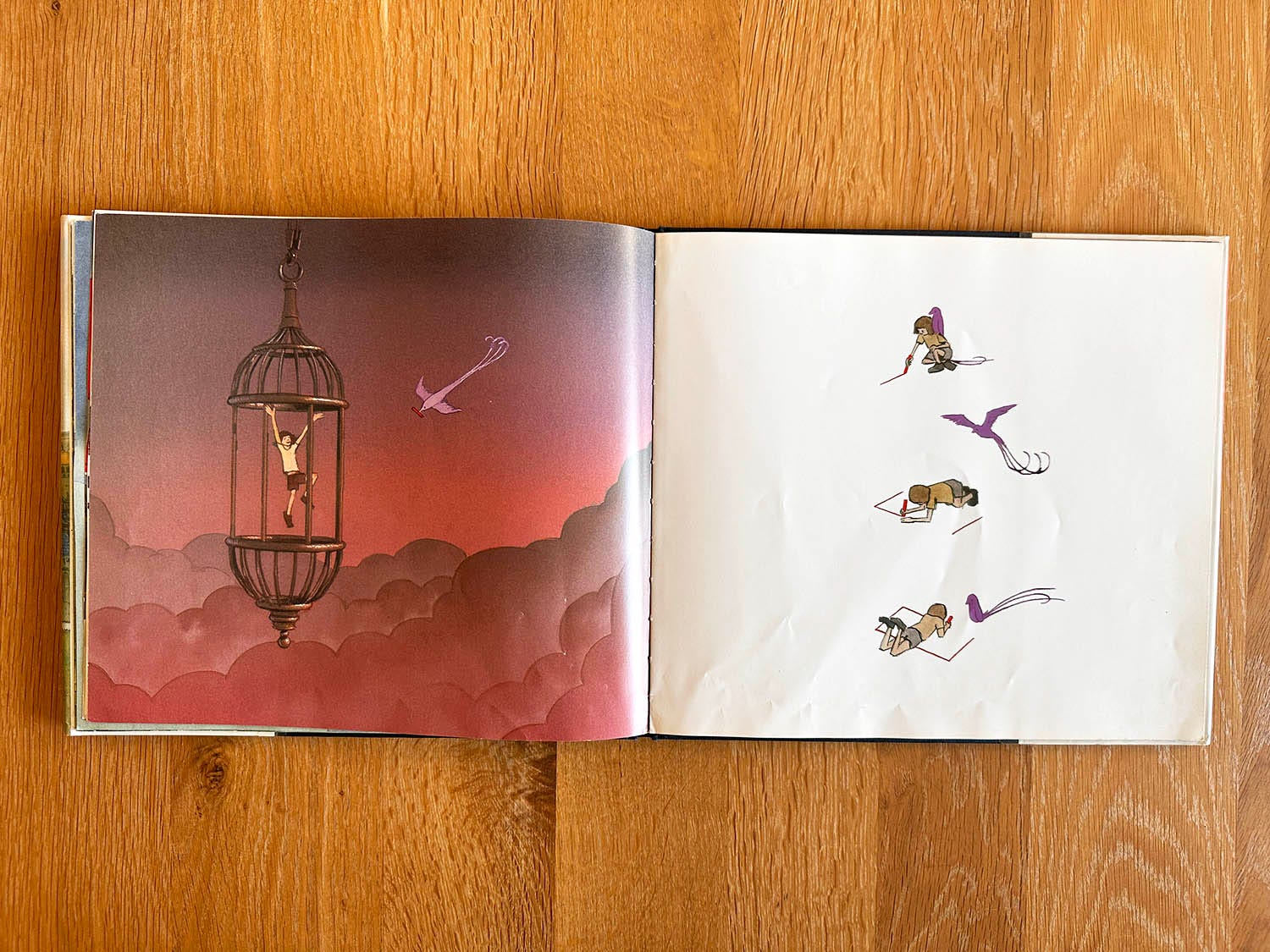
Ultimately, the bird and the girl rescue each other. (The right friends—and art—tend to do that.)
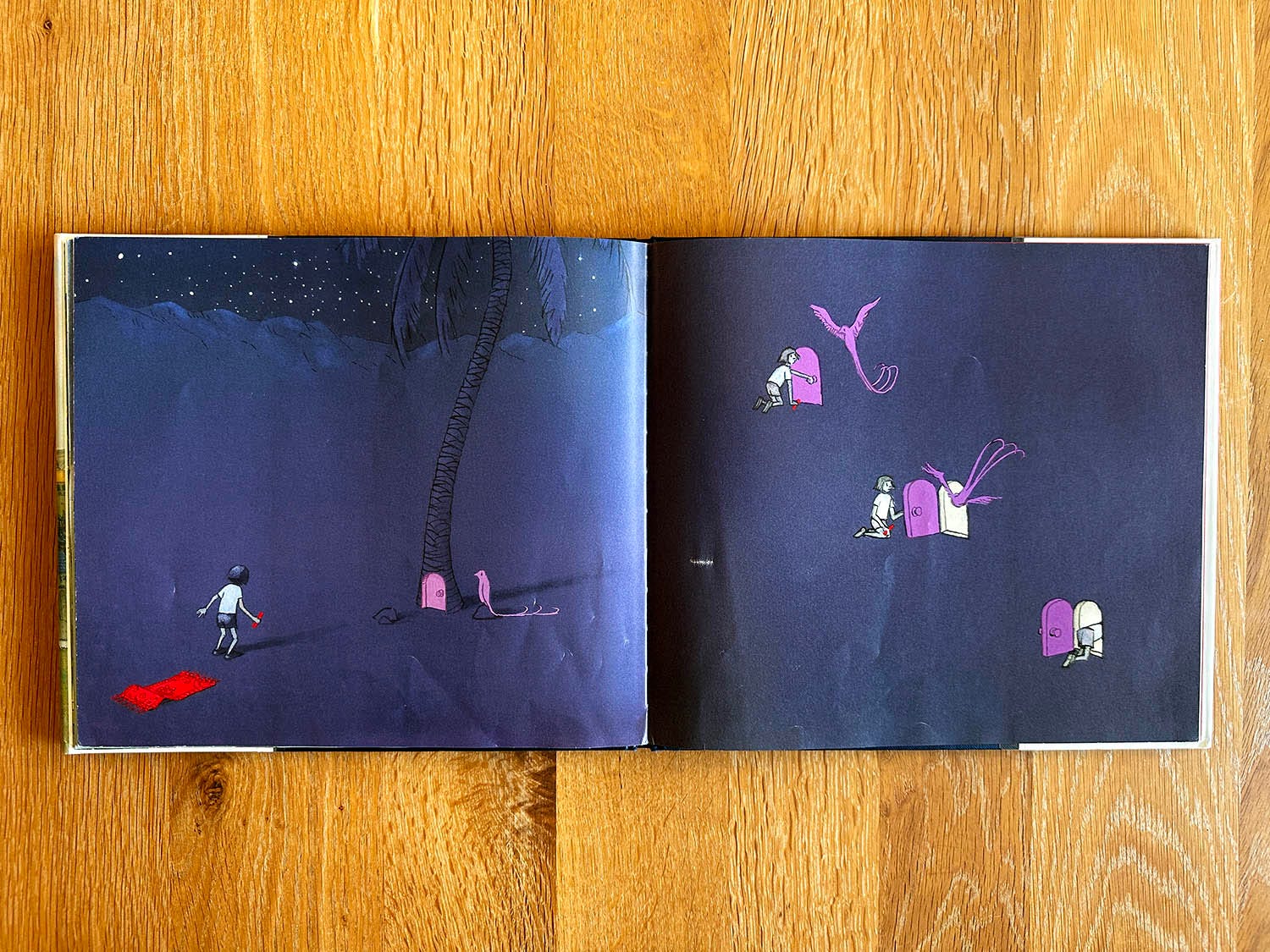
The pair escape via their imaginations once more (I’ll let your read of the book show you the full journey), with the bird navigating the girl to a small purple door, rendered in a matching purple. There’s a connection here, but what?
Through another magical door and…
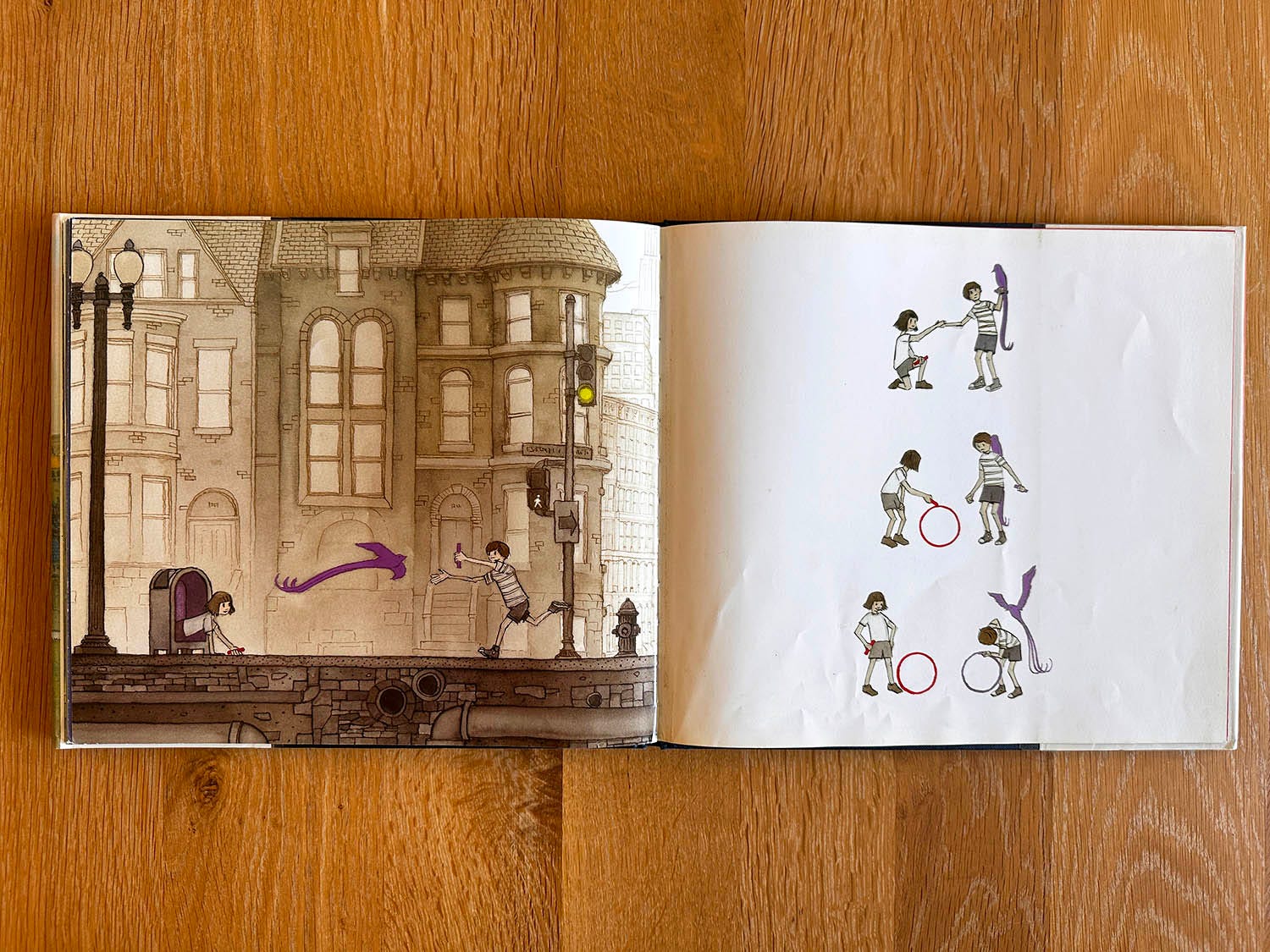
Back to real life! The bird is the product of a magical purple marker, whose owner is a boy in the neighborhood. Hooray for new friends!
…But wait a sec! Let’s go back to the beginning:
Look at the copyright spread. Who do you see? What are they holding?
Sometimes, a new friend is hiding in plain sight.

One of the joys of looking through JOURNEY is that there are so many details, including lots of “easter eggs” you can track down. For example, on the copyright page above, Becker has drawn a dragon emblem topping one of the buildings downtown. It appears again, golden and gleaming, on the steamship.
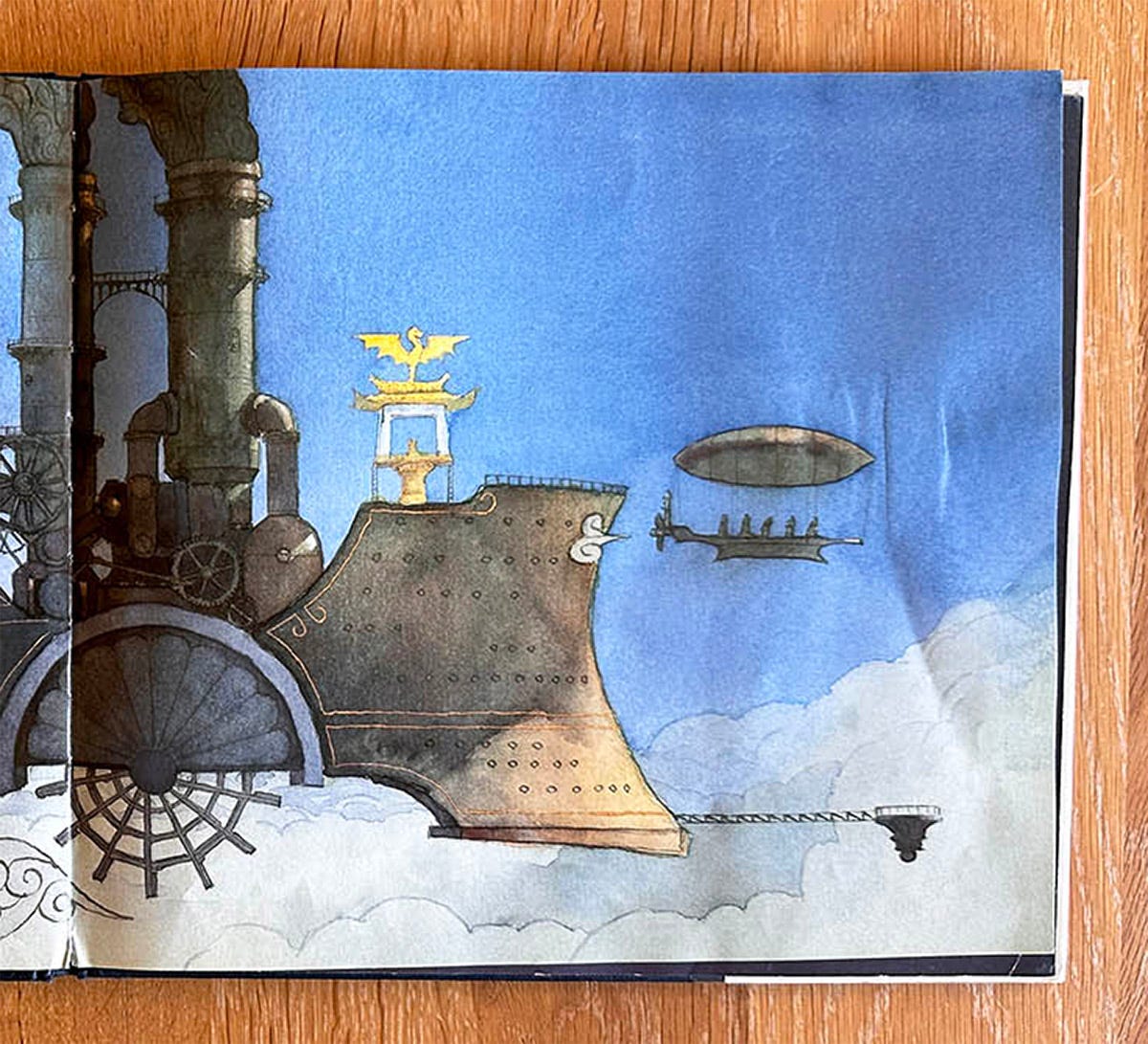
This offers such ripe, rich opportunities to talk about story with kids. Questions like: Is this all a dream, with the girl remembering the symbol from her daily life such that it pops up in a dream? Or perhaps the imaginary world is actually a parallel world to ours, and it inherits aspects of the “city” world while being completely real? (What is your kid’s theory?)
And for older kids and grown-ups: why would Becker make the connection between an office building and steamship? Is he making a statement about who the bad guys are? I haven’t read or heard him say as much, but it’s interesting to wonder about and formulate your own theories!

Aaron Becker has shared literal hours of incredibly generous content discussing his story development and artistic process across many of his books, and none more so than JOURNEY. It’s astounding that this was his debut picture book, even more so since it was granted a Caldecott Honor in 2014.
Here is a video he posted on his website during the making of this book, which talks about his approach and process. It’s beautifully done!
If you want to learn even more about his background from graphic designer to cinema concept artist to picture book maker, this StoryMakers interview was full of interesting tidbits. As ever, the things we love as kids inform so much of what we do as adults—from Legos to home art projects, everything pays off later!
Finally, here’s a great one to share with young students exploring their own art projects and creativity. In collaboration with JOURNEY’s publisher Candlewick, Aaron made this narrated video which discusses creating wordless picture books and honing your craft.
If you watched any of these, you heard a lot about the follow-ups QUEST and RETURN. Check them out, too!
Three more interviews to learn more about Aaron Becker and his work:

Support the makers:
You can also purchase prints and originals of Aaron’s work!
Buy your copy:

M E T A
In this Post: Journey by Aaron Becker
Keywords: Wordless, castles, soldiers, boat, mystical, imagined, dream, friendship, rescue, journey, loneliness, creativity, imagination, travel, city kids, boredom
Comments
Nothing yet. Say the first thing.
Sign in to join the conversation.