
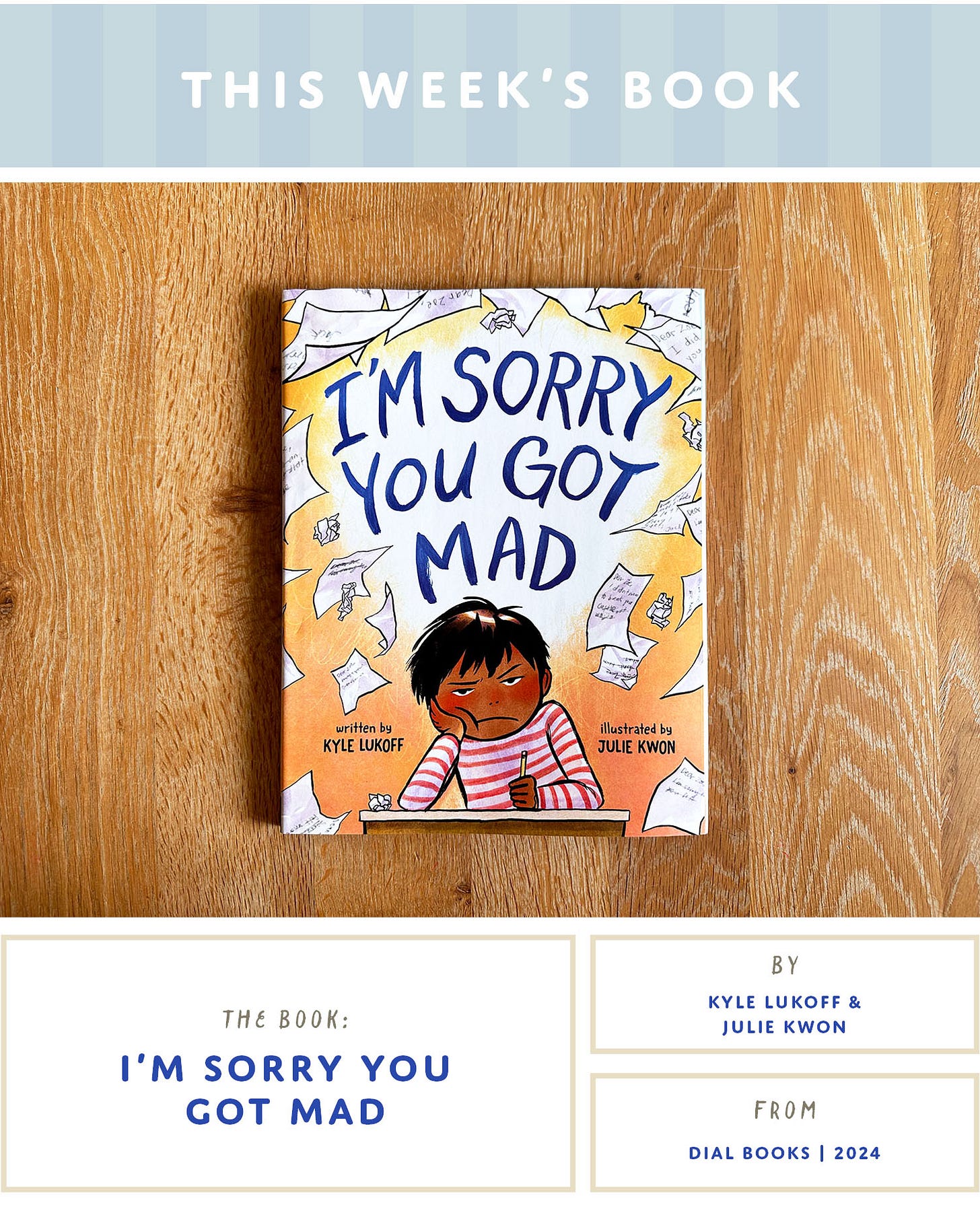
Lately there’s been a lot of discussion about moralizing and didacticism in picture books. I’ll save the behind-the-scenes industry drama and my hot takes for another day, but I will say that when a book manages to tell a great story while “teaching kids something,” and with an epistolary format to boot, well—I tip my hat.
I’M SORRY YOU GOT MAD, in my mind, threads that very fine needle. On its surface, it seems like it could go the didactic route (and to be sure, there are some clear lessons and takeaways). But thanks to wonderful character illustrations by Julie Kwon, plus Kyle Lukoff’s multi-layered story and deep empathy for his main character, this one makes for a great bedtime book, a classroom SEL book, even a mystery of sorts. More than anything, Lukoff highlights a core tenet of the human condition: We all just want to be seen, heard, and understood.
Let’s dive in!

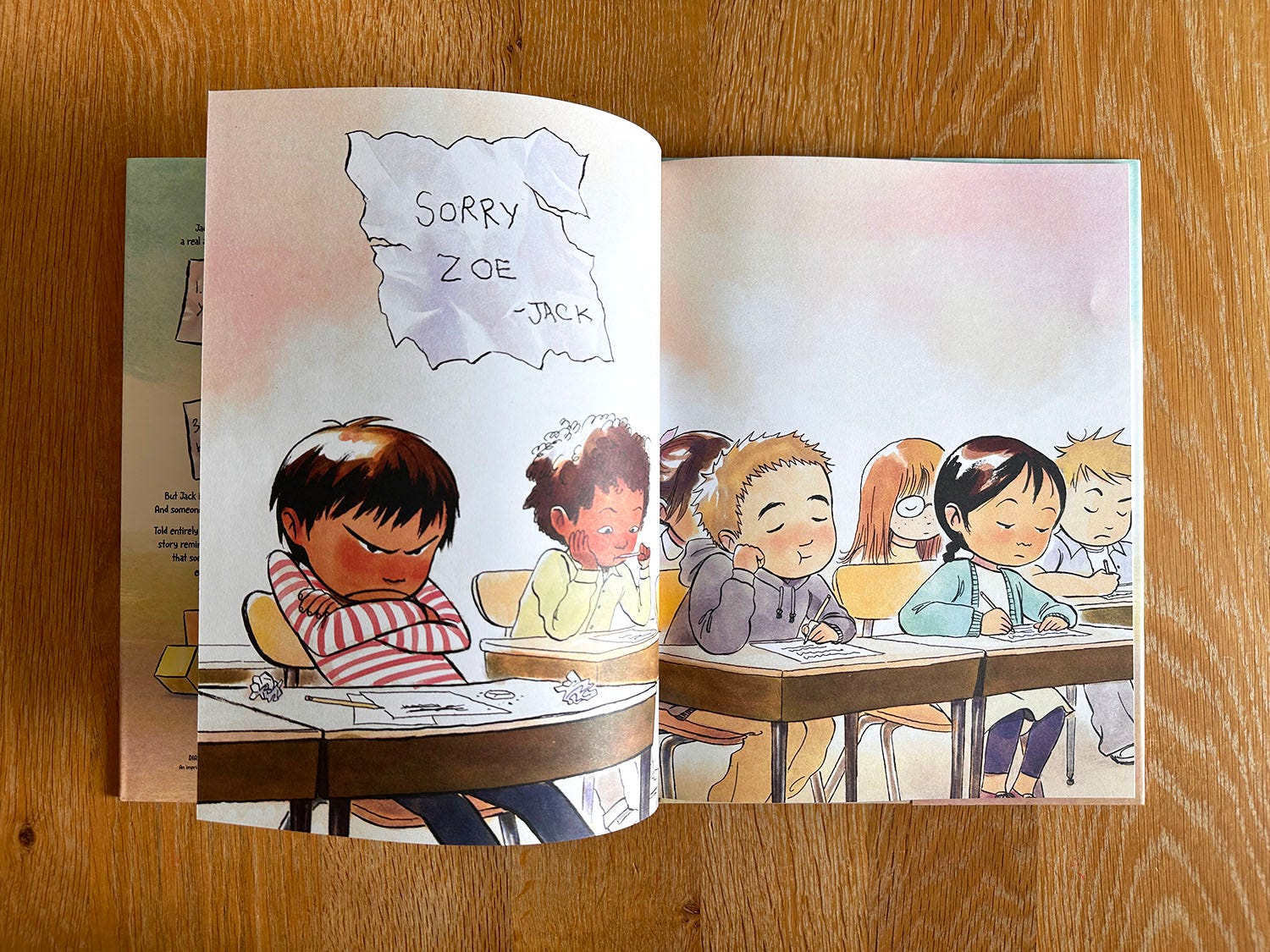
We open on Jack, throwing a crumpled, balled up note into the trash (revealed to yell read, simply, SORRY. Turn the page, and there’s a little more context: Jack is mad mad, burning red with indignation, and the most he can muster in v2 of his note is “Sorry Zoe.”
Oh, the tension, the mystery! What happened between these two kids? Who is Zoe? What about all these other kids in the class? (I love examining their faces and imagining who they are and what they’re thinking about!)
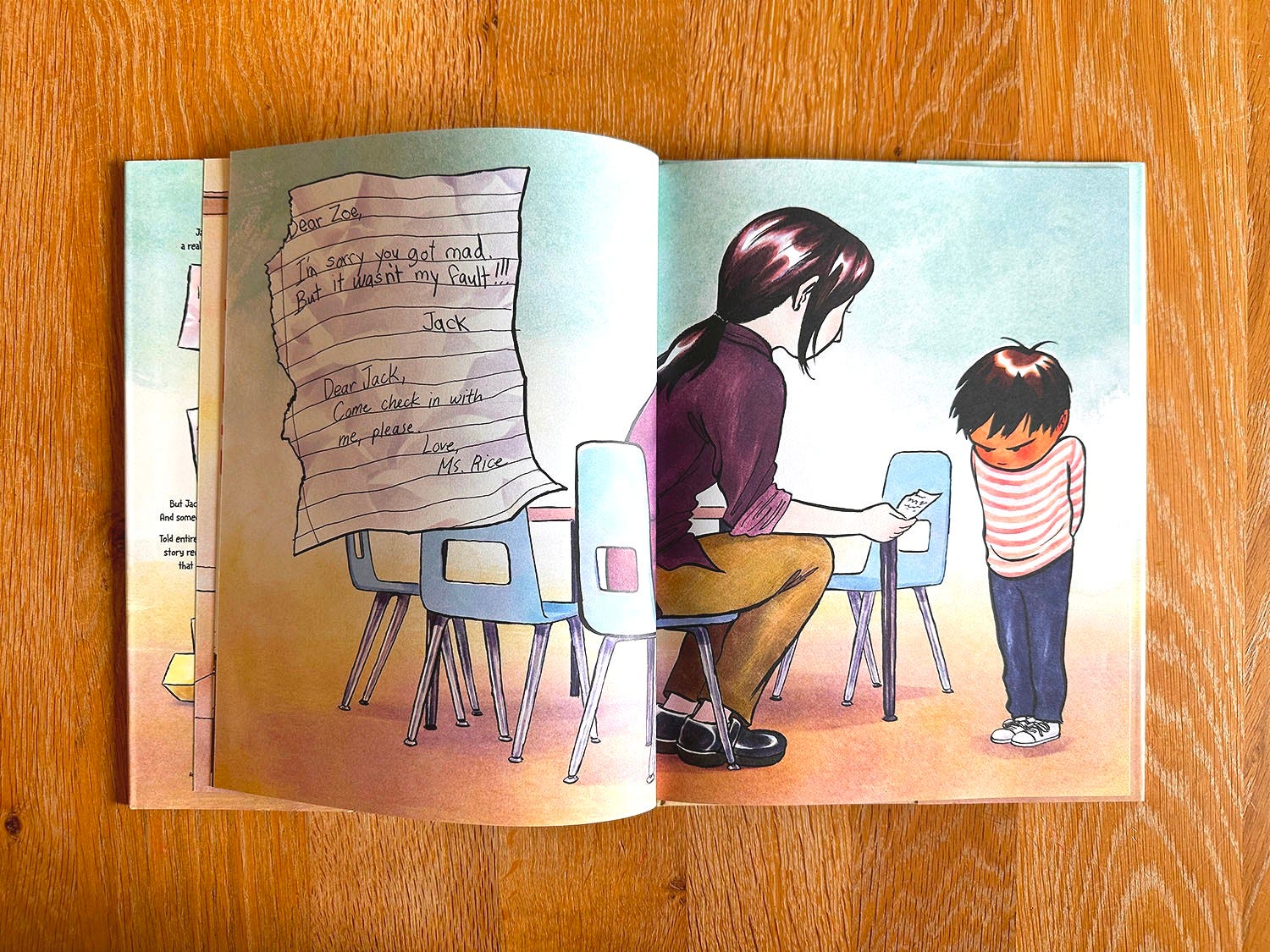
By the fourth spread, we get a little bit more from Jack, as well as the book’s title:
“I’m sorry you got mad. But it wasn’t my fault!
In response, Jack hear’s not from Zoe, but from his teacher, Ms. Rice:
“Dear Jack,
Come check in with me please.
Love, Ms. Rice”

As I’ve read this book over and over again, one thing I’ve wondered about is Ms. Rice’s writing on Jack’s notes. All the notes are crumpled, some even half torn—are these undelivered notes Ms. Rice finds in the trash? Or does Jack give them to her for review, before passing to Zoe?
From an art direction standpoint, having her write directly on his notes works well—the difference in handwriting and the interplay between text and picture force the reader to observe carefully. It moves the story along quickly, to say nothing of the additional (calm!) voice it adds. But I also wondered if Jack was pissed that someone read his words. I mean, I guess I’m glad they did (if I were Zoe and received a note that said “I’m sorry you got mad but it wasn’t my fault” I’d be like okayyyy). But still.
I’d love to know Lukoff’s vision here—teacher as copyeditor? Or does Jack never actually give any of these notes to Zoe, and Ms. Rice finds every single one in the trash? If the latter, does that mean he knows none of these apologies are it? Is there something else he’s trying to tell Zoe—and Ms. Rice? (ding ding ding)

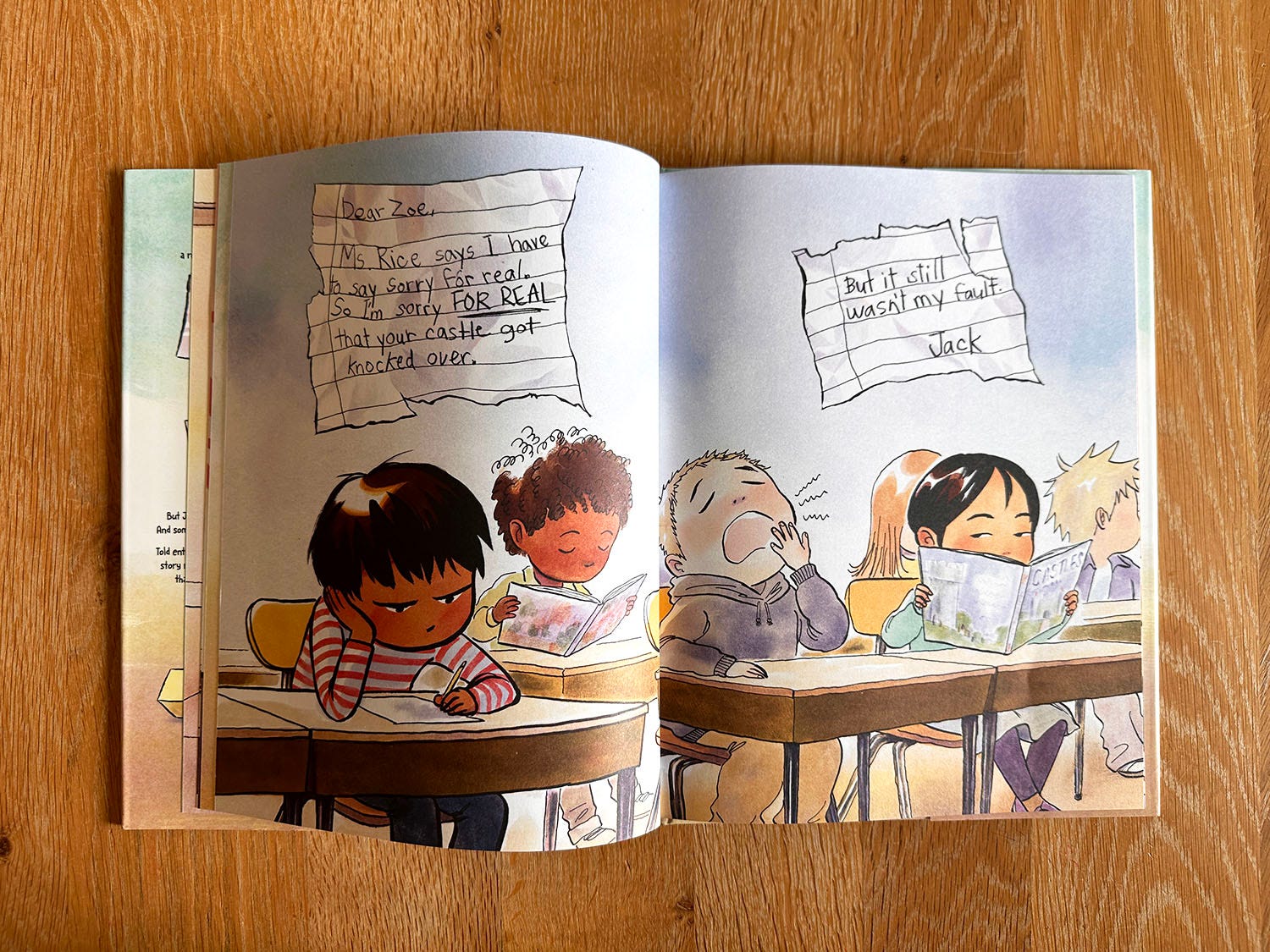
“Ms. Rice says I have to say sorry for real. So I’m sorry FOR REAL that your castle got knocked over. But it still wasn’t my fault.”
The first time I read the above version of Jack’s letter, I laughed out loud. Once (or twice) when I was a kid, I remember my mom instructing me to “Say you’re sorry, Victoria” and I retorted “You’re sorry, Victoria,” and let’s just say there’s a reason I only tried that once (or twice).
This kids-at-desks spread mirrors the earlier one, which is a great way to show the passage of time—even though we’re within the same school day. By this point, we’ve figured out who Zoe is, too. The Castles book. The side eye. She’s not impressed with Jack!
Meanwhile, the other kids are all in their own worlds, having very different days. Kwon talked a little bit about this on her Instagram:
“The most fun part of making this book was figuring out who all the classmates were and each of their personalities. Some are more outgoing, some more reserved, this kid is best friends with this kid, etc.
I also thought about my own experiences in school and how often things would be split on gender lines (which is an implicit sub-theme of the book). Beyond just making the book more interesting and adding more depth, thinking and figuring all of this out helps with compositional layout in other spreads. Instead of randomly clumping kids together, I would imagine mini scenes and dramas according to everyone’s own personalities and group them accordingly.”
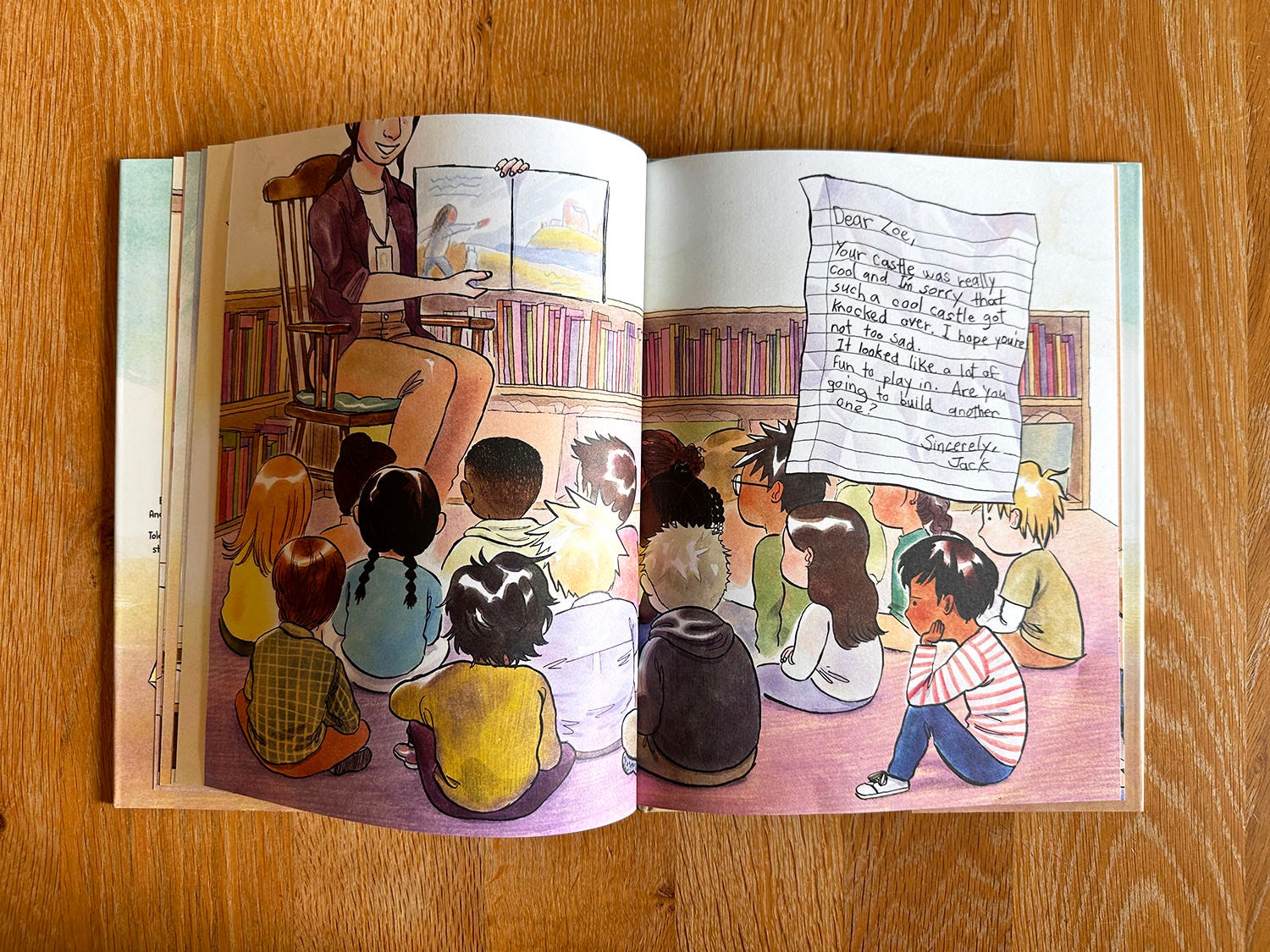
As the day wears on and Jack tries other versions of his letter, we can track his emotional journey via body language. Look at how his demeanor has changed here. The anger has dissipated and now, in his emotional distance and inability to repair things with Zoe, he’s also physically distant, set back as if not part of the group. This feels so real to me. I can remember as a kid, so vividly, whenever I knew I’d messed up but wasn’t sure how to own it, how that hesitation and anxiety made me feel so separate from my friends. It wasn’t always clear how to get back into the fold—because even though I knew I needed to apologize, the fear wasn’t in making the apology itself, but of rejection. It is a super lonely feeling. (What a tender thing it is, to be human in this world! To wish for understanding and visibility while also acknowledging the ways in which we can hurt the people we love!)
As for the letter:
“Your castle was really cool and I’m sorry that such a cool castle got knocked over. I hope you’re not too sad. It looked like a lot of fun to play in. Are you going to build another one?”
That’s pretty good, you may be tempted to think. But no. Off camera, Ms. Rice sets us straight:
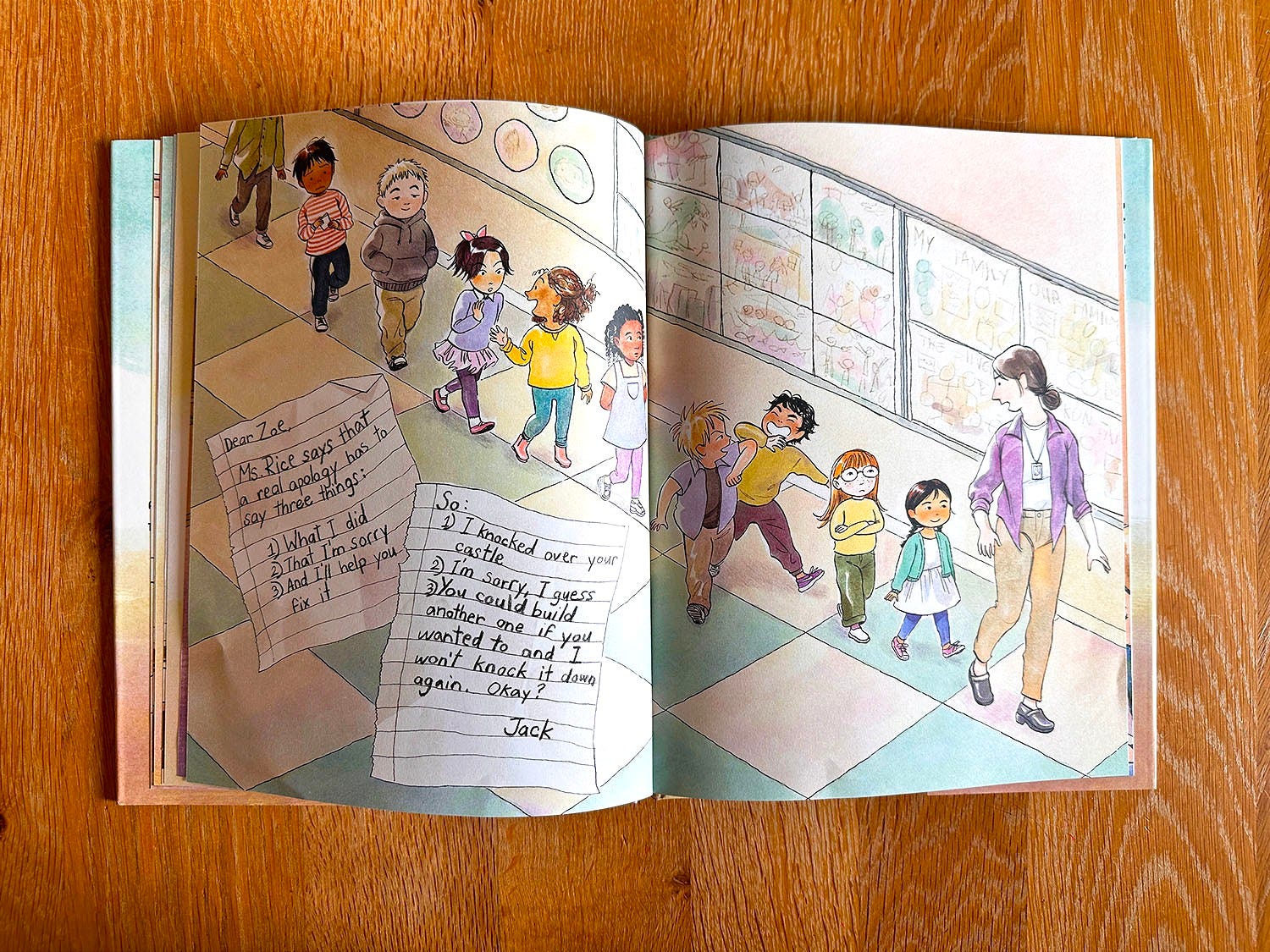
“Ms. Rice says that a real apology has to say three things:
What I did
That I’m sorry
And I’ll help you fix it
Who knew it could be so hard?

Spoiler alert: the whole castle getting knocked down thing?
It happens…again. Oh, Jack.
But in his letter about the repeat offense, we get another clue:
“Do you remember yesterday when you built a different castle? And you and Nia and Maddie were playing in it? I wanted to play too but I couldn’t and that got me mad. So someone should say sorry to ME! Because that’s why I knocked down your castle today.”
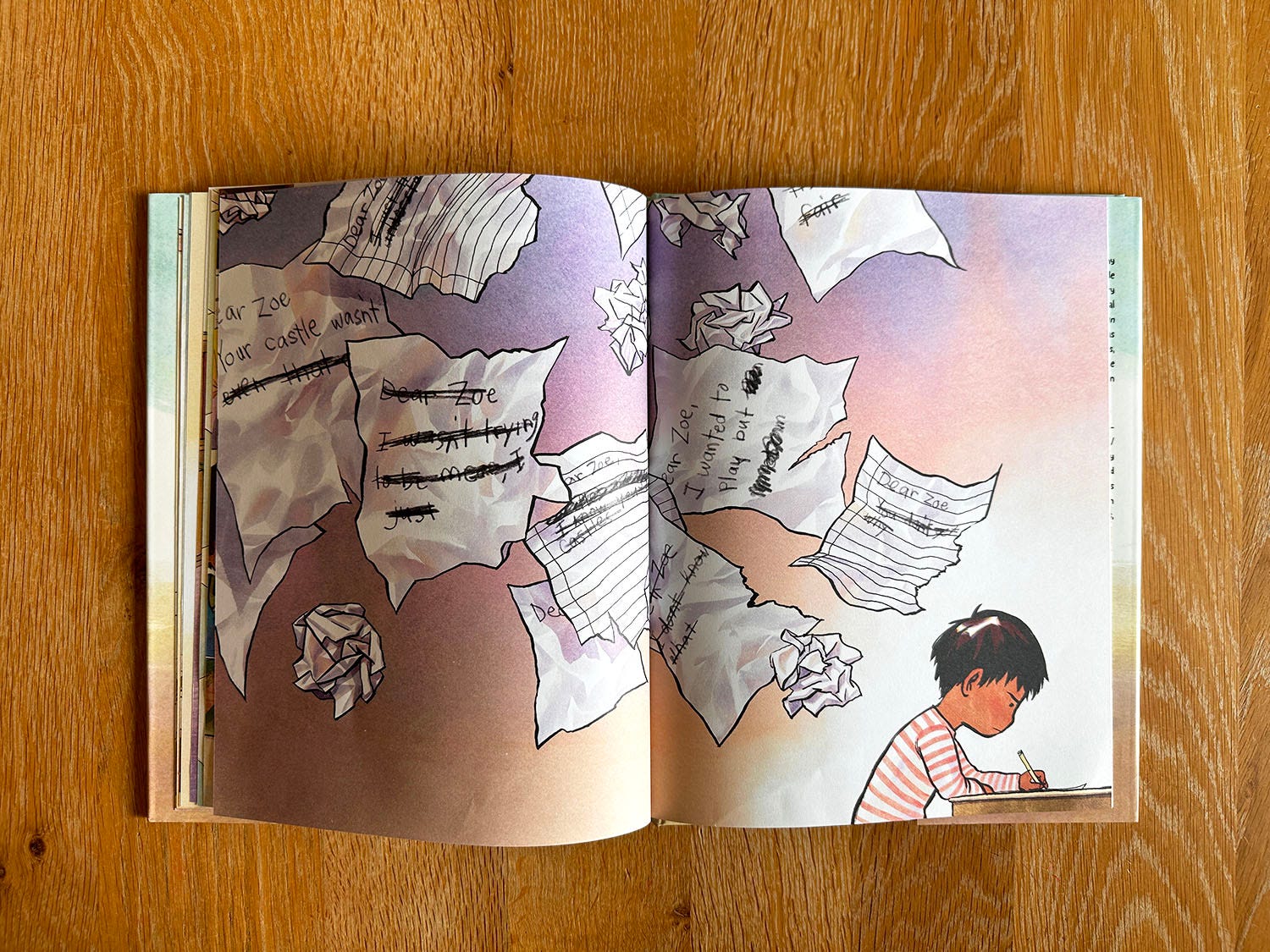
Writing another apology for the second transgression of the thing you haven’t apologized for in the first place is hard. Look at his concentration! The stakes are high for Jack. The budding character transformation is so great—alongside all the drafts, that look on his face speaks to his own frustration and determination, not just his anger. There’s an injustice here, but we’re not sure what it is quite yet. At the same time, you don’t crumple up that many drafts unless you care and want to get the words right, all with the end goal of connecting with someone. You know?
These discarded notes reveal that longing to be understood. It is such a deeply human thing to vulnerably offer an apology, and hope the recipient understands your motivations and your subconscious and still chooses to love you anyway.
(Meanwhile, I also want to jump into the book and be like, Jack, my guy, you CANNOT start an apology letter with “Your castle wasn’t even that…” PIVOT, quick!)
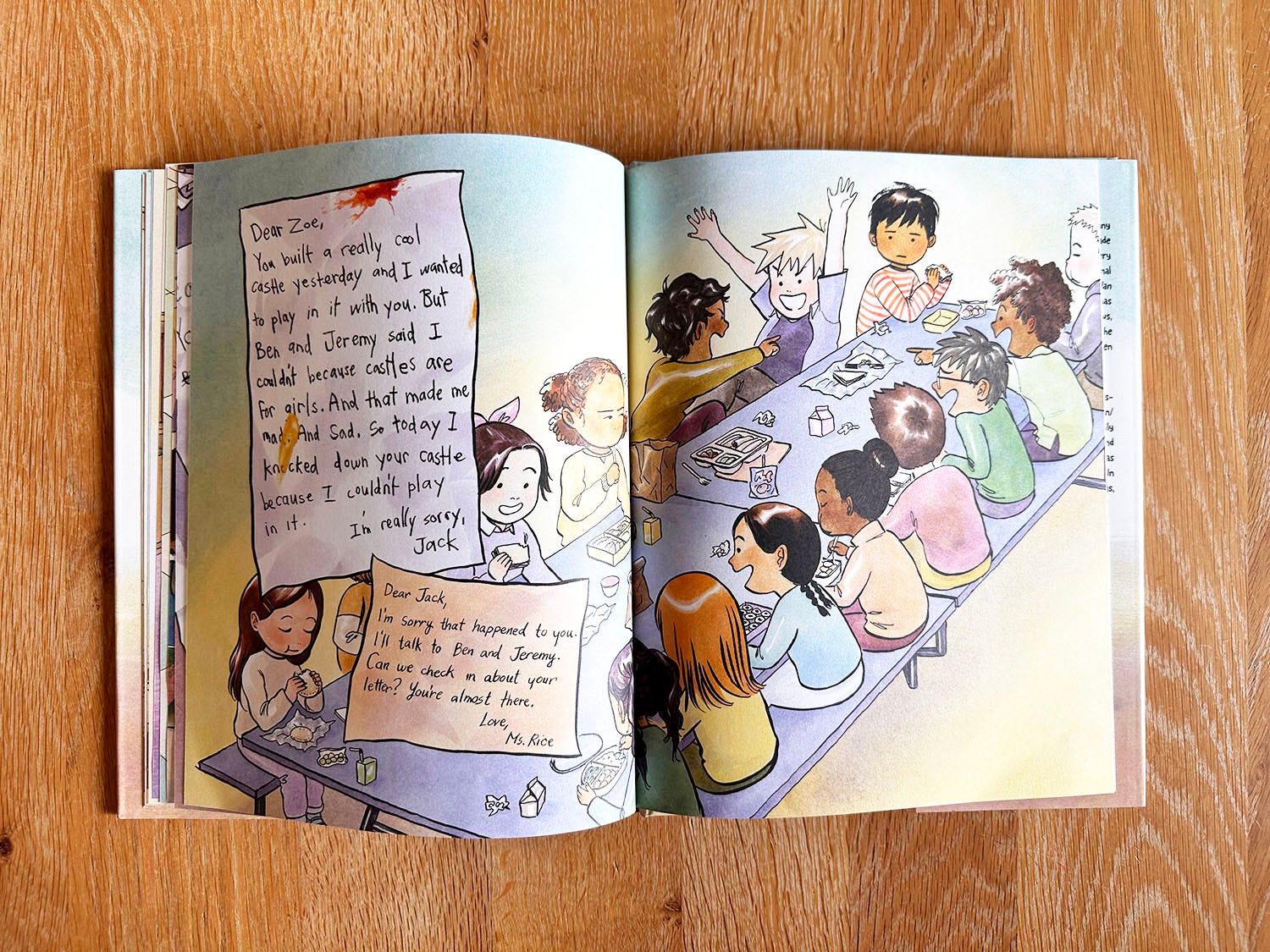
Turn the page, and here’s where we discover this was much more than Jack knocking down a castle for no reason. Jack writes:
“You built a really cool castle yesterday and I wanted to play in it with you. But Ben and Jeremy said I couldn’t because castles are for girls. And that made me mad. And sad. So today I knocked down your castle because I couldn’t play in it.”
People’s actions are never as simple as they seem, truly.
Jack’s next version of the letter is his last. It’s interesting, how writing out what happened and how he felt about it in the previous note allows him to forgive himself, and acknowledge how Zoe must’ve felt, too. In his final note, he writes:
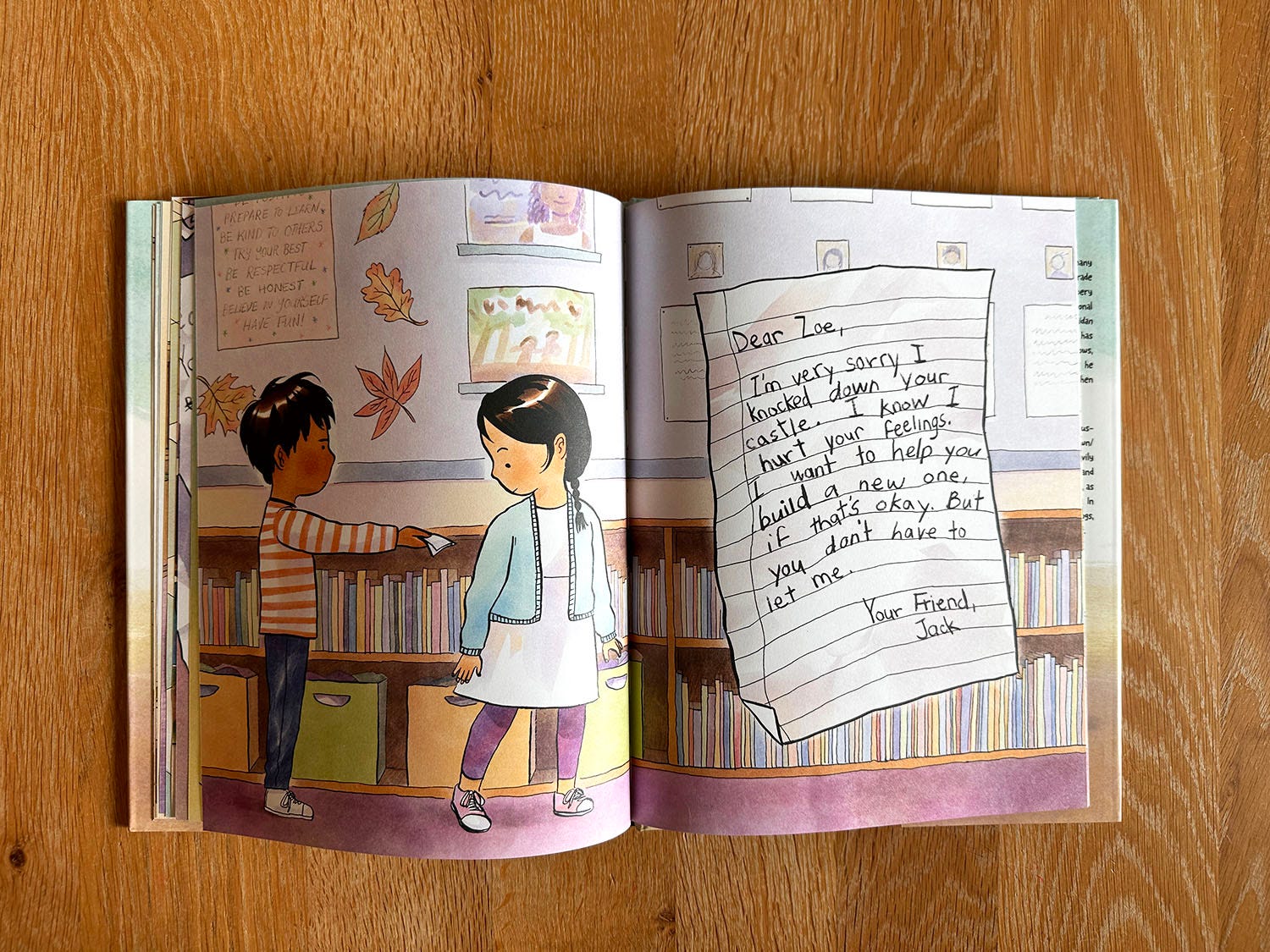
“I’m very sorry I knocked down your castle. I know I hurt your feelings. I want to help you build a new one, if that’s okay. But you don’t have to let me.”
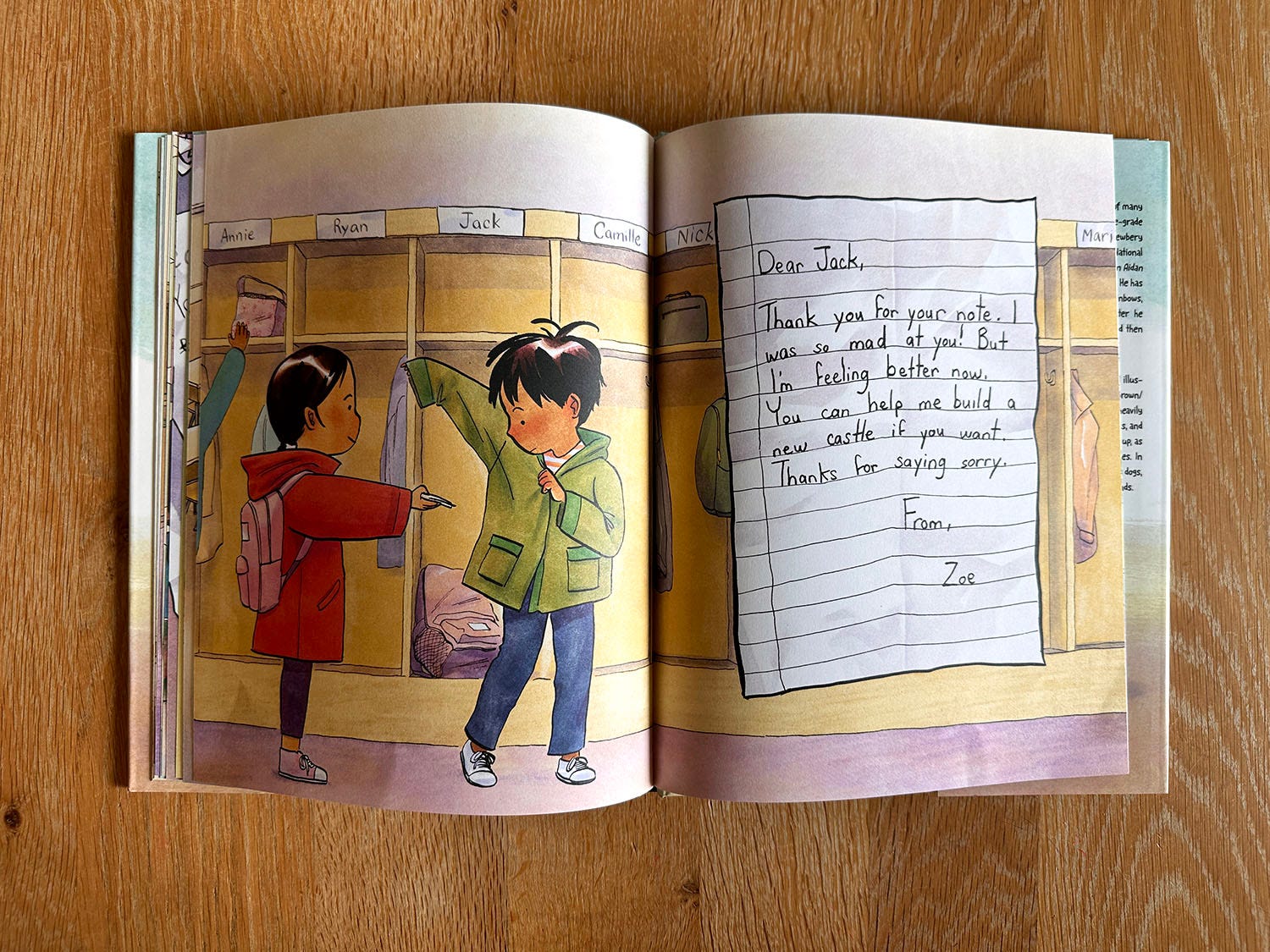
And the next day, Zoe writes back!
Like earlier in the book, these two spreads mirror one another and show the passage of this time, this time between days (as Zoe’s outfit has clearly changed). It’s a great bit of theater, turning the page and the layout and lines are effectively the same, with the character positions swapped.
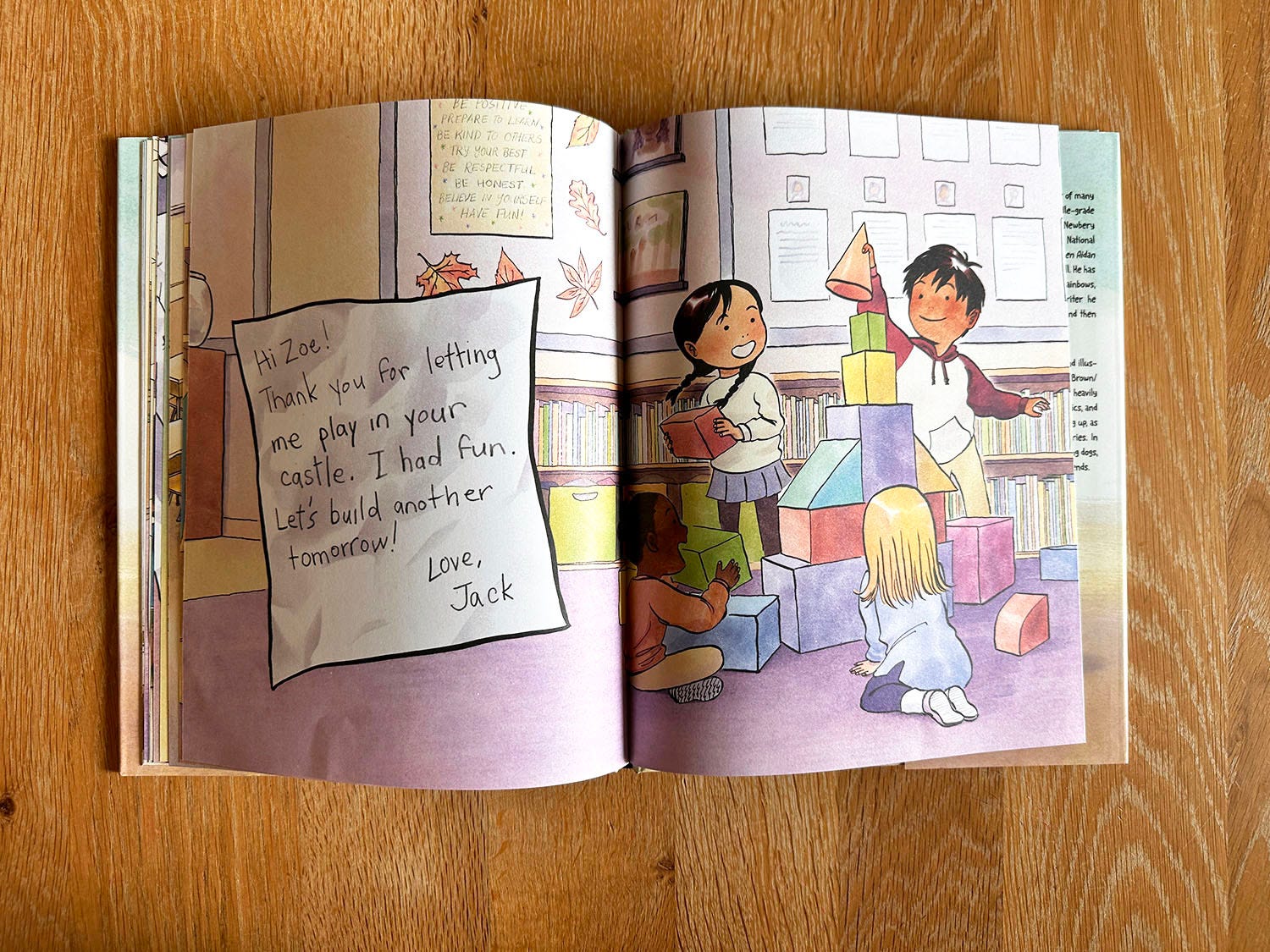
See what I mean about threading the needle? There’s a “lesson” in this book and yet—there is SO MUCH SUBTEXT and nuance and story within story. Just like Jack’s note, what seems simple on its face is much, much deeper.
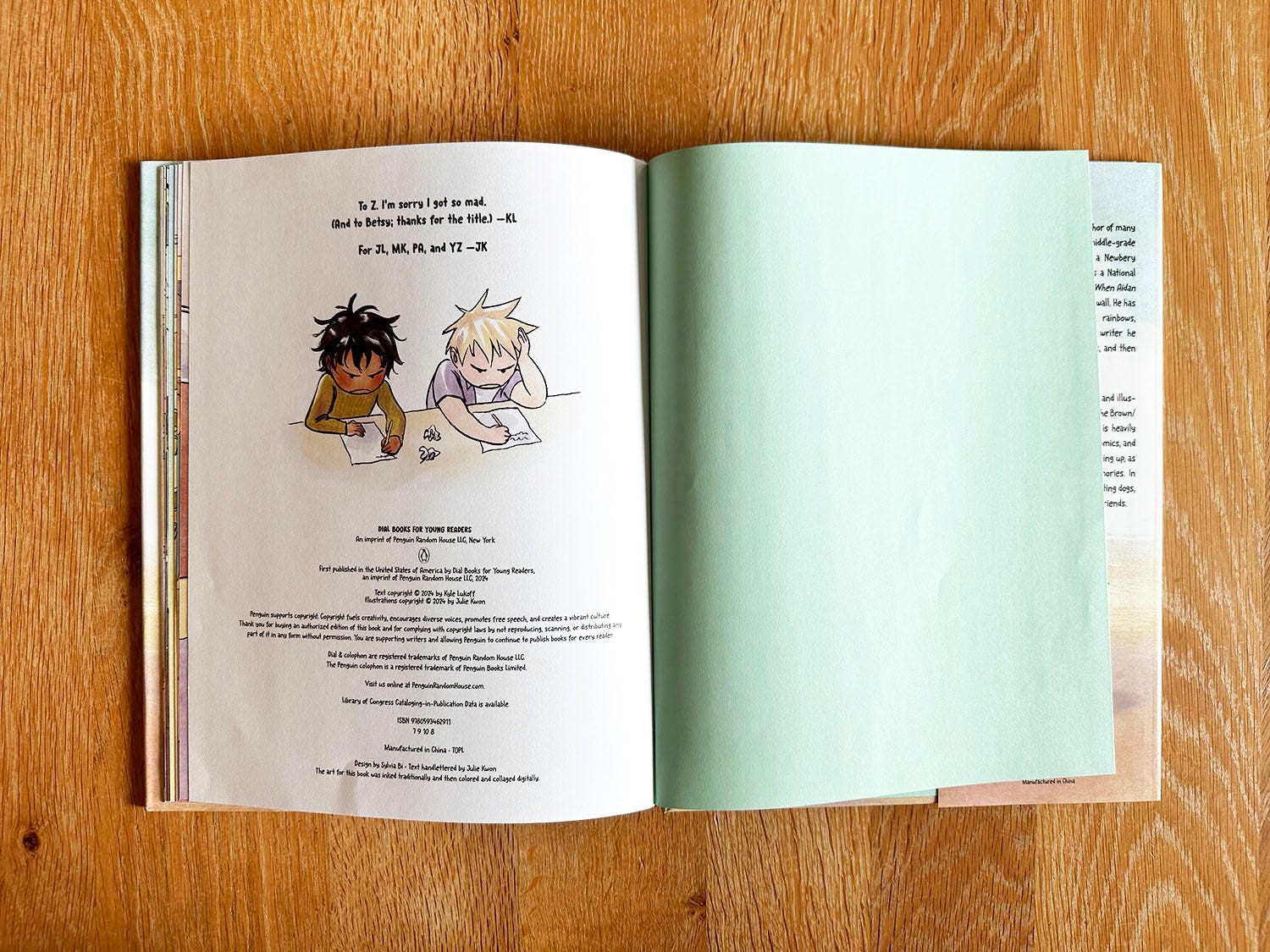
Turn the final page to the copyright, and what do we have here? No doubt Ben and Jeremy are learning how to write apologies, too…
(Wait, now I’m realizing—this might answer my question as to why Ms. Rice is writing feedback on the notes! Maybe she has a special desk where kids have to go to write apologies! Look at Ben and Jeremy’s crumped up papers—they are in apology time out, drafting away!)
I think it’s genius how Lukoff was able to weave a conflict around gendered play stereotypes into a SEL story about how to apologize. His message is so much bigger than writing a good apology: it encourages us to empathize with people’s motivations, to understand how boxing them in can cause great pain, and reminds everyone to let kids be kids—to play with whomever they want, and with whatever excites them.
Here’s a YouTube video if you’d like to “read” I’M SORRY YOU GOT MAD at home:
And hey, here’s a great page of resources for teachers, if you’d like to talk about this book in your classroom.
Total sidebar article I found while reading interviews for today’s newsletter: Kyle Lukoff wrote a great essay about how Frog and Toad were “more than friends.” Relatedly, I also recommend the new Arnold Lobel PB biography OUTSIDE IN AND THE INSIDE OUT: A Story About Arnold Lobel by Emmy Kastner. I learned a lot about Lobel’s life, and it inspired me to check out his earliest and later works.
Lukoff is the author of another favorite, THERE’S NO SUCH THING AS VEGETABLES, which my PB critique group discussed a couple years ago and really liked!! Check it out here.
Support the makers:
Buy your copy:

M E T A
In this Post: I’m Sorry You Got Mad, by Kyle Lukoff and Julie Kwon
Keywords: Apologies, epistolary, sorry, SEL, classroom, repair, friendship, frustration, student, teacher, how to apologize
Comments
Nothing yet. Say the first thing.
Sign in to join the conversation.