
There is, apparently, a genuine trade in mummified human heads — bought and sold quietly online, no safety guidance, sent by the same postal service that loses your parcels.
Scientists are now warning it could release actual ancient spores into actual British sitting rooms. I mention this only because it’s the most reassuring thing I’ve read all week: whatever’s wrong with my filing system, at least it isn’t a four-hundred-year-old fungal curse.
Three words the sea taught me. One’s about staying afloat, one’s about fairness, one’s about arriving.
FREEBOARD — the height of a ship’s hull above the waterline, the margin between afloat and not. A heavily loaded vessel rides low, and to a nervous passenger looks, quite reasonably, exactly like a ship that’s sinking on purpose. I spent thirty years explaining that six inches of freeboard was perfectly normal, and forty quietly checking that it was. Read more
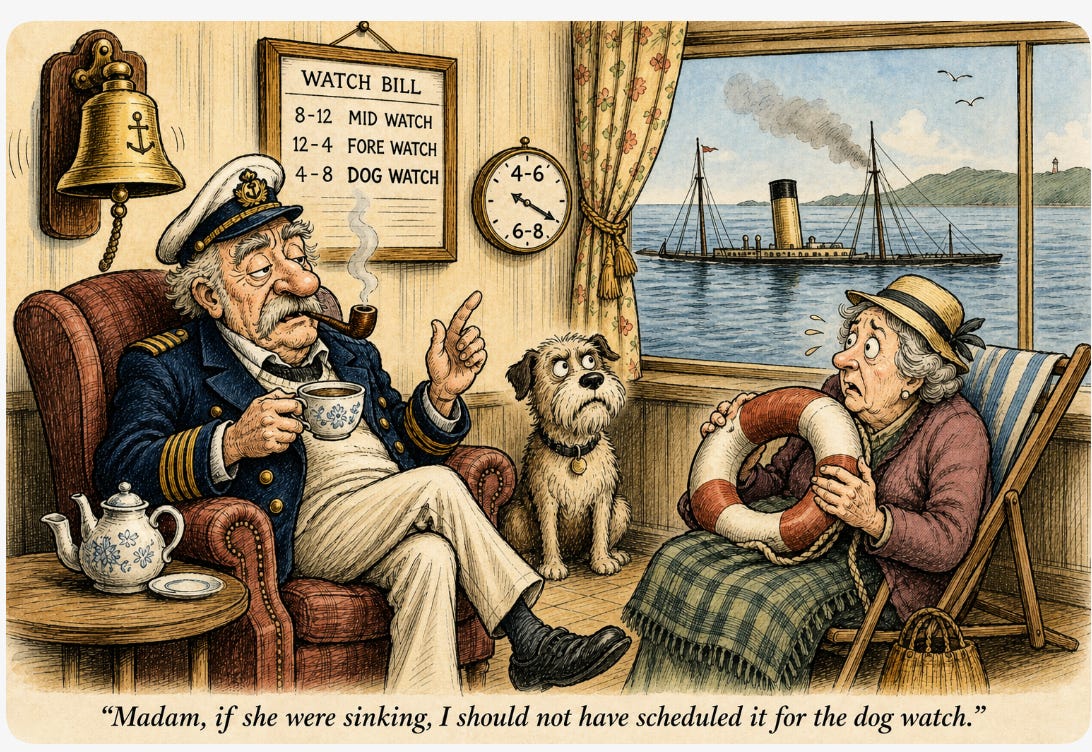
DOG WATCH — the two short watches, four to six and six to eight, split deliberately so no man stood the same hours every day of a voyage, and everyone occasionally got to eat supper sitting down. Whoever invented it understood something modern rostering has since forgotten entirely: fairness sometimes just means taking turns with who gets the bad shift. Read more
LANDFALL — the first sight of land after open water, and it never once looked the way I’d built it up to be — smaller, greyer, more ordinary than the coastline I’d been picturing for a fortnight. I’ve come to suspect most long-anticipated arrivals in life work exactly the same way, and nobody warns you. Read more
“I just watched my dog chase his tail for five minutes. I thought to myself dogs are easily entertained. Then it dawned on me: I’d just watched my dog chase his tail for five minutes.”
— Brad Davenport, via Substack
I read that on Tuesday and didn’t see myself in it at all. I saw myself in it on Wednesday, forty minutes into refolding a chart I already know by heart, for no reason I could have defended in a court of law. The tail, it turns out, doesn’t have to be an actual tail.
The parcel you really don’t want left on the porch.
There is a live, functioning international trade in mummified human hands, feet, and heads — sold openly on the same marketplaces you’d use to buy a lamp, no temperature control, no safety paperwork, delivered by ordinary courier. Researchers who studied 128 online listings found sellers displaying the remains in living rooms, and warned that dormant fungal spores in centuries-old preserved tissue can become airborne the moment they’re disturbed, with real risks of poisoning and lung damage to whoever’s unpacking the parcel.
The original “mummy’s curse,” from Tutankhamun’s tomb in 1922, is now suspected of having been exactly this — spores, not vengeance. Which is somehow a less comforting explanation than the curse. Daily Mail
How you actually find a single point on an empty ocean
The part people always ask about first, finally answered — sextant, clock, and a great deal of patience.
I promised a few weeks back that this slot would eventually explain the part people always ask about first: how, exactly, do you know where you are out there, with nothing on any side of you but more water? Here’s the honest version.
A sextant measures one thing only — the angle between the horizon and a fixed point in the sky, usually the sun at local noon, occasionally a star at dawn or dusk when both the star and the horizon are briefly visible together. You hold it steady against the roll of the ship, which is harder than it sounds and considerably harder than it looks in films, and you bring the reflected image of the sun down until it just kisses the horizon in the little mirror. Then you read the angle off the arc, note the exact second by a chronometer that has been kept correct to within a couple of seconds for the entire voyage, and you go below to do the arithmetic.
The angle tells you your latitude — how far north or south you are — almost directly. The time tells you your longitude, because the sun crosses any given meridian at a specific moment, and the gap between that moment and the time on your chronometer, set to a reference port, converts cleanly into distance east or west. Get the chronometer wrong by a minute and you can put your ship thirty miles from where she actually is.
That single fact cost more ships than most storms ever did — until a clockmaker solved what the Navy’s own astronomers couldn’t.
That single fact cost more ships than most storms ever did, until John Harrison spent most of a lifetime building a clock accurate enough to survive a voyage, and the Navy spent decades refusing to believe a clockmaker had solved a problem their astronomers couldn’t.
What nobody tells you is how patient the whole process is. You don’t get one triumphant reading and a position drawn with a flourish. You take several sights, over several minutes, and you average them, because your own hand is never quite as steady as you’d like to believe. Then you plot the result, and immediately start treating it as provisional again, because the ship hasn’t stopped moving just because you’ve worked out where she was thirty seconds ago.
I still own a sextant. It sits in a case I haven’t opened in years, not because I’ve forgotten how to use it, but because I’ve never quite worked out what I’d be fixing my position against now that nobody’s asking me to report it to anyone. More on how a sextant actually works
What a compass swing has to do with knowing who you still are.
Every compass on a steel ship lies, a little, and it lies differently depending on what cargo’s sitting near it, which way the ship’s pointed, and what the hull itself has picked up magnetically over the years. Left uncorrected, the error creeps — not dramatically, just a degree here, two degrees there, until the needle you’re trusting is quietly pointing at a version of north that doesn’t exist any more. So periodically you swing the ship: turn her slowly through a full circle on a clear day, checking the compass against known bearings you can verify by other means, and write down exactly how wrong it’s become on each heading.
You don’t throw the compass out. You just stop pretending it doesn’t need checking.
I think most of us are carrying an opinion of ourselves that hasn’t been swung in years. It formed honestly enough, back when there was a job, a rank, a crew, something external to check it against. Then the external thing stopped, and the opinion kept drifting quietly on its own momentum, uncorrected, because nothing’s been asking it to prove itself lately. I don’t think the answer is to distrust it completely. I think it’s to occasionally turn yourself through a full circle against something real — a proper conversation, an honest photograph, a friend who’ll actually tell you — and write down, without flinching, exactly how far off you’ve drifted. Not to punish yourself for the error. Just because an uncorrected compass is no use to anyone, least of all the man steering by it. More on how ships actually swing a compass
Three readers wrote in. None of them let me off easy.
K. O. Cart wrote in with something I’ve read three times now: “I lay awake listening to my sleeping puppy shift in her bed while I wait for tiredness to set in... I spoke with one of my flying colleagues, also recently retired, and he asked me if I am finally sleeping through the night. I said mostly. He said he still wakes up around three a.m., the same as he usually did when he had to go out and fly.” Forty years of watches does the same thing to a body. Mine still wakes at ten to four some nights, checking on a ship that was sold for scrap a decade ago.
Moss and Matchsticks reported a small domestic crime: a pair of thrifted fleece-lined Crocs, left unattended for ten minutes, discovered thoroughly chewed by a dog roughly the size of a shoe. “My feet are not boats. I’m a size 5.5/6 UK. He is just that small.” I have no maritime angle on this one whatsoever. I just think about it more than is probably healthy.
John M wrote about his father’s death, and the string of keys that turned up in the house afterwards that fit nothing anyone could identify — then added, quietly, “I find I’ve done the same.” I don’t have a tidy line to follow that one with. I’m not going to manufacture one just to close the paragraph neatly.
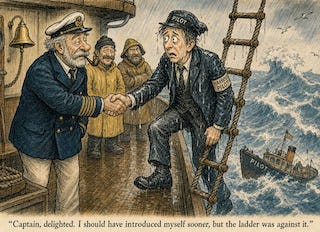
A pilot came aboard once in a rising sea, up a ladder that was doing its level best to throw him back in, and the moment his feet found the deck he straightened his jacket, extended a hand, and introduced himself by his full name and rank as though we’d met in a boardroom rather than four rungs above a Force 6.
I shook it. Seemed rude not to. There’s something I’ve never stopped admiring about a man who’s just had the fright of his professional life and decides the correct response is better manners, not fewer.
Three from the back catalogue, in case you missed them the first time.
They Sent Me a Form to Prove I Wasn’t Dead. — Bureaucracy doesn’t take your word for being alive. Neither, it turns out, does the form. (https://theoldgreythinker.substack.com/p/they-sent-me-a-form-to-prove-i-wasnt)
When Did You Last Let Yourself Be Genuinely Bad at Something, on Purpose? — On entering the horticultural show against my own better judgment, and what being a beginner again actually costs a man who spent forty years being competent for a living. (https://theoldgreythinker.substack.com/p/when-did-you-last-let-yourself-be)
Fourteen Years I Investigated Marine Disasters. — What over a decade of finding out exactly what went wrong, every time, does to a man’s tolerance for guessing. (https://theoldgreythinker.substack.com/p/fourteen-years-i-investigated-marine)
Secondhand books are vanishing into AI training warehouses, and nobody’s entirely sure why. Independent booksellers are reporting bulk orders that make no sense on their own terms — obscure Latin texts beside cowboy paperbacks, whole shelves gone to buyers who never explain what they want them for. The suspected destination is AI training data, and some of what’s bought is reportedly pulped after scanning. Strange, and a little sad if you’ve ever liked the smell of an old shop. BBC News
Forty vintage buses, one day a year, to a village that officially doesn’t exist any more. Imber, in Wiltshire, was evacuated in 1943 for D-Day training and never handed back — the Ministry of Defence still owns it, and the public gets in for a handful of days a year aboard a fleet of classic Routemasters run entirely by volunteers. A genuine time capsule, and exactly the sort of trip I’d have booked myself onto forty years ago without asking why. Daily Mail
Watch someone actually take a sun sight. If the sextant explainer above left you wanting to see it done rather than described, search “celestial navigation sextant demonstration” on YouTube — there are a handful of genuinely good ones, mostly filmed by people who clearly love this far more than their day job requires.
Two Years Before the Mast, Richard Henry Dana Jr. — roughly 400 pages, first published 1840, and still the most honest account I’ve ever read of what a working sailing life actually involved, written by a young man who signed on as an ordinary seaman rather than an officer and left nothing out. No romance, no swagger, just cold, food, boredom, danger, and the occasional flash of something worth all three. Who it’s for: anyone who suspects every other sea story they’ve read has been quietly edited for excitement.
If the compass-swinging above landed anywhere, The Invisible Man’s Handbook was written for exactly that stretch of the conversation — the practical work of checking who you are against something real once the job that used to do it for you has stopped. Have a look.
Next week, From the Bridge flips back to a story — a real one, no diagrams. And I want to know: when did you last check your own compass against something real, and what did you find? Not a big crisis. Just an honest reading. Tell me in the comments.
Tea’s getting cold. Go on.
P.S. — If this landed, forward it to one person. Just one. That’s how this grows.
The kettle’s already on.
Join the Greys at The Old Grey Thinker
Want something more practical?
I’ve created a collection of guides for people who still believe life isn’t over just because the calendar says so. You’ll find them here:
Not everything needs a subscription. If this one landed, you can support it here:
Comments
Nothing yet. Say the first thing.
Sign in to join the conversation.