
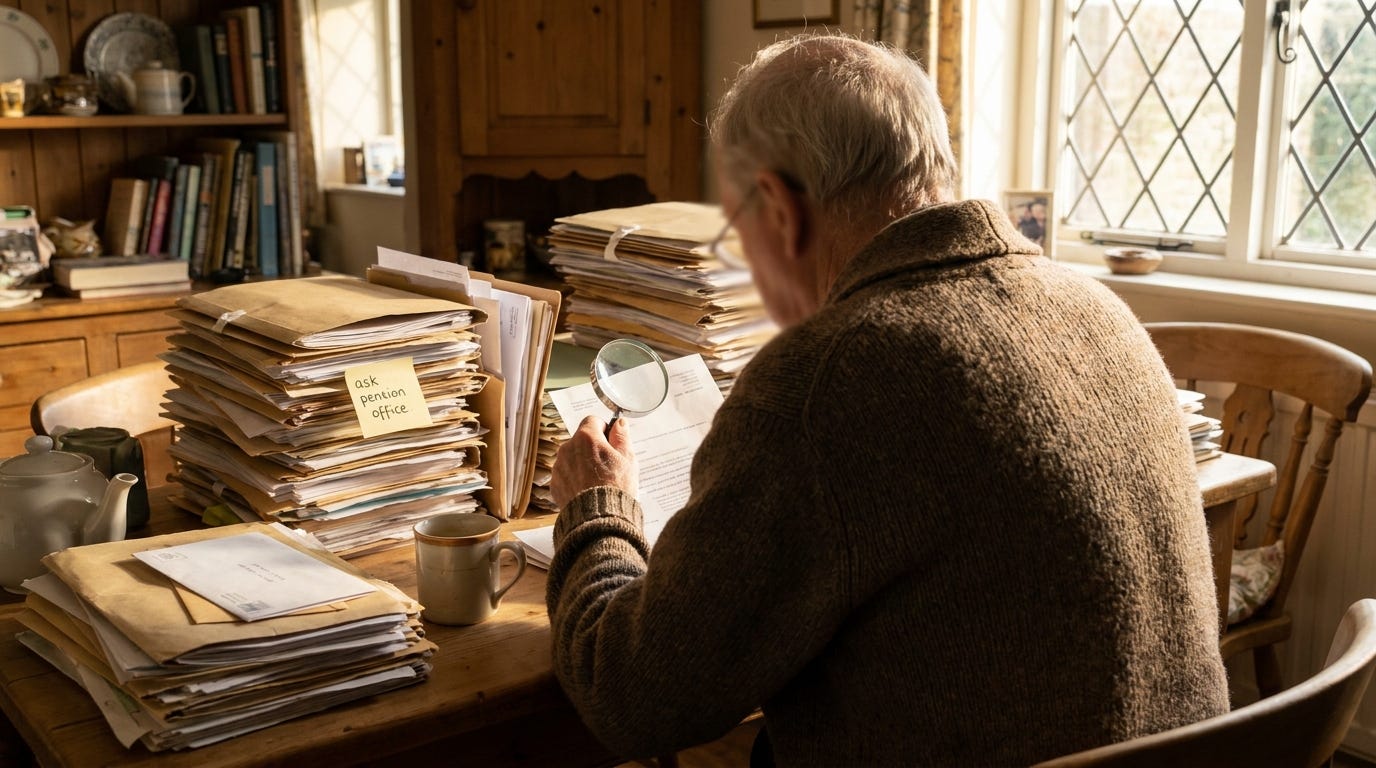
Poppy is eleven, and she has recently discovered that adults do not, in fact, know everything, which is a discovery I remember making myself at roughly the same age, about my own father, standing in a garage holding a fan belt like it owed him money.
She's at the stage where she tests this theory constantly, gently, the way you'd press a bruise to see if it still hurts.
Last Sunday she did it to me over a plate of flapjack, and it hurt rather more than I expected.
We were at the kitchen table.
Her mother — my daughter — was upstairs doing something with paint samples, and Poppy had a school worksheet in front of her about "money and the future," one of those well-meaning citizenship exercises they do now, bless them, that didn't exist when I was her age because nobody thought children needed warning about the future, the future was just going to turn up regardless and you'd deal with it same as everyone else.
One of the questions asked her to interview an adult about their pension.
Naturally, I was the adult available.
"Granda, what's a final salary pension?"
I said, quite breezily, "Ah, well, it's the good sort."
Which is true, technically, in the way that "it's the sort that isn't on fire" is technically true of most buildings.
She waited. Elevens do not accept "it's the good sort" as a complete sentence.
So I tried again, more carefully this time. I told her that when I was working — on the ships, and then ashore after — the company promised that when I retired, I'd get paid a set amount every year, worked out from my final salary and how long I'd been there, and it would keep going up a bit with prices, and it would keep going for the rest of my life, however long that turned out to be, and it didn't matter what happened to the stock market or interest rates or the price of tea, that number was mine, guaranteed, like it had been carved into something.
She thought about this for a moment and asked, quite reasonably, "So who pays for it?"
And that's where I started to go wrong.
I said the company did.
Which is true, sort of, except by the time I actually started drawing it the company had been sold twice and the pension scheme had been handed off to an insurer I'd never heard of, who I now trust roughly as much as I'd trust a seagull with my sandwich, purely because I don't know them and they've never given me a reason to.
I said it was "put by" for me, which made it sound like a jar of jam my employer had been quietly stashing in a cupboard for forty years with my name on the lid, which is not remotely how it works, and I knew it wasn't how it works even as I said it, and I could see on her face that faint eleven-year-old flicker that means she's noticed the joins.
I tried a different tack.
I said, look, love, it's a promise that somebody, somewhere, worked out the sums for, decades ago, and decided it was affordable, and mostly they were right, though it turned out to be a lot more expensive than anybody predicted, which is why hardly anyone gets offered one any more.
"Will I get one?"
"No," I said.
And there it was.
Out before I'd decided whether I was going to soften it.
She didn't seem devastated.
She's eleven; retirement is roughly as real to her as the Cretaceous period.
But she did ask, with the sort of clean logic children have before life teaches them to be diplomatic about things,
"Then why do you get one and I won't?"
How would you have answered?
⬇️ Read the rest below to see why the gap between our retirements is far worse than anyone is willing to admit.This is the part you shouldn’t miss.
Not everything needs a subscription. If this one stayed with you, you can support it here: Buy me a Yorkshire Tea
Comments
Nothing yet. Say the first thing.
Sign in to join the conversation.