
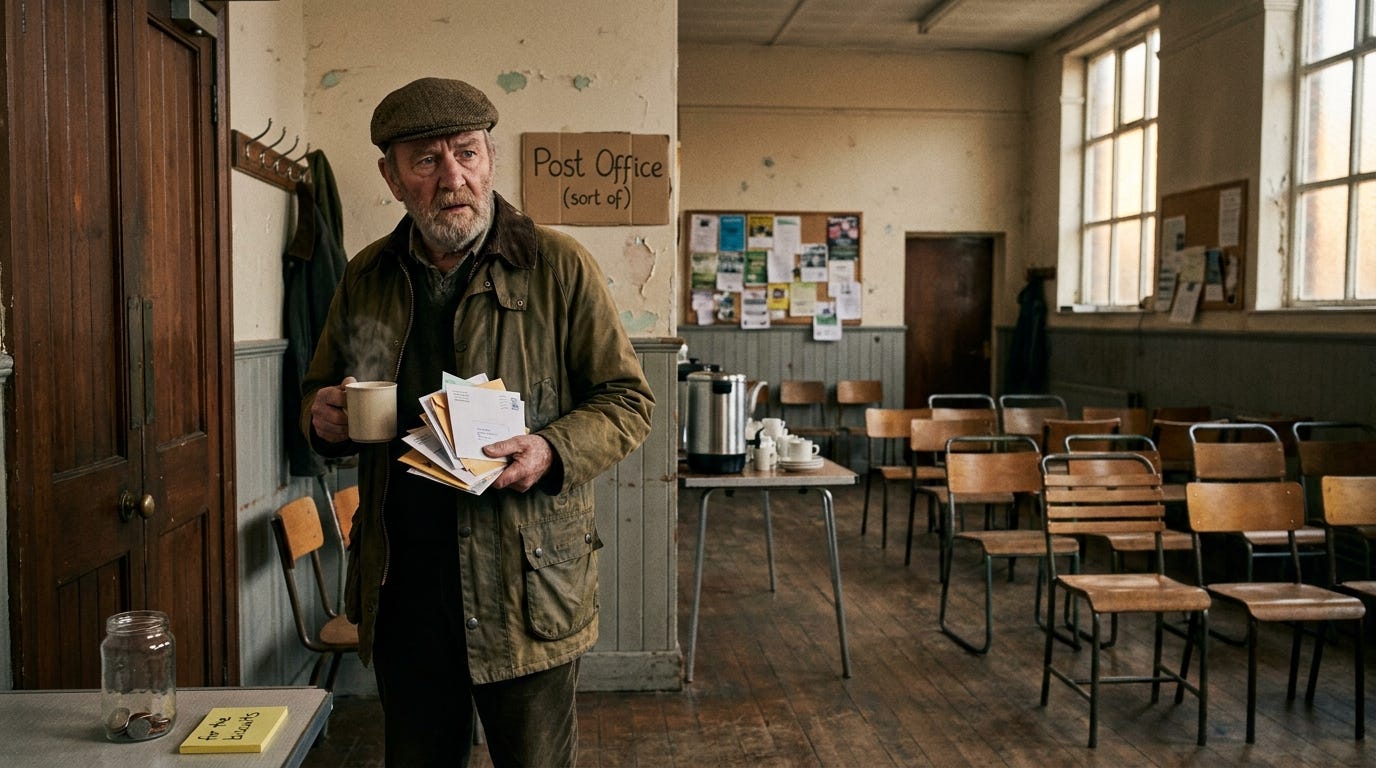
I want to be honest with you about the moment it actually hit me, because it wasn't the black-bordered notice in the window, and it wasn't the last day, with Sheila behind the counter looking like she was conducting a small funeral for herself.
It was three days after that, on a Tuesday, when I found myself standing outside the shuttered door with a parcel under my arm and nowhere to put it, and I had what I can only describe as a small, undignified moment of panic.
Not because the parcel mattered. It was a jumper going back to a catalogue firm that had already forgotten I existed. It was because I realised, standing there like a man who'd forgotten his own address, that the post office had been doing a job for me that had nothing to do with stamps at all. It had been giving me somewhere to go.
That's the quiet humiliation of retirement nobody puts on the leaflets.
You don't miss the job.
You miss the version of the week that had shape to it, and you don't notice how much of that shape was borrowed from small, unglamorous errands until they're gone. I'd go to the post office two, sometimes three times a week for reasons that, examined honestly, would not survive scrutiny. A stamp. A query about a redirection I didn't need redirected.
A chat with Sheila about nothing, which turned out, it transpires, to have been the whole point.
So when it closed for good — Crown Post Office, "consolidation," a word doing an enormous amount of lifting for a very small village — I did what I suspect a lot of us did. I complained about it to anyone who'd stand still long enough, wrote a stiff sentence or two to nobody in particular, and then quietly worried that this was one more thing being taken away that I was too old and too northern to do anything useful about.
What I did not expect, and this is the part that still makes me want to sit down and have a proper think about it, was that the vacuum wouldn't stay empty for long. And that nobody organised what filled it.
There was no committee. No consultation with a laminated agenda and a flip chart nobody reads.
It just started.
Somebody put a kettle in the village hall. Somebody else brought a second kettle, in case the first one broke, which tells you everything you need to know about the average age of the people involved.
Chairs appeared — not matching, not arranged with any discipline, just dragged into a rough circle by whoever got there first and couldn't be bothered to put them back properly. And people began turning up.
What happened next is the part most people still get wrong. Because the village hall did not just fill a gap left by the post office. It exposed how many of us had been quietly relying on places like that to hold the week together — and what happens when nobody notices until the door is already locked.
⬇️ Keep reading for the deeper story — this is the part you shouldn’t miss.
Not everything needs a subscription. If this one stayed with you, you can support it here: Buy me a Yorkshire Tea
Comments
Nothing yet. Say the first thing.
Sign in to join the conversation.