
I remember when my daughter was a couple of months old. She was a big crier. In those first months, when she woke at night, I would feed her and then hold her, walking around the apartment until she calmed down. I rocked her a lot. I also had a toddler and her newborn twin brother. I was exhausted in a way that doesn’t translate well into words.
At some point my thoughts stopped being go back to sleep, go back to sleep, go back to sleep, and became what if I moved that wall? Swapped those two rooms? What pendant could go here? A way to be somewhere else in my head until she calmed down.
Not everyone renovates an apartment in their head at 3am. But once you become an architect there is a kind of virus you catch that has no antidote.

I have moved 13 times. Across Europe, to the other side of the world, to Brazil once to follow a love that didn’t work out, and then back. A few pieces have followed me through most of it.
The walls change every time. The pieces we carry in are what make a new place feel like ours.
My husband and I have always rented, by choice. Ten years together, four apartments, and we want to be able to do it again. Packing everything, locking a door, handing over the keys and going is not something we are ready to give up. A family of five is already enough to carry.
I come from a culture where investire nel mattone, investing in the brick, is treated as the milestone that means you have arrived. Part of me still wants a house I could turn upside down and do whatever I liked with. But being tied to one place for a lifetime is getting harder to hold onto, and I have come to like something I never expected: how light it is to know you can go.
That lightness has a cost, and the cost is real. There is a difference between what you can do in a home you own and one you don’t, and the frustration bites. The apartment I am in now is lovely, and still, I would turn it upside down if it were mine.

So how do you decide what is worth doing, and what is worth buying, when the home isn’t yours? Years ago, doing the renter’s home insurance, the insurance man gave me a filter I have used ever since:
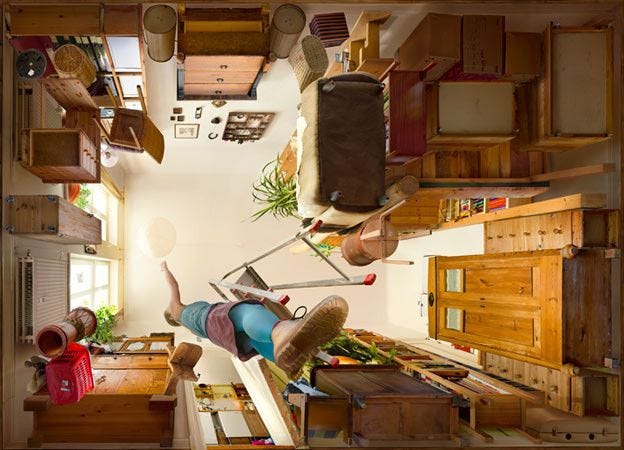
Turn the house upside down. Everything that falls is yours. Everything that stays belongs to the house.
The renter insures what falls. The landlord insures what doesn’t.
Furniture, lamps, rugs, curtains, art: they fall.
The kitchen, the floor tiles, the built-in closets: they don’t.
Take the best room in my apartment. It has direct access to the garden, the view, all the light. It should be the heart of the house. Instead it holds a dining table we rarely use, my husband's wardrobe, and a table for the children's activities. We pass through it all day and almost never stop. If it were mine, the kitchen would be there tomorrow. But a kitchen is the clearest example there is of something that stays, and a renter doesn't move what stays. So it stays where it is, in the north-facing room, and I sit with it.
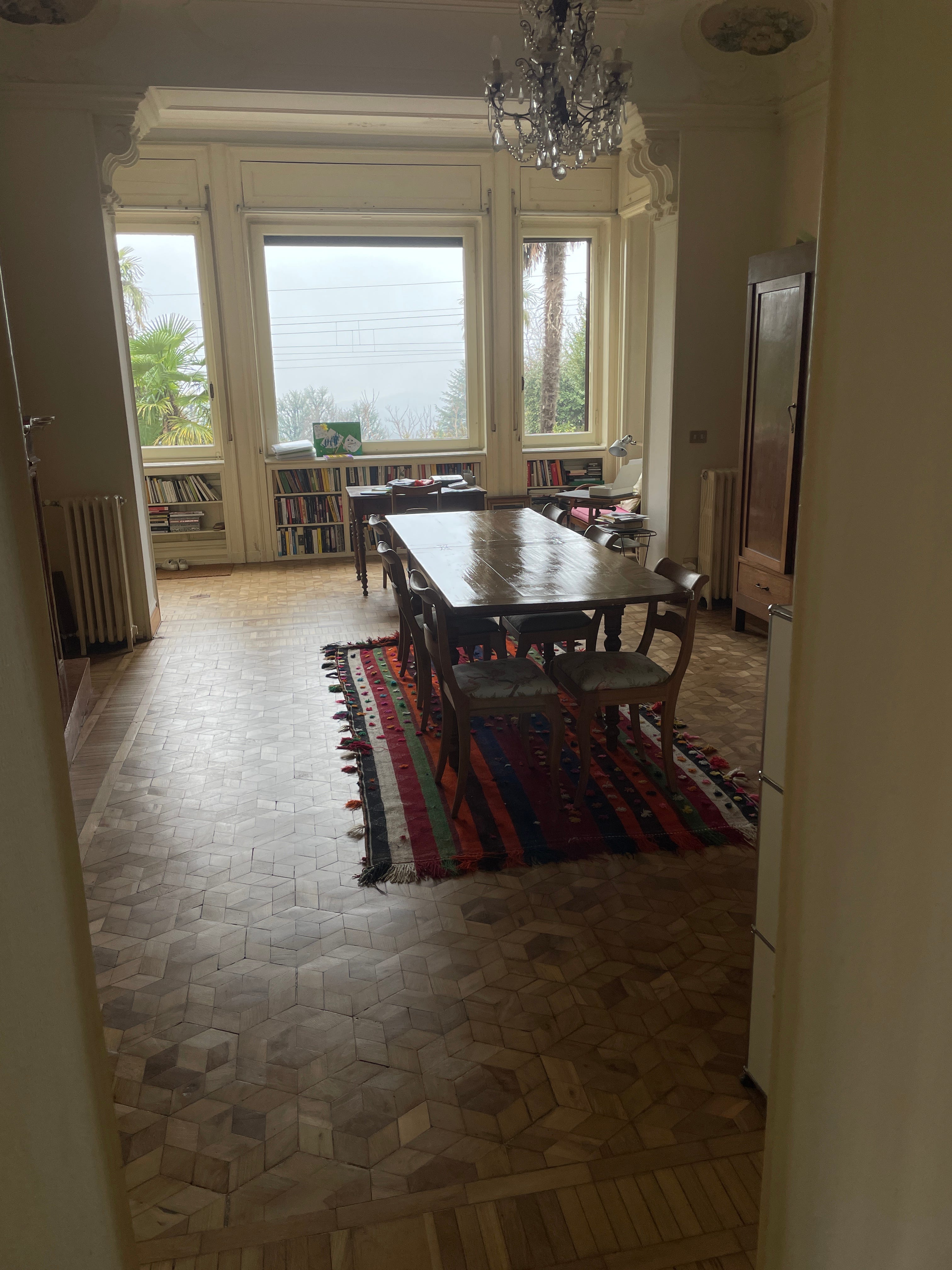
That is the whole logic. If you own, put your money early into what stays: the structure, the floors, the kitchen. They are expensive to change and they set the tone for everything on top of them. A designer I follow, Pandora, calls these the bones: “the architecture, the walls, the ceilings and the floors. They are what dictate how the rest of the room will look and feel.” If the bones bother you, you work with them or around them.
If you rent, run it the other way. Put your money into what falls. Into the pieces that will move with you, apartment after apartment, for years.
In my opinion, there are two exceptions worth knowing.
The first is when something bothers you enough to be worth a conversation. In Geneva I had a bathroom with horrible brown tiles. I asked the owner if I could paint it. He said yes. I painted it pink. Most people never ask, and many landlords are more open than you would expect, especially if you offer to restore whatever you change before you leave. For something bigger, you can propose to split the cost, since it improves their property, and offer to manage the work yourself.
The second is children. When you need to install something for their autonomy, like hooks at the right height to make the morning work, invest in it even knowing you will leave it behind. I built something into a niche in this apartment for exactly that (more on it here). I can’t take it with me. It doesn’t matter. Ask first, then do it, even if it means taking it down the day you leave. With small children, peace of mind is worth paying for, even when you can’t pack it. This is good

I still walk the apartment at night sometimes, despite myself. The list of what I would change is long. The list of what I have chosen to carry with me is longer, and that is the one that matters.
So before you buy anything for a home, ask which it is. Does it fall, or does it stay?
If you own, spend on what stays first. If you rent, spend on what falls, and choose it well enough to follow you.
In Part 2 I’ll get specific: the pieces that have come through thirteen moves with me, how I choose furniture that works in any apartment, in any house, in any city, and how I buy when I already know I’ll move again. Starting with a sofa that has moved with me four times.

Thanks for reading Off Camera! This post is public so feel free to share it.


Three kids in 20 months taught me this: homes need to evolve with us.
I’m Francesca, Italian architect. I practiced for over a decade and ran a small floral art atelier for a while. Then my first boy was born, and less than two years later, the twins arrived.
With three small children, shaping space became both more urgent and more chaotic. I keep adjusting, moving things, reassigning rooms, rethinking storage. Homes have to keep up with life.
Here, I write for parents who are fighting their homes every day, pouring everything I know about spaces, routines, and the beautiful mess of family life into every post.
If any of this resonated, subscribe so you don’t miss the next one. And if you know someone whose home is working against them instead of with them, share it with them.
💬 If something in your home isn’t working and you want to talk it through, send me a DM and I’d be happy to help.
No posts
Comments
Nothing yet. Say the first thing.
Sign in to join the conversation.