
The first morning in the glamping tent in Tuscany, I went to make coffee and found a French press I didn’t know how to use. That’s not exactly true, because I do know how a French press works. But at seven-thirty in the morning, with three children already awake and asking for things, the extra two minutes it required felt like the wrong kind of adventure.
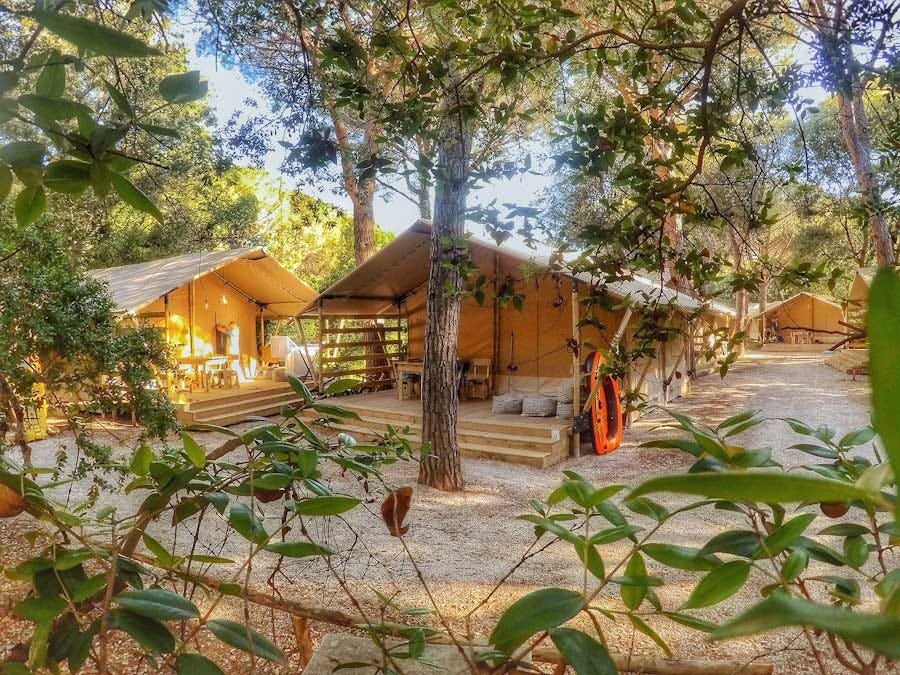
The tent was beautiful. Wooden floor, canvas walls, a room for us and one for the children, both with real beds. The kitchen was simple and nice. And yet everything was slightly off, not set up for the life we were about to live in it.
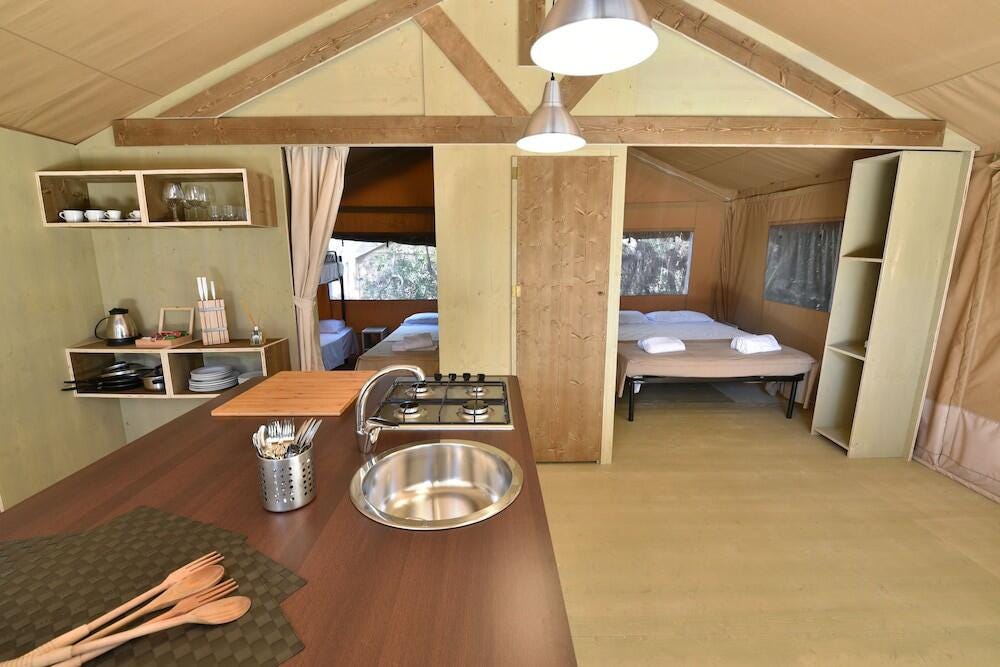
Both rooms had an open cupboard with two shelves instead of four or five. By day two, it looked like someone had packed it in the dark: clothes on top of swimsuits on top of sunscreen on top of the one book I brought and, as usual, brought back home without reading more than three pages. Every time one of the children went to get something, something fell. Every time something fell, someone cried.
There were almost no hooks. A couple in the bedroom and one in the bathroom (one, in the bathroom...). All of our things lived on chairs, on the floor, on a bench outside that was damp in the morning. You could see the progression across the week: every surface slowly accumulating everything that had nowhere to go.
The kitchen had no dish rack. There was a sink, there were dishes, there was soap. But washing things and having nowhere to put them to dry is its own kind of friction. Stacking plates on a folded towel was fine. It was just slightly, persistently effortful. On day three I bought a cheap dish rack and an extra set of towels (that I could hang nowhere to dry).
I thought about all of this a lot that week. Not with frustration (or not only with frustration). More with a kind of attention. I kept noticing what was missing, and then noticing what that absence meant.
We adapt quickly when we travel as adults (at least most of us do). A hotel room, an unfamiliar apartment, a friend's house. We find the coffee, we work out the shower, we manage. The friction barely registers because we're only managing ourselves, and adults are usually good at absorbing small inconveniences without falling apart.
Children are not. Their brains are still building the internal scaffolding that makes emotional regulation possible, and, until it is solid, they borrow it from the environment around them. But they also borrow it from us. When the dish situation is adding friction to the morning and you’re slightly “distracted”, they feel it before you’ve noticed it yourself. The disruption you’re managing becomes their mood.
And so the slight inefficiency of not having a dish rack turns into a slightly harder morning because you’re managing the dish situation while also managing a three-year-old who hasn’t slept well because the tent had no curtains and it was light at five.
None of these things is catastrophic on its own. Together, they are what makes the first two days of a holiday feel like work.

Here's what I noticed in Tuscany, over the course of a week: the things that were bothering me were not random. Each one was a load-bearing element of my home's system, missing. A part I had stopped noticing because at home it had never failed.
Five shelves instead of two isn't simply an aesthetic choice. It's a capacity calculation. With enough vertical space, each person can have a section; each category of things can have a place; nothing has to live on top of something else, nothing falls when something else is retrieved. The system works without drama because the space allows it to. Strip it to two shelves, and the system fails.
Every hook at home is a decision about where things transition: where the outside world stops and the inside begins. Take those away, and things stop wherever you put them down. By day two, we had given one of the six chairs a job: holding everything that had to come to the beach the next morning (bags, sunscreen, hats, toys).

The point is not that rentals are bad or that holidays are hard. Some friction is just part of it, and some of it you should let go. The tent was wonderful. The week was good. I would go back.
But I think there’s something worth paying attention to in the discomfort of the first two days, before you’ve adapted and stopped noticing.
What you notice in a place like this is a map of what your home is actually doing for you.
Most of the time this logic is invisible. Your home works, you live in it, you stop seeing it. Then you go on holiday and you can see exactly what was doing the work, because it isn’t there.
The end of a holiday is always a little sad. You think about the beach you won't see again for a year. But on the drive home there's something else waiting for you, and now you know what it is. The dish rack and the hooks and the five shelves, ready to do their work without asking, the way they did before you stopped noticing them.
Everyday life, about to get smooth again. But until then, happy holidays.

Thanks for reading Off Camera! This post is public so feel free to share it.


Three kids in 20 months taught me this: homes need to evolve with us.
I’m Francesca, Italian architect. I practiced for over a decade and ran a small floral art atelier for a while. Then my first boy was born, and less than two years later, the twins arrived.
With three small children, shaping space became both more urgent and more chaotic. I keep adjusting, moving things, reassigning rooms, rethinking storage. Homes have to keep up with life.
Here, I write for parents who are fighting their homes every day, pouring everything I know about spaces, routines, and the beautiful mess of family life into every post.
If any of this resonated, subscribe so you don’t miss the next one. And if you know someone whose home is working against them instead of with them, share it with them.
💬 If something in your home isn’t working and you want to talk it through, send me a DM and I’d be happy to help.
No posts
Comments
Nothing yet. Say the first thing.
Sign in to join the conversation.