
This is Part 2. If you haven’t read Part 1, it’s the part I’d start with.
Part 1 is the thinking, the filter I use to decide what’s worth buying for a home that isn’t mine. Turn the house upside down: what falls is yours (sofa, bed, art, rugs), what stays belongs to the house (kitchen, built-ins, floor). If you rent, you spend on what falls. If you want the reasoning before the shopping list, start there.
This part is the shopping list, sort of. These are the pieces themselves, one by one, with the reason each keeps earning its spot on the van.

One thing before we start, and it matters to me. Every time I tell you about something I’ve carried with me, I am not telling you to go buy the same sofa, the same lamp, the same dresser. I want you to see the principle underneath it. The object is tied to my taste, and sometimes to my luck at a flea market. The reasoning is the part you can take home and use in your own house, with your own things. So read these as small arguments, not product links. And I’ve kept the ones I love most, the pieces that have grown up with my children, for the end.
The temptation, almost every time, is to buy for the apartment you are in right now. But when you have a choice, and you are someone who rents and knows they will leave, the question to ask before you buy is “will this work almost anywhere?”
That one question changes everything you choose.
There’s a second thing these pieces share, and I only noticed it writing this down. The good ones never stay the same. They change job, change room, sometimes change owner, and keep working.
The best furniture has a biography.

Before I bought my actual sofa, I owned, like so many students and young workers, the IKEA Ektorp. I still think it’s one of the best sofas IKEA makes. The shape is classic and it marries well with all kinds of apartments. And there are companies now making really good covers for IKEA pieces, so you can elevate one in a second.
I don’t think everything in a home has to be expensive, or design with a capital D, to be beautiful. But there are pieces that, when they are really well made, change the face of a house. Those are the ones worth investing in. They’re also the ones you’ll hand down to your children and their children. The sofa is one of them.
Mine is a William, by Zanotta, a historical Italian brand whose work I love almost without exception. It has been in four apartments: three in Switzerland, and now here in Italy. Against walls, floating in the middle of a room, in a period home with high ceilings and in a modern flat with none. It always looks right.
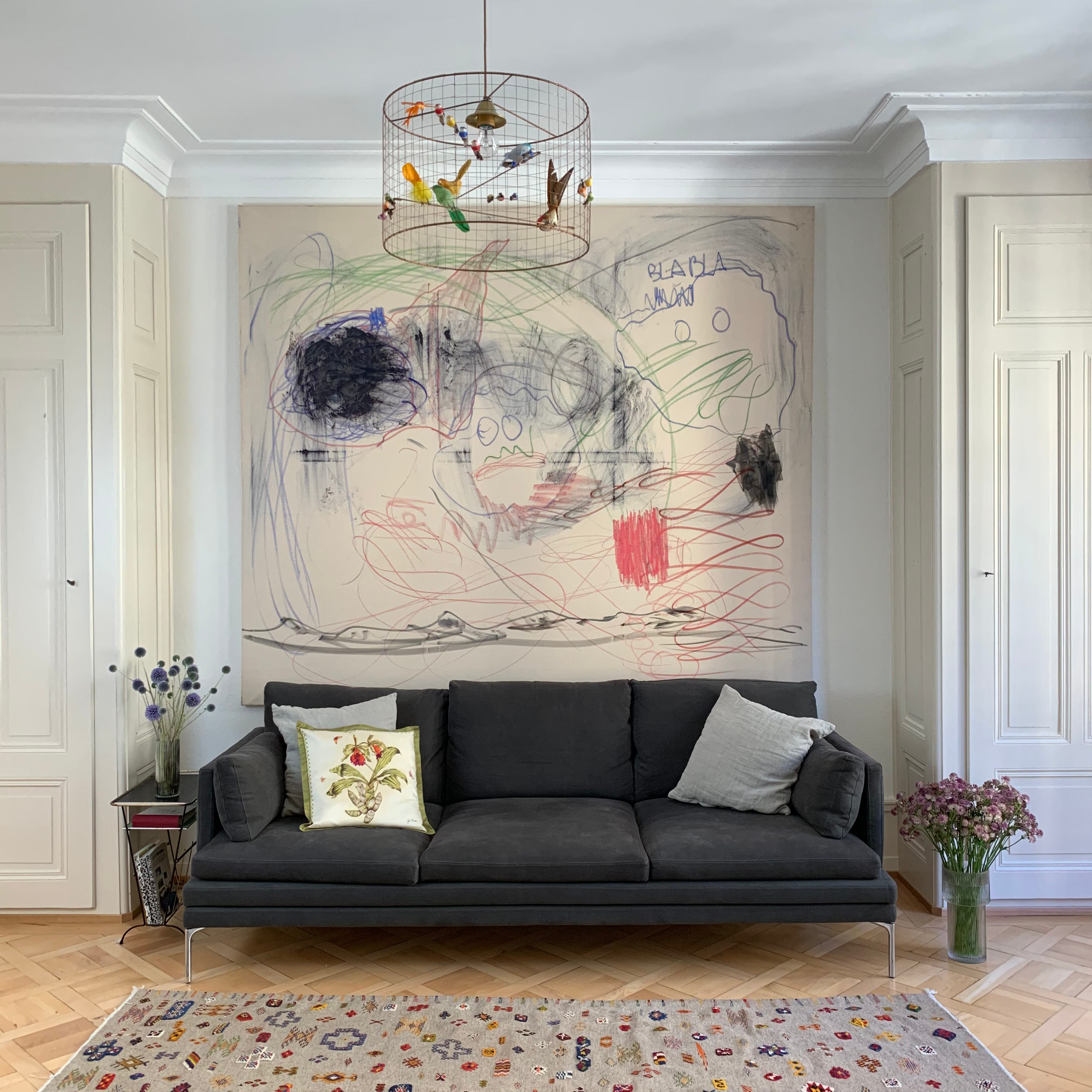
The form is most of the reason. A sofa that isn't an L is far more versatile. The moment a sofa commits to an L, it commits to one corner, one orientation, one room. If an apartment really forces you into an L, I'd buy a modular one instead: separate sections you can join and pull apart, use as one long L or as two sofas facing each other.
When I was at university my aunt lent me a genius one, square wooden bases with cushions that attached a hundred different ways. Side by side they made one long sofa, or an L, or a U, or you could back them together in the middle of the room so two people sat back to back. It was almost certainly a designer piece, and such a shame I don't have a single picture of it.
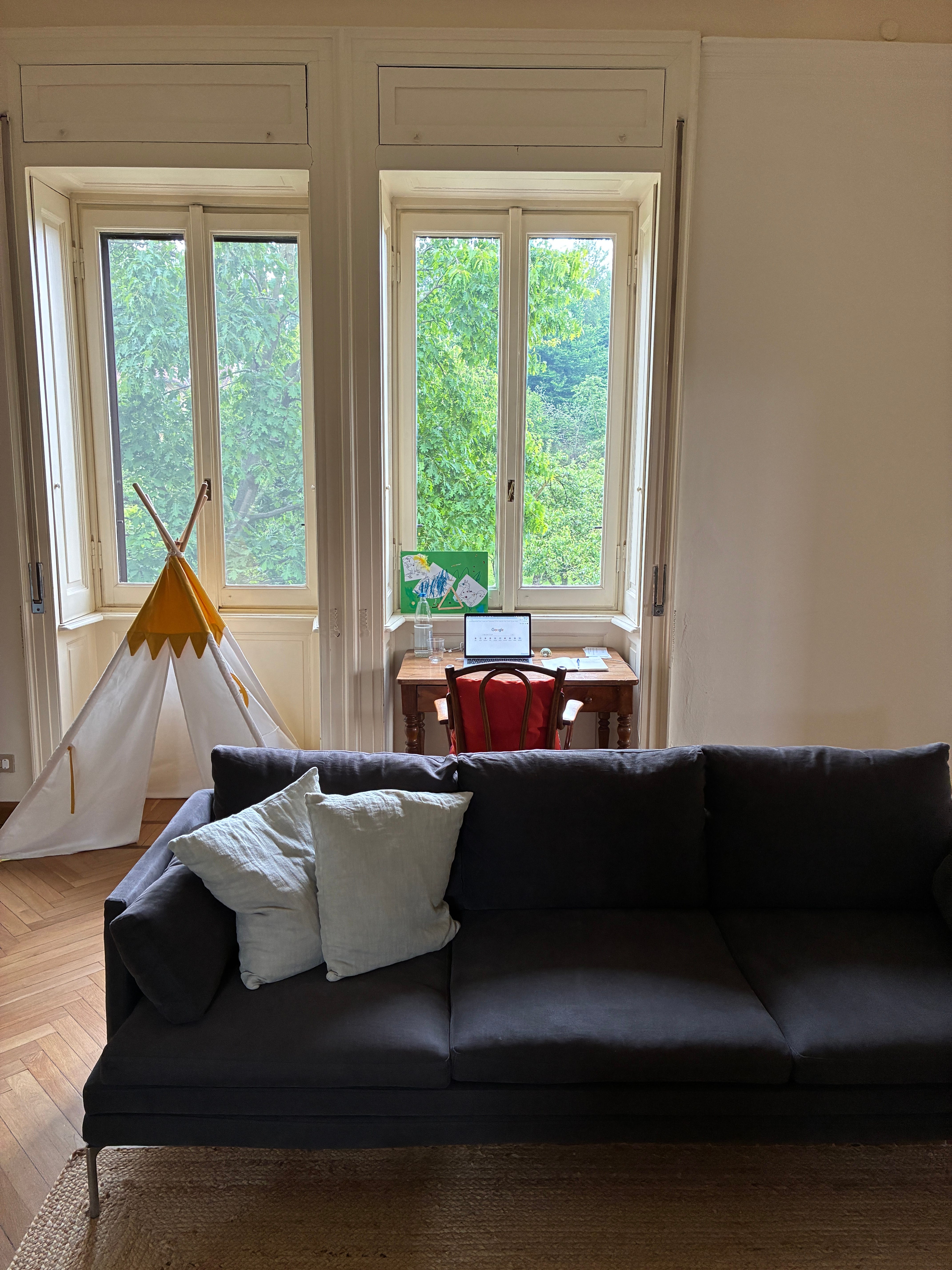
The colour helps too. It's a dark blue-grey that reads as a neutral against almost anything. I've paired it with a blue velvet sofa, with a leather pouf, and now it sits next to a bright green IKEA chair and a floral green vintage sofa that was my grandmother's, and it absorbs all of them without arguing. The cushions are where you make whatever statement you want that season.
The principle: the sofa is the piece most tempted to fit one room, and the one you'll most regret fitting. Buy the shape that works anywhere: straight, passe-partout, not too patterned. The cushions carry the season's mood; the frame has to outlast the address.
I have three USM Haller units. Two grey ones I took from an office that was being dismantled. They were free, I just had to come and carry them out. One white one I bought. I will never get rid of any of them.
For anyone who doesn’t know it, USM Haller is a Swiss brand that has been around since 1885. I know Switzerland very well. It’s beautiful, precise and a little boring, but if there’s one thing the Swiss do, it’s make a thing until it’s perfect. What’s brilliant about these units is that they’re modular, and you can reconfigure them more or less forever.
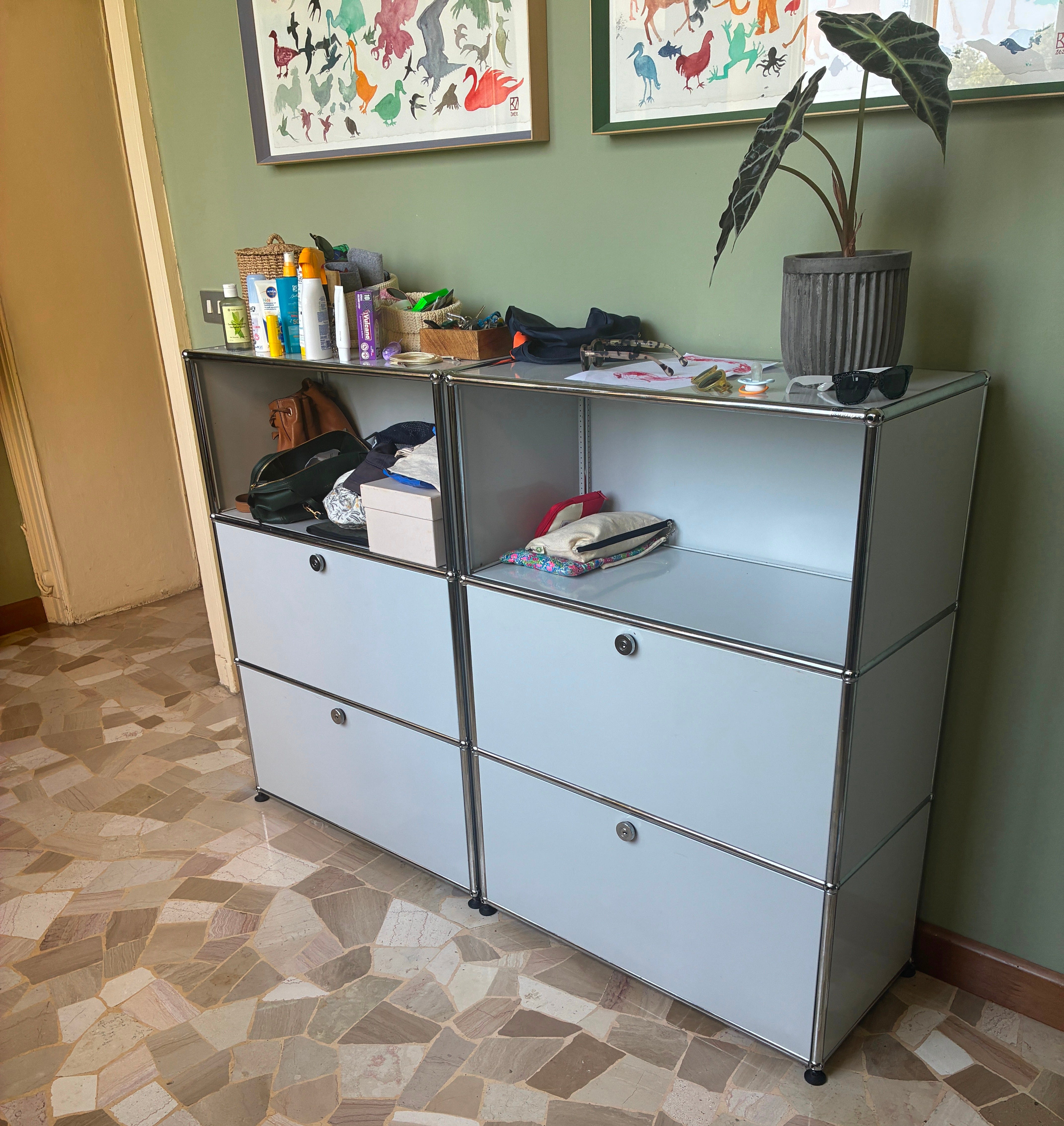
The white one was a long, low TV unit in one apartment. In the one before, it was four units across. In this one it stands vertical, three drawers tall, for filing and entrance storage. The fourth module has become my husband’s bedside table. In the next apartment it will be something else again. You add modules, remove them, recompose.
The system keeps adapting, and it works in a modern space and in an old apartment with parquet and cornices equally well. There’s something about that industrial-clean form that doesn’t compete with anything around it.
They are expensive new. But there’s a large secondhand market, and most pieces circulate in very good condition, because USM is built to last. Outside Switzerland the secondhand price tends to climb, so if you can, look in Switzerland first. Otherwise there are countless imitations, though I’ve never tested one myself.
The principle: modularity is one of the most intelligent ideas in furniture for a renter. It doesn't have to be USM. It can be modular shelving, a sofa made of attachable sections, a storage system you reconfigure. You're buying a system that adapts to whatever room comes next, instead of a piece sized for one.
I could write article after article about lamps. Like the sofa, they’re one of the objects that lift a whole space. A home needs more than one source of light: different kinds, different heights, different intensities. Here I’ll talk about them through a renter’s eyes, so what matters is how easily they install and how well they travel. Nothing is more convenient than a lamp that simply plugs and unplugs.
I’ve asked for lamps as birthday presents and as wedding presents (I say “asked,” though we all know who actually chose them). Looking back, they’re the best investment I ever made in homes I don’t own.
La Suspension Petite Volière, by Mathieu Challière - One of the first presents my husband gave me, and still one of the best. The birdcage pendant now hangs in my entrance. Before that it was in the hallway of the last apartment. Before that, the living room. Three spaces, three roles, always right. It's perfect for a child's room too.
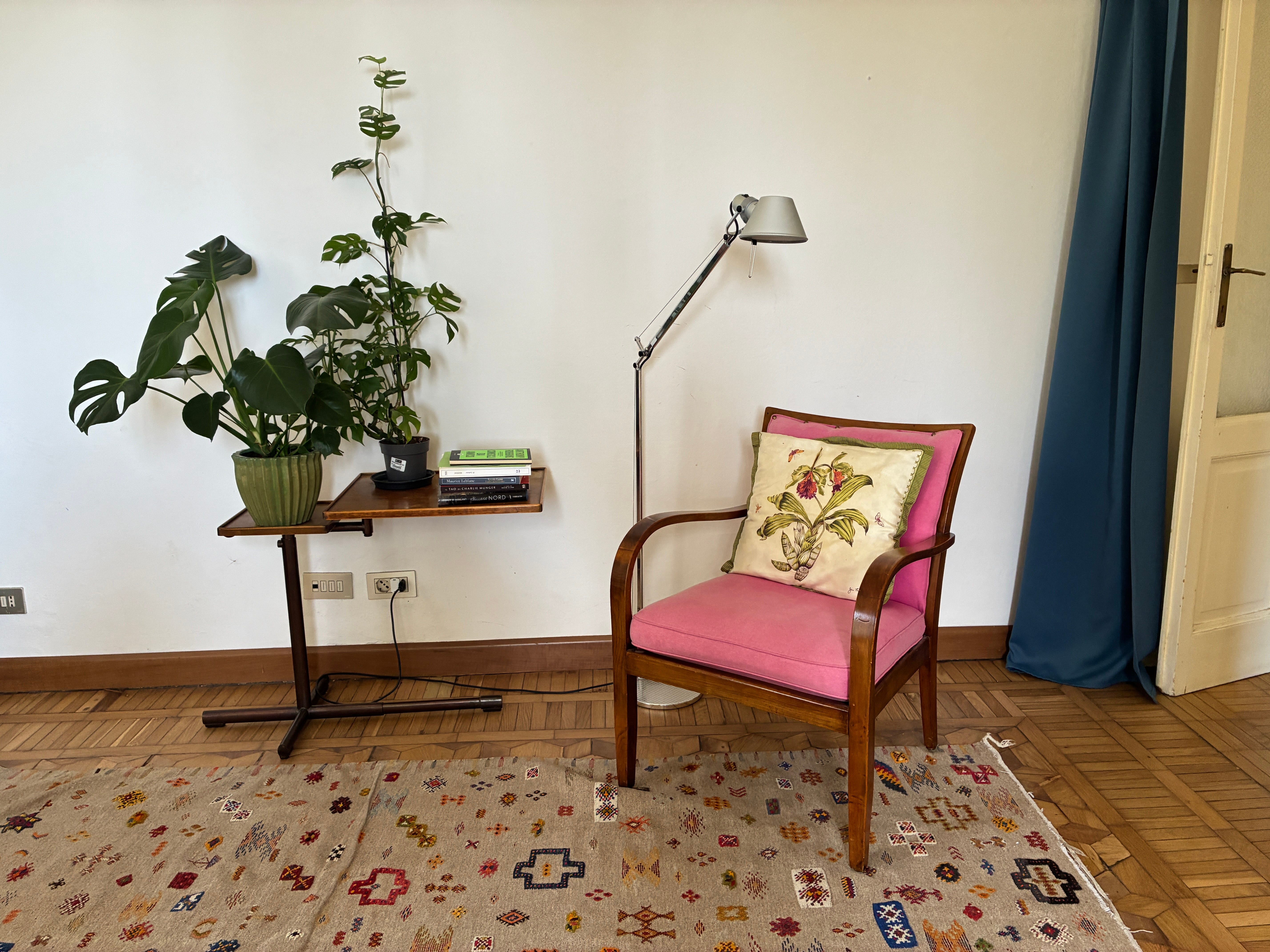
The Tolomeo, by Michele De Lucchi for Artemide - I have two. One is the ceiling version, with an asymmetric arm that extends to 200 cm; here it hangs over the kitchen table and solves the "light over the table" problem very elegantly. The other is the small floor version, possibly the most versatile lamp I own. I've stood it next to a bed, next to a sofa, next to an armchair, in a corner that just needed something. It looks as right beside an old piece as beside a modern one.
I have others I love just as much, the Castiglioni Toio and Luminator among them, two mostri sacri of Italian design. But lamps really deserve a piece of their own, so I’ll save the rest for it.
Not all of it has to be an investment, though. The big designer lamps are expensive, the cheap ones are usually not that pretty, and the trick is finding something simple and elegant in between.
My go-to is the humble rice paper ball, the round paper shade everyone knows. On its own it can look like a student let-down, but give it a coloured fabric cord and a nice collar and it suddenly reads as a choice. That's what hangs in the bedrooms here.
The living room has very high ceilings and big volumes, and I didn't want to buy lamps scaled for that for one apartment, so I stacked two origami paper shades to get the volume the room needed. Not my proudest piece of design, but it works perfectly.
The principle: lamps change a room more than almost anything, and they travel completely. If you'd rather not rewire pendants at every move, put your money into floor and table lamps, unplug and go. And layer your light: one source overhead is never enough. A home's feel is built from light at different heights, in different corners, at different intensities.
My grandmother gave us money for a bed as a wedding present. I designed it, chose the fabric (a James Malone print I'd wanted to use in a home for years) and had it made. That bed has moved with us through every apartment since.
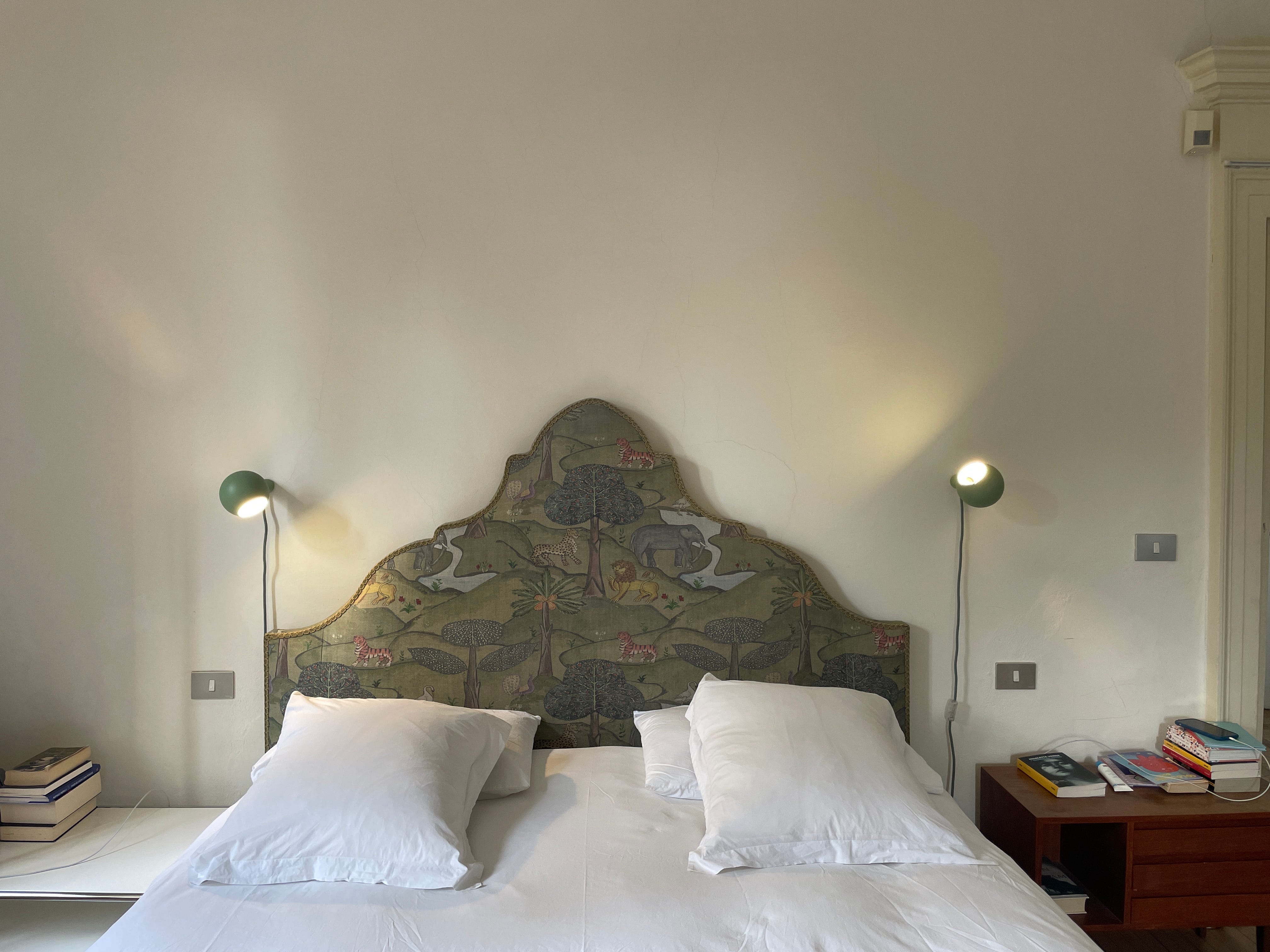
We also have two mattresses. My husband and I sleep better on different types, and instead of compromising on one, we just bought two. Everything else about the bed dismantles and packs flat. The mattresses go on the van.
The principle: if you're going to invest in a bed, choose one that comes apart easily, into manageable pieces, without needing a specialist to put it back together at the other end. And think about the mattress as a separate, long-term investment. You'll carry it with you for years. Sleeping well is not the place to save money on a move.
Two rugs are worth telling you about, because they’re the ones with a story and the ones that have travelled furthest.
The first my parents brought back from Iran. Long and narrow, very patterned, very specific. It’s also my favourite thing in this house. It has been under a dining table and is now on a cement floor in the children’s room, and it is beautiful in both places. A rug with a strong identity doesn’t clash with everything. It organises everything else around it. This one works on wood, on cement, on tile. I think it would work almost anywhere that isn’t itself very patterned.
The second we bought in Morocco. Also patterned, also completely adaptable.
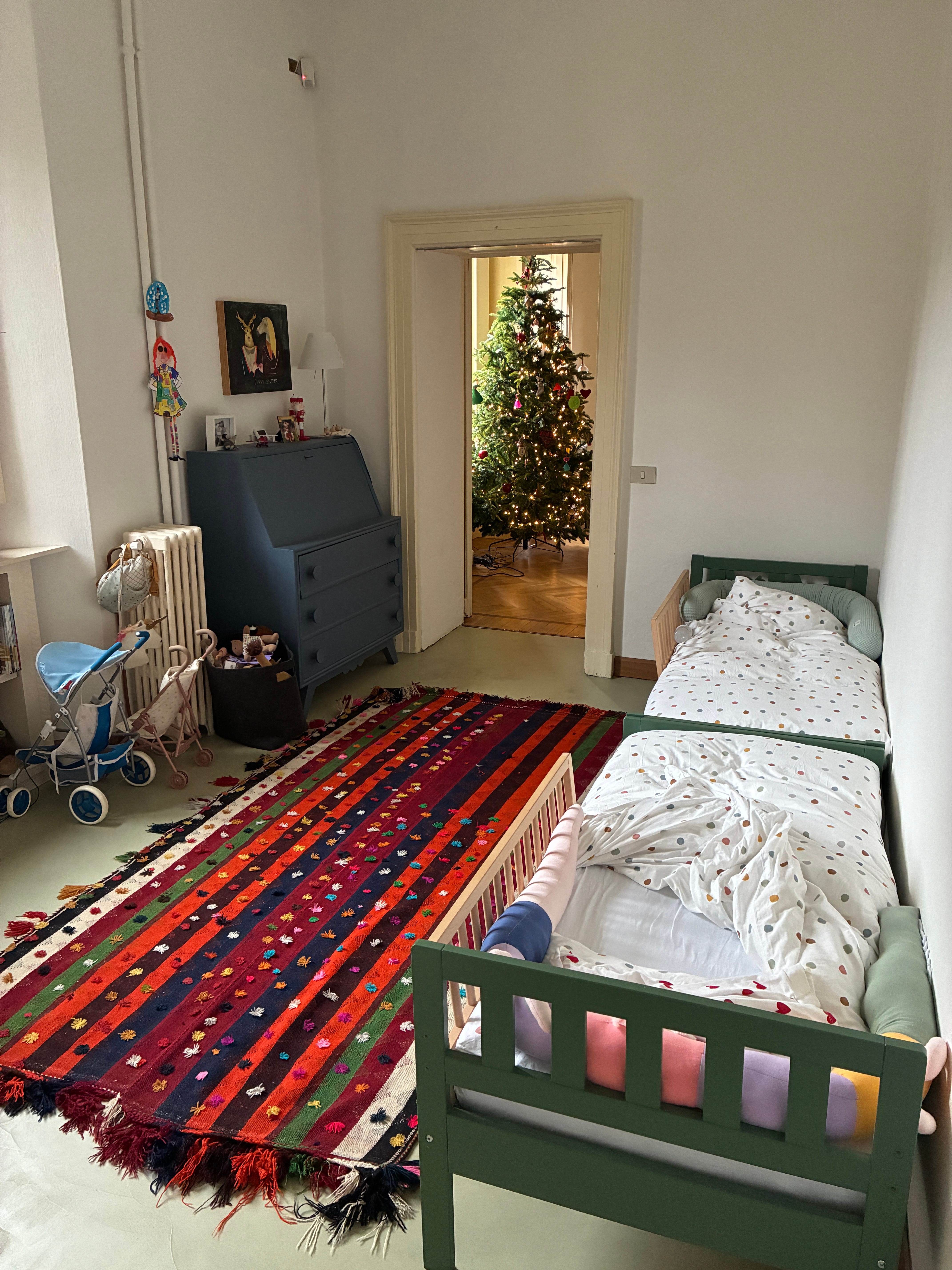
In my experience, the rugs you find on a trip or at a market are the ones that last. They weren't chosen to match a room. They were chosen because you loved them, and that turns out to be a much better filter.
The principle: a rug with a strong identity is not a risk, it's a starting point. The room reads from it. The one real constraint is the floor: a busy floor and a busy rug fight each other. And size matters more than pattern, a rug that's too small leaves a room feeling unassembled. When in doubt, go bigger.
I have seven dining chairs. I wish I had eight, and if you keep reading you’ll see why I don’t.
Three I found on the street in Geneva, left out for collection, old wooden frames. I took them home, sanded them, found a fabric I liked, and reupholstered them myself. A few months later I was at a flea market and found four more almost identical to them. Same period, same lines. I took the lot.
So I have seven chairs that look like they always belonged together, that nobody would guess came from two different street corners, that cost me almost nothing, and that I’ve moved, and will move again, without a second thought. That’s also why there are seven and not eight. I didn’t set out to assemble a matching set of a particular size. I took what chance put in front of me, and chance happened to hand me seven.
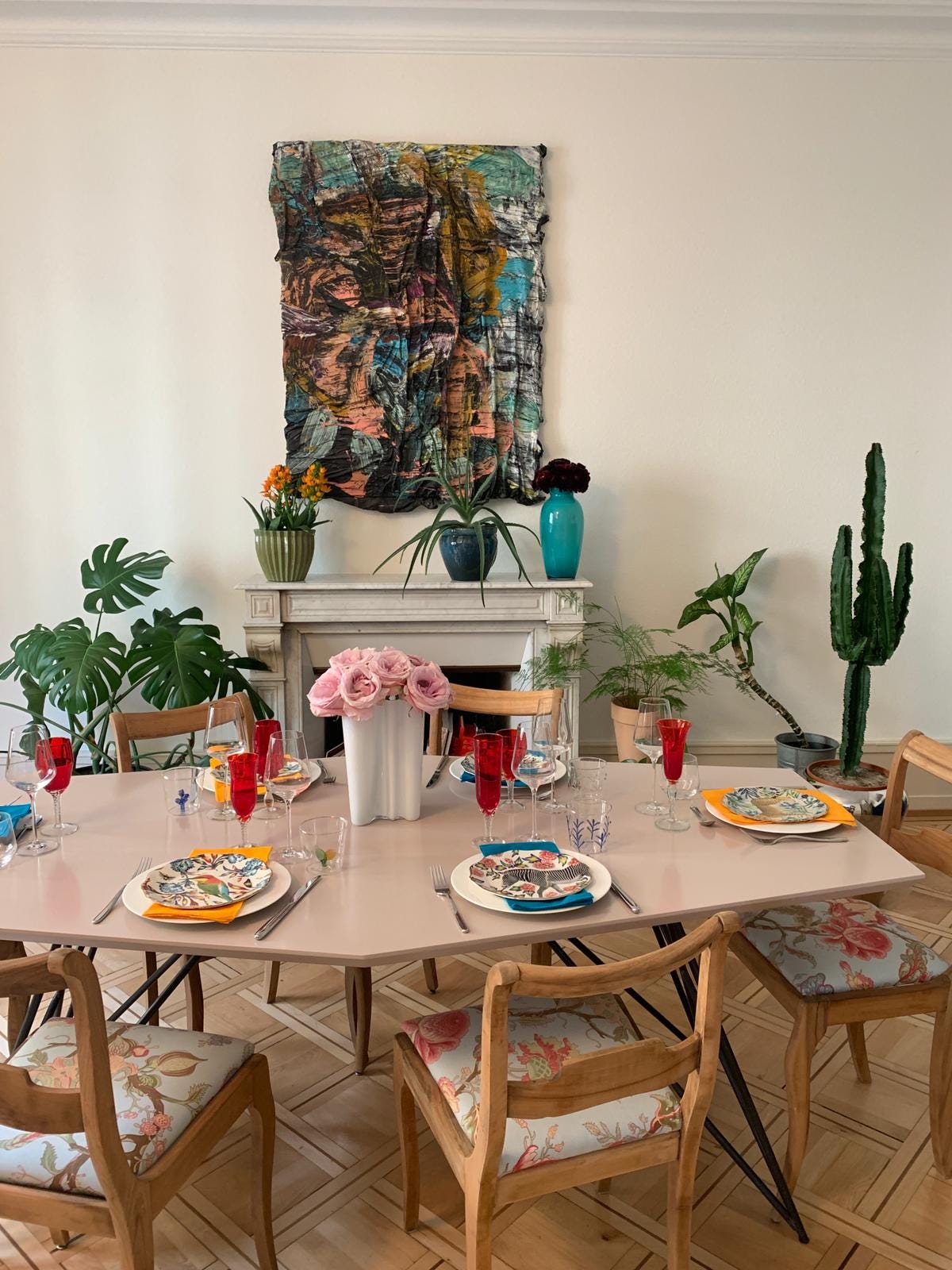
The principle: cheap chairs rarely last; the flimsy ones wobble and break in a few years, while a well-made one lasts a lifetime. If you don't want to invest, buy them vintage, good old frames you can sand and reupholster. If you do invest, choose a shape that marries both a modern table and an antique one, because the table will change and the chairs should still fit. My own favourites are the Cesca chairs by Marcel Breuer, named after his daughter Francesca (destiny?). Sooner or later I'll buy them.
The dresser I’ve owned longest started as mine when I was single, and it has found a wall in every apartment since, five of them now. That, more than anything, is the case for a dresser. It always finds a wall, while a wardrobe is built for a specific space and often doesn’t survive the move to the next one. (More on what that dresser became once the children arrived, later on).
On the cheaper end I’m a big advocate of the IKEA Malm. We have four: three I painted and wallpapered for the children, and one in white for my husband and me. The white one has come with us through three apartments and still looks good. It’s certainly not a piece for life, but for the price it travels well and takes paint and wallpaper beautifully. Sometimes IKEA makes very cool limited editions too; I still haven’t got over not buying the mirrored one.
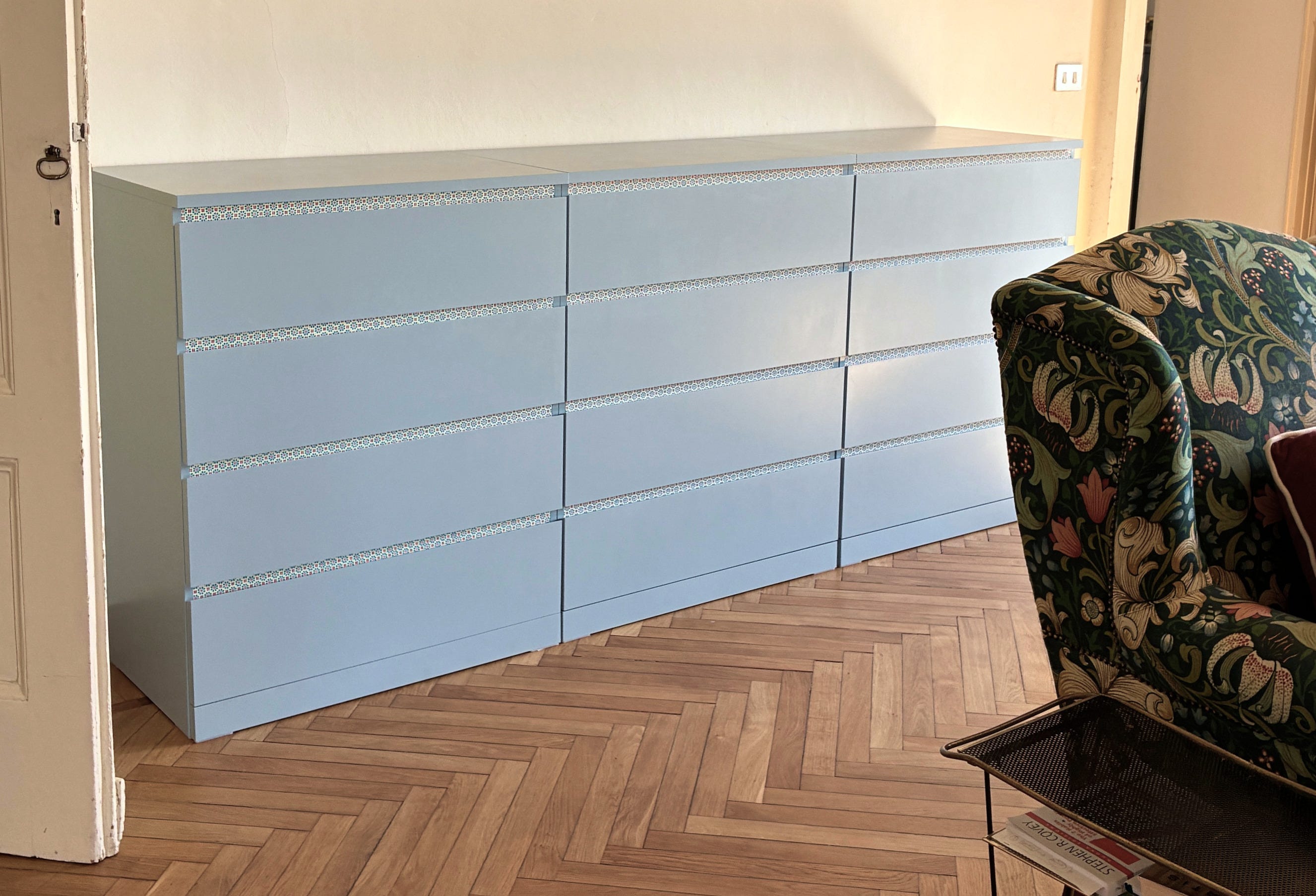
Large storage is the hardest category for a renter, and wardrobes are the worst of it. If you're lucky enough to rent in a period home (I always had built-in storage in Geneva and Lausanne, the apartments were simply made that way), you don't have to solve this at all. If you do have to solve it, modularity helps again. A system you can add to and rearrange travels better than a single piece designed to fill one specific wall.
The principle: invest in dressers over wardrobes, and before you buy any large piece of storage, ask whether it will find a place in a home you haven't seen yet. If the answer needs a very specific set of conditions, look for something else, or wait until you're staying somewhere long enough to make it worthwhile.
I have three armchairs, none of them match, and that is exactly the point.
One is a leather pouf by Zanotta. One is a bright green IKEA chair. One is a pink vintage armchair my aunt gave me for my thirtieth; it’s been with me for twelve years and needs reupholstering again, which I’ll do, because I’m not leaving it behind.
The pouf is in the children’s area, the pink one in my husband’s study, the green one moves around, and every so often we shuffle them. The lovely thing is that if I swapped them all tomorrow they’d still look right. That isn’t because any armchair goes with anything, it doesn’t; mine were chosen precisely so they would. A piece with a strong character, a strong colour, an unusual form, a visible age, carries its own logic, and doesn’t need the room to complete it.
The principle: armchairs are one of the best investments a renter can make, precisely because they're small enough to go anywhere and strong enough to anchor a room on their own. With an armchair you can dare more than with a sofa, because a single one can stand alone in a reading corner and furnish the whole corner by itself. And unlike a sofa, you can have several, all very different from each other, and they still get along.
Then there’s a cluster of odds and ends, small freestanding pieces I’ve carried for years, some longer than others, that I’ve used in a dozen different ways. None of them is big. They slip into any apartment, and they make a space better both to look at and to use.
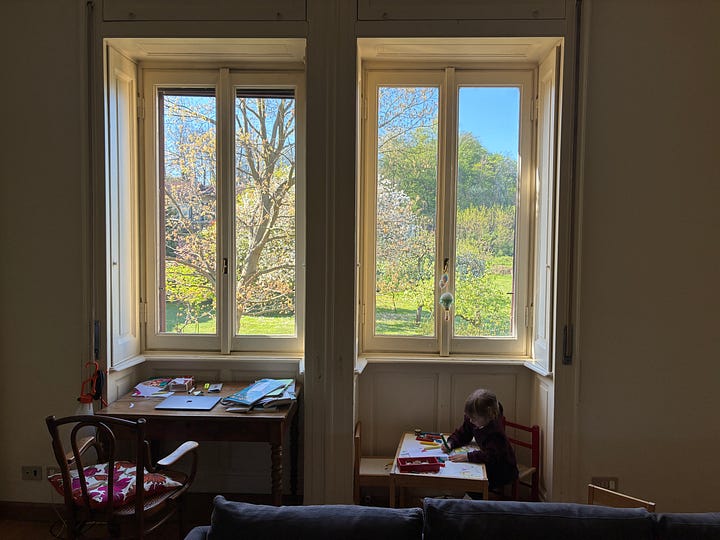
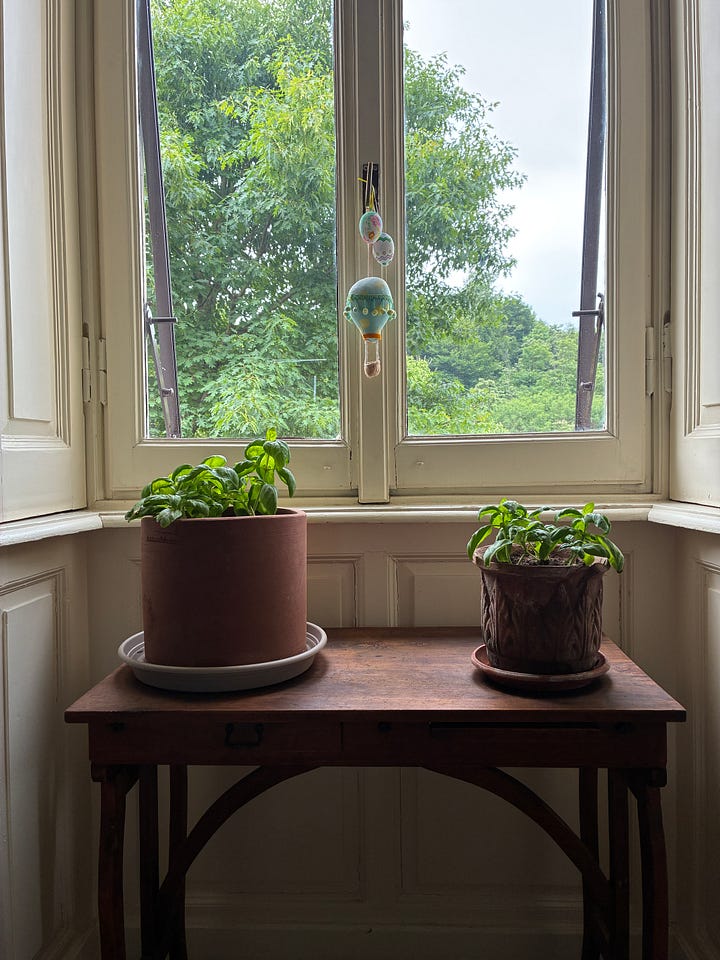

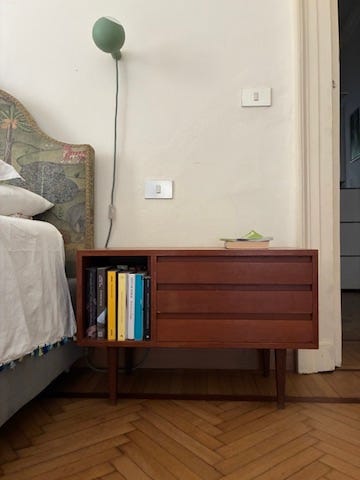
There’s a bedside table that was a TV console in Lausanne and a cocktail table in one of the Geneva flats before it ended up next to my bed. There’s the desk my grandfather made, the one piece I’d carry out of a fire, which has been everywhere and has already changed spot three times in this apartment alone. There’s the little table under the window that holds my basil now and lived in a bathroom before it. And there’s a small adjustable table, the kind they used to roll over beds in old hospital rooms, that I found at a flea market in Lausanne fifteen years ago; it was a side table next to the sofa for years, and now it sits beside the pink armchair in the office.
The principle: the smallest pieces travel furthest, because they never belonged to one room to begin with. A side table, a little desk, a stool with good lines will always find a job somewhere. Buy the box, not the label it came with.
There’s one kind of piece that does even more than find its place. It grows up with the people in the house.
Children outgrow phases faster than anything else in a home. The temptation is to buy for the phase they’re in right now: the changing station, the toy-cube tower, the toddler wardrobe. Two years later the phase is gone, and so is the piece. The better buy is furniture whose job can change as fast as the child does. (There’s far more to say about this than fits here, enough for a piece of its own).
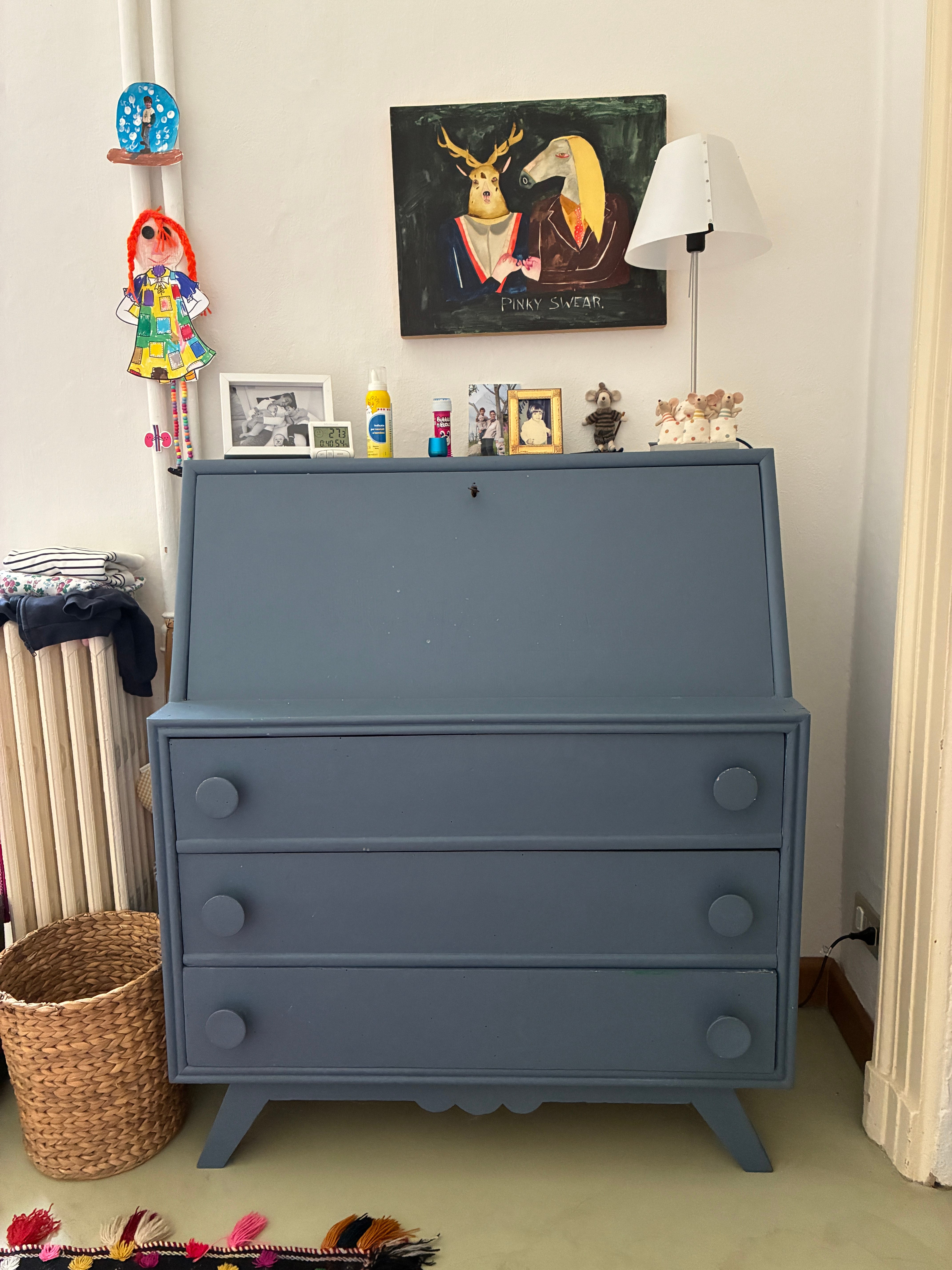
The dresser I mentioned is the proof. It started as mine, I painted it blue-grey when my eldest was born and it became his, and when the twins came each child got a drawer. Now that they're bigger it still stands in their room, holding bedsheets and art supplies.
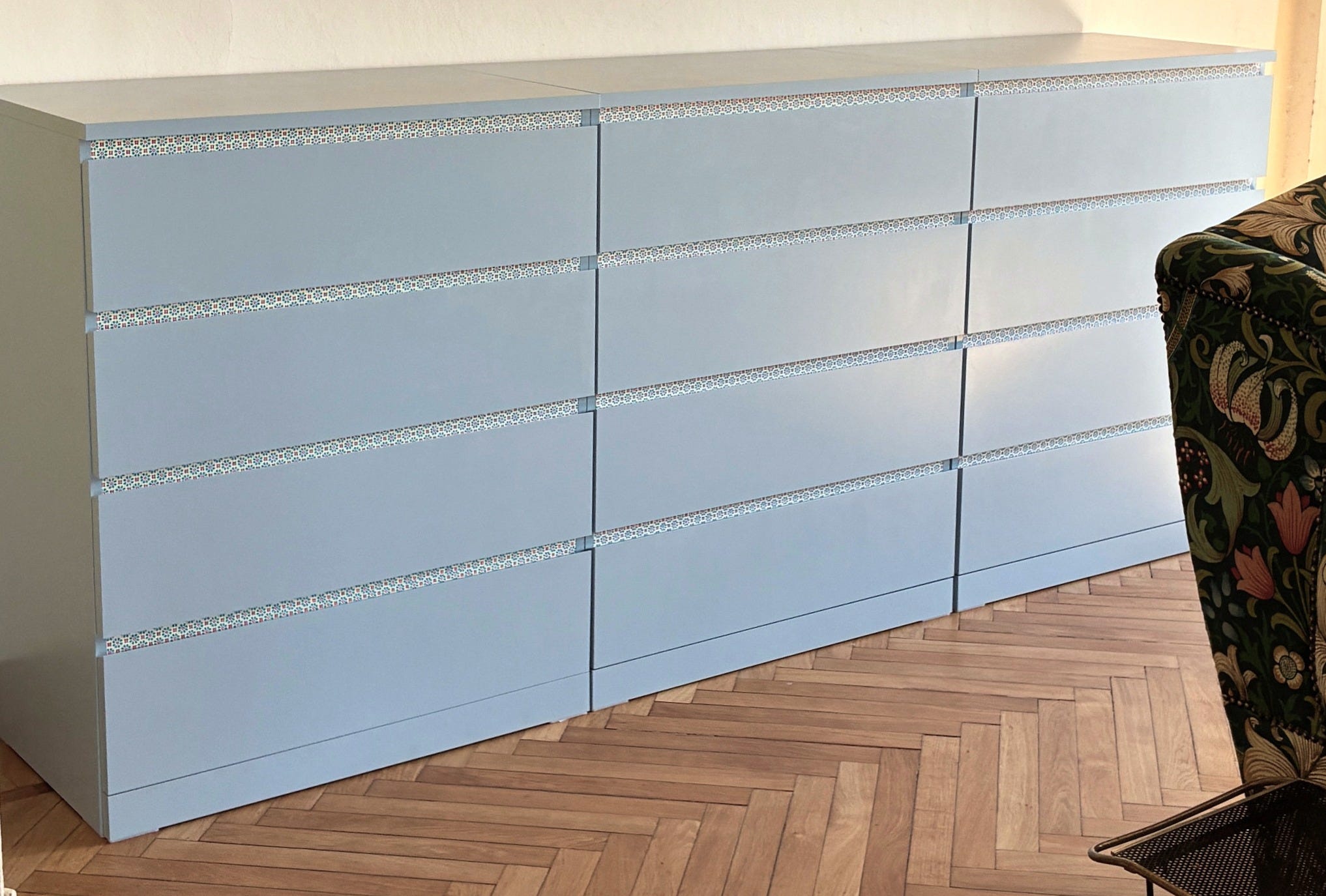
Their clothes have moved into three IKEA Malm units, one each, painted and wallpapered. Right now the three sit side by side, but I bought them thinking ahead: the day the children want their own rooms I can split them up, one each, and if they ever outgrow them, the units come back to me, for my clothes or a laundry room.
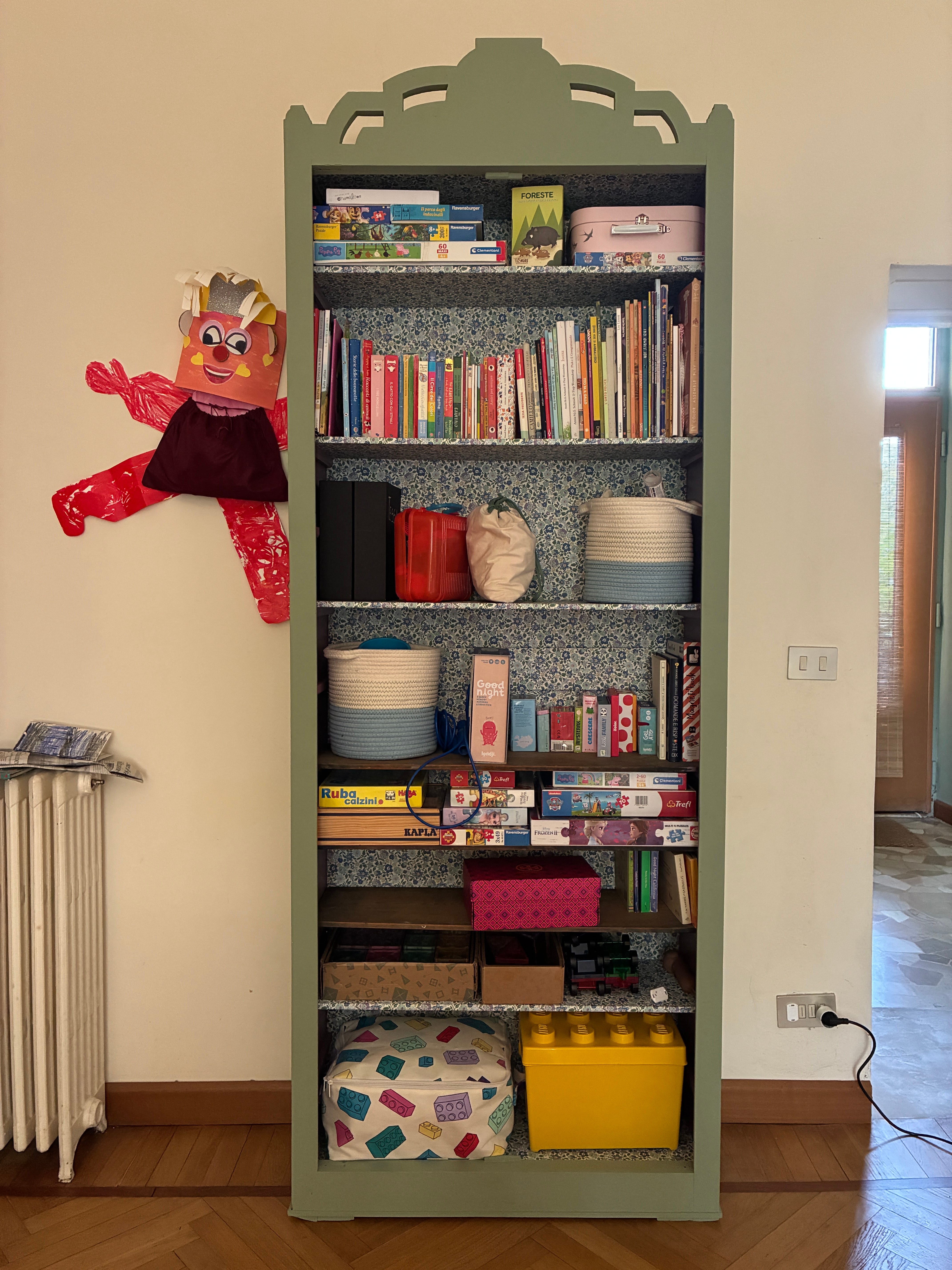
The piece I love most for this is a freestanding bookcase I painted myself and lined with wallpaper on the back. Right now it holds the children's toys and that is why the glassed doors are in the basement at the moment. I bought it knowing that one day it would be a library, or a wardrobe for my daughter, or a shoe cabinet, whatever the next phase asks for. Underneath it's just a box with shelves and a good face, and it changes job every time the family changes. A piece sold for exactly one job is gone in two years. The same money, spent on a box with good lines, is still working when the toddler is a teenager.
The principle: children outgrow functions, not good boxes. Buy the box and the good lines, and let the job change with them.
These few have done something more than the rest. They have grown up alongside the children, becoming whatever the next year asked for.

There’s one more thing that connects almost everything on this list. Most of it wasn’t bought new in a shop. The USM units came from an office. The chairs from the street and a flea market. The Iranian rug my parents carried back from a trip. The pink armchair was my aunt’s present for my thirtieth.
That so much of it came secondhand, or as a gift, doesn’t mean there’s anything wrong with buying new. There isn’t, as long as you do it with your head. New doesn’t have to mean cheap, or expensive for its own sake.
Plenty of brands make beautiful furniture at accessible prices now: IKEA for all sorts of things, HAY and Ferm Living a step up, H&M Home and Zara Home for textiles and small pieces, Søstrene Grene for the cheap and charming. Choose well, and buy the few that will move with you.
You don’t have to buy your way into a home that feels like yours. Sometimes you find your way into it. The pieces that last are almost never the ones chosen to match a particular room. They’re the ones you chose because you loved them.
The best of them never stay the same. They change job, change room, sometimes change owner, and keep working.
The best furniture has a biography.

Thanks for reading Off Camera! This post is public so feel free to share it.


Three kids in 20 months taught me this: homes need to evolve with us.
I’m Francesca, Italian architect. I practiced for over a decade and ran a small floral art atelier for a while. Then my first boy was born, and less than two years later, the twins arrived.
With three small children, shaping space became both more urgent and more chaotic. I keep adjusting, moving things, reassigning rooms, rethinking storage. Homes have to keep up with life.
Here, I write for parents who are fighting their homes every day, pouring everything I know about spaces, routines, and the beautiful mess of family life into every post.
If any of this resonated, subscribe so you don’t miss the next one. And if you know someone whose home is working against them instead of with them, share it with them.
💬 If something in your home isn’t working and you want to talk it through, send me a DM and I’d be happy to help.
No posts
Comments
Nothing yet. Say the first thing.
Sign in to join the conversation.