
“All the secrets in the world worth knowing are hiding in plain sight.” — Robin Sloan, Mr. Penumbra’s 24-Hour Bookstore
There is an old trader's axiom worth remembering: the market doesn't panic about the thing that's happening, it panics about the thing it can't measure. Strategic petroleum reserves fall squarely into that second category. Governments publish GDP, inflation, and defense budgets because concealing them buys little. Reserves are different. A reserve figure tells an adversary how long you can bleed before politics changes. Which is exactly why Beijing has never published one, and why an entire cottage industry of satellite imagery, AIS tracking, and customs-declaration modeling exists to reconstruct what China refuses to disclose. Reuters has repeatedly noted that analysts are forced to infer Chinese inventory movements rather than observe them directly. The models have gotten sophisticated. They remain, by definition, guesses.
That opacity turned the recent Iran War into the most interesting economics experiment nobody asked for. China entered the conflict as the planet's largest crude importer, buying north of 11 million barrels a day, roughly half of it transiting the Persian Gulf. When The United States and Israel started rattling the cage around the Strait of Hormuz — a chokepoint carrying close to a fifth of the world's oil — the models all pointed the same direction. Remove several million barrels a day of Gulf supply, and the world's largest manufacturing economy should have felt it within weeks. Wall Street revised $150 oil calls to $200. War-risk insurance on Gulf tankers went vertical.
It didn't come. And more strangely, China — the country everyone question if it would buckle first — barely flinched. Ports stayed open. Factories kept running. No queues at the pump.
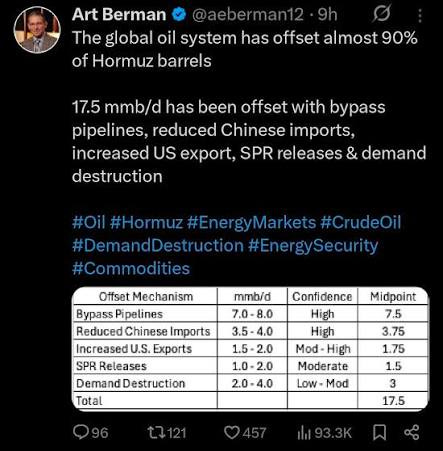
Give credit where it's due: Doomberg flagged this anomaly in real time, in Flex Capacitor, while most of the commentariat was still arguing about whether prices were being manipulated. The piece's central data point is worth restating: a Reuters report revised the estimate of lost Gulf exports from an initial back-of-envelope 12–15 million barrels a day down to something closer to 5–6 million, once traders and shippers accounted for rerouted cargoes and sanctioned barrels still finding buyers. That revision, more than any narrative about strategic patience, explains why WTI never got near $150, let alone $200. Doomberg's broader argument — that China had, almost invisibly, built a kind of shock absorber for the global hydrocarbon system, insulating not just itself but everyone downstream of it — is well evidenced and worth taking seriously.
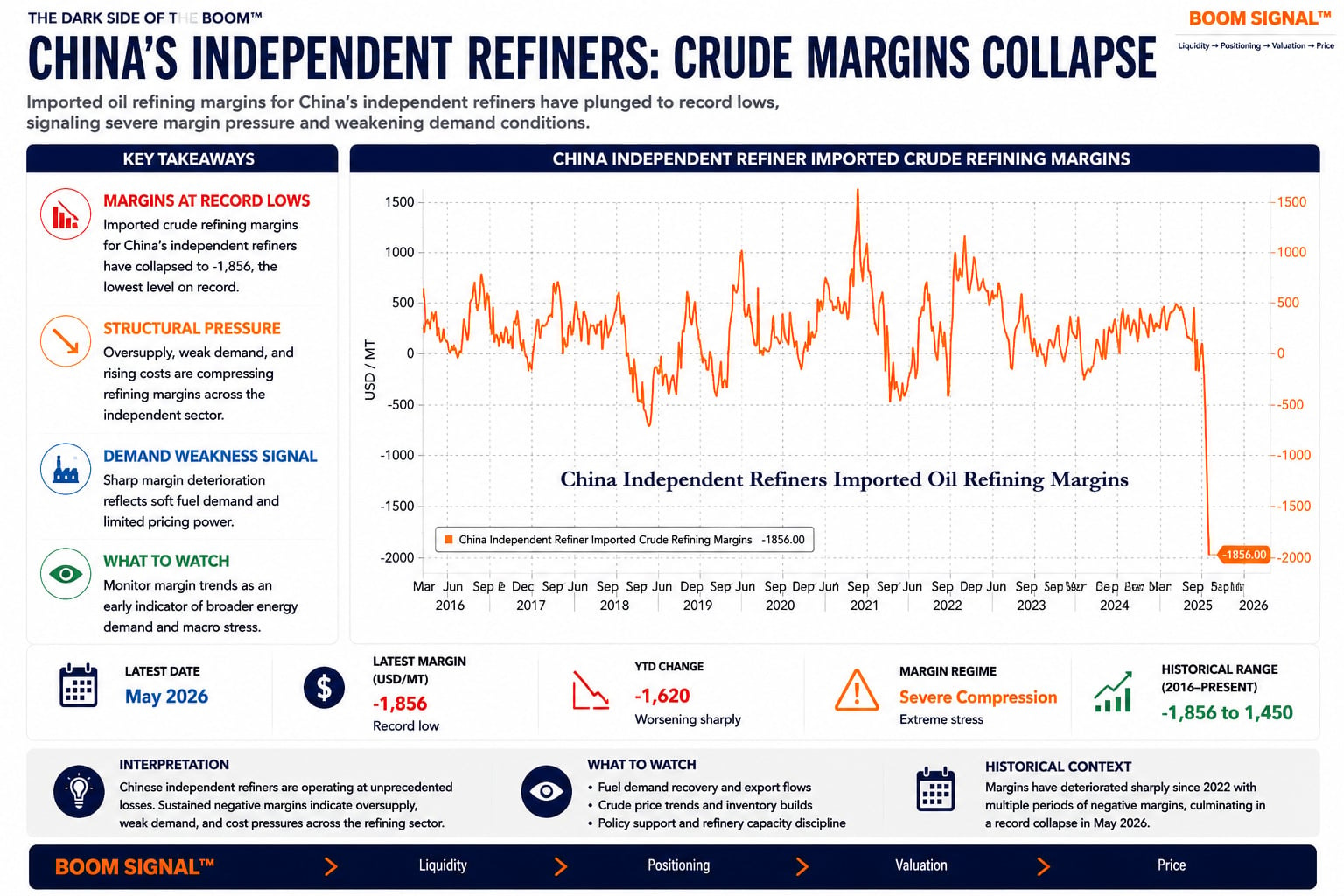
The architecture behind that shock absorber is real, and it didn't appear overnight. China today runs roughly 19 million barrels a day of refining capacity — the largest system on earth, and one that has puzzled Western analysts for years because it operates below optimal utilization with compressed margins. Viewed as a commercial decision, that's inefficient. Viewed as a national-security decision, it's optionality: crude can be redirected between facilities, maintenance deferred, regional disruptions absorbed elsewhere in the system. Storage tells the same story. Independent estimates place combined strategic and commercial inventories somewhere between 900 million and well over a billion barrels — the number is unknowable by design, but the direction of travel (accumulation, for years, while outsiders debated whether Beijing was overdoing it) is not in dispute. For context, that's roughly the same ballpark as total US inventory across every category combined — SPR, commercial crude, and refined products together — even though the American figure is fully disclosed weekly, or subjected to civil penalties, and the Chinese one is satellite-imagery guesswork. Both governments, as it happens, were quietly drawing down their own reserves during the same war for very different reasons: Washington to cap prices via a loaned-out, IEA-coordinated SPR release that leaves the barrels as a receivable rather than a permanent loss, Beijing to manage a war it may not have needed to manage as urgently as it appeared.
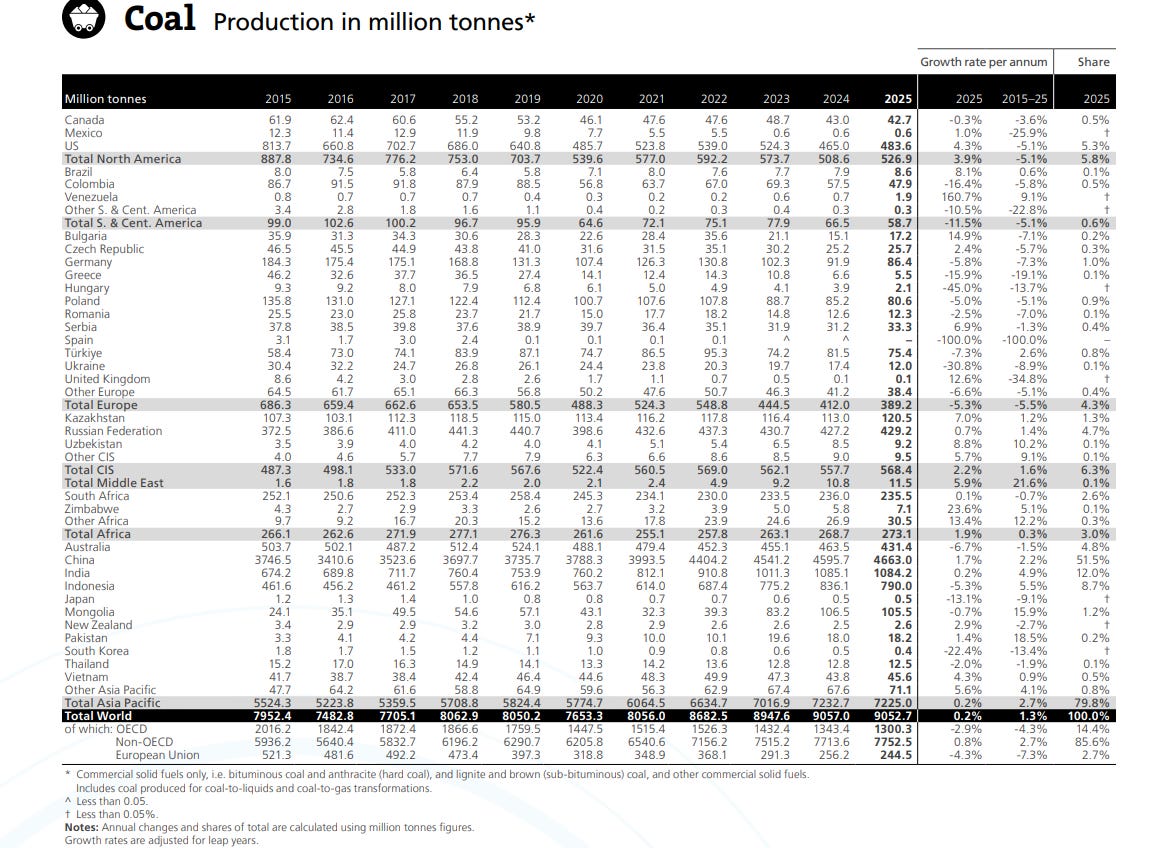
Nor did Beijing stop at oil. China mined roughly 4.8 billion metric tons of coal last year — more than the rest of the world combined — and coal still supplies about 60% of Chinese electricity. Coal can't be interdicted by a foreign navy; every domestically-mined electron is one less barrel of imported fuel needed to keep a factory running during a crisis. Overland pipelines — Power of Siberia from Russia, connections through Kazakhstan and Central Asia, the Myanmar-to-Kunming crude line that lets Gulf and African oil bypass the Strait of Malacca entirely — have spent two decades quietly diluting maritime dependence without ever eliminating it. More than 60 nuclear reactors, with dozens more under construction, convert a fuel that can be stockpiled for years into baseload electricity that doesn't need a tanker. Add 48,000-plus kilometers of high-speed rail displacing car and short-haul air travel, plus an EV fleet that now accounts for well over half the global total, and you have two decades of policy that — whatever else it was for — has the cumulative effect of shrinking the amount of imported crude China needs to keep functioning.
That is a genuinely impressive list. It is also, on its own, an incomplete explanation.
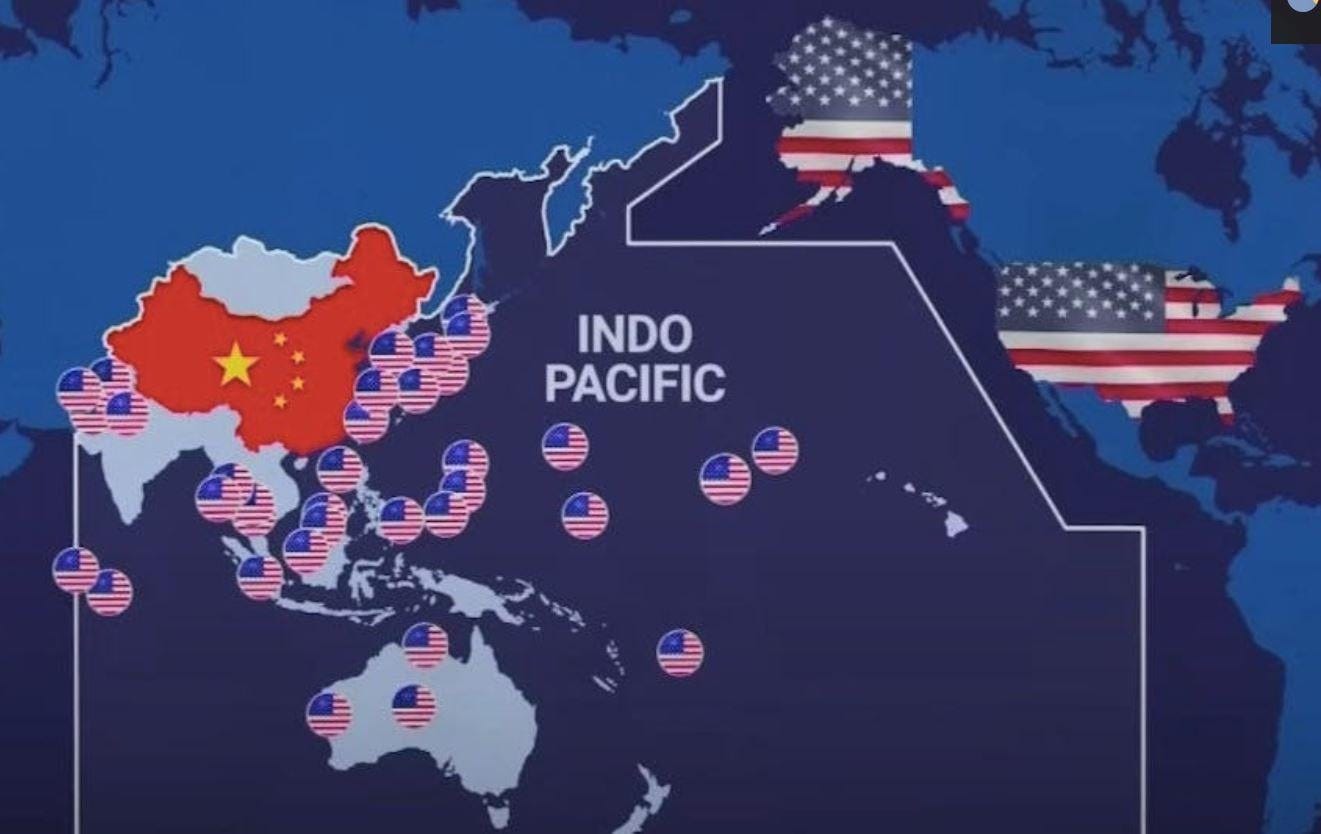
Longtime readers know where the chokepoint framework in this newsletter comes from. In Choke Collar, the case was laid out for how Washington has spent the better part of a decade tightening its grip on the sea lanes and resource geography ringing China — deepening military access across Indonesia, the Philippines, Australia, and Japan, with Indonesia's Grasberg-anchored resource base as one node in a broader campaign toward escalation dominance. The Malacca Dilemma — Hu Jintao's 2003 warning that nearly 80% of China's seaborne crude has to funnel through one strait — has been the load-bearing assumption underneath that entire strategy: control the chokepoint, control the leverage.
The Iran War was, in effect, a live-fire test of that assumption. And the test result, on its face, favors Beijing. Whatever combination of reserves, refining flex, coal, pipelines, and electrification China had assembled, it proved sufficient to absorb the largest disruption to Gulf energy flows in decades without producing visible economic dislocation. If that holds up, the Malacca Dilemma isn't dead — 60% of Chinese crude imports and a large share of its LNG still arrive by sea, and the US Navy hasn't lost the ability to contest those lanes in a prolonged conflict — but its coercive value looks smaller than two decades of strategic planning assumed.
Here's the uncomfortable question underneath that conclusion, though: is the Malacca Dilemma being solved, or is the size of the dilemma simply shrinking for reasons that have very little to do with strategy?
Comments
Nothing yet. Say the first thing.
Sign in to join the conversation.