
"War is merely the continuation of policy by other means." — Carl von Clausewitz
Few countries have benefited more quietly from the return of Donald Trump to the White House than North Korea.
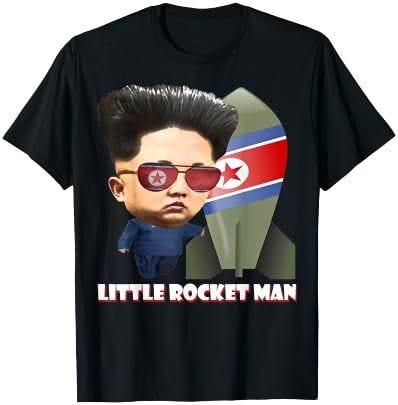
During Trump’s first term, “Little Rocket Man” dominated headlines as Washington and Pyongyang traded threats over North Korea’s growing nuclear arsenal. Today, by contrast, Kim Jong Un’s regime receives remarkably little attention despite expanding its strategic importance across multiple fronts.
North Korean troops have fought alongside Russian forces in Ukraine. Its factories have become a major source of artillery shells and munitions flowing into Russia’s war effort. Its uranium enrichment capacity is expanding through major new construction at the Yongbyon nuclear complex — the IAEA confirmed in April that a new building there, similar in scale to the Kangson enrichment facility, was externally complete with internal fitting underway, and in June Kim Jong Un personally toured a nuclear materials production facility, claiming output had “more than doubled” in five years. Meanwhile, trade between China and North Korea has rebounded sharply, with Beijing openly pledging deeper economic cooperation.
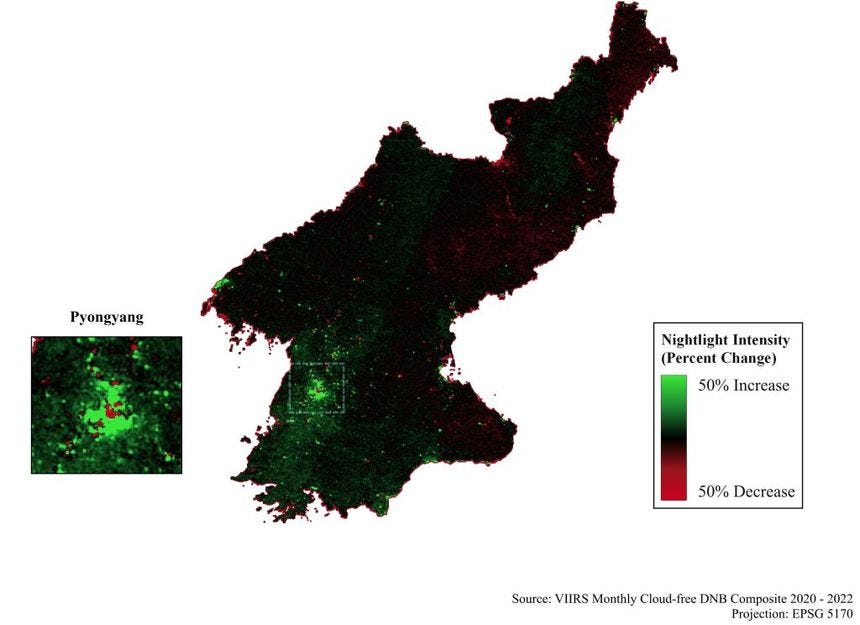
The regime’s finances tell the same story. Bank of Korea estimates put North Korean GDP growth at 3.1% in 2023 and 3.7% in 2024 — the fastest pace since 2016, and by the Wall Street Journal’s assessment, the strongest North Korean economy since Kim took power in 2011, arguably stronger than his father’s entire tenure. That outpaces most G7 economies over the same period. But the shape of the growth matters more than the headline number. Satellite nighttime-light data compiled by KAIST and the Max Planck Institute across 178 North Korean cities and counties shows illumination up 25.9% nationally between January 2022 and October 2025 — with almost the entire gain concentrated in 2022–2023, then flat since. The brightening tracks Pyongyang and military-industrial hubs specifically; it does not reach the countryside. And the timing lines up almost exactly with when South Korean intelligence assessed North Korea began supplying weapons to Russia. This isn’t broad-based development. It’s conflict cash, converted into visible capacity in a handful of favored cities, while the rest of the country stays dark. Russia needs ammunition. China needs industrial inputs. North Korea needs hard currency. Tungsten helps satisfy all three requirements simultaneously.
Known as the “war metal,” tungsten is essential for armor-piercing ammunition, missile systems, aircraft engines, semiconductor fabrication, machine tools, mining equipment, and countless defense applications. As global supplies tighten and prices surge — up roughly 500% since early 2025 by most benchmark measures — tungsten has emerged as one of the most strategically important minerals in the world.
The irony is that while Washington races to reduce dependence on China, some of the most important alternative supplies are emerging from countries deeply connected to Beijing’s sphere of influence.
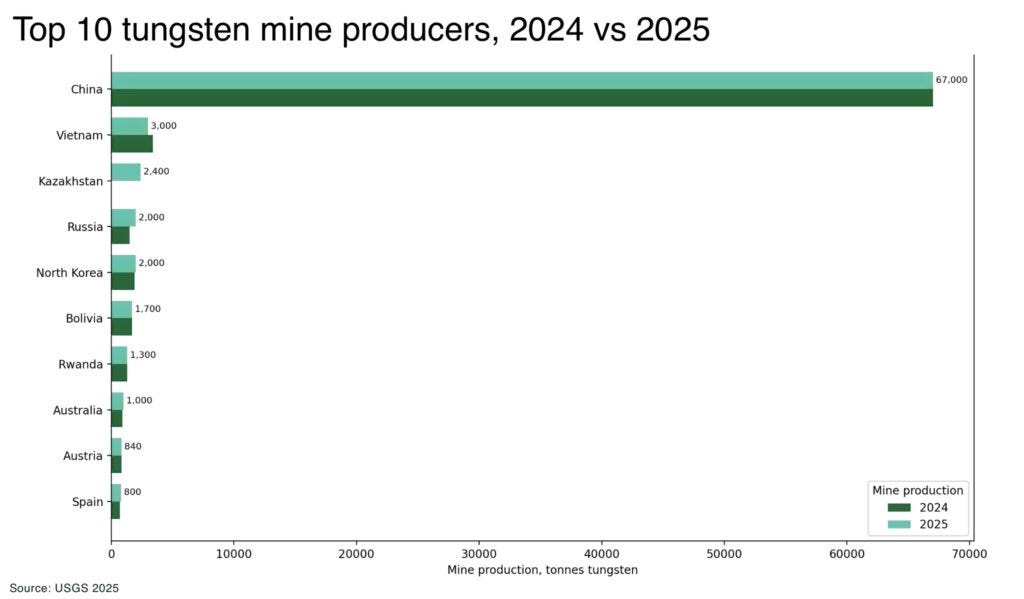
China still controls more than 80% of global tungsten production and refining capacity. For years, that dominance appeared nearly absolute. Then an unusual problem emerged: dominance does not necessarily guarantee security. Export restrictions, environmental constraints, military demand, and tightening global supplies have created a situation where the world’s largest tungsten power increasingly finds itself searching for additional material. Reports of Chinese-linked buyers aggressively pursuing tungsten scrap in the United States — with some dealers offered up to five times normal prices, according to the Financial Times — have become common enough that American manufacturers, organized through a coalition led by AMERMIN, have petitioned the Department of Commerce for export controls on scrap shipments bound for China and Russia.
“We’ve got to stop the export back to China,” said Ryan McAdams, chief executive of Texas-based recycler Amermin. “This is a secret war that nobody’s talking about.”
The world’s dominant supplier has quietly become one of the world’s most determined buyers. This has transformed an obscure industrial metal into the latest front in the global resource competition between Washington and Beijing. Let’s pierce through the amor and see what’s underneath.
Comments
Nothing yet. Say the first thing.
Sign in to join the conversation.