
“unleashed from the tether of fuel”—Jim Mattis
Every summer, the energy world pauses to consult its bible. The Statistical Review of World Energy — the report formerly stamped with BP’s logo, now published under the Energy Institute’s banner — lands with its usual authority: country-by-country breakdowns of oil, gas, coal, nuclear, and renewables consumption, sliced fine enough to tell you how much diesel Uzbekistan burned last year. Analysts, traders, and central bankers treat it as ground truth. It is, in its way, the closest thing the energy business has to a census.
And yet buried in that census is a rounding error the size of a small nation’s energy grid, hiding in plain sight because nobody asks it to identify itself. The United States military does not appear as a line item in the Statistical Review. It doesn’t need to — its consumption is folded quietly into the broader U.S. national totals, indistinguishable from the diesel burned by a Kansas City delivery fleet or the jet fuel consumed by a Delta 767. But unlike Delta, the Pentagon doesn’t file a 10-K. It doesn’t hold earnings calls. It is, by a wide and uncontested margin, the largest single institutional consumer of petroleum and energy on the planet, and it has spent the better part of two decades declining to make that fact easy to find.
It’s an omission of convenience — the kind bureaucracies produce not through malice but through decades of nobody in particular being incentivized to fix it. But omissions of convenience are exactly the kind worth pulling on, because they tend to sit directly on top of the most interesting stories.
So let’s pull.

Start with the plain scale of the thing. Researchers who’ve spent careers trying to pin down Pentagon energy use — chief among them Boston University’s Neta Crawford, whose work for Brown University’s Costs of War project remains the most rigorously sourced public accounting available — have consistently found that the Department of Defense has accounted for somewhere between 77 and 80 percent of all U.S. federal government energy consumption in every year since 2001. Not “a meaningful share.” Four-fifths.
All this capacity for and use of military force requires a great deal of energy, most of it in the form of fossil fuel." Neta Crawford
Zoom out to the national level and the number shrinks, but not the way you’d expect it to matter less. DoW’s footprint works out to roughly one percent of the entire United States’ total energy supply — one institution, spanning every combatant command from the Indo-Pacific to the Sahel, consuming energy at a scale comparable to entire industrial sectors of the domestic economy.
Break it down by fuel type and the picture sharpens further. The military burns something in the neighborhood of 4.6 billion gallons of liquid fuel annually — a figure that has held remarkably stable across administrations, wars, and drawdowns alike, because it is a function of platforms and posture, not politics. The overwhelming majority of that total is jet fuel: JP-8 for the Air Force and Army, JP-5 for Navy carrier decks, feeding a fleet of aircraft that measure fuel burn in gallons per mile the way the rest of us measure it in miles per gallon. But tucked inside that number are hundreds of millions of gallons of diesel and marine distillate — the fuel that moves an armored division across a training range, that keeps a destroyer’s auxiliary systems alive, that idles behind every forward operating base’s generator bank.
Then there’s the installations themselves — the roughly 800 major domestic and approximately 750 to 800 military sites overseas bases that don’t move, but still need to be lit, heated, cooled, and kept running around the clock. Installation electricity consumption runs somewhere between 30 and 34 terawatt-hours per year. For context, that’s more power than several G20 members’ civilian electricity sectors generate in total.
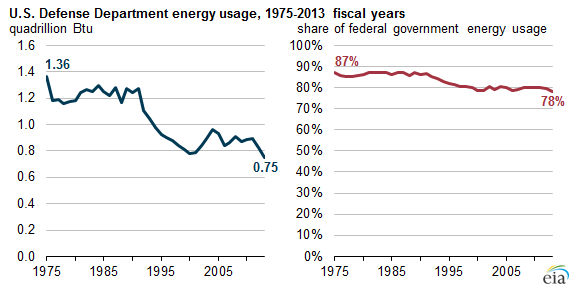
Add the fuel and the electricity together and you get a combined footprint of roughly 220 terawatt-hour-equivalents — about 0.75 quadrillion BTUs, or 0.75 “Quads” in the unit of measure energy analysts use when the numbers get too unwieldy for anything smaller. If the Pentagon operated as a sovereign nation and reported its own energy statistics, it would rank as one of the more energy-intensive economies on Earth — a fact borne out historically by a still-cited estimate from the height of the Iraq War: at the peak of that conflict, the Pentagon’s daily oil consumption alone would have ranked it 34th among the world’s nations, ahead of Pakistan’s entire population and just behind Iraq itself, the country in which much of that oil was being burned.
None of this is secret, exactly. It’s simply inconvenient to advertise, and convenient to leave for outside researchers to reconstruct from fragments — DLA fuel purchase records here, EIA cross-references there, congressional testimony sprinkled in between. The Pentagon does not report its consumption in a single consolidated public disclosure, and it has resisted doing so for years, citing operational security. That’s a defensible position. It is also, conveniently, one that keeps America’s single largest energy customer off the books that the rest of the world uses to understand global demand.
But there is another angle to the Pentagon’s energy posture that gets far less attention. It has to do with the slow, deliberate, multi-agency effort to wean the most fuel-intensive institution in the country off liquid hydrocarbons for its stationary load — and the fact that doing so happens to open a very useful door for a policy goal Washington has wanted to pursue for entirely separate reasons: rebuilding a domestic advanced nuclear industry that atrophied for two generations.
Executive Order 14299, “Deploying Advanced Nuclear Reactor Technologies for National Security,” set a hard deadline — September 30, 2028 — for fielding operational advanced reactor capability tied to national security missions. That is not a target arrived at by accident. It sits on top of a Nuclear Regulatory Commission licensing environment that has, in parallel, been streamlined through proposed NEPA reforms, alongside a concurrent ALARA rulemaking push and a stack of DOE advanced-reactor milestones — all converging on the same several-year window.

The Pentagon, in other words, doesn’t need to persuade anyone that it should buy nuclear power. It has a captive, unambiguous, apolitical justification sitting right there in its own energy bill: unreliable liquid-fuel logistics chains are a documented vulnerability in contested theaters. The Pentagon’s own term for the problem is the tyranny of fuel, coined after two decades of counterinsurgency in which moving diesel proved almost as dangerous as fighting itself. Route Irish, linking central Baghdad to the airport, earned its reputation as the most dangerous road in Iraq between 2003 and 2007 largely because of what traveled on it. A 2008 attack on a NATO supply depot near Peshawar destroyed thirteen fuel trucks outright; a 2010 strike on tankers staged near the Torkham border crossing took out more than thirty of them and killed or badly burned several drivers. Grid-tied installations carry a parallel vulnerability to cyberattack and blackout, and both problems are solved — or at least meaningfully mitigated — by parking a sealed, factory-fueled microreactor inside the wire. Nobody has to make the case for nuclear power on its own economic merits. National security does the persuading for you.
And once that door is open, the traffic through it doesn’t have to be limited to a handful of demonstration units on remote bases. It becomes the leading edge — the government-funded, risk-absorbing, first-mover customer — for an entire generation of advanced reactor vendors who have spent a decade struggling to get anyone to write the first check. A guaranteed federal anchor tenant is exactly the kind of de-risking event that turns a story stock into an investable industrial base, and turns an industrial base into IPO candidates.
Whether that’s the primary motive or a convenient second-order benefit is, admittedly, above this author’s pay grade to adjudicate with certainty. But it would be naive to assume the Pentagon’s nuclear buildout is purely a fuel-logistics play with no awareness of the industrial policy it doubles as.
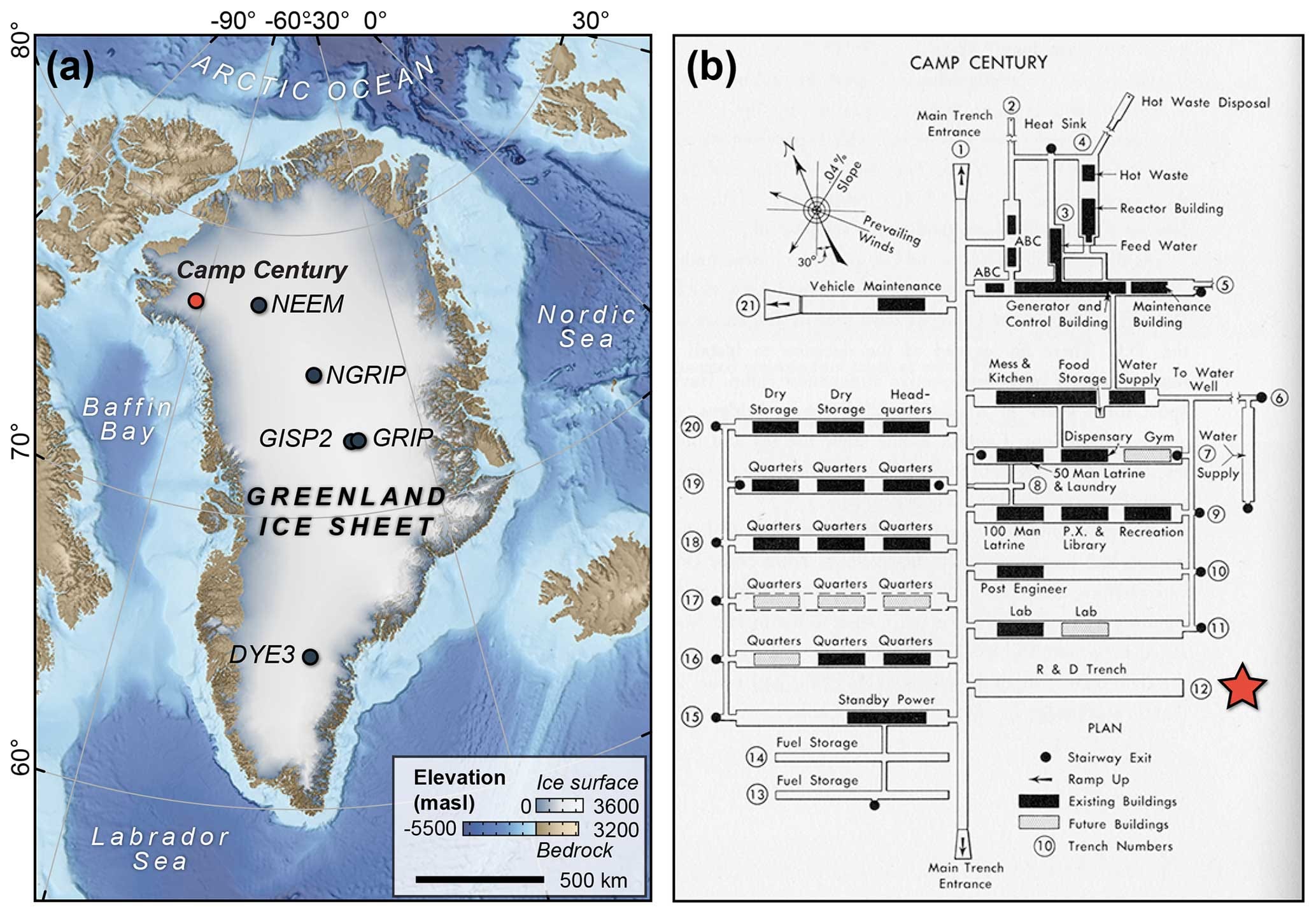
None of this is happening in an institutional vacuum, for what it’s worth. The Army tried something similar once — eight remote reactors built between 1954 and 1977, at outposts as improbable as the ice tunnels of Camp Century and a converted Liberty ship moored in Panama’s Gatun Lake — before a fatal 1961 accident at an experimental reactor called SL-1, at the same Idaho site where Pele is tested today, ended in the only fatal reactor power-excursion accident in U.S. history and closed the book on military nuclear power for a generation. It stayed closed until a 2016 Defense Science Board report reopened the case, arguing small deployable reactors could do something diesel generators structurally can’t. Pele isn’t picking up a blank slate; it’s picking up a thread the Pentagon dropped fifty years ago for good reason, betting that better fuel forms and tighter safety margins have actually closed the gap this time.
With the framing established, let’s dig through the details of the project that’s actually doing the work.
Comments
Nothing yet. Say the first thing.
Sign in to join the conversation.