
"[We must ensure] we do not go it alone and that we have maximum American support."
— Harold Macmillan, UK Chancellor of the Exchequer
In 1976, Britain went to the IMF with its hand out. Inflation had run past 25%, the highest reading since the Napoleonic Wars. Sterling was in freefall, the government was borrowing at a pace no lender wanted to underwrite, and the country that had helped build the postwar order was reduced to accepting a $3.9 billion facility on terms that required real spending cuts and higher rates to get it. Britain was, at that point, the first advanced economy in the postwar era to require a bailout. Alongside Italy, it had earned the epithet “the sick man of Europe” — a diagnosis of decline so total that an entire genre of gloomy paperbacks, with titles like Is Britain Dying?, found a ready audience.
And then, almost providentially, the North Sea started paying out. First oil had come ashore in 1975; by 1978 and 1979 it was flowing in earnest, and by 1981 Britain had gone from importer to net exporter. James Callaghan, the Labour prime minister presiding over the IMF humiliation, called it “God’s gift to the British economy,” and for once a politician’s phrase undersold the reality. The basin didn’t just balance the books — it rewrote Britain’s entire economic trajectory. Oil went from roughly $3 a barrel in the early ‘70s to north of $37 by the mid-’80s, and Margaret Thatcher inherited a revenue stream large enough to fund tax cuts, break the unions, and privatize her way through a decade without ever quite having to answer for the bill.
That windfall didn’t just rebuild Britain’s economy — it rebuilt its confidence, and confidence is what the special relationship actually runs on. A Britain that had just gone begging to the IMF was not a Britain capable of standing shoulder to shoulder with Washington in any meaningful sense. A Britain suddenly flush with its own oil, run by a prime minister who could credibly claim the country was back on its feet, was exactly the kind of partner an American president could lean on. Reagan and Thatcher’s relationship was personal and ideological, but it was underwritten by the fact that Britain, for the first time in a generation, could show up to the alliance as a solvent power rather than a supplicant one. That backing proved decisive when it mattered most: when Argentina invaded the Falklands in 1982, Reagan’s Washington sided unambiguously with Britain, providing missiles, intelligence, and fuel that Thatcher’s own advisers later said was likely the difference between winning the war and losing the islands. Oil money bought Britain a prime minister strong enough to fight that war, and that prime minister’s closeness with an American president bought her the backing to win it.
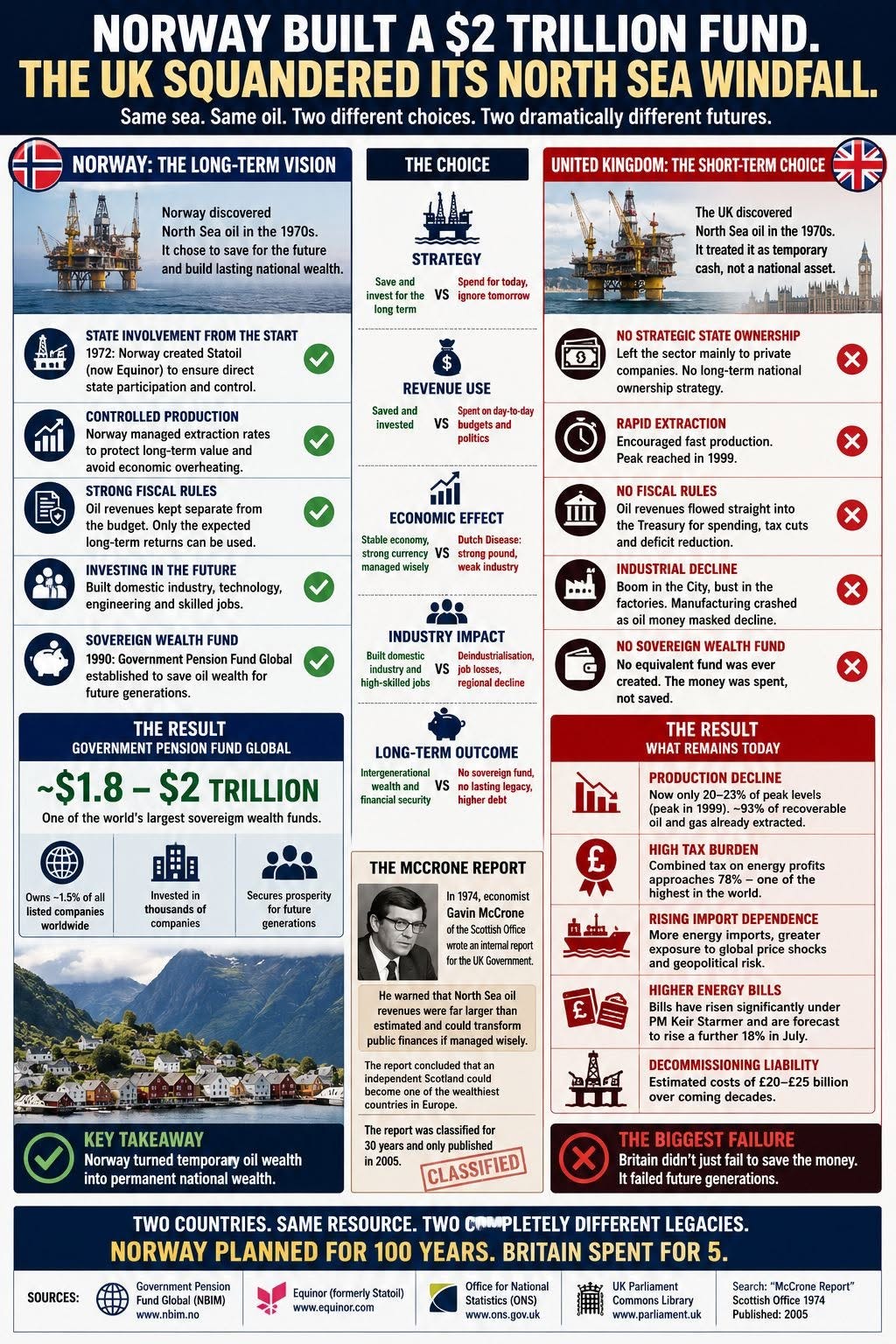
It is worth noting what Britain chose to do with the windfall, if only because it explains the country’s current predicament. Norway, discovering oil in the same waters on the same timeline, nationalized the upside through Statoil — now Equinor — and built a sovereign wealth fund now worth roughly $2 trillion, larger than Saudi Arabia’s entire GDP. Britain farmed out licenses to the majors, privatized BP itself in the 1980s, and let the revenue flow straight through the exchequer into tax relief and a housing boom that ended, predictably, in the bust of 1990. Two nations, one continental shelf, and one of them has nothing to show for forty-seven billion barrels of extracted oil beyond having once not needed the IMF. The other has a fund worth one and a half percent of the value of every listed company on Earth.

Half a century later, the basin that rescued Callaghan’s government and underwrote Thatcher’s alliance with Reagan is being abandoned by the company whose name is practically synonymous with it. Meg O’Neill did not phrase it as a retreat. In April, on an earnings call that markets mostly shrugged off, BP’s new chief executive said the company had to ask itself a plain question: what assets might be worth more in someone else’s hands? Weeks later, Bloomberg reported what the question had been building toward — BP is weighing an exit from part or all of its UK North Sea operations, a divestment that could fetch upward of £2 billion. Reflecting on her first 100 days as CEO, O’Neill put the same logic in writing:
“We are taking concrete action to grow long-term value for shareholders: simplifying our portfolio, reducing costs, maintaining tight discipline on capex and strengthening the balance sheet, we need to be deliberate about where we invest and where we don’t. We need to make fewer, better choices and hold ourselves to account, investors should be able to rely on us in the same way our customers do,” the executive added, O’Neill, the first female CEO of a Big Oil company, wrote in a LinkedIn post to reflect on the first 100 days as top executive of BP.
The proximate cause is not mysterious. A combined tax rate near 78% on North Sea oil and gas profits has done what confiscatory tax rates reliably do: made the marginal barrel not worth the trouble. Chevron and ConocoPhillips got there years ago. What’s notable is that BP was the basin’s last major holdout, now conducting the kind of internal portfolio review that precedes a company quietly agreeing to stop being who it was. Its own $20 billion divestment target through 2027 isn’t a strategy slide. It’s a debt covenant with a deadline.
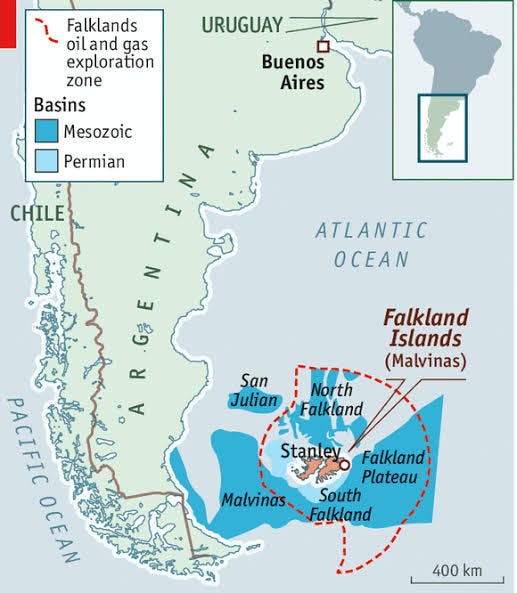
The North Sea is what Britain is leaving. Its other major hydrocarbon frontier is the one place where the exact opposite is happening. The UK government has banned new oil and gas licensing in its own waters — a stated climate policy, not a tax-driven half-measure. And yet 8,000 miles south, in the North Falkland Basin, a British company just took final investment decision on a field expected to produce 170 million barrels in its first phase alone, with a broader prospective resource estimated near 3.1 billion barrels next door. The reconciliation is a technicality: Falkland Islands hydrocarbon policy is devolved, so Westminster keeps its climate credibility at home while a self-governing territory of 3,600 people races ahead with exactly the kind of drilling the mainland has foreclosed on itself.
That territory has cost Britain more than money to hold, long before any of this oil was found. The UK spends roughly £150 million a year maintaining RAF Mount Pleasant and its garrison — permanent Typhoon fighters on quick-reaction alert, an air-defense battery, a rotating Army presence, the air bridge through Ascension Island. Spread across 3,600 residents, that’s about £42,000 in annual defense spending per Falkland Islander, equivalent to more than half the islands’ entire GDP, spent every year, in perpetuity, on deterrence alone — a higher ratio of military spending to GDP than any country on Earth, Ukraine included. That was the price of pure principle, justified by the 255 British dead of 1982 and the political impossibility of ever admitting the sacrifice might not be worth it anymore. A field now projected to pay the islands £5.6 billion in royalties over three decades doesn’t change why Britain defends the Falklands. But it means London no longer has to choose between principle and profit motive to justify the same £150 million a year — the oil arrived just in time to make expensive symbolism look like it was strategy all along.
Which brings the story to now, and to a very different kind of debt.
Comments
Nothing yet. Say the first thing.
Sign in to join the conversation.