
Hello,
Jordan here, welcome back! Today is day 43 of me living in hospitals following the Brain Haemorrhage that I suffered on July 13th, thank you for all of your messages, DMs and emails of support as I continue to recover.
In last week’s newsletter, I said it was acquisition season in sports. Today’s newsletter is the sequel.
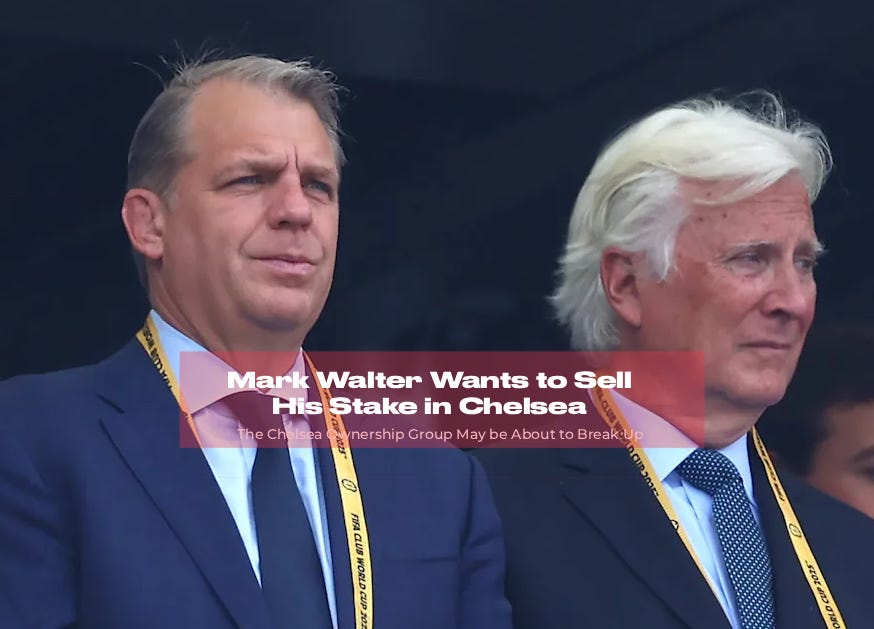
The man at the centre of this week’s edition is Mark Walter (pictured above right)
Walter is a very successful, very rich American businessman with interests spanning finance, insurance and, of course, sport.
But right now, something interesting is happening across his business empire, let me tell you the story on what this means for Chelsea and The Lakers.
Walter’s wider business empire needs to raise a significant amount of cash relatively quickly.
We don’t have evidence that Walter personally is short of cash. The evidence instead points towards liquidity pressure within businesses connected to his wider group, particularly his insurance operations.
Last week, we covered his surprise $12.5 billion sale of the LA Lakers. This week, reports emerged that he could also sell his stake in Chelsea.
More on that shortly.
Here is what we are covering today:
Why a Divorce at Chelsea Leadership is Looming
The US Open Just Put a Record $108m on the Table
The World’s Richest Football League Is Back
Let’s get into the details.
In last week’s newsletter, we reported on the surprise sale of the LA Lakers.
Owner Mark Walter agreed to sell the Lakers for a record $12.5 billion to Josh Kushner and former Disney CEO Bob Iger, just 14 months after agreeing to acquire control at a $10 billion valuation.
At the time, it looked like an extraordinary piece of business.
Buy at $10 billion. Sell at $12.5 billion. Make a 25% return in just over a year.
But there may be more to the story.
Walter’s wider business empire is currently under scrutiny from US federal prosecutors and the SEC over whether billions of dollars of loans and investments made by insurance companies he controls were properly disclosed as investments in affiliated businesses (that doesn’t sound good).
No charges have been filed against Walter, and related-party investing itself isn’t necessarily a problem. The question is whether those relationships were properly disclosed.
And this is where things get slightly complicated.
One of the businesses at the centre of Walter’s empire is Guggenheim Partners, the giant financial services company he helped build.
Sitting above Guggenheim’s asset-management operations is a financing company called GIH Borrower, which has borrowed $1.175 billion from investors.
Think of it like a very large corporate mortgage.
Investors lend the company money, receive interest and eventually expect to get their money back.
But as most of you know, loans can themselves be bought and sold between investors.
Until recently, this particular loan was being valued at roughly 100 cents on the dollar. In simple terms, $100 of debt was considered to be worth about $100.
Then Guggenheim revealed that revenue had fallen 38% in the second quarter, while a measure of earnings had fallen 77%.
The market price of that debt subsequently fell below 80 cents on the dollar.
In simple terms, investors were now only willing to pay less than $80 for every $100 the company still owed.
That doesn’t mean Guggenheim suddenly owes less money.
It means investors have become considerably less confident about the risk attached to that debt.
And that matters because this is happening while other parts of Walter’s business empire also appear to be trying to generate liquidity.
Which brings us back to Chelsea.
The Athletic has reported that Walter is now in talks to sell his stake in Chelsea alongside Todd Boehly.
Clearlake Capital currently owns approximately 61.5% of Chelsea, while Boehly, Walter and Hansjörg Wyss each own around 12.8%.
Clearlake is the obvious potential buyer, although no agreement is imminent.
Strangely, this could end up being good news for Chelsea fans.
The BlueCo era hasn’t exactly gone to plan.
On the pitch, Chelsea have qualifieƒd for the Champions League just once under the new ownership. Off it, huge losses have persisted, while the increasingly public divide between Todd Boehly and Clearlake has created uncertainty over who ultimately controls the direction of the club.
Buying out Walter and Boehly could change that.
Clearlake already owns around 61.5% of Chelsea. If it acquired their stakes, it would consolidate its control of the club and potentially bring an end to the ownership divide that has hung over Chelsea for the past few years.
But there is another number I’m going to be watching very closely: the valuation.
Walter reportedly wants to sell at a valuation of around £5 billion.
If his wider business empire really does need liquidity, he has an obvious incentive to get as much as possible for his Chelsea stake. At a £5 billion valuation, his roughly 12.8% holding would theoretically be worth around £640 million.
Clearlake, of course, has precisely the opposite incentive. It will want to buy the stake for as little as possible.
And that creates a fascinating negotiation.
If Clearlake buys Walter out at a £5 billion valuation, it gives him tens of millions in potential liquidity while establishing a huge new benchmark for Chelsea’s value.
If the eventual valuation is considerably lower, however, it raises another question: has Chelsea actually increased in value since BlueCo bought the club for £2.5 billion in 2022?
Either way, there could be a silver lining for Chelsea fans.
If Clearlake buys out Walter and Boehly, Chelsea could finally get something they have been missing for several years: clarity over who is actually in charge.
Walter appears to want liquidity. Chelsea represents hundreds of millions of pounds of it.
Now we find out how badly Clearlake wants full control.
P.S. If you like the deeper financial side of these stories, Paul Quinn published an excellent breakdown of Walter’s wider business empire over the weekend. I’ve linked it below.

Paul Quinn@theesk
The Analysis Series: Private credit, governance and relevance to football financing Chelsea co-owner Mark Walter's financial empire has just given us the clearest look yet at how modern club ownership is really financed. His firm's $1.175bn loan fell 20 points in a morning. No
7:40 AM · Aug 23, 2026 · 189K Views
5 Replies · 53 Reposts · 243 Likes
Flushing Meadows starts next week and the US Open has announced the biggest player compensation package in tennis history.
This year’s total will reach $108 million, up 20% from $90 million last year.
The numbers are huge:
Singles champions will receive $5.5 million each, up 10%.
First-round losers will receive $140,000, up 27%.
$2 million will be placed into a new player welfare fund.
All four Grand Slams have agreed to establish a new Grand Slam Player Council, giving players a formal forum to raise concerns with tournament organisers.
On the surface, this looks like a massive win for the players.
But there is an important distinction.
The players haven’t simply been asking for more prize money. They’ve been asking for a bigger percentage of the money the Grand Slams make.
For the past 18 months, some of tennis’s biggest names have been pushing the four Grand Slams to commit 16% of their revenue to prize money, eventually rising to 22% by 2030.
And that’s a very different request.
I’ve made a lot of content about this recently, and this is a classic move you see across big business.
Announce “the biggest prize-money pot in history”, put a huge $108 million number in the headline and, understandably, it sounds like the problem has been solved.
But peel back the layers and the fundamental disagreement remains.
The players aren’t really fighting over the absolute number.
They’re fighting over the percentage.
If US Open revenues keep growing, the players want their compensation to grow with them. They don’t want to come back every year and negotiate whether the tournament feels like increasing the prize pot.
Now, to give the US Open credit, it may actually have reached the players’ current 16% target.
We don’t know yet because the USTA hasn’t published its latest financial statements. Based on reasonable revenue-growth estimates, the BBC calculates that around $98.5 million in prize money would be enough to meet the players’ current demand.
So the US Open could have become the first Grand Slam to get there.
But that isn’t really the end goal.
The players aren’t asking for a one-off record payout. They’re asking for a structural change to how the economics of tennis work, with a guaranteed share of the revenues they help generate.
Eventually, they want that share to rise to 22% by 2030.
The US Open has put more money on the table.
The question is whether the Grand Slams are willing to permanently give players a bigger slice of the pie.
The Premier League is back and I have three predictions for the upcoming season:
A footballer will be bought for more than £200 million
The front of shirt gambling ban will not make a dent in Premier League Clubs overall commercial revenues.
A top 6 Premier League Manager will be sacked before Christmas Day
A footballer will be bought for more than £200 million
Maybe not in this window, but before the end of next summer’s transfer window, I think we will see the first £200m+ Premier League transfer.
Premier League revenues keep going through the roof and player valuations are following them.
Elliot Anderson is the perfect example. Nottingham Forest bought him from Newcastle for £35 million in 2024. Just two years later, Manchester City bought him for £116 million.
£35 million to £116 million in two years. Bonkers.
And the new financial rules could give clubs even more reason to push these valuations higher.
Under the Premier League’s new Squad Cost Ratio (SCR) rules, clubs will broadly be limited to spending 85% of their football-related revenue plus net profits from player sales on squad costs.
That last bit is important.
The more profit you generate from selling players, the more capacity you create to spend on new ones. So clubs have an enormous incentive to maximise the value of their players and demand increasingly large fees when someone wants to buy them.
And that is how we get more Elliot Andersons.
A player bought for £35 million becomes a £116 million player two years later. That £116 million then becomes part of the benchmark for the next player.
Premier League revenues are rising. Club valuations are rising. Player-sale profits are becoming increasingly important. And Premier League clubs have already spent close to $3 billion this summer.
My prediction is pretty simple: that £116 million number will be north of £200 million sooner than we think.
The front of shirt gambling ban will not make a dent in Premier League Clubs overall commercial revenues.
From this season, Premier League clubs will no longer be able to have gambling companies as their front-of-shirt sponsors.
On paper, that’s a pretty significant commercial change. Betting companies have been some of the most aggressive sponsors in football and have historically been willing to pay prices that other brands wouldn’t.
But my prediction is that it won’t make much of a dent in Premier League clubs’ overall commercial revenues.
The reason is simple: the Premier League offers an almost unrivalled level of exposure.
Sky alone will show at least 1500 Premier League matches live this season, significantly more than under the previous broadcast deal. Add international broadcasters, highlights, social media and the global reach of the clubs themselves and there are very few sporting properties that can offer brands this level of consistent exposure.
And 3 speaks for itself….
My money is on De Zerbi!
To understand why I have such conviction in takes 2 and 3, watch these videos if you haven’t already
And with the return of the football:
Defending champions Arsenal kicked off the new season with an impressive 3-0 win over Coventry City on 21 August.
But away from the pitch, the Premier League remains the money poster boy of European football.
As we gear up for another season, it is worth reminding ourselves of the scale.
In the 2024/25 season, the Premier League generated revenues of around $9.22 billion, nearly double that of the Bundesliga!
And the dominance doesn’t stop there.
There were 11 Premier League clubs on Forbes’ 2026 list of the world’s most valuable football clubs.
Of course, there were the usual suspects: Manchester United, Liverpool, Manchester City, Arsenal, Chelsea and Tottenham.
But there was also room for clubs like Everton, Brighton and Fulham.
Similarly, nine English clubs ranked inside the top 20 of Deloitte’s 2026 Football Money League, which ranks clubs by revenue.
And generating revenue is about to become even more important.
This season, the Squad Cost Ratio (SCR) replaces Profit and Sustainability Rules as the Premier League’s main squad-cost control.
Under SCR, clubs will broadly be limited to spending 85% of their relevant football revenues and player-sale profits on squad costs, including player and coach wages and transfer-related costs.
In other words, the more money your football club makes, the more money it can spend on football.
And Premier League clubs certainly aren’t slowing down.
They have already spent close to $3 billion in the transfer market this summer.
Comments
Nothing yet. Say the first thing.
Sign in to join the conversation.