
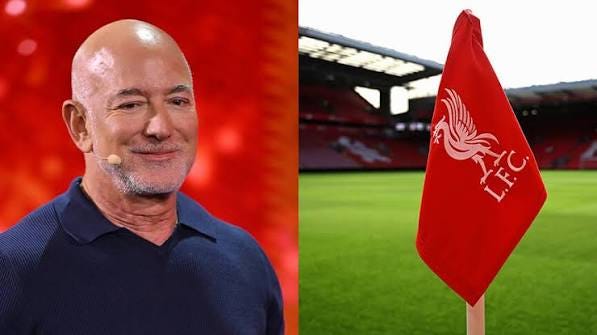
Jordan here. Good morning to the 7,008 of you who receive this email. It is acquisition season in sports. Some of the best-known teams in the world, Liverpool and the Los Angeles Lakers, have new owners in record-breaking deals. We’ll be discussing both of them today. One thing is truly certain. Sports teams are blue-chip assets, and investors can pay anything for them.
Elsewhere today, Formula E is trying for relevance with a new broadcast deal (on a streaming app)
Last week I mentioned in the newsletter that I’m currently in hospital recovering from a stroke that I suffered in the middle of July. That prompted a large wave of messages, emails, and DMs from you all wishing me a speedy recovery. I am hoping that by this time next month I’ll be back to normal so regular scheduling on YouTube can continue, I also have some exciting new stuff in the works so stay tuned and fingers crossed.
Thank you so much. This support has been very overwhelming, I see and I appreciate every single message
Here’s a breakdown of what to expect today.
Jeff Bezos-backed Consortium Acquires Minority Stake in Liverpool. We have to speak about this
The Los Angeles Lakers have a different cap table again
Emirates extend Arsenal Stadium naming rights deal
One of England’s most storied clubs, Liverpool has new minority owners.
On August 14th, Liverpool’s owners, Fenway Sports Group, announced that they had agreed to a deal to sell 30% of the club to a consortium called 1892 Holdings.
The consortium is led by Amit Bhatia, the former vice-chairman/co-owner of QPR, and includes: Jeff Bezos, Amazon founder, through K5 Sports; Eduardo and Elaine Saverin, with Eduardo being the Facebook co-founder; and the Mittal family interests.
The deal values Liverpool at about £5.5 billion ($7.4 billion), with the 30% stake worth about £1.65 billion. Bhatia will become Liverpool’s new vice chairman.
This sale represents an 18x return on investment for FSG, which bought Liverpool in 2010 for roughly $300m.
Revenue is king in the Premier League. It determines how much a club can spend. Over the past five years, the Liverpool revenue machine has been increasing steadily:
2020/21: £487.4m
2021/22: £594.3m
2022/23: £593.8m
2023/24: £613.8m
2024/25: £702.7m
That works out to an average of roughly £598 million a year. The interesting part is what happens next. Liverpool broke through the £700 million barrier for the first time last season, but can the new investors make that the norm rather than an exceptional year?
If they can take a club that has historically generated around £600 million and turn it into a business consistently generating £700 million-plus, then this starts to look like a very shrewd acquisition.
TLP’s TAKE:
The winners here are the owners. Liverpool’s valuation puts it above Man Utd as the most valuable club in England. This valuation will set a benchmark for future potential acquisition deals, especially those involving the rest of the Premier League’s traditional big six. These clubs should hit the $10 billion valuation soon.
And it opens another pathway. Owners do not need to sell the entirety of their asset to have a healthy return on their investment.
The Athletic report, that former Disney CEO Bob Iger have agreed to acquire Walter’s stake in the Lakers at a staggering $12.5 billion valuation.
The timeline is pretty extraordinary:
June 2025: Mark Walter agrees to buy control of the Lakers from the Buss family at a $10bn valuation.
2025–26: Walter begins making changes to the business, including new sponsorship inventory, additional courtside seating and investment into the team’s medical and analytics departments.
August 2026: Joshua Kushner approaches Walter about buying his stake.
Days later: a deal is agreed at a $12.5bn valuation. Walter reportedly wasn’t even looking to sell, but the offer was simply too good to turn down.
That means the implied value of the Lakers has increased by $2.5 billion, or 25%, in just 14 months.
So, who wins?
The obvious winner is Mark Walter.
He agreed to buy control of the Lakers at a $10 billion valuation in June 2025. Just 14 months later, he has agreed to sell his stake at a $12.5 billion valuation.
On paper, that is a 25% increase in the value of the asset in a little over a year.
Joshua Kushner and Bob Iger
Whether Kushner and Iger are winners is much harder to know.
They’re paying the highest valuation ever attached to a US sports franchise.
But they’re also buying something that almost never becomes available.
There are 30 NBA teams. There is only one Los Angeles Lakers.
Now, that doesn’t mean Walter personally pockets $2.5 billion. He didn’t own 100% of the Lakers and the headline numbers are valuations rather than the actual price paid for his shares.
But whichever way you cut it, this is an extraordinary return over an extraordinarily short period of time.
TLP’s TAKE:
So, who wins?
Well, for starters, this shows that investors can pay anything for NBA franchises even though the prices are getting ridiculous. It also sets a benchmark for any future acquisitions, especially around the other valuable franchises like the Golden State Warriors, New York Knicks and Boston Celtics. So existing owners must be licking their lips.
Formula E finally has a global home.
From the 2026–27 season, Disney+ will become Formula E’s global streaming home across 144 territories, with races also available through ESPN+ in the United States.
The multi-year agreement will carry every race weekend, including practice, qualifying and races, alongside replays and additional content.
The financial terms of this deal were not disclosed. However, for Formula E, distribution may be more important than the size of the cheque at this point.
The electric racing series has spent years building the legitimacy to challenge Formula 1. It has the technology, races in major cities and ticks all the sustainability boxes, but a consistent global audience has been the challenge.
The deal with Disney+ gives Formula E access to millions of existing customers, as it enters a new era with faster and more powerful cars, and an expanded 2026–27 calendar featuring 21 races across 13 events.
For Disney, meanwhile, Formula E adds another live sports property to its increasingly streaming-focused business.
TLP’s TAKE
Putting Formula E on Disney+ solves the accessibility problem, but it will not make people care about it or make the sport popular.
The next challenge will be converting that reach into dedicated viewers, sponsors and eventually higher commercial value. Disney+ is betting Formula E will be able to do so.
Arsenal keep winning on and off the pitch. This week, Emirates announced that they will extend their long-running sponsorship agreement for another five years. The mad thing is, reports suggest their deal is worth £70m a season, spanning both front of shirt and stadium naming rights. I made a video recently talking about how Arsenal are killing it financially. See below to get an idea as to how they are killing it off the pitch.
Comments
Nothing yet. Say the first thing.
Sign in to join the conversation.