
Amber going toward mahogany in the glass. A nose that hit dried fruit and beeswax before anything else showed up. And then the sip — balanced, warm without being hot, a finish that just kept unspooling. I've had a lot of bourbon since 2015. I've had a lot of bourbon that costs a lot more than what I paid that year. None of it has topped this bottle, and I don't expect it ever will.
The whiskey was A.H. Hirsch Reserve, 16 years old, distilled in the spring of 1974. And here's the strange part: it isn't just the best bourbon I've ever had. It's something closer to the idea of bourbon — the flavor your brain reaches for when someone says the word. Every bourbon I've had since gets measured against it, whether I mean to or not. That's a strange kind of fame for a whiskey to have. Most legendary bottles are legendary because of scarcity, or story, or a name on the label. Hirsch is legendary for all of those reasons — and then, almost as an afterthought, it also happens to be genuinely great. That combination is rare enough that it deserves its own telling.
Whiskey doesn't sell on flavor alone. It never has. Ask anyone who's stood in a liquor store aisle choosing between two bottles at the same price point — the one with a story wins almost every time. Bourbon in particular has built an entire premium tier on the back of history, half of it documented, half of it folklore, and precious little daylight between the two once the marketing department gets hold of it. A "lost distillery." A patriarch's secret recipe. A president's favorite dram. These aren't lies, exactly. They're just history with the rough edges sanded down until it's smooth enough to put on a label.
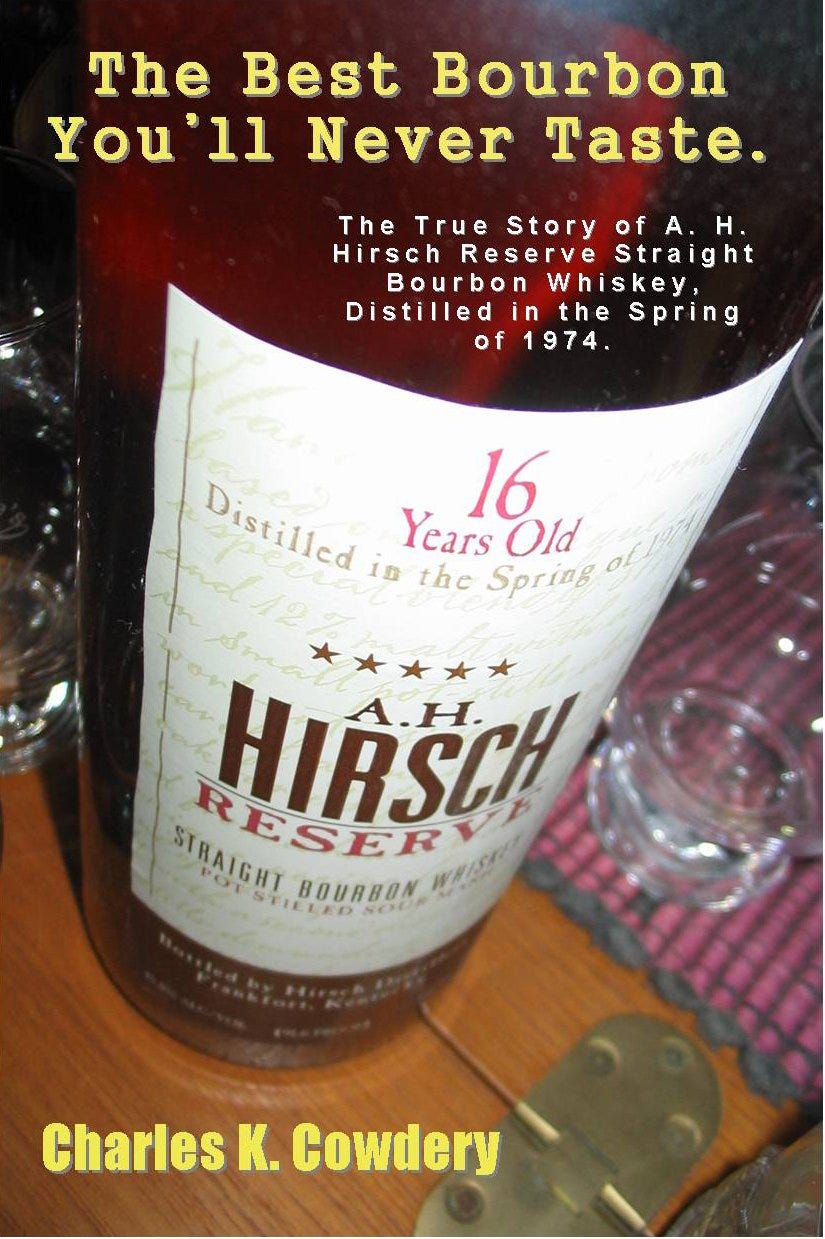
Hirsch is the best example I know of this machine working exactly as designed — and, somehow, still being worth the hype. To understand why, you have to run the story back further than 1974, because the ground this whiskey was made on came pre-loaded with its own myth.
The distillery sat outside Schaefferstown, Pennsylvania, on a site with roots back to the 1750s — genuinely one of the oldest continuously operating distilling grounds in the country, long before it went by the name most people know it as. By the 1970s it was operating as Pennco, though everyone still called it Michter's.
In the spring of 1974, master distiller Dick Stoll — who'd learned his craft under C. Everett Beam, a relative of the Jim Beam family — ran a batch of bourbon using a 75% corn, 13% rye, 12% malted barley mash bill. It was a contract job, commissioned by a man named Adolph Hirsch, a former Schenley Distillers executive. The story goes that Hirsch didn't order the whiskey because he had a plan for it. He ordered it as a favor to a distillery that needed the business.
And then he forgot about it. Or didn't forget, exactly — he kept paying the taxes on all 400 barrels, year after year, while they sat in the Pennsylvania warehouses aging far longer than any bourbon of that era was supposed to age. Nobody was rushing this whiskey to market because nobody had a market for it. It just sat. Waited.
In 1989, the distillery closed for good, bankrupt. Hirsch, by then well into his nineties, finally sold the barrels — the whole 400 of them — to Gordon Hue, a liquor store owner and bourbon industry veteran who'd gotten a tip about an old man in Michigan sitting on a fortune he didn't know what to do with. Hue turned to his friend Julian Van Winkle III — yes, that Van Winkle, years before the Pappy name meant anything to anyone outside Kentucky — to bottle it. There was no grand release strategy. They bottled more whenever retailers ran out. The first batch, a 15-year-old, went almost entirely to Japan. It was fifteen years old by pure accident of neglect, and it was already remarkable.
The distillery itself was demolished not long after closing. Whatever combination of pot still character, mash bill, warehouse conditions, and sheer dumb luck produced this whiskey cannot be repeated. Not approximately. Not at all. The place where it was made no longer exists.
Here's where the story gets interesting, because Hirsch's own myth is only half the picture. The other half was already sitting there, baked into the ground, waiting for someone to build a brand on top of it.
Long before Pennco, long before Michter's, the distillery operated under a Mennonite farmer named John Shenk, who started producing rye whiskey there in 1753. And according to Pennsylvania historical lore — commemorated, notably, by a coin club plaque in 1978, which tells you something about how these legends get their staying power — General George Washington visited the distillery during the Revolutionary War and purchased whiskey to help his men survive the brutal winter encampment at Valley Forge. The tagline that grew out of that story, used by Michter's marketing for decades afterward, was that this was "the whiskey that warmed the American Revolution."
I want to be precise about this, because precision is the whole point: historians frame it as speculation, not documented fact. Washington may have stopped there on his way to Valley Forge. Nobody has a receipt. But the story has outlived any need for proof, because it does something more useful than being verifiable — it gives a whiskey brand a 200-year head start on gravitas.
Adolph Hirsch didn't invent that story. He inherited it. When he commissioned his batch of bourbon at that Pennsylvania distillery in 1974, he wasn't just buying barrel space — he was buying into a haunted building, one already carrying two centuries of half-true legend. That's the mechanism, and it's worth naming plainly: real scarcity (400 barrels, one batch, never repeatable) fused onto real place-history (a distillery with a Revolutionary War-adjacent legend) is how you get a myth strong enough to survive being bottled, rebottled, and sold in a strip mall forty years later.
Once the whiskey started moving, the release strategy — if you can call it that — turned into its own kind of theater. There was a 15-year, a 16-year, a 17-year, an 18-year (37 cases in 1992), a 19-year (121 cases in 1993), a 20-year (500 cases, the oldest and final release from the Van Winkle era). There were wax seal colors — gold, blue, red — that now function as a collector's dating system, plus a Colonel Randolph bottling done specifically for overseas markets. Silver capsule. Gold foil. Each variant its own small mythology, each one a slightly different door into the same 400 barrels.
In 2003, Preiss Imports bought the remaining 16-year stock from Hue; that run became known as the gold foil bottling, rebottled through Buffalo Trace. And then, in 2009, came the finale: Henry Preiss decanted what remained of that stock into hand-blown glass bottles he'd imported from France, packaged them in wooden humidor sets, numbered one through 1,000, and let it be known that this was it. No more after this. The suggested retail was $1,499 a set.
It did not sell quickly. Four years after that release, in 2013, roughly 800 of the 1,000 sets were still sitting in inventory, at the original price, and nobody could quite figure out why the company wasn't discounting to move them. The last three — numbered 998, 999, and 1,000 — eventually landed with a small restaurant chain in Scottsdale, Arizona. They'd wanted two sets, but the distributor's minimum order was a four-set case, so they agreed to buy four. One of those four, bottle number 997, was broken by the distributor before it ever shipped. A moment of silence, if you're the type. So instead of the two they'd originally wanted, they ended up with three, at $925 apiece, planning to pour it by the shot at $89 for an ounce and a half.
Even the label got the story wrong. It claimed the whiskey was distilled in Kentucky. It was Pennsylvania. It claimed the whiskey was pot-distilled. It wasn't. Forty years on, even Hirsch's own packaging couldn't keep its own legend straight — which feels, somehow, exactly right for a whiskey built this much on story.
I found out about all of this the way you find out about everything now: a Reddit thread. Someone was raving about a bourbon I'd never heard of, calling it the best they'd ever tasted. I was hooked before I finished reading the post. Then came the spiral — forums, auction listings, Cowdery's blog, anything with the words "A.H. Hirsch" in it. The more I read, the more I needed to taste it for myself.
My local liquor store, run by a great owner who actually knows what's on his shelves, had a bottle. $2,500. Too rich for my blood, even for this.
Then I found one at Hi-Time Wine Cellars in Orange County, California: $1,600. Still absurd money for a bottle of bourbon by any sane measure. But doable. I placed the order.
They called me. "Sir, are you sure you want to buy this? This wasn't a fraudulent order, right?" I told them it was real. "Ok. We'll get it out tomorrow."
I called on a Tuesday. It arrived Friday.
I made sure not to drop it.
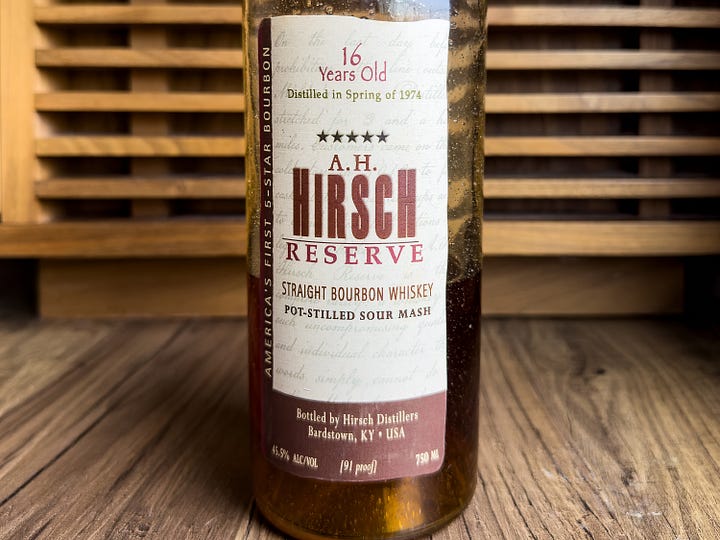
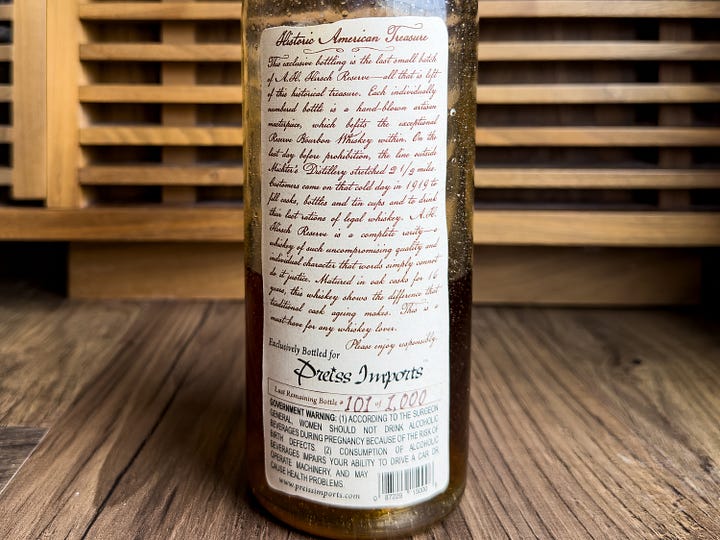
The first sip — and every one after — was perfection. Balanced. A great nose. Just the right amount of heat. A stunning color in the glass. And for context: a bottle of Pappy Van Winkle 15 was going for anywhere between $1,250 and $2,000 on the secondary market around that same time. Next to that, my $1,600 Hirsch wasn't just a purchase. It was a steal.
Most legends don't survive contact with the actual glass. You build up a whiskey in your head for months — years, in my case — and then you finally taste it, and it's good, sure, but it's not *that* good. It couldn't be. Nothing could carry that much expectation.
Hirsch carries it anyway. That's the part I still can't quite get over. A whiskey born from an accident, aged by neglect, wrapped in a two-hundred-year-old legend it didn't earn but inherited, sold in a strip-mall scramble through wax colors and hand-blown French bottles and a broken bottle number 997 — and somehow, when you finally pour it, it's not just living up to the story. It's the reason the story got told in the first place.
That's the trick almost nobody pulls off. History and lore usually do the heavy lifting so the whiskey doesn't have to. With Hirsch, for once, the whiskey was always good enough on its own. The legend just happened to be true.
No posts
Comments
Nothing yet. Say the first thing.
Sign in to join the conversation.