
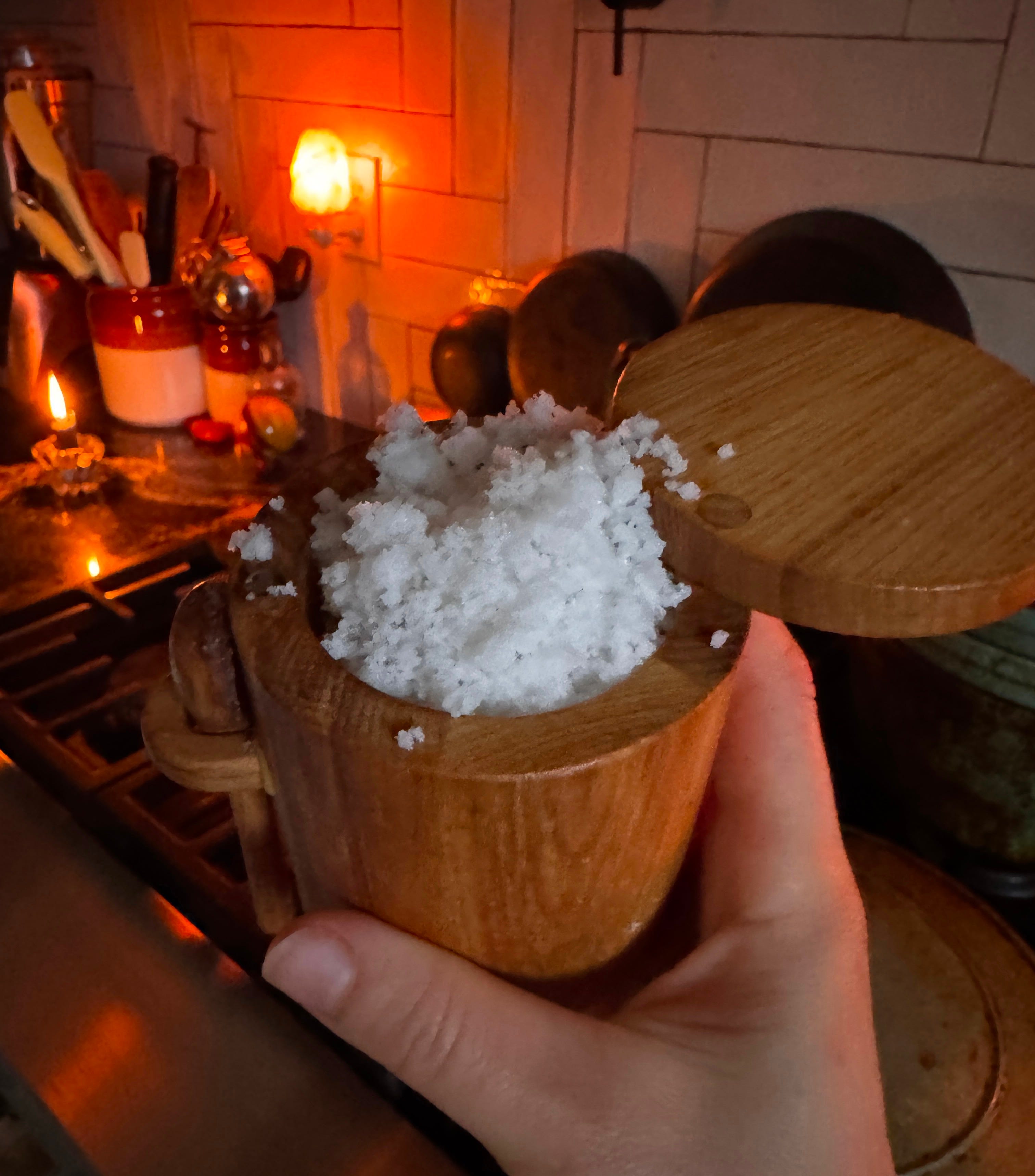
The second piece of magic I’d love to teach you is also a practice that only requires what you already have in your kitchen.
One of the most powerful magical tools or ingredients is sitting right next to your stove in a shaker, jar or vessel. You use it in nearly everything you cook, and it’s an amplifier that enhances everything it interacts with. You may have been casting spells with it without even knowing, and it might just be the reason that so many people feel drawn to your food and feel something special when they eat what you’ve crafted in your kitchen.
Salt also acts as a powerful protector, sharing its energy of cleansing and boundaries to keep what you don’t want out of your space and food. Think about when you cure meat. It’s rubbed down or packed in a ton of salt, which prevents pathogens from entering the meat as it cures and also encourages the moisture to leave so that the meat can remain edible for a very long time. It’s one of the oldest methods for food preservation, and when you think about food preservation, it almost always involves salt.
Why salt is spellwork
Think about what actually happens when you salt a pot of soup.
For a while, as you taste, it’s just fine. Warm, edible, fine. Then you add one more pinch, stir, taste again. The onions suddenly taste like onions. The broth tastes like it came from an actual animal or an actual garden instead of from nowhere. The whole pot wakes up, and the strange part is what kind of change it is. Properly salted food tastes even more like itself, because as an enhancer it amplifies the beautiful subtleties that already exist. What the salt is doing underneath (there’s real chemistry here, this isn’t me being poetic) is muting the bitterness that muddies everything and lifting the aromas up where your nose can get at them, so the flavor that was sitting in the pot the whole time can finally come through. Salt reveals more than it adds. Reveal is the closest word I’ve found for it, though I’m unsure any single word gets it exactly.
When we think about magic and what it actually is, we can easily see that it’s not so much about the specific tool or ingredient (even though its energies are, of course, a very important component), but more about the intentions and attention we are offering to the craft in that moment. You can find what is already alive in something, moving that energy with yours to create beautiful alchemy and a spell unlike any other, because it has your specific imprint.
New here? Welcome. The Kitchen Witch is where cooking and magic sit at the same table. Subscribe and let’s stir up something good together.
I feel like it’s important that I share a bit about myself here. I am someone who can taste and smell almost everything, which is pretty incredible when it comes to tasting food or pulling out specific flavors in wine (I used to help with tasting notes for a winery), but it’s also incredibly awful when smells and flavors that are less than desirable come across my sensory palate. It can feel like a full on overload to my nervous system.
When I was pregnant I thought for sure that these senses would be amplified, but it turns out that mine were always cranked up to 5000%, so I really didn’t notice a difference in intensity (but I did notice that specific flavors or aromas that used to not bother me were horrific and would induce losing my entire desire to eat for the day). I’ve always been this way since childhood, and as someone on the spectrum it was even more difficult to be in a household where everything must be eaten off my plate before leaving the table. While I am a huge fan of the concept that it’s important to try new things, I also think it’s essential that if your mouth hates what it’s eating it should be allowed to never try it again.
The quality of what you’re amplifying matters just as much as the salt itself, and one of the best example I can give you of this is tomatoes. A hot house tomato gets picked long before it ever turns red, right when the interior has just gone to jelly, so that it can survive being shipped to grocery stores all around the country and finish ripening along the way. No amount of salt will make that tomato taste like magic. All you’re going to amplify is hollow flavor, the ghost of a tomato (also don’t get me started on the texture). Now imagine instead a perfectly ripened tomato picked in late July or early August. It’s shiny and heavy in your hand, and when you bring it up to your nose the aroma is already begging you to take a bite. You know exactly what to do with that one. A few slices, a little sprinkle of the sea, and you’ve created a moment worth remembering.
The salt on your shelf
Growing up my mom only had sea salt in the house. I had never tried iodized table salt until going over to my grandparents house for a summer vacation. They always had the little tin containers with flip up openings on their table. The pre-ground pepper (which my grandma would liberally apply to anything she ate) and then salt. I reached for both, adding a bit of each to my eggs, and after taking one bite I was a bit surprised by the flavor. The main flavors that ambushed my tastebuds were of course saltiness, but then this strange metallic and chemical taste. That was the first and last time I ever wanted to use or try anything made with iodized salt, and yes, I can taste it if someone is using it to cook (unfortunately).
I do think that in order to properly do magic we must involve our senses. For some of us it can be overwhelming and sometimes exciting. There’s a delicate balance there, but it is essential that they participate in the experience of kitchen witchery. I do think that we each have our own signature sensory experience which allows for our individual crafts to be so magnificent and unique (the world needs each of us to craft with our magic, because as a collective they work together to restore balance). I also think that we can train our senses to become even more capable of recognizing energy signatures. I know that they are often referred to as specific chemical components that you can find in a variety of ingredients and things, but I want us to focus on the metaphysical aspects of salt. How it is a combination of interwoven energies from the location where it came.
Have you ever done a salt tasting? I haven’t intentionally done one, but over time I have had the opportunity to taste a range of different types from around the world. Sea salt is so much more than just saltiness, it varies quite a bit, and those variations are the whole teaching of this section. Where a salt comes from is what it carries. The metaphysics follows the making, same as flavor does. Different waters, different shores, different hands doing the harvesting, and every single one arrives tasting like the place it left.
Plain sea salt, fine or coarse, is the one I use for almost everything, cooking and craft both. It was ocean water not that long ago, and I do think it holds onto that cleansing energy from the sea, which makes it my go to for clearing work, fresh starts, and just the daily blessing of a meal. If a ritual calls for salt and doesn’t tell you what kind, this is the one it means.
Celtic sea salt is the gray damp one, and it’s the one I feel the most connected to. It gets raked by hand off the clay bottom of salt ponds on the coast of Brittany, and the farmers there are still using wooden tools the same way it’s been done for over a thousand years. Brittany is a living Celtic nation, a cousin to Ireland, and since my people were Irish, using this salt genuinely feels like participating in something my ancestors would recognize. I reach for it when the cooking is ancestral for me, recipes that came down through family, meals made in remembrance, or honestly any night I want to feel like the women who came before me are a little closer while I cook.
I also have to admit that I’m a huge fan of good flaky sea salt. Those glassy little pyramid shaped crystals that crunch between your teeth and then dissolve all at once. Sprinkle some over a sliced tomato (you already know which tomato I mean) or a square of dark chocolate and suddenly you’ve made yourself a little occasion out of nothing. For me flake salt is celebration energy, and some days that’s honestly the spell I need most.
Fleur de sel is a fun one to know about. On warm days with no wind, a thin fragile crust of crystals forms on the very surface of the salt ponds, and someone has to skim it off by hand before evening or it sinks and it’s lost. The name means flower of salt, and it spends its whole life floating at the surface, so it makes sense that you’d use it the same way. This is a finishing salt, saved for the very end, the last touch before something goes to the table. I think of it as the blessing you add right before you let a dish go.
Himalayan pink salt comes from a completely different story. It gets mined out of a seabed that dried up hundreds of millions of years ago, long before there were people at all, and the iron content is what gives it that pink blush. Something about how ancient it is makes me save it for the gentle work: self-care, the bath after a brutal week, the kind of love you’re still learning how to give yourself. It’s held its energy that long, so I trust it to hold mine.
Black salt needs a quick clarification, because there are two totally different things that go by that name and they aren’t interchangeable. Kala namak is the kiln fired black salt used in South Asian cooking, and since fire has already been through it once, I associate it with transformation work. Witch’s black salt is the other kind, the one you see in spell shops, and please know it isn’t for eating at all. The traditional way is to make your own by mixing white salt with ash from your own hearth, or the black scrapings off the bottom of your own cast iron. The thinking behind it is that the ash from your own fire protects your own home better than anything you could ever buy, and I find that thinking both really beautiful and completely sound.
You truly don’t need all of these, for the record. One box of sea salt will do everything, the same way one wooden spoon will. I just think it’s worth knowing that when you pick a salt, you’re picking a story, and that story goes into the pot along with it.
Why every threshold wanted it
Our ancestors treated salt like a guardian, and you can still see it in what they did at their doors.
All across the old countries, when someone moved into a new home or started a marriage, neighbors showed up at the door carrying bread and salt together. Bread so nobody under this roof ever goes hungry. Salt so the family stays protected, and so their life keeps some flavor in it, which I’ve always found to be the tender part of the custom. Russia, Poland, Ukraine, Serbia, they still do it today. Jewish families dip the challah in salt to complete the blessing. Estonia named the entire housewarming after the gift, soolaleiba pidu, the salt bread party. In Ireland, the bread and salt came with a lump of coal, so a family crossing a bare threshold walked in already holding food, protection, and warmth.
Before refrigeration existed, salt was used to cured fish, packed the meat, and brined the cabbage down in crocks in the cellar; and it could do all of that because nothing rots in salt and nothing unwanted can live in it. I like to imagine what those cellar shelves must have meant to the people who filled them.
Now when we look at how salt gets used in witchcraft, it’s easy to see that every single spell uses salt for boundaries, protection and cleansing on both the physical and the metaphysical level. Think about the salt circle cast before a working, or the thin line poured across a windowsill, or the little bowl of salt left out in a grieving house to absorb some of the heaviness in the room. Every one of these practices grew out of what people watched salt actually do with their own eyes, year after year, keeping the food safe and the family fed while everything outside froze. Salt kept death outside, so it became the first thing carried to the door of a new home.
It was never complicated
The magic we work over and over again can start to feel less important and less powerful. We can get used to the feeling of that energy flowing through us. The first time you cast anything with real intention, it lights you up, and by the five hundredth time your body has absorbed it so completely that you can do it without noticing you’re doing it at all. The novelty wears off. The working itself never stopped being essential, though. Salting your food is one of those essential workings, performed daily, so familiar that we’ve mistaken familiarity for insignificance. The women who kept entire families alive on salted harvests weren’t doing anything grand either. They were doing something necessary over and over again, but it was not less magical than something more complex or fantastical.
Here is your second hands-on working: waking up the most automatic gesture in your kitchen, plus the words to speak and a small blessing to give away. Come cast the oldest spell in the house with me.
Comments
Nothing yet. Say the first thing.
Sign in to join the conversation.