
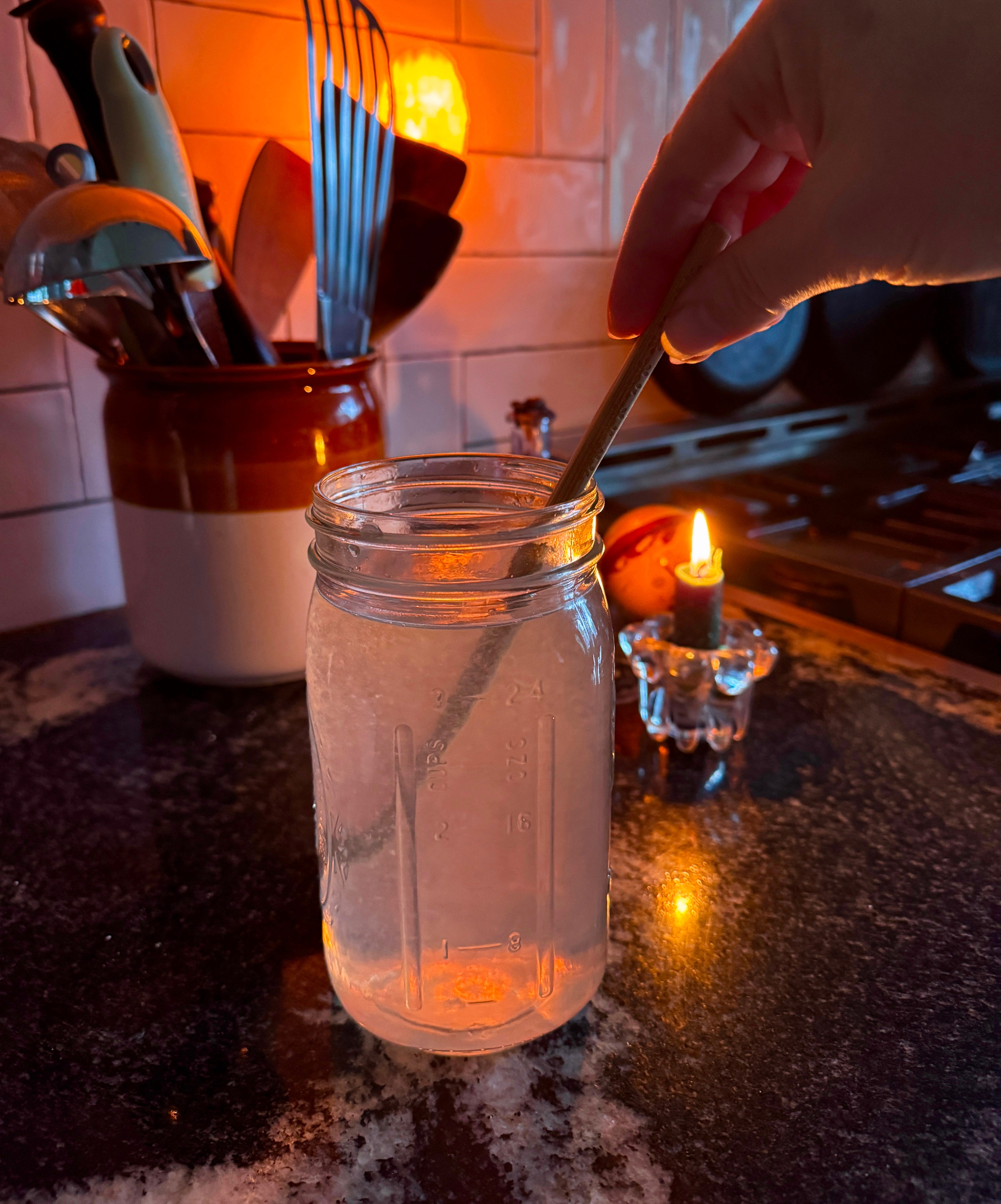
Here is the first thing I want to teach you, because everything else we do here grows from it.
You can turn any pot of food into a spell with nothing but a spoon and your attention.
That’s it. That’s the whole foundation. Before the herbs and their correspondences, before the moon phases and the simmer pots and the elaborate rituals, there is this one simple, ancient practice: stirring with intention. It costs nothing. It requires no special tools, no experience, no belief in anything you can’t feel for yourself. And once you learn it, you will never cook the same way again, because you’ll understand that you were always doing magic at the stove. You just weren’t doing it on purpose.
Let me show you how to do it on purpose.
New here? Welcome. The Kitchen Witch is where cooking and magic sit at the same table. Subscribe and let’s stir up something good together.
Think about what you’re actually doing when you stir a pot.
You’re taking separate things, water, salt, roots, leaves, heat, and moving them, over and over, in one direction, until they become one thing. You’re applying your will and your energy to raw ingredients and transforming them into something that will become part of another person’s body. If you sat down and tried to design a magical act from scratch, you could hardly do better. Transformation, intention, nourishment, care, all of it happening in a single humble motion you’ve made ten thousand times without thinking.
Witches have always known this. The cauldron is just a pot. The “bubble, bubble” of the old stories is just a stew coming to a simmer. What made it magic was never the vessel. It was the woman standing over it, stirring her intention into the pot with every turn of the spoon, whispering to the food what she needed it to carry.
The magic was always in the stirring. We’re just going to be deliberate about it now.
Here is the one piece of traditional knowledge that turns ordinary stirring into spellcraft, and it’s beautifully simple.
Stir clockwise to draw in. When you want to bring something toward you, more love, more abundance, more health, more warmth, more peace, you stir in a clockwise direction, the same way the sun moves across the sky. This is the direction of building, growing, and calling things in. Most of the time, when you’re cooking to nourish and to bless, this is the way you’ll turn the spoon.
Stir counterclockwise to banish. When you want to remove or release something, to draw out illness, to clear away stagnant energy, to break a run of bad luck, to cleanse, you stir counterclockwise, against the sun. This is the direction of undoing and sending away.
Clockwise calls in. Counterclockwise sends out.
This isn’t a modern witchy invention. It comes down to us from Scottish and Irish Gaelic tradition, and the old words for it are gorgeous. Clockwise, sunwise, was called deosil (or deiseal), and it was considered the propitious, blessed, lucky direction, the “prosperous course.” Counterclockwise was widdershins, or in Gaelic tuathal, and it was the direction you did not turn lightly. In the old Highlands and islands, this belief ran through everything. People would walk sunwise three times around someone they were blessing. Fishermen would row their boats sunwise before setting out, certain that to neglect it would curse the voyage. A burning brand was carried sunwise around houses and fields and around new mothers and their babies, to protect them. To move widdershins around a church or a holy well was believed to be genuinely dangerous, the kind of thing that could sour a blessing or invite in what you did not want.
And here is the detail almost no one knows, the one that will change how you move through your own kitchen forever: the tradition didn’t stop at the pot. Traditional cooks stirred food clockwise and cut and served from left to right, keeping the whole meal moving in the lucky, sunwise direction, from the first stir to the plate set in front of you. If someone accidentally stirred or turned the wrong way, they’d correct it by turning the same number of times clockwise to undo the mischief. The entire act of feeding people was choreographed to the movement of the sun.
Two more things worth carrying with you. First, as my own people were Scottish and Irish, this is quite literally an ancestral practice for me, and it may be for you too; when I stir sunwise I feel like I’m doing something my grandmothers’ grandmothers did without needing anyone to explain it. And second, a fascinating wrinkle: this all assumes the northern half of the world, where the sun arcs across the southern sky and “sunwise” happens to match the clock. If you live in the Southern Hemisphere, the sun moves the other way, and many practitioners there reverse it, stirring counterclockwise to draw in, because that is their sunwise. The magic was never really about the clock. It was always about following the sun.
You do not have to get this perfect. You will not ruin a spell by stirring the wrong way while you’re distracted, or by forgetting entirely on a hard night when dinner is just survival. Magic is not fragile, and neither are you. Kitchen witchery is not one more thing to do correctly or fail at. It’s an invitation to bring your attention and your love to something you were already going to do anyway.
Some nights the magic will be nothing more than a single clockwise turn and the thought let this feed us well. That counts. That has always counted. The oldest kitchen witches in your own family line were rarely doing anything more elaborate than that, and their food held together homes for generations.
Start there. Start small. Start tonight.
For our paid circle, here is your first hands-on working: a simple, complete practice for stirring intention into a pot of food tonight, plus the words to speak and a few of my favorite intentions to begin with. Come stir with me.
Tonight, or the next time you cook something you can stir, try this. It takes nothing extra and maybe two minutes of real attention.
Comments
Nothing yet. Say the first thing.
Sign in to join the conversation.