
If history is simply “what happened,” how can five historians write five different books about Abraham Lincoln?
Facts are the building blocks of history, but these facts do not become history until someone explains what they mean. (in other words, the historian interprets the facts and makes sense of them.)
Many students approach history as if it’s a matter of memorizing a lot of names and dates. If they think about what historians do (which is unlikely), they probably imagine we just find some facts and list them because facts are facts. They are hard and fast and can’t be changed. The past is just the past—it can’t be changed or altered. So why bother?
In fact, the study of history is about reconstructing and interpreting the past based on the surviving evidence. In many ways, historians are like detectives, asking questions, investigating, looking for evidence, and then making meaning of what is found.
I’ll give you an example:
Lincoln issued the Emancipation Proclamation in 1863.
That’s a fact.
But historians ask:
Why then?
What motivated him?
Was emancipation primarily military? Moral? Political? Diplomatic?
Each answer requires interpretation—and every historian will interpret those questions differently based on the evidence they have found.
While facts remain constant, the arguments around those facts can differ dramatically.
A historian’s job is to build an argument—this is what we call “historical thinking.” Historians:
collect evidence
evaluate sources
look for patterns
consider context
compare interpretations
construct arguments
But the evidence is always, always incomplete. Much of the evidence has disappeared. Courthouses have burned down, letters lost to floods, diaries thrown away or burned, voices totally ignored, records censored.
A historian has to interpret facts but often, the facts are incomplete or missing or even contradictory. That’s where interpretation lies—in that gulf between what is known and what is likely.
Historians often disagree over interpretations. It’s not that one historian is “right” and the other is “wrong. But different historians:
ask different questions
prioritize different evidence
emphasize different causes
use different theoretical approaches
interpret motives differently
It’s those differences that lead to different arguments and interpretations.
Here’s an example of what I mean. A question many people have asked since 1861:
Why did the Civil War begin?
Different historians have emphasized:
slavery
economic systems
political failure
constitutional conflict
sectional identity
western expansion
The evidence overlaps.
The arguments differ, often depending on the time period in which the historian was working and living, the availability of source materials, or even the agenda of the historian or the institutions for which they worked.
While a “good” historian attempts to be objective, there have been many historians who are not and who seek to use the past to justify or illicit an action or mindset in the present or the future.
Again, the Civil War is an excellent example of this.
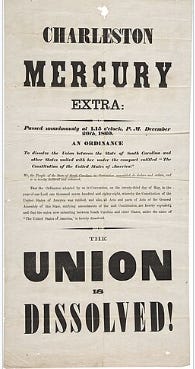
If we look at South Carolina’s 1860 secession document, the Declaration of the Immediate Causes Which Induce and Justify the Secession of South Carolina from the Federal Union, it explicitly identifies the preservation of slavery as the primary reason for leaving.
Here’s a link to the full secession document.
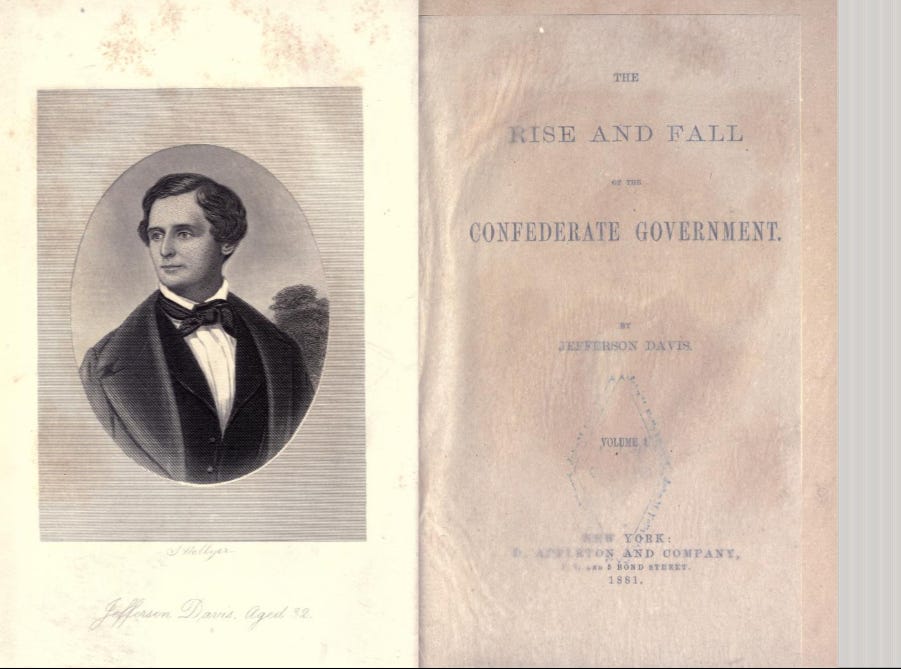
But by 1881 when Jefferson Davis, former president of the Confederacy, published his memoirs, he was claiming that the Civil War was about states rights’ not slavery.
Clearly, Davis knew exactly why states had seceded. So why did he say the war was about one thing when it was about something else entirely?
If a historian wanted an answer to: Why did the Civil War begin?
Should they view the secession document from South Carolina? Or Davis’s memoir? They represent conflicting evidence. What “fact” is then true?
We have to go back to our historian. What question is she asking? What evidence is he looking at? Do they have an agenda with their interpretation? What might that be?
History is not a warehouse of facts waiting to be memorized. It is an ongoing conversation about the meaning of the evidence that survives from the past. That meaning can be used by people for good and for bad. The past is all around us and informs our everday lives, even if we aren’t paying attention to it. Most students are introduced to history as a collection of names, dates, battles, and important events to memorize for an exam. It is no surprise, then, that many come away believing history is simply a record of “what happened.” In reality, that is only the starting point.
Understanding that history is an argument changes everything. It shifts your role from passive consumer of information to active evaluator of evidence. Instead of asking, What happened? you begin asking, How do we know? What evidence supports this interpretation? What evidence challenges it? Those are the questions historians ask every day.
This lesson also explains why historical debates never truly end. New evidence is discovered, overlooked voices are recovered, and historians ask new questions of familiar sources. The past does not change, but our understanding of it does. That ongoing process is not a weakness of history. It is one of its greatest strengths.
Whether you are writing a research paper, reading a biography, listening to a podcast, or scrolling through social media, recognizing that historical narratives are arguments built from evidence will make you a more careful reader, a more thoughtful citizen, and a more discerning consumer of information.
Want to learn more about what it is historians do?
Try--
John H. Arnold, History: A Very Short Introduction
A concise and engaging introduction to what historians do, how they construct arguments, and why historical interpretations change over time. This is perhaps the best starting point for anyone new to historical thinking.
Or—
Richard J. Evans, In Defense of History
One of the classic modern defenses of the historical profession. Evans explores objectivity, evidence, revisionism, and why historians disagree while still producing meaningful knowledge about the past.
Comments
Nothing yet. Say the first thing.
Sign in to join the conversation.