
In This Issue:
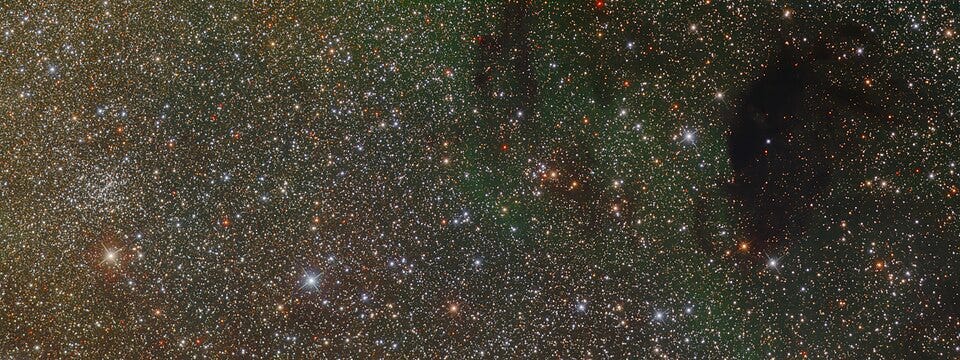
Cover Photo — The Sagittarius Star Cloud M24
Welcome to The Galactic Times Inbox Magazine Issue #116
Sky-Lites — Planet Ins and Outs in Both Twilight Periods
The Total Eclipse of the Sun August 12th
A Moon-Free Perseid Meteor Shower, August 11-12th, Too!
Astronomy in Everyday Life — It’s A Candy Universe
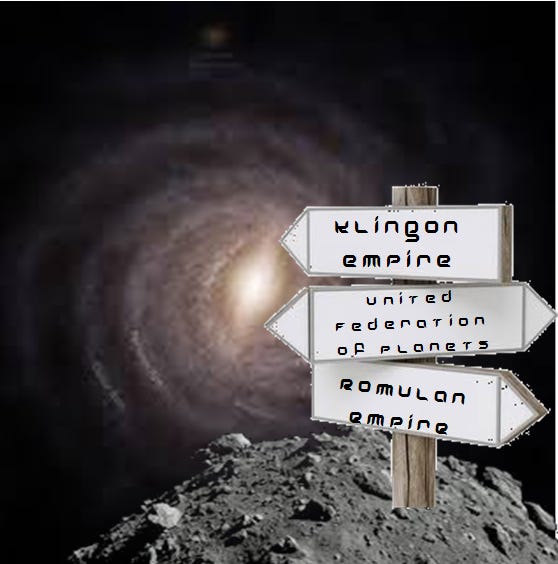
Federation Space - The Astronomy in Star Trek - Learning Astronomy With Science Fiction
Greetings, Galactic Timers!
As the song once sung, it’s those lazy, hazy, crazy days of summer…..
For those who recall the end of June, most of the damage from the lightning bolt that hit my house has been rectified. In time for the days of heat indices of over 100 degrees Fahrenheit. Yay, air conditioning.
For the future, we have three exciting celestial events (and this Inbox Magazine has a global audience), two of which are in this first half of the month. I don’t usually like to repeat myself, but I am going to repeat myself…..or at least copy the same text from the July The Classroom Astronomer Newsletter on observing the Total Eclipse of the Sun in Europe (and partial in North America (partially….<groan>) and the peak of the Perseid meteors in a moonless night, both of these August the 12th. I’ll bring in Event #3 next issue.
As reported in Sky-Lites, the dawn sky brings interesting planet phenomena, Mercury at its brightest, Jupiter rising up to meet it, and Mars visiting a supernova remnant. Evening has Venus edging slowly out of view but Saturn entering the spotlight right after twilight ends.
Tables of contents are provided for yours truly’s latest writing project, Federation Space - The Astronomy of Star Trek. As I assemble this data for a forthcoming book, I am giving its readers both reviews of astronomical objects in the current episodes of Star Trek: Strange New Worlds and a tour for the next year of those Trek stars and planets and other objects that are also real in our universe, and discuss the latest findings on them in hopefully interesting lessons on astronomy. Learning astronomy with science fiction!
Enjoy!
- - - - -
Do you want to get these issues right away in your mail inbox? Then subscribe. We don’t put the latest issue up on the Substack webpage until 3-7 days later.
* Not a Subscriber? Want to read this off the Web? Please hit the link….below:
Publisher — Dr. Larry Krumenaker Email: newsletter@thegalactictimes.com
August 5. Last Quarter.
August 10. Perigee.
August 12. New Moon, plus Total Eclipse of the Sun
Mercury (Dawn) — On the 2nd it is at greatest elongation west of the Sun, rising only 20 minutes after the start of morning twilight. It reaches its brightest magnitude on the 14th, brighter than the Dog Star, Sirius. If that wasn’t enough help to find it in the dawn, the thin morning crescent Moon passes it by 2-degrees on the 11th and a mere 0.6-degrees from Jupiter on the 15th.
Venus (Evening, Dusk) — Venus reaches its greatest elongation, too, but on the other side of the sky from Mercury. Yet against expectations, you won’t see it in a dark sky after the 14th for it sets on that date at the end of twilight, and stays in the twilight glow the rest of the apparition through August and September. On the 16th it is 2-degrees from the Moon. The best part of this slow disappearing act is that as it rounds the Sun and begins to head towards being between Sun and Earth, its size begins increase but its phase shrinks, reaching a ‘half-Venus’ at mid-month.
Mars (Pre-dawn Night) —Rises halfway between local (daylight savings time) midnight and the start of dawn, and not overly outstanding, yet. It does play tag with two objects this half-month. It passes 1.4-degrees North of the Crab Nebula so use Mars to find this ghostly cloud in a telescope the morning of the 3rd. More easily, the Moon passes 4-degrees South of Mars on the night of the 8-9th.
Jupiter (Dawn) — Jupiter rapidly escapes the solar glare after the Sun passes by it, moving faster than the planet among the stars. Jupiter rises 40 minutes before the Sun, becoming more visible, on the 9th. It is passed by Mercury by less than a degree on the 15th.
Saturn (Evening and all night) — Rapidly approaching opposition, its best time for observations, the Ringed Planet rises about a half hour, give or take the date, after evening twilight ends. The Moon passes it on the night of the 3rd-4th.
The next every-half-year-and-two-weeks eclipse season begins next month. The first of two interesting eclipses is on August 12th. Its path is a bit unusual. The Moon’s shadow first touches down just inland from Russia’s arctic shore and traverses the Arctic Ocean just missing the Earth’s North Pole. It then heads southwards and darkens the entire eastern shoreline of Greenland before jumping over to Iceland where it just nips that island’s western shoreline. Traveling over the Atlantic Ocean the Moon’s shadow then squeezes between one line made by the Pyrenees Mountains between France and Spain and a second line connecting a tiny tip of Portugal’s northeast border and the suburbs on the north side of Madrid, Spain. Leaving Spain the shadow goes over the touristy island of Mallorca and its neighbors and leaves Earth.
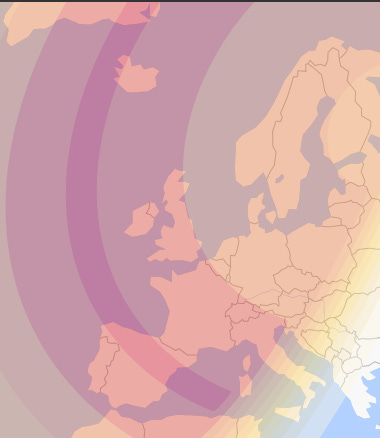
The totality maxes out just over 2-minutes-long halfway through its journey over the Earth’s surface. The largest city easily reached by air that gets covered is Iceland’s capital, Reykjavik, which only sees 59 seconds of totality.
What, besides simply observing this wonderful phenomenon, can you do as an experiment?
Total Eclipse Phenomena:
Can Baily’s Beads and shadow bands be detected, and for a longer time, from the edge of the total eclipse zone; how far beyond the totality zone?
Environmental Phenomena:
We know the sky will darken but are color changes sometimes perceived in eclipses measure-able and real? What kind of changes in light intensity and temperature can be seen when the Sun is not completely covered by the Moon?
To view the eclipse, definitely use polymer eclipse glasses for all, or telescopes to project magnified images, filters to place over cameras, and various pinhole projectors and pinhole reflectors. To measure temperature, sky brightness and color, use a variety of Vernier sensors attached to a laptop or some LabQuest units. The sensors should be mounted on a flat stick taped to a camera tripod. At least one of the sensors should be aimed to the one point in the sky that would always be equally distant from the Sun, the North Celestial Pole. Another should be aimed 180 degrees away, downwards towards a white sheet on the ground, to try to detect shadow bands.
Sensors should be on continuously, taking measurements every one to ten minutes. The laptop and LabQuest sensor interface-recorders should be on a table nearby, shaded with an umbrella. Though capable of running on batteries, an extension cord providing power for them from a convenient outlet is nice. Only the sensor, SpectroVis, to measure the sky spectrum, probably has to be manually operated in recording its measures as a data file, every ten minutes.
Elsewhere, observers could be photographing the eclipse with film or digital cameras and making records of any Bailey’s Beads, and other phenomena.
Temperature, Light and Color
All electronic observations have to begin at the moment the Moon touches the Sun. For a prior, annular eclipse, there was no apparent influence of the eclipse on temperature until about .80 hours into the eclipse.
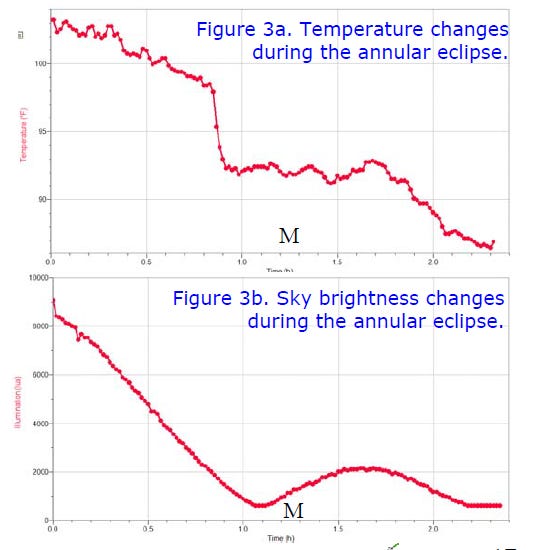
The temperature declines steadily simply as the Sun lowered in the West, until two-thirds of the way into the opening partial phases (annularity was for 1.72 minutes at the 1.2 hours, M-mark on the chart). It drops rapidly but then stays fairly steady until the line rejoins the normal diurnal temperature line at .55 hours before the eclipse ends. Any increase in temperature due to less coverage of the Sun by the Moon must be balanced out by cooling due to lowering solar altitude. Unlike the author’s previous measures at total solar eclipses, this minimum temperature occurs before maximum coverage. What will you detect in Europe this August?
The light variation, on the other hand, showed quite a smooth curve with the deepest drop about 6 minutes before maximum eclipse. This and the temperature graph could indicate a systematic error in our sensors’ start times. Recovery to normal light occurs about at the same time that the temperature sensor returns to normal as well. Clearly a partial eclipse should not have little effect on local lighting or temperature until it reaches a certain depth, somewhere between 45 and 66% coverage of the Sun’s visible surface this was determined. Will it be the same this August?
On the other hand, the distribution of colors of the sky, its spectrum despite a common qualitative assertion that it gets perhaps bluer, showed no changes whatsoever beyond the uncertainties of measurement. What about this August, same or different? The relative intensities of the different peaks of the sky spectrum did not waver at all. Logically, that should be true, as the sky may darken but it’s still the Sun’s light illuminating us and that the scattering effects of the atmosphere should not change the relative amounts of color we see. Any bluishness must be attributable to human eye color response due to the darkening conditions conditions.
What results will you get with this total eclipse?
Partial Phases
While there will be partial phases visible on either side of the shadow track, most of the partial phases’ visibilities are on its south side. Virtually all of Canada excepting Vancouver, British Columbia, will see some partial phases. In the USA, Alaska gets the deepest partial 39% coverage in Anchorage, more on the North Slopes, but on the continental USA, it maxes out a little less in northern NY, northeastern New England, the deepest in upper Maine. The southern limit is a line from the Idaho-Canadian border to Chicago to the Atlantic Coast in the Outer Banks of North Carolina.
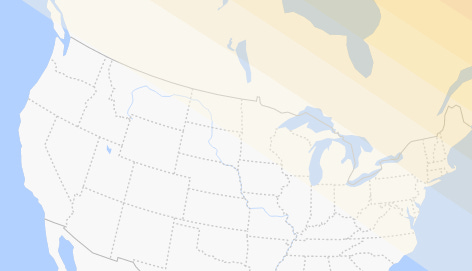
In Europe, partial phases are visible West of a line from western Russia, Scandinavia, Poland to Austria and northern Italy.
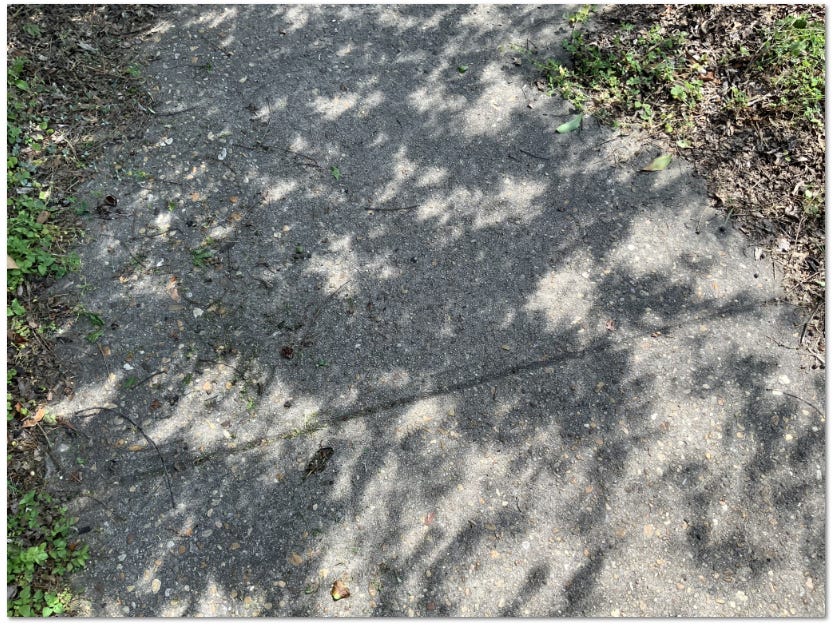
During the Great American Eclipse two years ago, yours truly was hundreds of miles from the totality shadow track. That doesn’t mean during partial phases one cannot do any of the above observations. In fact, here in AL, when the shadow was in the SE part of Missouri, photographs of the partial phases could be seen not only visually (in solar eclipse glasses) but also on the ground caused by pinholes between tree leaves, and the darkness of the sky were still experimentally possible to view, photograph and measure. So should drops in temperature with the partial phases.
This next article is excerpted and adapted out of the author’s chapter on meteor showers in the book “From Out of the Sky”, available from Hermograph Press www.hermograph.com .
*********
The Perseids of August are a reliable meteor shower. They always produce a good, and year-to-year consistent, show. The only things that change are the light pollution effects and moon-light that may be around, blanketing the sky with light that hides the fainter meteors, and lowers the hourly count, which is at least 60 per hour, called the Zenithal Hourly Rate (ZHR). More on that later. The major part of the shower covers five nights, peaking usually on the night of August 11 or 12th, varying slightly with Earth’s Leap Year. A few can be seen even before or after the five days but these nights are more for the random sporadic meteors or some very minor showers that may produce a few per hour during these nights.
So what can you do to enjoy the showers?
You have to train yourself to scan as much of the sky, slowly, as possible. A bit of a public misconception here; looking for meteors coming out of or near the radiant—the point in the sky where they seem to radiate out of in all directions, here in the constellation of Perseus, hence the name— is not much fun. They will be short trails if they have trails at all, quick, and usually quite easy to miss. Experience says to look at least 30-degrees away from that point, preferably a zone all around the radiant but at 90-degrees, a right angle, away from the radiant point. You’ll catch the bigger and more easily seen meteors flying by! But keep checking the areas closer and farther than that from time to time in your scanning to catch more of the total.
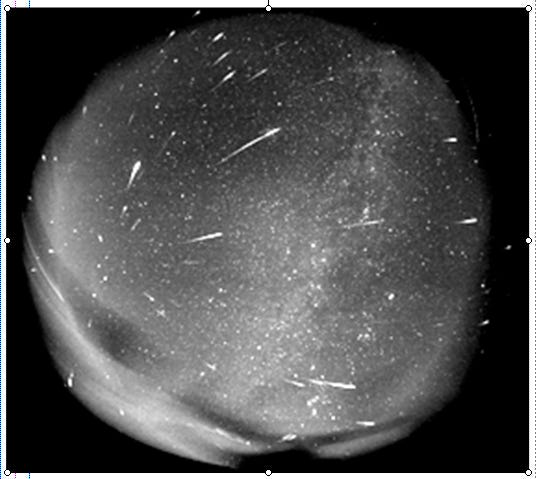
Like most radiants, at least for the major showers, the Perseids are simply in a constellation that rises late in the night and reaches its highest altitude above the horizon by dawn. When the radiant point is below ground, or close to the horizon just barely up, half or more of the meteors are not visible to you because the Earth blocks them from view. If the hourly rate is 50, 25 of them or more are on the other side of the Earth. When the radiant is highest, you see more of them, unhidden.
What Can You Do? First Count, Then Calculate ZHR
The usual thing is to count how many meteors you see in an hour; for example, between 1:00 and 2:00 in the morning. Write down the count and start the next hour’s count at zero. (It helps, but isn’t required, that you have someone who observes and agrees with you if you spot a meteor, and they did, too! Your eyes can play tricks in the morning hours!). The hourly counts start to be really active after the radiant rises over the horizon and max out at the start of morning twilight. Why? Because we finally are looking straight at the meteoroid stream head-on. But the ZHR should actually be consistent over the various hours watched. Why the difference?
The rate of meteors advertised is actually not quite true in observation. The rates published are what you might see on average when the sky is totally clear, moonless, not light polluted, and the radiant is at the zenith, also known as the overhead point—that place in the sky right over your head when you are standing, and is 90-degrees from the horizon, that last where sky meets Earth (not counting trees and buildings and structures that hide the horizon!) — in all directions. So the hourly rate under those ideal conditions is called the ZHR, or Zenithal Hourly Rate, and you won’t usually see that many unless all the conditions are met or the shower is unusually strong this time. Most radiants for most people don’t get to the zenith.
So what do you do with your counts? You take every hour’s count and at the end of the hour time you calculate the ZHR. The basic calculation is —
ZHR = N / sin(h),
where N is your hourly count and h is the height of the radiant at the middle of the hour in degrees, put into the mathematical trigonometry sine function, abbreviated sin. Most calculators can calculate the sine value.
The h value can be estimated by using one’s fist, held out at arm’s length. Count how many fists it takes to climb from horizon to zenith and divide that number into 90 (most people are 9 or 10 degrees per fist if they do it correctly). Stand up every mid-hour and measure the radiant point where meteors seem to come from with your fist — e.g. if the radiant was 3 fists above the nearest horizon point, it was 3 x 10 (or whatever value your fist made, times 3) or 30-degrees, one-third of the way up. Put that into your calculator and calculate sine of h (0.5 in this case), divide it into your hour’s total count of meteors. Example, if the count was 30, your ZHR is 30/0.5 or 60, a good hour!.
Oh, but there’s those other factors. The real detailed equation is —
ZHR = N x F x r(6.5-lm) / (sin(h) x T), where
· F = 1/1-f where f is the fraction of sky covered by clouds, as a decimal, i.e. 0.25,
· lm is how faint can you see a star (in a great clear dark sky one can see stars as faint as magnitude 6.5 but a moonlit night (NOT this August’s shower nights!) might have a limit down just to 2nd magnitude) and ...
· … r itself is a so-called population index that describes what ratio of meteors are bright versus faint, perhaps use the average of a value of 2 or 3; and finally,
· T is the fraction of an hour that you actually observed. Did you take a 15-minute break? Then T = 0.75.
If you are calculating ZHR measures for just your own fun, use the first equation, it is easier. If you doing this to do a report to a meteoritic organization, you need to use the more complicated one.
Where is the Radiant?
Plotting the meteors you see will be more fun and more sleep-preventing! You need a star chart for every hour or two hour stretch. The Earth doesn’t stop rotating and you are carried along for the ride so the stars and constellations seem to move all the time. On each chart, plot any and all meteors you see, making sure you accurately plot their starting and ending points, and put an arrowhead on the path where it disappeared. Later on, your can make a copy of the plotted chart and on the copy you can extend all the trails back past their starting points until you see an obvious area (not likely an exact single point) where the trails all intersect with each other. The center of that area is the radiant.
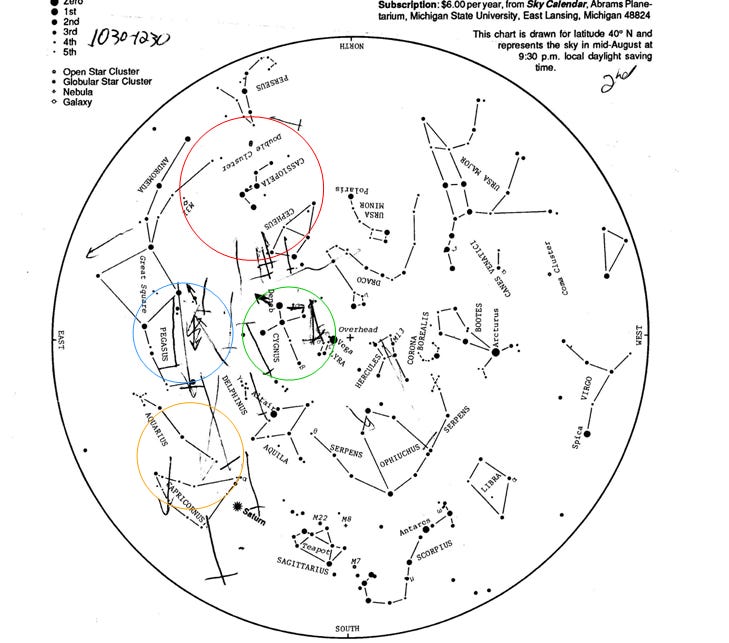
What is interesting to do is to check each chart later and see if all the radiants for each hour actually match. Also, if you observe the shower over more than one night, you might be able to see the nightly shift in the radiant’s position, a change caused by the moving-around-the-Sun planet Earth now observing the meteor stream from a different angle. Another thing to look for are other radiants, i.e. other places where the trails of some meteors intersect somewhere else on the chart. There are often one or more minor showers going at the same time as the main shower!
Then What?
This interest can be used in a classroom (or for fun just for yourself!) to teach or learn some basic science and math. What can you do with it? Here are some ideas:
· How many meteors were seen on a given date? Were there many or just a few? If many, was a meteor shower going on? If so, what fraction of the meteors belonged to the shower?
· How long do meteor showers last? Over how many nights do you see meteors belonging to a given meteor shower? Do some showers last longer than others?
· Frequency of meteors. Is there a certain time of night when one sees the most meteors? If there is, when and why? Which meteor shower produces the most meteors detected?
It’s a Candy Universe
Saw this in a feed and simply have to pass this along…

The first two Issues covered:
Issue 1, July 28, 2026. Introduction to the Project; Strange New Worlds This Week—Valles Marineris on Mars, and the Asteroids; Trek Star Culmination—The Galactic Center.
Issue 2, July 31. SNW This Week; The Astronomy of Star Names; Trek Star Culmination—M24 Alpha (M24 is the star cloud above Sagittarius, see the Cover Photo).
Next issue after Thursday, August 6th.
Subscribe at FederationSpace.substack.com !
Comments
Nothing yet. Say the first thing.
Sign in to join the conversation.