TGT #117 - What to Do With a Nearly-Total Lunar Eclipse - July Full Moon Names - The Trek Stars of the Weeks: Vega, Beta Lyrae, Kepler-22 -- Venus Phasing
The Galactic Times Inbox Magazine · The Galactic Times Inbox Magazine
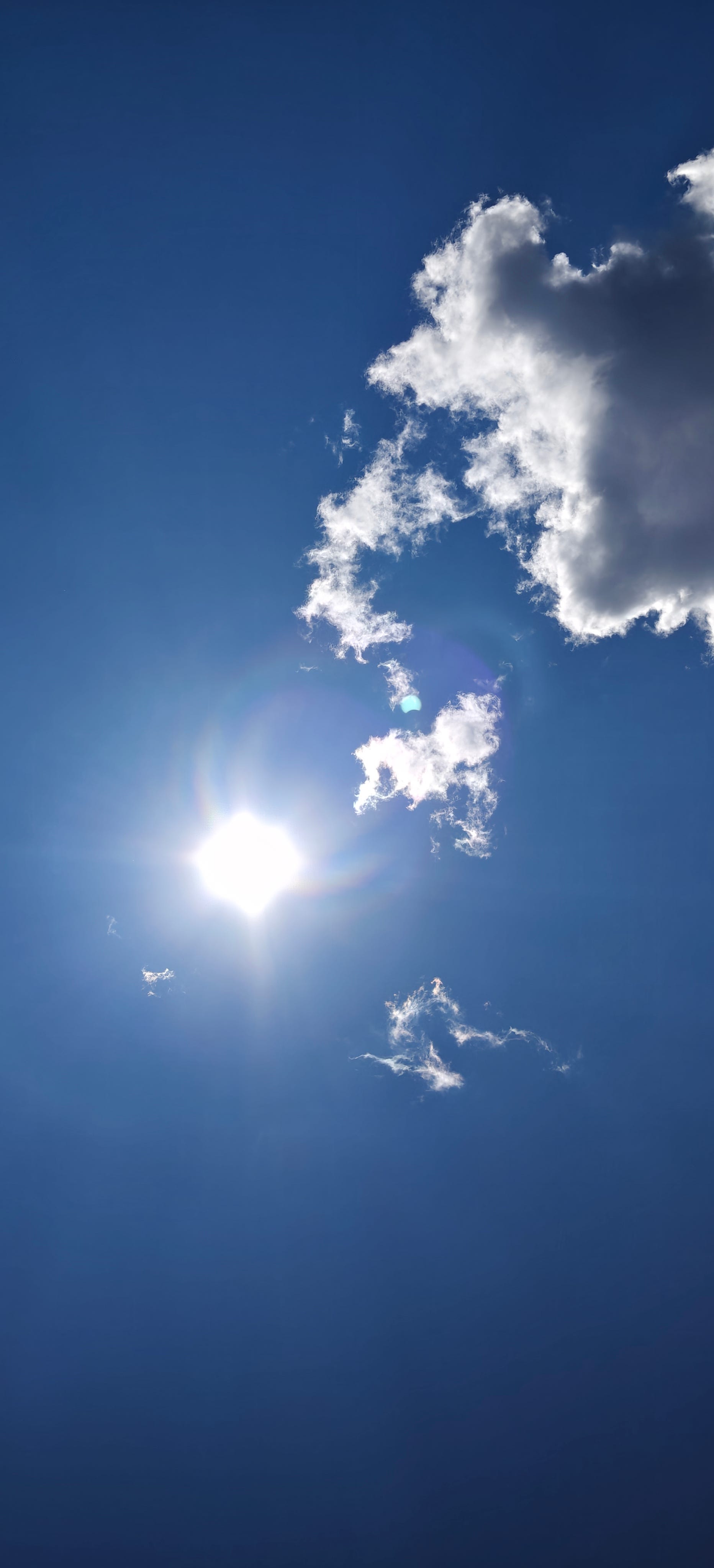
Can you see the partially eclipsed Sun of August 11th? Too bright? Look to the Sun’s upper right, in the clouds! Photo: R. Stillman, Massachusetts
Cover Photo — Eclipse in the Clouds
Welcome to The Galactic Times Inbox Magazine Issue #117
Sky-Lites— Planets Replace Planets in Dawn and Dusk
Measuring the Moon During A Nearly-Total Eclipse, August 27-28
Federation Space - The Astronomy in Star Trek - Learning Astronomy With Science Fiction - Tables of Contents for the Past Two Issues.
Greetings, Galactic Timers!
As the song once sung, it’s those lazy, hazy, crazy days of summer…..
For those who recall the end of June, most of the damage from the lightning bolt that hit my house has been rectified…in time for the days of heat indices of over 100 degrees Fahrenheit. Yay, air conditioning.
In this half-month is this August’s Full Moon and in this issue’s Sky-Lites column is a veritable summer feast of Full Moon names. Often known as the Corn Moon or the Sturgeon Moon, there are numerous other names of (g)astronomic importance to other times and cultures. Sky-wise, there are shifts of planets coming and going into the hot summer skies, both dawn and dusk.
As before in the previous Issue of The Galactic Times, I don’t usually like to repeat myself, but I am going to repeat myself…..or at least copy the same text from the July The Classroom Astronomer Newsletter on observing this upcoming Nearly Total Lunar Eclipse and what you can do with it educationally, and for fun. [Congratulate me on NOT calling this something like a Harry Potter ‘Nearly Moonless Nick of Earth’s Shadow’.] See this and have fun with the eclipse because, as you shall see, it will be the last for a very long while…..
Tables of contents are provided for yours truly’s latest writing project, the Substack newsletter and soon-to-be book Federation Space - The Astronomy of Star Trek. As I assemble this data for the book, I am giving its readers both reviews of any real astronomical objects in the current episodes of Star Trek: Strange New Worlds and a tour for the next year of those Trek stars and planets and other objects that are also real in our universe, and discuss the latest findings on them in hopefully interesting lessons on astronomy. Learning astronomy with science fiction!
Note that while there will be a September 1st issue, the September 16th issue will be delayed because yours truly is time-traveling to the 1770s—er—traveling on a week-long site photography trip in Savannah for some Revolutionary War writing for a book and not online to write for the week before.
Enjoy!
- - - - -
Do you want to get these issues right away in your mail inbox? Then subscribe. We don’t put the latest issue up on the Substack webpage until 3-7 days later.
* Not a Subscriber? Want to read this off the Web? Please hit the link….below:
August 28. Full Moon, plus Nearly-Total Eclipse of the Moon; see below.
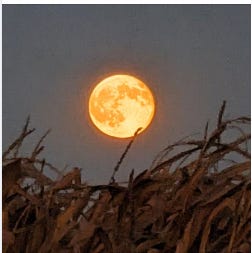
It is a Feast-ly Full Moon for August! While not the end of the growing season, when traditionally we have a Harvest Mon, it IS the peak season for harvesting. In agriculture and, apparently, in Full Moon nomenclatures.
Moon over corn field, credit Illinois Storm Community
Most of the Native American tribes give animal or plant names to the August Full Moon. The Dakota Sioux name it the All Things Ripen Moon while the Ojibway name it the Ripe-Making Moon and also the Corn Moon. The Algonquin call it the Sturgeon Moon, the general name given to the Full Moon in this modern era. Well, one of the names. In addition to some of the Ojibwa, the Chippewa and the Medieval English called it a Corn Moon, plus to be different, the Old Farmers Almanac calls it the Green Corn Moon. Corn, thus competes for the most popular August Moon name. Other plant-related names include the Fruit Moon of the Cherokee and the Barley Moon of the Celtics. At least some of them. Other Celts call it the Dispute Moon. No explanation known….except the Choctaw called it a Women’s Moon. Could it be because they think women are in disputes? Or is it because August is, well, the 9th month?
One possible astronomical Full Moon name. It was called the Dog’s Day Moon in colonial American times. Perhaps you have heard that the hot days of August are sometimes called the Dog Days of Summer? Dogs just don’t want to run around in this heat, true. But in August is the first dawn appearance of the Dog Star, Sirius. A day of importance in the calendars of ancient Egypt and Greece and, to them, presumably the brightest star in the sky heats up the summer times of Earth.
The Chinese are general and diplomatic. It is just the Harvest Moon, but we’ll leave that for September.
Mercury (Dawn) — Mercury had its best dawn days just before this issue date and had a passing-by greeting with Jupiter, a mere 0.6-degreeson the 15th. It then rapidly drops into the morning twilight glow, and is gone from view by the 24th. Technically in the evening twilight by month-end but not sufficiently to be visible until after the first week of September.
Venus (Dusk) — After having the Moon pass it on the 16th, and despite Venus just reaching its greatest elongation East of the Sun, it crosses into see-it-in-twilight-only observing mode on the 17th, setting during evening twilight from thereafter. All this half-month Venus is taking a dead bead on first magnitude star Spica, approaching at roughly a degree per day, just passing it by a degree on September 1st. A good opportunity to photograph the movement of a planet against a ‘stationary” star.
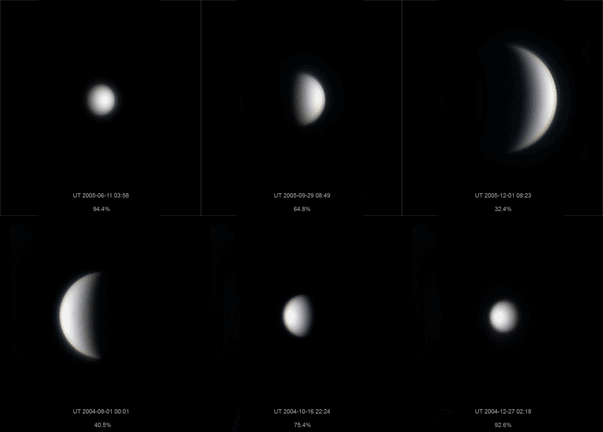
Yet even so, Venus is gaining brightness! That is because it is rounding its orbit to pass closer to Earth soon, and therefore has a larger illuminated surface to reflect light to us. That is taking place even as its phase shape gets thinner and thinner, into a crescent from here on.
Mars (Pre-dawn Night) —Rises around 2 AM daylight savings time, alone but for Saturn in the night.
Jupiter (Dawn) — Jupiter is rapidly escaping the solar glare as it rises before morning twilight begins after the 26th, more than replacing the departed Mercury which it passed on the 16th.
Saturn (Evening and all night) — Saturn, rising earlier and earlier, and rising in the twilight time on the 30th, replaces Venus as the starring planet of the night. It It approaches the Moon at month-end.
The second eclipse of the eclipse season is two weeks after the big solar eclipse in Europe (and partial in parts of North America), August 28. It is a bit unusual, an almost-total lunar eclipse, 93% inside the central umbral shadow, and visible from the Americas and Europe and Africa but not really from the Eastern Hemisphere nations. For timing purposes, note that it:
Starts at 10:33 PM on the 27th US Eastern Daylight Time;
Maxes out at 12:13 AM on the 28th;
Is over at 1:52 AM.
You need to adjust your times (and DATES!) accordingly; earlier towards the US West Coast, later on the 28th for Western Europe.
Nevertheless, this eclipse is so close to total that the following observations and experiments normally done during a completely total eclipse should work, too! Even if it is a school night in many places.
This technique can be done anyplace where the Moon can be watched through the beginning partial, total, and end partial phases of the eclipse. It can be recorded by drawing or photography.
* * * *
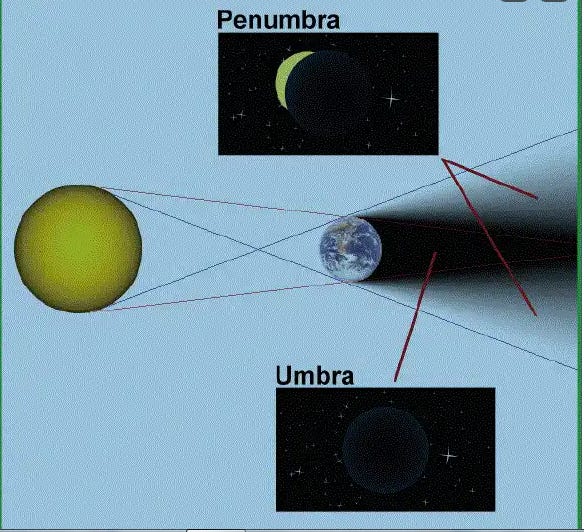
The shadow of any spherical object in the solar system consists of a dark central cone called the Umbra and an outer shadow zone surrounding the cone called the Penumbra, where some sunlight shines directly into that space. The umbral shadow edges may appear sharp to the unaided eye but it isn’t as sharp as it seems. This will cause some uncertainty in the measures, an important point all budding scientists should learn--no measurement is ever infinitely precise. We are attempting to measure the diameter of the umbral shadow at the distance of the Moon when it gets eclipsed this time. The Moon’s distance varies because of its elliptical orbit. The Earth’s shadow length also varies; the cone can be longer or shorter depending on whether we are close to the Sun or farther, though not as extremely as the Moon’s.
The farther way the Moon is, the smaller the cross section of the umbra it cuts through. So, measuring the ratio of the size of the Moon in our sky to the size of the umbral shadow cross section in degrees during totality gives us a way to find the distance to the Moon at that time.
Courtesy Wikimedia
Here’s what you will do to measure the Moon using the Shadow technique:
Take drawings or photographs of the Moon as it moves through the Earth’s umbra (central) shadow.
After the eclipse ends, put your photographs or drawings on a timeline along the edge of a piece of graph paper (preferably).
Here’s the challenging part: Using a drawing compass and adjusting its size AND where the ‘center point’ should be, find the circle that BEST fits the circular edge of the shadow as the Moon moved through the umbra.
Measure the diameter of your estimated shadow cross section in millimeters, and the diameter of a Moon image, dividing the first by the second to get a ratio value somewhere between 2.5 and 3.0. You will use this to find the Moon’s distance and size.
1. You MUST be within the zones where you can see all the nearly-total phases and at least some of the partial phases on both sides of that “totality” in order to do the Shadow Method.
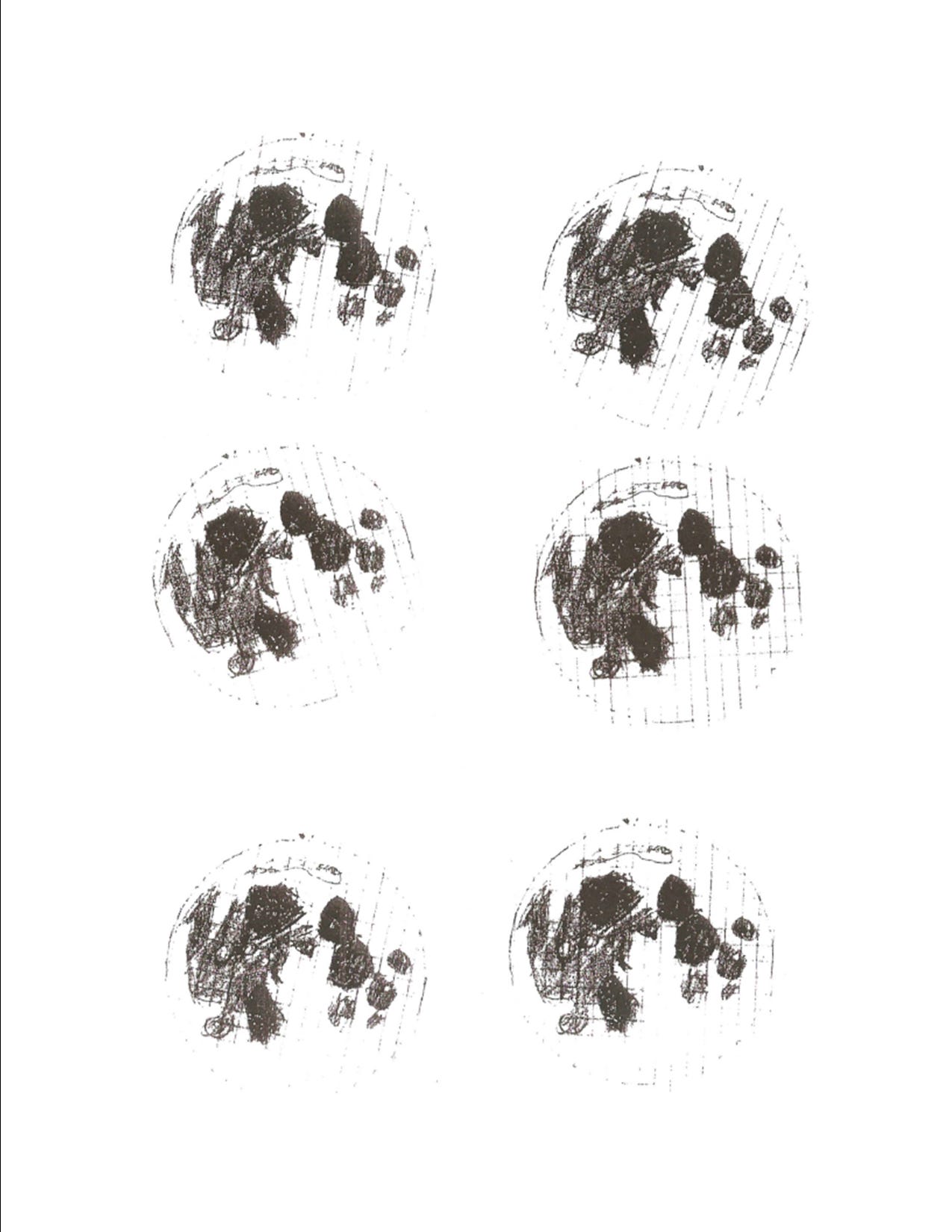
Above is just an excerpt of the full sheet. See the upside-down three-toed footprint on the right (west side)? When you line up your drawings, that footprint should ALWAYS be to the right!
3. Print also the timeline sheet attached to the drawing sheet (see below for its image) and use or adapt this to another piece of paper. The Moon moves its own diameter every hour so each hour mark MUST BE wide enough to just appear on the left and right edges of any Moon drawing image.
During The Eclipse
You must begin drawing the edge and coverage of the shadow on the Moon circles just as the partial phases begin, and stop just after the partial phases/entire eclipse, ends. We suggest you make your observations every 30 minutes; overlaps are okay.Your drawings should draw the shadow edge as it appears over the lunar seas that you see with the naked eye (or low-power binoculars and with the shadowed part shaded in. It is very easy and tempting to draw the eclipse as it appears in the sky relative to the horizon but this would be wrong!!! Observers should rotate their sheet of paper with Moon images to match the Moon as it appears, particularly as to which maria (seas) are “up”. Record the times of observations on a white part of the Moon circle. We suggest you NOT cut out the circles until after the eclipse.
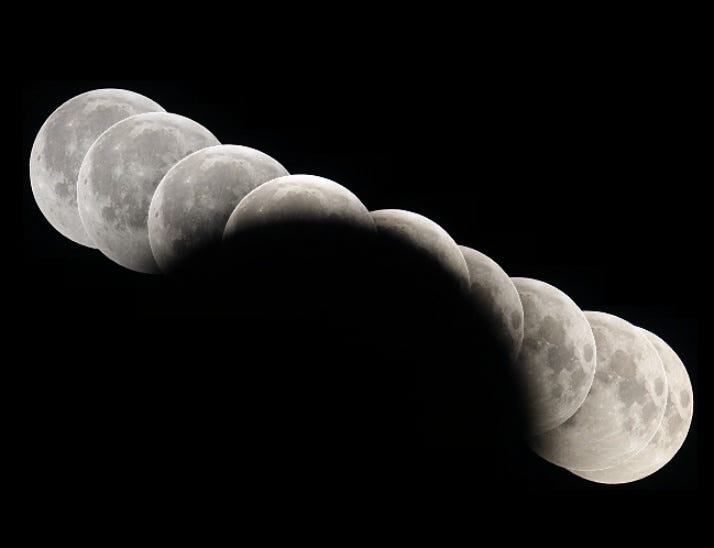
(You can also take individual photos during the eclipse and print them and cut them out and put them on a timeline. There are some photographers who can take a series of photographs on the same image (sheet of film or stored CCD image and show the circular outline of the umbral shadow, like our Cover Photo).
After The Eclipse
Cut out and put the Moon drawings on the paper with the time line. Mark your hours and half-hours on the timeline as appropriate for your time zone. If you drew the Moon every thirty minutes you should have Moon images overlapping. This is a good thing; you will be able to “average out” some of your drawing discrepancies.
Note that though the Moon’s features may appear to rotate as the Moon moves across the sky, they actually do not and all your lunar seas should always line up exactly the same way on the timeline - the seas that seem to form a three-toed footprint should always be on the right (west) side of each drawing.
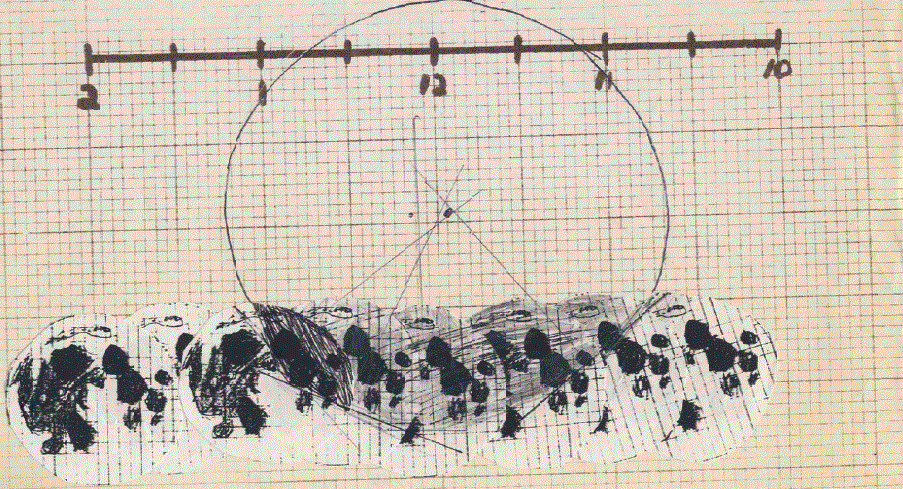
You should see that the edge of the Earth’s shadow has a circular form, but you will only see part of the circle. Your next job is to make the circle that best fits the visible shadow edge arcs. This may require several attempts to get it done well; you are doing a BEST FIT and it won’t be exact or going through all parts of the arc perfectly. We find that if you make tangents around the drawn large circular edge at several places, and then use a T-square to get perpendiculars to the tangent lines, you will find they roughly converge near a point. Adjusting your drawing compass in size and center location place, you will eventually find your ‘best fit’ circle.
Here are the Moon circles placed on a timeline paper. Notice that all of them have the “footprint” facing to the right (west). Also, see the tangent lines along the edge of the shadow and the perpendiculars from them that helped locate the center of the umbral cone cross-section....
3. Measure the Moon image diameter and the best-fit shadow circle diameter in millimeters. Divide the second value by the first; you should get a ratio between 2.5 and 3.0 (usually around 2.7). Calculate the shadow circle diameter in degrees by knowing the Moon is ~0.5 degrees and multiplying that by the ratio you just determined (e.g. 0.5 x 2.7 = 1.35).
Any object has an angular size in radians equal to its diameter in miles divided by its distance from us in miles. Now, as the distance gets larger, the shadow cone cross section (XSD) will get smaller. It starts at 7926 miles at the bottom of the cone (at Earth), goes to zero at the end, and thus has an proportionally intermediate size between the extremes. For example, fly 25% of the 856,000 miles away and you’ll find Earth’s shadow’s cross section is 100-25%, or 75%, the size of Earth, down to 5945 miles across. This Equation we can write as XSD = 7926 x (1-f), where f is how far into the shadow cone you are from Earth —above it was 25%. Conversely if you can measure the size of the cross section in miles, you can determine how far away you are! That’s where the Moon and its eclipse comes in. The ancient Greeks knew to use them to find the Moon’s distance.
We’ve measured the size of the umbra, (typically it is 1.33 degrees, close to the value in our example above). Saving all the math, we get a second equation below:
Multiply f by the shadow length 856,000 miles makes the Moon about 241,000 miles away in this example. Each eclipse will differ but with this method one can find the Moon’s distance!
This is simpler. Knowing that the Moon (and the umbral cross section) is, say, 28% of the way out, the size of the shadow we see on the Moon is (from Equation 2): 7926 * 1-f, or 7926 x (1-.28), yielding 5706 miles across.
As the shadow, in this example—your real value likely will vary—is 2.67 times the Moon’s size in this example, the Moon must be 5706 / 2.67, or 2137 miles across, about 1% smaller than its actual 2160-mile size! We clearly can determine size and distance of the Moon to within a few percent accuracy! Use your eclipse values to get this August’s values.
The best science technique is to get a group to do this, and do statistics, i.e. get a mean value and graph the spread, and see how close to known values you get, and remember, the Moon’s orbit IS elliptical so it won’t be the average Earth-Moon distance. But the Moon’s diameter doesn’t change <g>.
How clever those ancient Greek astronomers were!
If You Are Clouded Out…
….you may be out of Lunar Eclipse observing luck for a rather long time.
In 2027 there are only two lunar eclipses, both penumbral, the first nearly world wide, the second in the Americas. Plus, for fun, there is an ALMOST lunar eclipse, the Moon missing the Earth’s shadow by mere seconds of arc, but nothing to see unless you are in orbit below Antarctica.
In 2028, there is an extremely small bite of umbral shadow partial eclipse in January, a larger partial (about a half coverage) in July, and a total eclipse in Australia, Asia, Europe and only the northwestern part of North America.
There is NO Total Lunar Eclipse covering all of North America until AFTER 2036.
The third weekly issue of Federation Space Newsletter covered Strange New Worlds This Week; Astronomical Location, Brightness, and Color ; Trek Star Culmination--Vega
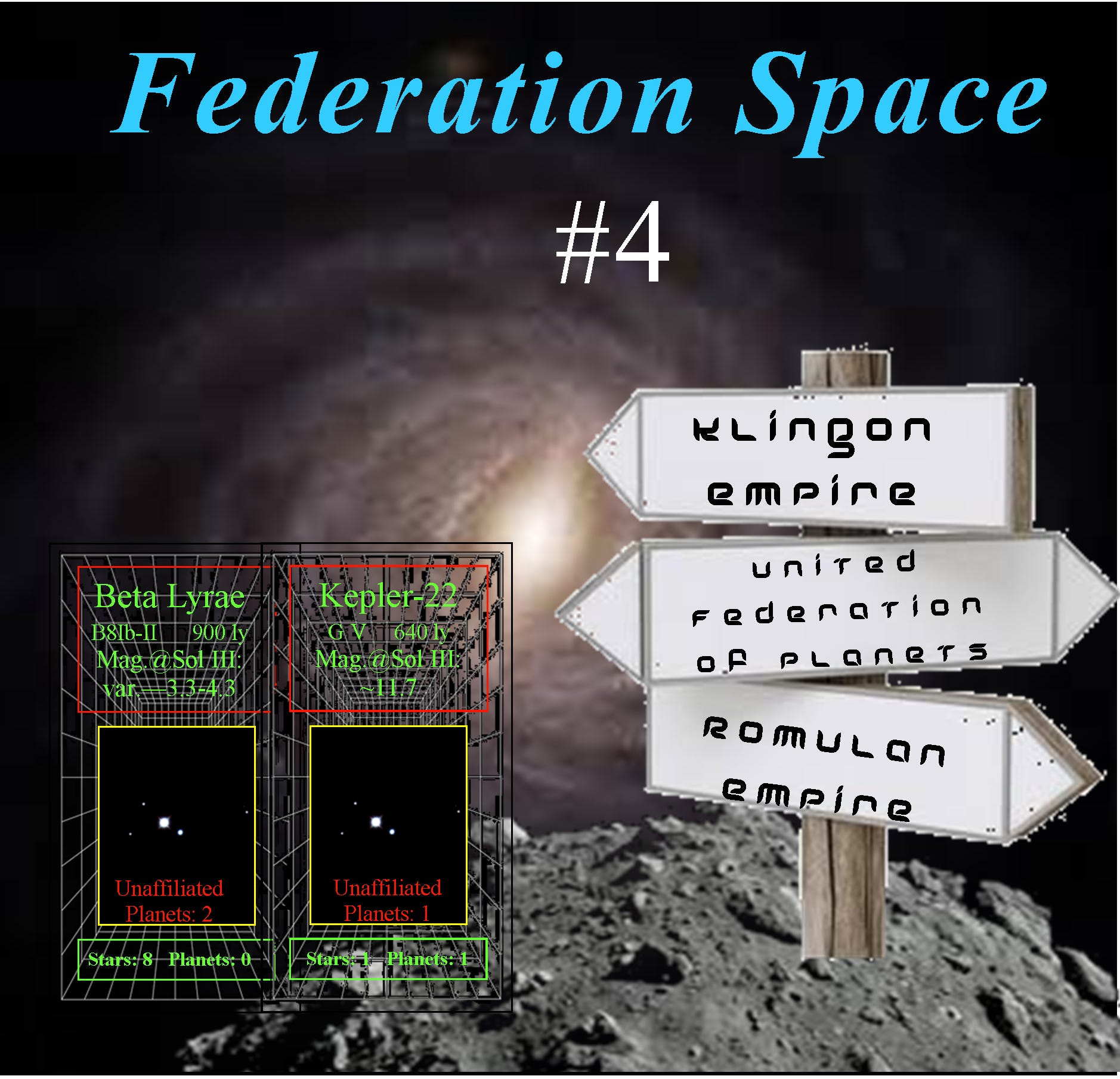
The fourth issue, on August 14th, included “You’re a Stellar Companion! What’s Your Designation?” and looks at Trek real stars Beta Lyrae (learn how to monitor its large range of variable brightness without being a professional astronomer!) and Kepler-22.
This newsletter is (c) 2026 Hermograph Press LLC, Opelika, AL. All rights reserved. No part of this may be reproduced without permission in any other medium, such as newspaper columns, webpages, blogs, etc. Please contact the undersigned for permissions, etc., and do not feed the hungry lawyers…….


Comments
Nothing yet. Say the first thing.
Sign in to join the conversation.