The Galactic Times Inbox Magazine · The Galactic Times Inbox Magazine
In This Issue:
Cover Photo — What is THAT?
Welcome to The Galactic Times Inbox Magazine Issue #115
Sky-Lites—The July Full Moon; Planets Shifting Locations
TCA - Towards Cosmic Awareness — The Gourd of the USA, and China, Too
Astronomy in Everyday Life — The North Star of Vehicles.
Greetings, Galactic Timers!
I had an idea! Came out of the blue like a thunderbolt! Like the one that hit my house a few minutes after I had finished and sent out the last issue of The Galactic Times!
Yes, adding to my list of unusual occurrences that have happened to me in my lifetime, a bolt hit the incoming power line at the roof mast of my house, just about 15 feet away from me INSIDE the house—just as I was about to turn on my stove, which probably saved me from being fried in place of my dinner. And, no, there wasn’t really any warning; some rumbles of thunder heard beforehand were distant and miles away and it wasn’t raining here at the time. A definite surprise, and nearly a month before the Thunder Moon. For that, see the Full Moon discussion in Sky-Lites.
In case you were curious, a) the most brilliant flash of lightning I’ve ever seen, b) a thunder like the gates of the Netherworld slamming shut, c) half the power sockets were affected and several things were electrically fried, d) I was unharmed, if momentarily quite startled.
Sky activity is taking a small breather before the eclipses of August (and if you want more info on that, activities for those eclipses and the Perseid meteors are in the next The Classroom Astronomer newsletter). The evening sky loses two planets, Mercury and Jupiter, both reappearing in the dawn during the second half of the month or early August. But Saturn enters the night sky at or before midnight. See Sky-Lites, too.
Like the Earth, the sky is fractured. The stars we see are often exclaimed to be common to all peoples…but we all don’t see the same star patterns. A simple set of examples and a teachable exercise, in Towards Cosmic Awareness. (There lies the answers to the Cover Photo question, What is THAT?)
I have seen several products with this name, but this advertisement for a vehicle hits the astronomical right notes. Look at Astronomy in Everyday Life.
Next week, yours truly is in attendance at the fourth and last summer astronomical society meeting, the Royal Astronomical Society of the UK. A full week of astronomical updates. And jet lag…..
Enjoy!
- - - - -
Do you want to get these issues right away in your mail inbox? Then subscribe. We don’t put the latest issue up on the Substack webpage until 3-7 days later.
* Not a Subscriber? Want to read this off the Web? Please hit the link….below:
Summer time. A time for food. A time for drink. A time for short nights and summer highlights. All good source material for naming the July Full Moon.
Let’s start with the time aspect. As a source, time isn’t very creatively used. Colonial North Americans called it the … Summer Moon. Duh. Not to be outdone, the Dakotah Native Americans and the Ojibwa called it the Middle of Summer Moon. Well, it isn’t quite middle yet—that’s really end of July or in August, but we already know Moon names aren’t precise things. The Old Farmers Almanac (OFA) called it the Thunder Moon, which makes sense for all those diurnal storms.
Let’s turn to something more interesting…food. The Celtics and the Cherokee both called it the Corn Moon—the latter actually the Ripe Corn Moon—though the former surprises me since Corn is not a native plant to Celtic lands, like Ireland. The Chippewa called it in their language, translated to English, as the Raspberry Moon, which sounds tasty if visually not very Moon-like. In the fauna category, the Algonquin and (also, again) Ojibwa tribes called it the (Full) Buck Moon, when the young bucks have grown in their antlers, probably the source of the Old Farmer’s Almanac also calling this the Buck Moon. We need some food for animals we can eat so the OFA also said it was the Hay Moon.
Two other Full Moon names are a bit more whimsical. Up in Canada it is the Birds Shedding Feathers Moon, good for stuffing pillows for yourhead to lie back and look at the short night skies, or meteors.
The Chinese called the July Full Moon the Hungry Ghost Moon. No idea why…..
Speaking of meteors, unfortunately, this date is also the peak of the Southern Delta Aquarid meteor shower, barely a major shower at 20 meteors per hour max around dawn, and the Full Moon brilliance will all but wipe this shower out.
Mercury (Dawn) — In the solar glare but peeking out at least 45 minutes before sunrise after the 22nd. Reaches maximum elongation and brightness just after month’s end.
Venus (Evening, Dusk) — Has a nice though wide conjunction with the crescent Moon on the 17th, the planet to the right as seen in the Northern hemisphere. But because it has indeed been high in the celestial northern hemisphere and now dropping rapidly towards the celestial Equator, Venus is actually edging back towards the twilight zone, setting 15 minutes after twilight ends in mid-month, 10 minutes at month end.
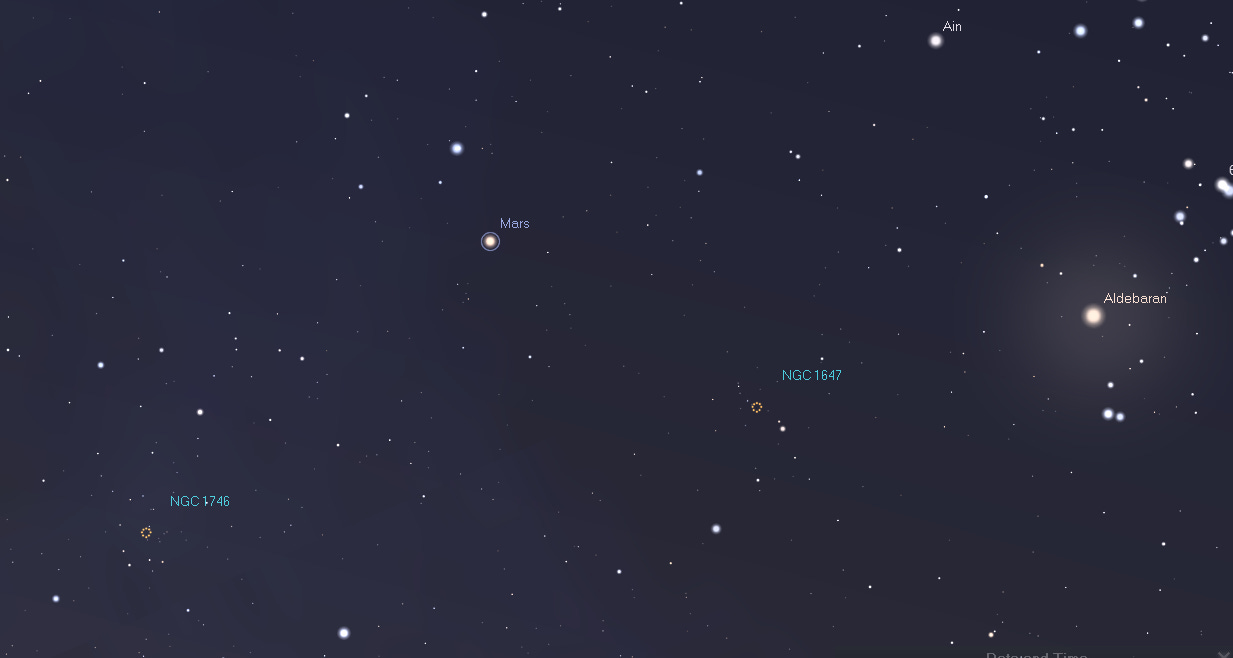
Mars (Pre-dawn Night) —Rises halfway between local (daylight savings time) midnight and the start of dawn.
It passes two small star clusters, smaller and fainter than the Pleaides or Hyades, but easy in binoculars or small telescopes. NGC 1647 on the 17th and NGC 1740 on the 24th. A great way to discover the diversity of star clusters!
Jupiter (Nope) — Jupiter starts this half-month setting about 30 minutes after sunset and disappears, if visible to you at all, after that. Reaches solar conjunction just before month end.
Saturn (Evening until Dawn) — The Ringed Planet rises around local Daylight-Time midnight on the 17th and so enters the evening star realm….In fact, it rises only a hour after evening twilight ends on the 31st. It is stationary on the 27th, beginning its approximately 5 months of retrograde (backwards, westward) motion when it gets into fullest, largest diameter, brightest, all night mode visible mode as Earth begins to pass it in our two orbits.
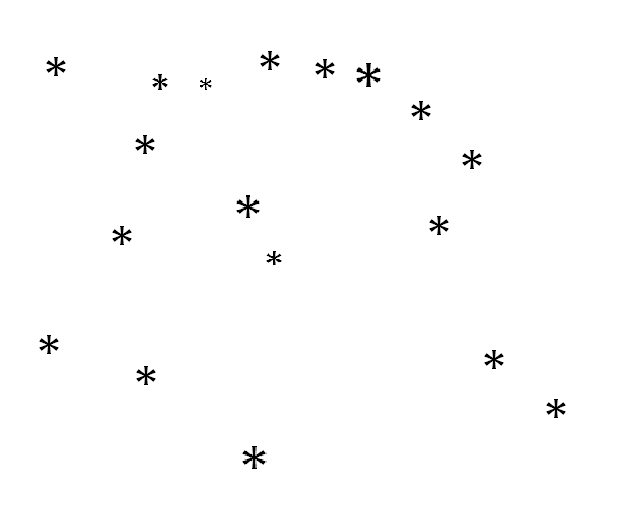
Yours truly is getting into ‘alternative; constellations. Meaning, constellations of other cultures that are not the same as the official worldwide ones sanctioned by the IAU. The latter are mostly derived from ancient Greek mythology for northern ones and Western objects of technology from the 1700s (the telescope, the microscope, ocean going vessels, and others). I currently am in the midst of learning Native American constellations, starting with the Creek (Muskogee) tribe. In fact, one of the things I used to do when teaching about constellations to students was to present a series of dots for them to connect….
…and ask the students to draw and entitle what the ‘constellation’ is. Of course it isn’t any more real than any constellation is; all constellations are just a man-made Rorschach test and the stars are NOT connected to each other in 3-D space.
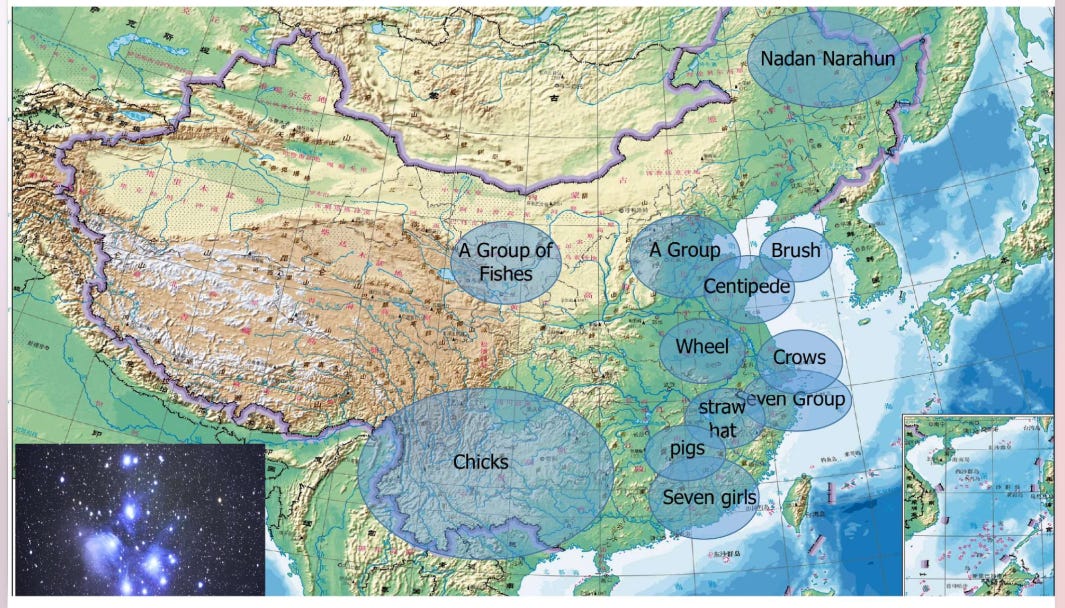
So during one particular CAP conference session with Chenzhou Cui, of the National Observatory of China, on Citizen Science and Virtual Observatory exercises for astronomy education in China, I was intrigued by what seemed to be some additional information, a diversion from the main story, on different constellations for the same groups of stars across China!
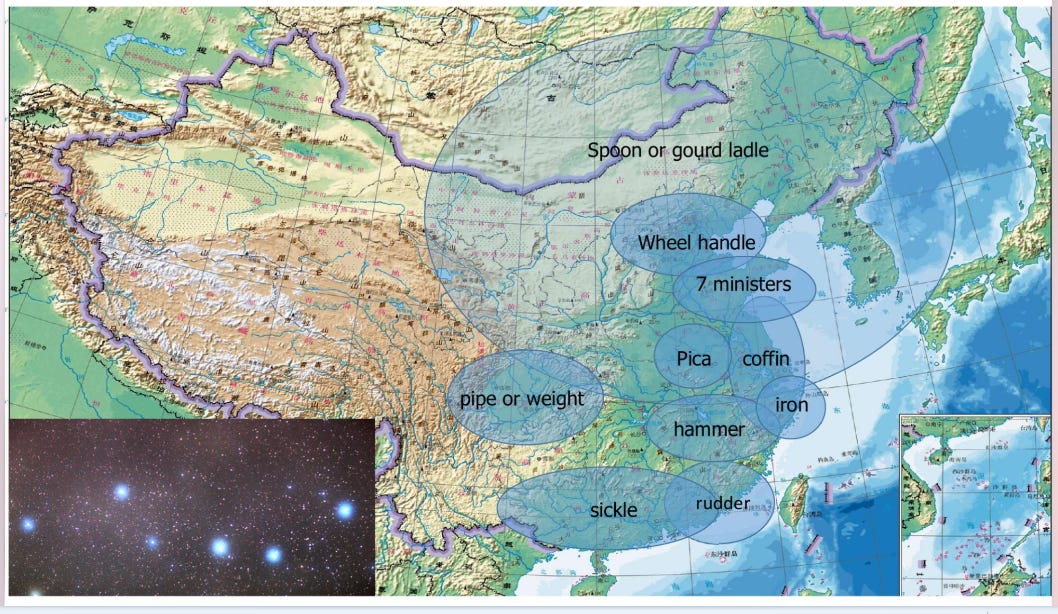
The two examples shown utilized the Big Dipper (part of Ursa Major, to be technically correct) and a non-constellation — the asterism made by the Pleiades star cluster, also known as the Seven Sisters. But not in China.
First, the Big Dipper. In England it was once known commonly as the Plough, and also as the Wagon. In the USA, two hundred years ago, enslaved people used it (and sang about it) as the Drinking Gourd. In China, a geographically large country with a number of different Chinese peoples, it has in its folk cultures different images.
The most people apparently also saw it as a gourd, but others saw it as other inanimate objects—a pipe, a weight, a coffin, a hammer, an iron (for getting out wrinkles, presumably) and one I can see, a boat rudder (especially when it is low in the sky). But also, to some, it was a conclave of government officials. It was seen as a pica; I had to look that up and it is, among other things, a word derived from the Eurasian magpie name.
Is this pattern of material goods the same for the Pleiades?
Nope. Much more naturalistic and creature-related.
A small group match the ancient Greeks! They saw Seven Girls. Another saw a Group of Seven (seven what isn’t explained) and another a simple…Group. Chicks and Fishes and Pigs and Crows are the non-human groups seen, and a Centipede all alone but with many legs—did the ancient Chinese detect more than seven stars?
The only inanimate objects are a Brush, a Wheel (???) and a Straw Hat.
The point here is that both commonalities and differences exist in the star patterns, even if the stars themselves don’t change across continents.
In class, the reasons to go through this exercise are two-fold. First, simply the interesting cultural aspects. A Rorschach test for what is important for different cultures and eras of history. And your students. Secondly, to do the science of astronomy, we need ONE common group of constellations in which to discuss our discoveries and research. It would be impossible to relate a discovery in Ursa Major AND the Seven Ministers AND the magpie Pica, and…. and be understandable. A space station named Babel that would be. It happens that when this became an important issue, the Greek constellations won out, rightly or wrongly.
Yeah!
Cover Photo -A Nearly Total Luanr Eclipse
Welcome to Issue #57 of The Classroom Astronomer!
The Total Eclipse of the Sun, August 12th
A Moon-Free Perseid Meteor Shower, August 11-12 Peak
Measuring the Moon During A Nearly-Total Eclipse, August 28
Are you subscribed to The Classroom Astronomer?
This newsletter is (c) 2026 Hermograph Press LLC, Opelika, AL. All rights reserved. No part of this may be reproduced without permission in any other medium, such as newspaper columns, webpages, blogs, etc. Please contact the undersigned for permissions, etc., and do not feed the hungry lawyers…….


Comments
Nothing yet. Say the first thing.
Sign in to join the conversation.