
Many organizations are beginning to mistake AI adoption for AI-native transformation.
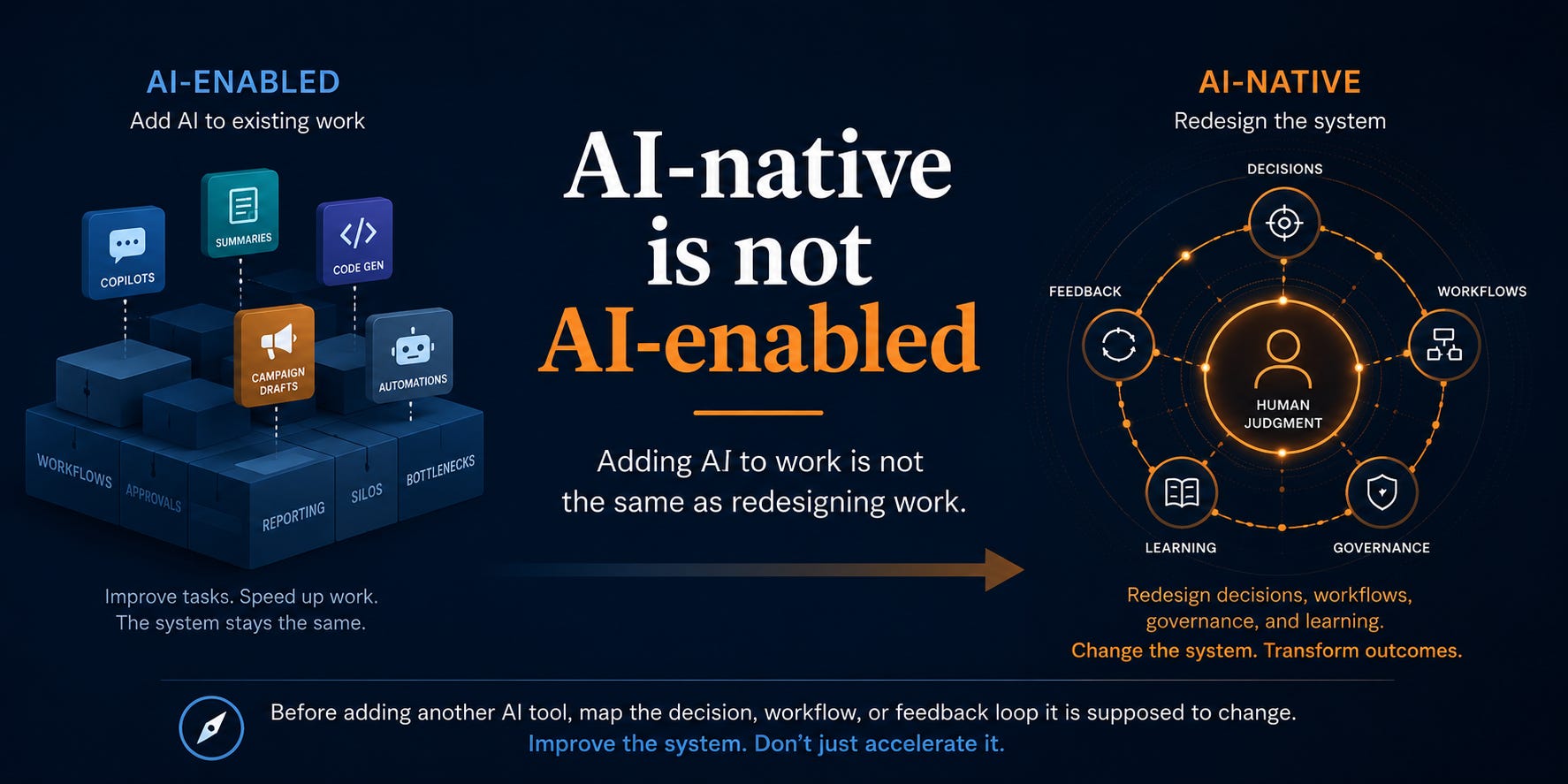
The signs are easy to see.
People are using copilots.
Teams are summarizing meetings with AI.
Developers are generating code.
Marketers are drafting campaigns.
Leaders are asking for AI use cases.
Departments are experimenting with assistants, automations, and AI-supported workflows.
All of this can be useful.
But it does not automatically make an organization AI-native.
It makes the organization AI-enabled.
That distinction matters because the first improves work inside the existing system. The second changes the system itself.
An AI-enabled organization asks:
Where can we add AI?
An AI-native organization asks:
How should the organization work now that intelligence, synthesis, execution, and feedback can be distributed differently?
That is a deeper question.
It moves AI from the tool layer into the operating model.
The first phase of AI adoption has mostly been about access.
Give people tools.
Encourage experimentation.
Find productivity gains.
Automate repetitive tasks.
Speed up content, analysis, coding, and communication.
This phase matters. It helps people build fluency. It reveals useful use cases. It reduces friction in daily work.
But in many organizations, the system underneath remains largely unchanged.
The same workflows remain.
The same approval paths remain.
The same reporting lines remain.
The same bottlenecks remain.
The same unclear decision rights remain.
The same fragmented knowledge remains.
Now, parts of the system move faster.
That is not always progress.
AI can accelerate work without improving the organization.
It can help people produce more without improving decision quality.
It can reduce effort in one place while increasing coordination cost somewhere else.
It can make existing workflows faster without making them wiser.
It can create more artifacts without creating better organizational memory.
This is the risk of becoming AI-enabled but not AI-native.
The organization gets more capability at the edges, but the core operating model remains the same.
The difference between AI-enabled and AI-native is not the number of tools in use.
It is the depth of redesign.
An AI-enabled team might use AI to prepare a report faster.
An AI-native organization asks whether the report is still the right artifact. It asks who needs to make the decision, what information should flow automatically, what requires human judgment, and how the outcome should feed back into organizational learning.
An AI-enabled company encourages employees to use AI.
An AI-native company redesigns the relationship between people, machines, workflows, decisions, and governance.
The distinction is architectural: AI-native transformation is not only about adding intelligence to existing processes, but redesigning the system around new forms of intelligence.
That means the central leadership question changes.
Not:
How do we get more people to use AI?
But:
Where should AI change how the organization senses, decides, acts, learns, and adapts?
This is where systems thinking becomes essential.
An organization is not a collection of isolated tasks. It is a system of decisions, incentives, constraints, habits, technologies, feedback loops, and people.
When AI enters that system, it does not simply improve individual tasks. It changes relationships between tasks. It changes what can be delegated, what must be reviewed, what should be remembered, and where human judgment matters most.
This is why AI-native transformation cannot be reduced to tool adoption.
It is operating model design.
This diagnostic is not a maturity score. It is a way to see what kind of transformation is actually happening.
A company can be highly AI-enabled and still not be AI-native.
It may have broad usage, many experiments, and visible productivity gains, but still lack redesigned decision systems, governance loops, architectural clarity, or organizational learning.
That is the gap leaders need to notice.
AI-enabled is not wrong.
For many organizations, it is the necessary first step.
People need to experiment. Teams need to learn what AI can and cannot do. Leaders need to see where value appears. Organizations need practical exposure before they can redesign with confidence.
But AI-enabled should be treated as a transition stage, not the destination.
The next stage requires different questions:
Which decisions should remain explicitly human-governed?
Which tasks can be delegated?
Which workflows should be redesigned rather than accelerated?
Which approvals should become part of the architecture?
What should be logged, reviewed, and learned from?
How does knowledge move from individual work into organizational memory?
Where does AI reduce complexity, and where does it create new complexity?
These are not tool-selection questions.
They are leadership questions.
They are architecture questions.
They are operating model questions.
This is also where strategy and architecture come together. Good AI strategy cannot remain a slide deck. It has to become visible in how decisions are made, how work flows, how governance operates, and how the organization learns.
An AI-native organization is not simply faster.
It is more deliberately designed.
It has clearer human-machine boundaries.
It has stronger feedback loops.
It has better decision architecture.
It has governance built into the way work happens.
It treats AI not as decoration around the existing model, but as a reason to rethink the model.
The practical starting point is simple:
Before adding another AI tool, map the decision, workflow, or feedback loop it is supposed to change.
Ask:
Are we making the existing system faster, or are we redesigning the system to work better?
If AI only accelerates current processes, the organization may become more AI-enabled.
If AI changes how the organization learns, decides, governs, and adapts, it may be moving toward AI-native.
That is the difference.
The next phase of AI transformation will not be decided by who adopts the most tools.
It will be shaped by who redesigns the system with the most clarity.
Thanks for reading The Future Thinker! This post is public so feel free to share it.
No posts
Comments
Nothing yet. Say the first thing.
Sign in to join the conversation.