
Most AI adoption starts with workflows.
That is understandable.
Workflows are visible. They are easy to name, easy to map, and easy to improve.
A customer support workflow.
A sales workflow.
A reporting workflow.
A software delivery workflow.
A hiring workflow.
When leaders ask where AI can help, workflows are often the first place they look.
Can we summarize this faster?
Can we generate this document?
Can we automate this handoff?
Can we reduce manual effort?
Can we move this task from hours to minutes?
These are useful questions.
But they are not always the highest-leverage questions.
Not every workflow needs deep redesign. Some simply need to become easier. But the workflows that shape decisions, accountability, customer experience, strategy, or learning deserve a different lens.
Because a workflow describes how work moves.
A decision loop describes how the organization learns.
That distinction matters.
AI can make a workflow faster without improving the decision it serves. It can produce more analysis without better judgment, more artifacts without clearer accountability, and more speed without deeper learning.
This is why AI-native transformation should not stop at workflow automation.
It should begin with decision-loop redesign.
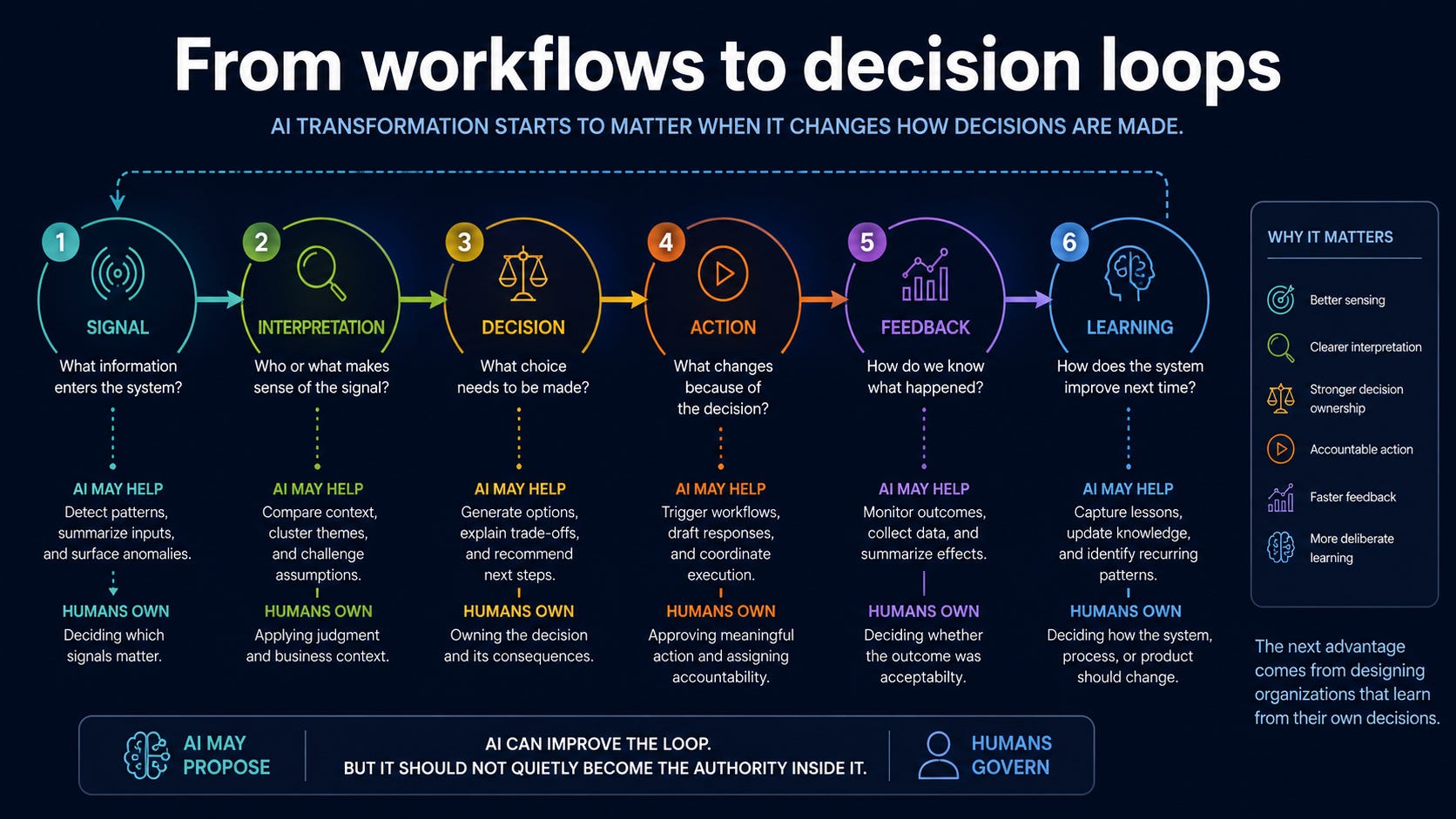
A workflow usually follows a sequence:
Input → Task → Output
A decision loop follows a system:
Signal → Interpretation → Decision → Action → Feedback → Learning
That second model is where AI starts to change the organization more deeply.
Not because AI replaces decision-makers.
But because AI changes what can be sensed, summarized, compared, challenged, delegated, reviewed, and learned from.
Consider a simple reporting process.
An AI-enabled organization may use AI to generate the report faster.
That may be helpful.
But an AI-native organization asks a different set of questions.
What decision is this report supposed to support?
Who owns that decision?
What signal should the report surface?
What context is missing?
What assumptions should be challenged?
What action follows from the decision?
How do we know whether the decision was good?
Where does the learning go afterward?
The report is no longer just an artifact.
It becomes part of a decision loop.
That is the shift.
The same applies to meetings.
An AI-enabled team may use AI to summarize a meeting.
An AI-native team asks whether the meeting produced a clear decision, whether ownership was assigned, whether unresolved assumptions were captured, whether follow-up action happened, and whether the result fed back into the system.
The meeting summary is useful.
But the decision loop matters more.
Customer support offers another example.
An AI-enabled support team may use AI to draft replies, classify tickets, summarize conversations, or suggest answers from a knowledge base.
Again, this may be valuable.
But an AI-native support system asks a deeper question:
What is this support interaction teaching the organization?
Is the customer problem an isolated request, or a signal of product friction?
Is the answer missing because documentation is unclear?
Is the issue recurring because the product experience needs to change?
Who should see the pattern?
What decision should follow?
How should the learning feed back into product, engineering, onboarding, or customer success?
In the AI-enabled version, AI helps the support team move through tickets faster.
In the AI-native version, AI helps the organization detect weak signals, interpret recurring patterns, improve the product, and reduce future support demand.
The workflow becomes faster.
But more importantly, the loop becomes smarter.
This is the deeper leadership challenge.
Many organizations are trying to use AI to make work faster. Fewer are asking whether the work is connected to clear decisions, accountable action, and organizational learning.
That gap matters because speed without learning can make a system more productive on the surface and more confused underneath.
If AI helps a team produce more documents, but nobody knows which decisions improved, the organization may simply be generating more noise.
If AI helps leaders see more dashboards, but accountability remains unclear, the organization may create more visibility without more judgment.
If AI helps teams close more tickets, but recurring problems never reach product decisions, the organization may hide friction instead of learning from it.
This is why the unit of AI-native redesign should not only be the workflow.
It should be the decision loop.
A simple way to see the loop is:
Signal → Interpretation → Decision → Action → Feedback → Learning
Each step creates a different leadership question. AI may support the loop, but humans still own judgment, accountability, and change.
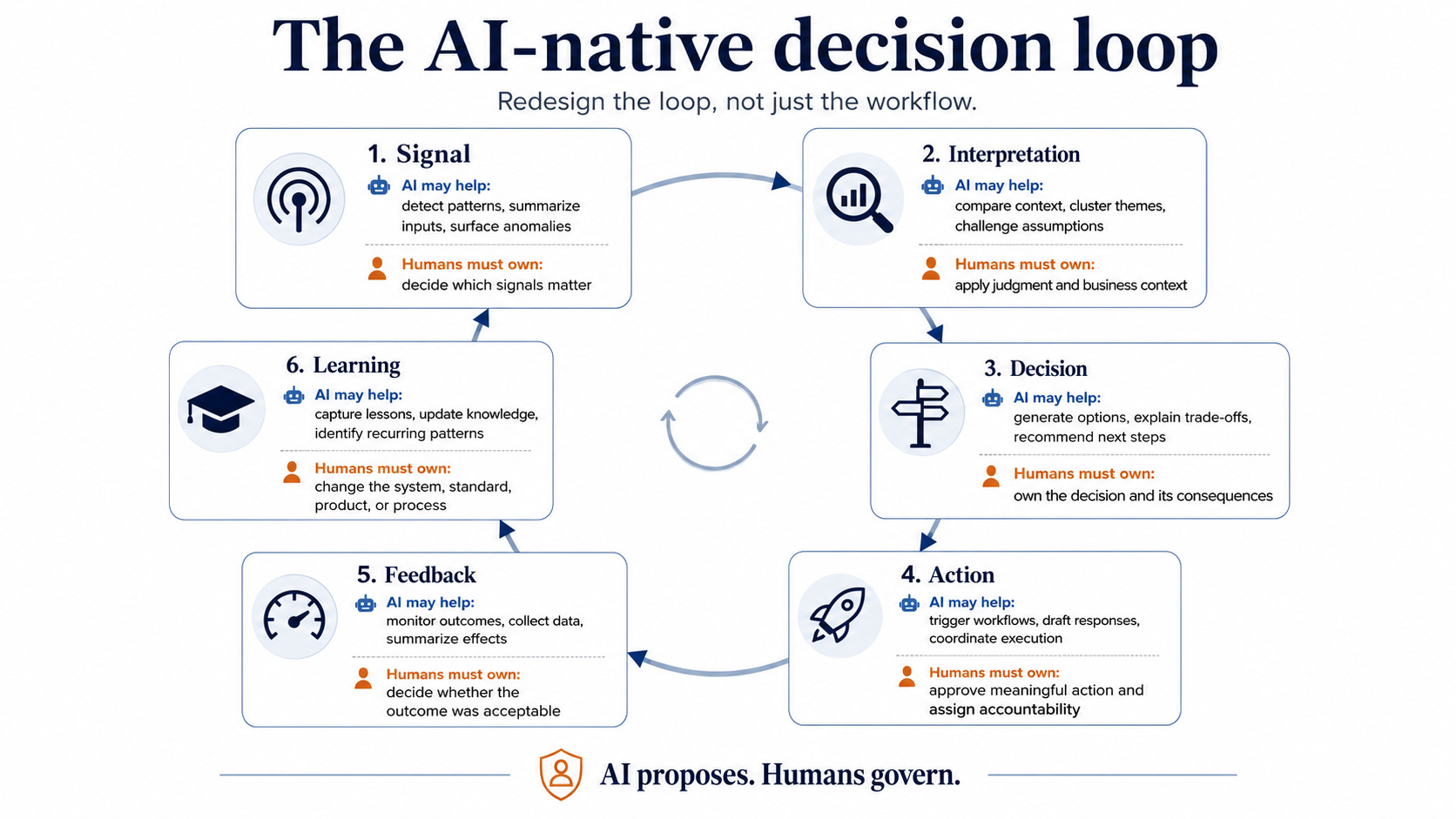
The point of this diagnostic is not to automate every step.
It is to see the whole loop before deciding where AI belongs.
Once the loop is visible, AI becomes easier to place responsibly.
AI may help detect signals earlier.
It may summarize context.
It may compare options.
It may challenge assumptions.
It may recommend next actions.
It may monitor outcomes.
It may capture learning.
But the human role remains essential.
Humans still define intent.
Humans still own judgment.
Humans still approve high-impact decisions.
Humans still decide what kind of system they are building.
AI may improve the loop.
But it should not quietly become the authority inside it.
This is where AI-native organizations differ from AI-enabled ones.
AI-enabled organizations ask which workflow can be automated.
AI-native organizations ask which decision loop should be redesigned.
They understand that the real value is not just faster execution. It is better sensing, clearer interpretation, stronger decision ownership, and more deliberate learning.
That is a different kind of transformation.
It is less visible than a new tool.
But it is more important.
Because organizations do not become adaptive simply by moving faster.
They become adaptive when they learn better from what they do.
Before automating another workflow, map the decision loop it serves.
The leadership question is not only:
Can AI do this faster?
It is:
What should this loop learn?
If that question has no clear answer, the organization may be accelerating work without improving the system.
The next advantage will not come from making every workflow faster.
It will come from designing organizations that learn from their own decisions.
Thanks for reading The Future Thinker! This post is public so feel free to share it.
No posts
Comments
Nothing yet. Say the first thing.
Sign in to join the conversation.