
When we moved from monoliths to micro-services, architects learned to think in components. When we moved from on-premise to cloud, we learned to think in platforms.
Now, as we move from cloud-native to AI-native, something deeper is changing.
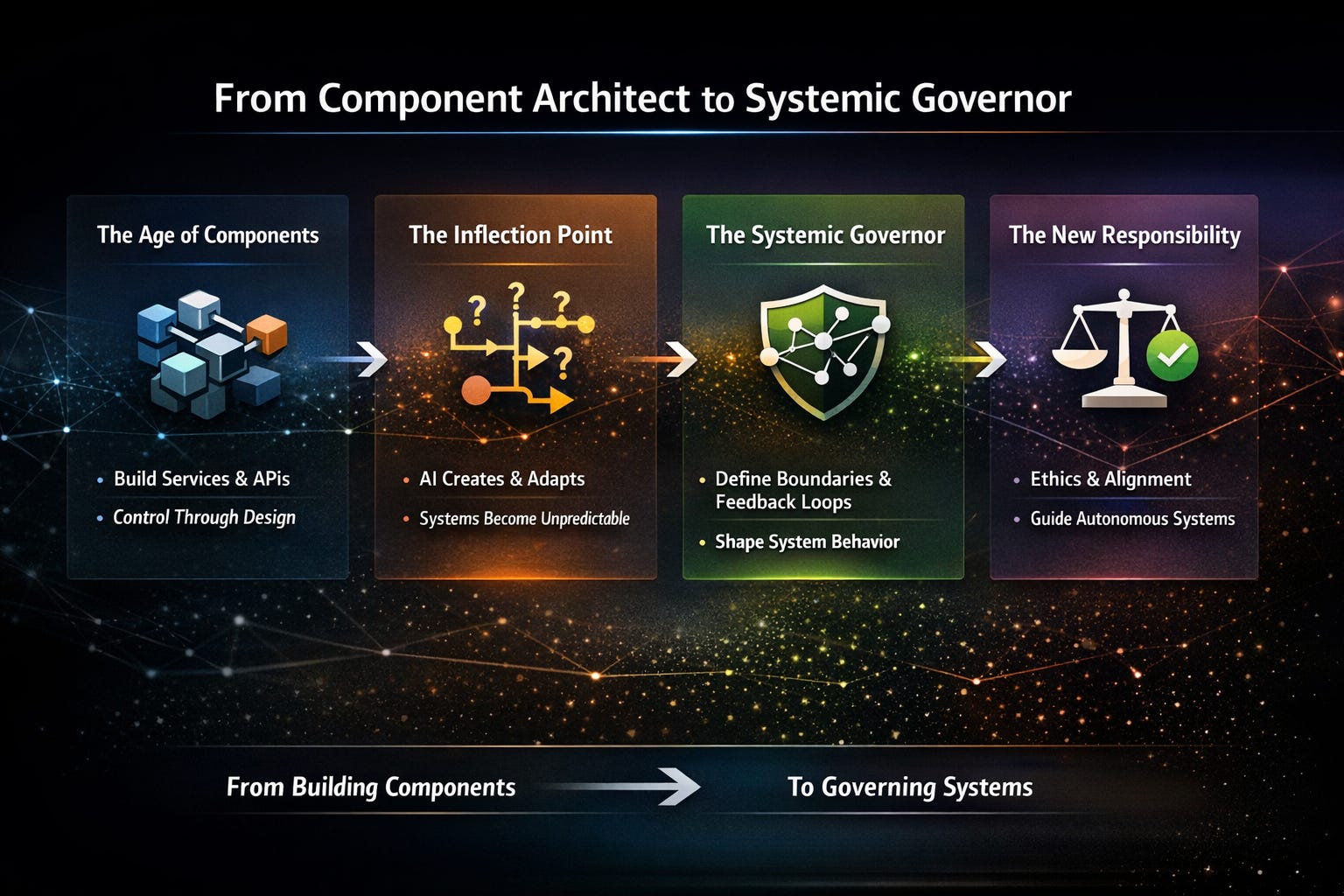
For years, architecture was about designing precise building blocks—services, APIs, pipelines. If the parts were well designed, the system worked.
That assumption is starting to break.
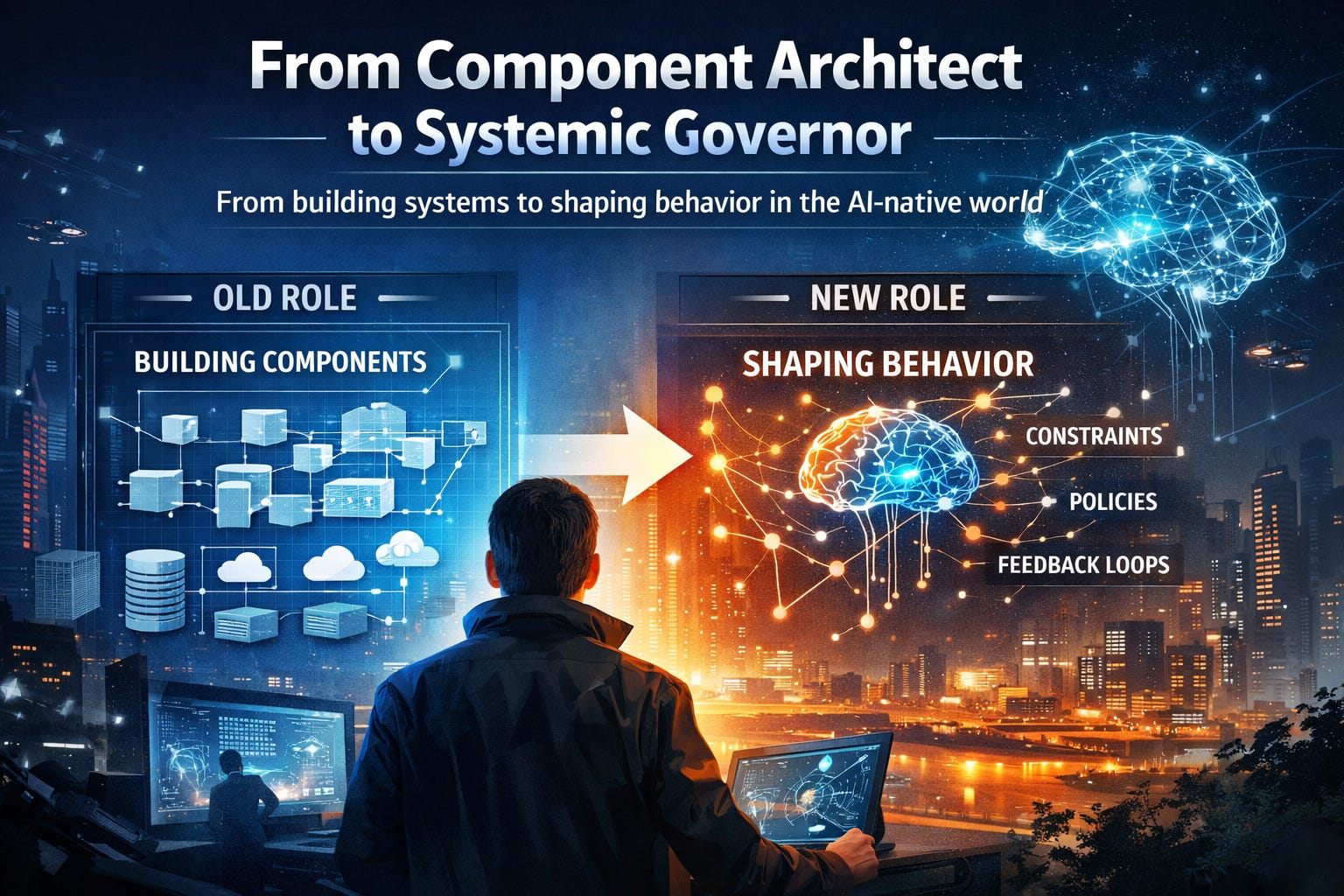
For most of my career, architecture meant designing good components. We cared about clean APIs, clear boundaries, and systems that scaled without surprises.
There was a certain satisfaction in it. You could look at a service and know exactly what it did. You could trace a request from one component to another. If something broke, you could usually find it. It felt under control.
Over time, we became very good at this. We stopped building everything from scratch and started assembling systems from existing parts cloud services, SaaS platforms, and APIs for almost everything. Architecture became less about writing code and more about choosing and connecting the right pieces.
But even as systems grew more complex, one belief stayed the same: if we designed the system well enough, we could control how it behaved.
And most of the time, that was true.
Until it wasn’t.
And then that assumption started to break.
AI is no longer just helping us build systems—it is starting to build them. Code is generated, infrastructure is described in natural language, and decisions are made by models rather than explicit logic.
As a result, systems are no longer fully deterministic. They are probabilistic, adaptive, and at times unpredictable.
This introduces a fundamental shift — we lose direct control.
For example, in agent-based systems, the same prompt can lead to different execution paths depending on context. The system is no longer following a predefined flow—it is making decisions.
You can no longer review every line of code or define every execution path. You cannot fully predict how the system will behave in every situation. And yet, the expectations remain the same—the system must be reliable, safe, and aligned with business goals.
This is where the role of the architect changes.
The architect moves from builder to governor—not governance as process or bureaucracy, but governance as a new form of system design.
The systemic governor does not define implementation. Instead, they define what the system can do, what it must never do, and how it should respond when things go wrong. They design feedback loops that shape behavior over time and establish constraints that guide autonomous decisions.
In this model, the architect is no longer controlling individual components. They are shaping the conditions under which the system operates.
The shift is subtle but profound: from designing structure to designing behavior.
In a world where AI builds the components, the highest leverage no longer lies in crafting each piece, but in shaping how the system behaves as a whole.
This requires a different way of thinking.
Not in terms of individual components, but in terms of systems that are defined, composed, and evolved through language.
This shift changes more than architecture—it changes accountability.
Architects are no longer only responsible for system structure. They are increasingly responsible for how decisions are made, how risk is managed, and how systems behave under uncertainty.
This is where architecture intersects with ethics, organizational design, and strategy.
Governance, in this context, is no longer overhead. The question is no longer how we build systems. It’s how we guide systems that build themselves.
Thanks for reading The Future Thinker! This post is public so feel free to share it.
No posts
Comments
Nothing yet. Say the first thing.
Sign in to join the conversation.