
Happy Tuesday! According to Crunchbase, 2026 has already produced more new unicorns than all of 2025: 250 companies YTD versus 193 for the entire prior year. But before "AI is minting billion-dollar companies faster than ever" becomes this week's headline, it's worth checking that against what venture has actually been returning to LPs. Those two stories, unicorn creation and cash returned, are not telling the same tale right now. More below.
AngelList - As VC firms scale their institutional LP base, finance is no longer just back-office hygiene—it’s a strategic advantage. AngelList’s fund admin operates like an outsourced COO, streamlining operations, meeting institutional diligence standards, and delivering timely, accurate reporting. See why 25k funds and syndicates trust AngelList.
Pliancy - Experience the freedom of IT that just works. Partnering with Pliancy means regaining the time & energy to focus on your mission—without having to worry about the day-to-day tech that makes it possible. Discover why VC firms from coast to coast choose Pliancy (or ask about us in VCBC).
Standard Metrics - Structured portfolio data and LLMs are enabling VC firms to automate portfolio reporting, from tear sheets to valuation memos. Explore 17 workflows that modern fund teams are automating with AI.
Airstream Alpha CFO - Modern CFO support for venture funds and investment firms. With 50+ CFO mandates, Airstream Alpha brings structured, tech-forward oversight and guidance to fund finance, from reporting and compliance to service-provider coordination, so partners stay focused on investing and LP relationships. Learn how funds work with Airstream Alpha from first close through scale.
The raw count alone marks 2026 as a different kind of year.
What the data shows:
250 companies have joined the Crunchbase Unicorn Board so far in 2026 (through Aug 15), already ahead of the 193 that joined in all of 2025.
195 of those arrived in H1 2026 alone, which by itself already surpassed 2025’s full-year total, the fastest pace since the second half of 2022.
Leading sectors are robotics and “AI neolabs,” followed by healthcare and biotech, financial services, AI infrastructure, and AI deployment/devtools, not a single-sector story.
56% of 2026’s new unicorns are US-headquartered; China has surged to 19% of the cohort (up sharply from just 10 new unicorns in all of 2025).
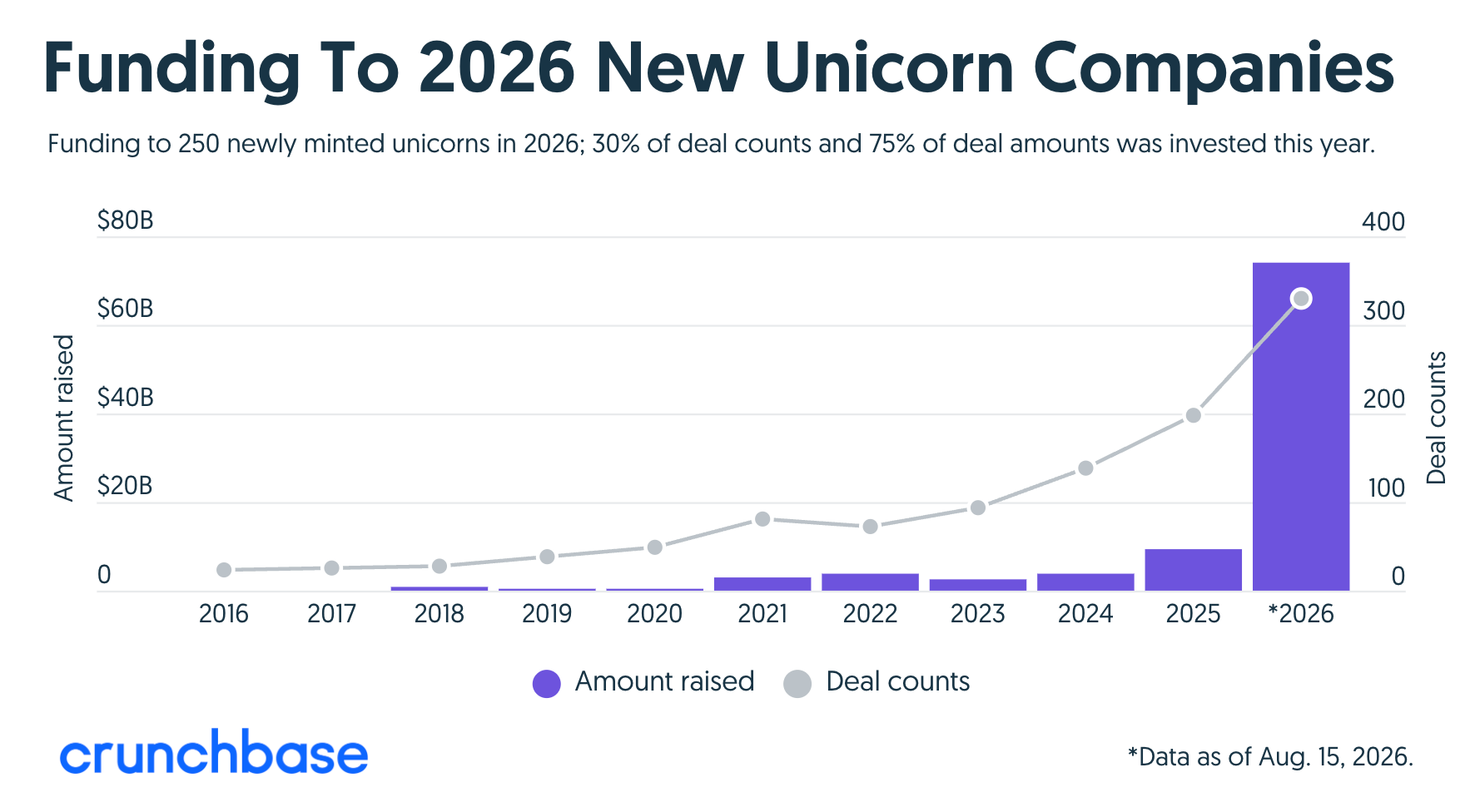
What this means for you: the sheer velocity of unicorn creation this year is a genuine regime change, not a small uptick. If you’re benchmarking your own pipeline or LP conversations against “normal” unicorn formation rates, 2026 isn’t normal, plan accordingly.
Fast counts hide an even more concentrated story underneath.
What the data shows:
H1 2026’s new unicorns added roughly $440 billion in value to the board, about 5% of its entire current value, and raised $80 billion over time, also about 5% of all funding to still-private unicorns.
The three most valuable new unicorns this year: DeepSeek at $50B in its first external financing, OKX at $25B, and OpenAI Deployment Co. at $14B.
19 of H1’s new unicorns raised fast follow-on rounds, often in six months or less, doubling an earlier valuation to $2B or more. Etched went from $5B to $10B in six months; Hadrian from $1.6B to $7.9B in seven months; Valar Atomics from $2B to $6B in four months.
Of 2025’s 193 new unicorns, 12 were already decacorns and 18 were valued above $5B, and 9 of those decacorns crossed $10B again in 2026, last year’s cohort is still re-rating upward.
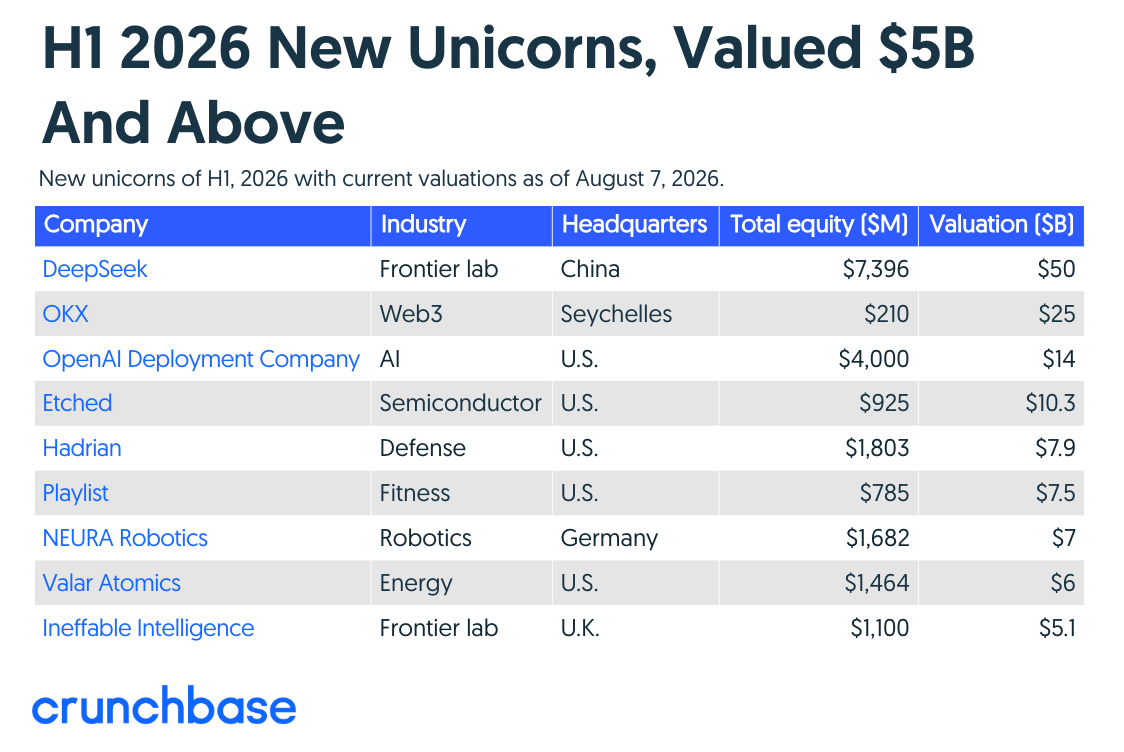
What this means for you: this isn’t broad-based value creation, it’s a small number of companies re-rating extremely fast, repeatedly. If your fund’s model assumes a startup takes years between valuation step-ups, the fastest-moving names in this cohort are compressing that timeline to months, more on what that does to reserve math in Thursday’s issue.
Unicorn creation at this pace doesn’t mean broad access to it.
What the data shows:
Crunchbase’s analysis of the 2026 cohort’s investors found Sequoia Capital, Khosla Ventures, and Y Combinator topped the list by investment count, with Lightspeed, Founders Fund, a16z, Bessemer, Lux Capital, General Catalyst, and BoxGroup rounding out the top 10 of a 29-firm leading list.
Y Combinator is the only accelerator and BoxGroup the only seed-focused firm to break into that top 10, everyone else is an established multistage platform.
75% of all funding raised by this cohort came in 2026 itself, $74B of $98B total, even though these companies’ earliest rounds date back as far as 2012.
a16z led Series A investment count in this cohort, with Khosla, Spark Capital, and Sequoia tied at six each; round sizes ranged from $6M to $500M.
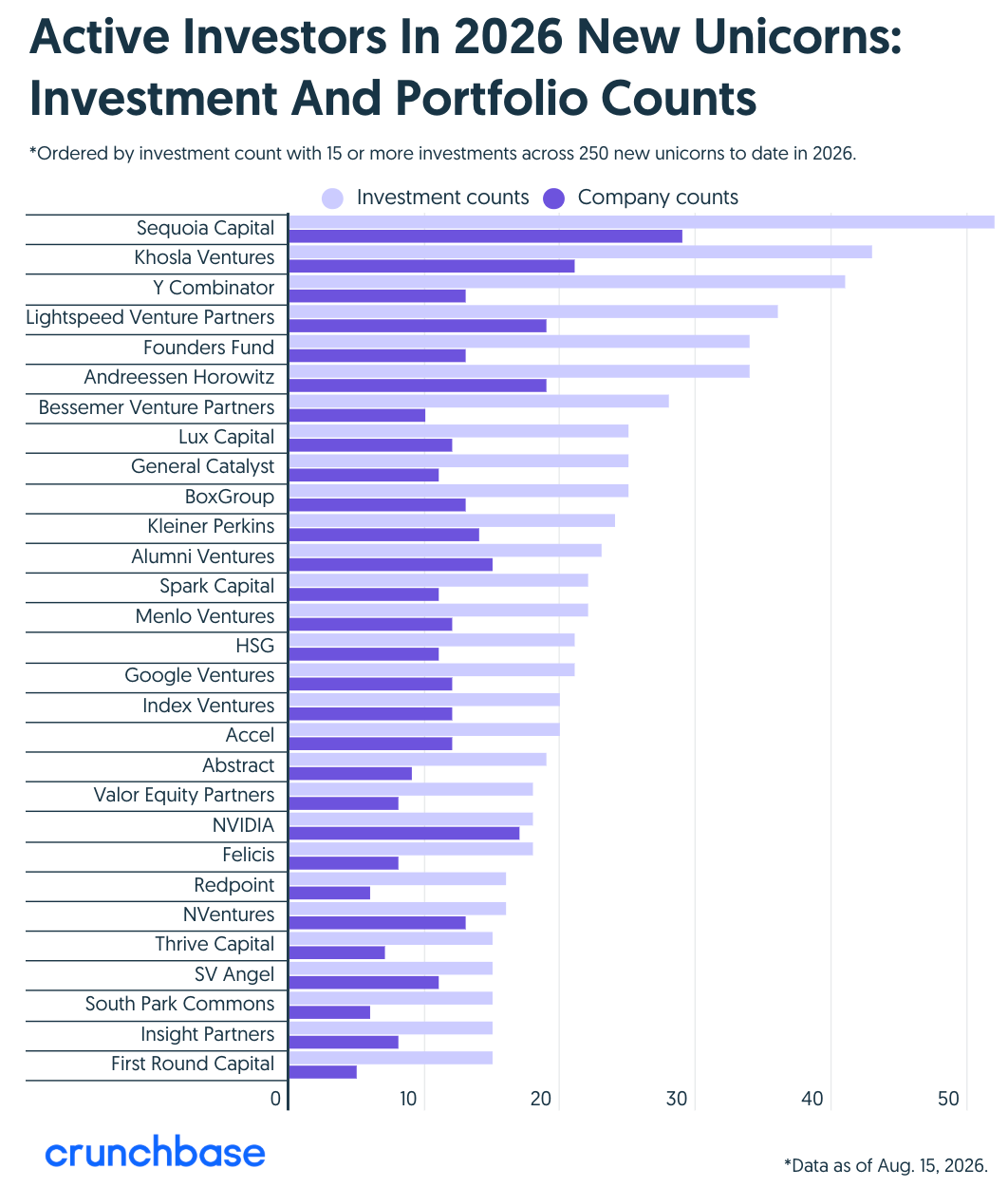
What this means for you: if you’re not already in the deal flow of one of roughly two dozen firms, the current unicorn wave is largely happening without you, and that’s before asking whether any of it has turned into cash yet.
Which brings up the harder question underneath all of this.
What the data shows:
Fewer than 20% of 2017-2018 fund vintages have a DPI above 1x, even as paper markups (TVPI) keep climbing, per Carta, Cambridge Associates, and TrueBridge, covered in #358: 5 Traits Top-Decile VC Funds Share.
McKinsey estimates over $1 trillion in NAV is trapped in older vintages, with distributions running at roughly 6% of NAV versus a 14% historical average, covered in #359: DPI in 2026 vs. $1 Trillion in NAV.
2021-vintage funds have returned just 0.05x to 0.08x DPI five years in, the lowest five-year mark this century, per PitchBook and Value Add VC, covered in #366: The Math Behind 5x and 10x Funds.
None of the unicorn-formation data above says anything about exits or distributions, a $50B valuation on a first financing is a paper number until there’s a liquidity event.
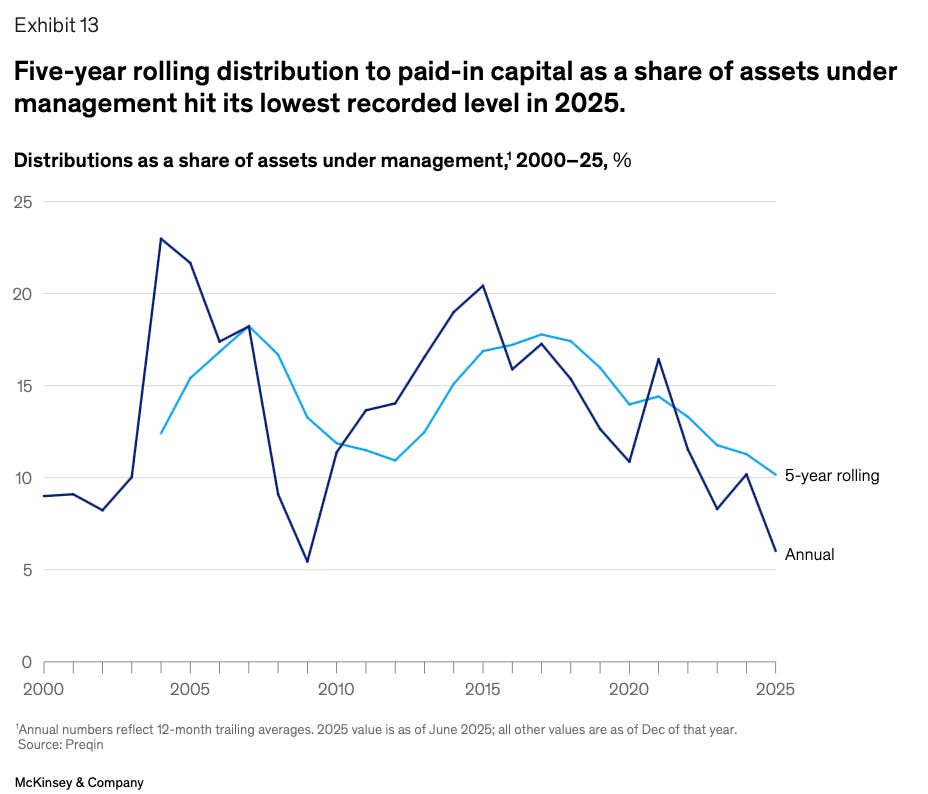
What this means for you: unicorn creation is a leading indicator of where capital and attention are going, not a trailing indicator of what LPs are actually getting back. The two headlines, “record unicorn pace” and “worst five-year DPI this century,” are describing the same market from opposite ends of the pipeline. Don’t let paper markups from this cohort get pitched to LPs as proof of a returns recovery, that’s a different, much slower-moving number.
2026 has already produced more new unicorns (250 through Aug 15) than all of 2025 (193), the fastest pace since H2 2022.
Value creation is extremely concentrated: H1’s new unicorns alone added ~$440B, with names like DeepSeek, OKX, and OpenAI Deployment Co. leading, and some companies doubling valuations in months.
Access is just as concentrated: roughly two dozen firms, led by Sequoia, Khosla, and Y Combinator, account for most of the investment activity in this year’s unicorn cohort.
None of this changes the DPI picture: 2021-vintage funds are still at 0.05-0.08x DPI five years in, and under 20% of 2017-2018 vintages have cleared 1x.
Bottom Line: Unicorn creation and cash returned to LPs are two different markets moving at two different speeds right now. 2026 is minting billion-dollar valuations faster than any year since 2022, but that pace lives almost entirely on the paper-markup side of the ledger. The DPI numbers haven’t moved. Until they do, “record unicorn year” and “strong venture returns” are not the same claim, and shouldn’t be pitched to LPs as if they were.
That’s all for today folks! Thanks for your support and spreading the word! Share this on Twitter or LinkedIn to help grow “the crew!”
Every Tuesday/Thursday, we publish VC/CFO insights that matter - highlights from notable VC GPs, LPs, and CFOs/finance pros. Check out our VC Fund Playbooks, Models, Budgets, & Compliance Checklists @ AirstreamAlpha Products!
Need more help? Check out Fund CFO Support provided by the Airstream Alpha Team.
Love what we’re doing? Consider upgrading to paid for deeper dives on Thursdays (most paid subscribers expense these insights!). Top recent posts:
No posts
Comments
Nothing yet. Say the first thing.
Sign in to join the conversation.