
Happy Thursday! Tuesday's issue covered how fast 2026's unicorns are being minted, 250 so far this year against 193 for all of 2025. Some of that pace shows up in individual companies: Hadrian went from $1.6B to $7.9B in seven months, Valar Atomics from $2B to $6B in four, and Etched has now re-priced twice in seven months, most recently doubling to $21B in under a month. Most fund models still assume 12 to 18 months between a company's rounds. That gap between what the market is actually doing and what most reserve plans are built for is this week's issue. More below.
AngelList - As VC firms scale their institutional LP base, finance is no longer just back-office hygiene—it’s a strategic advantage. AngelList’s fund admin operates like an outsourced COO, streamlining operations, meeting institutional diligence standards, and delivering timely, accurate reporting. See why 25k funds and syndicates trust AngelList.
Pliancy - Experience the freedom of IT that just works. Partnering with Pliancy means regaining the time & energy to focus on your mission—without having to worry about the day-to-day tech that makes it possible. Discover why VC firms from coast to coast choose Pliancy (or ask about us in VCBC).
Standard Metrics - Structured portfolio data and LLMs are enabling VC firms to automate portfolio reporting, from tear sheets to valuation memos. Explore 17 workflows that modern fund teams are automating with AI.
Airstream Alpha CFO - Modern CFO support for venture funds and investment firms. With 50+ CFO mandates, Airstream Alpha brings structured, tech-forward oversight and guidance to fund finance, from reporting and compliance to service-provider coordination, so partners stay focused on investing and LP relationships. Learn how funds work with Airstream Alpha from first close through scale.
Start with what a “normal” round looks like right now.
What the data shows:
Carta’s Peter Walker found, across more than 1,000 software rounds in the last six months: Seed at a $24.3M median valuation on $4.1M raised (18% dilution), Series A at $80M on $14.4M (also 18%), Series B at $191M on $25M (12%), Series C at $391M on ~$40M (under 10%), and Series D at $789M on $63M (8%).
Dilution at both Seed and Series A has been ticking down for months, lower than at any point in the last few years.
By Walker’s own estimate, at least half of the companies in this sample would count as AI-native.
A separate Carta post found early-stage valuations at record highs while the number of rounds actually being completed is falling, concentrating dollars into fewer companies rather than spreading across more.
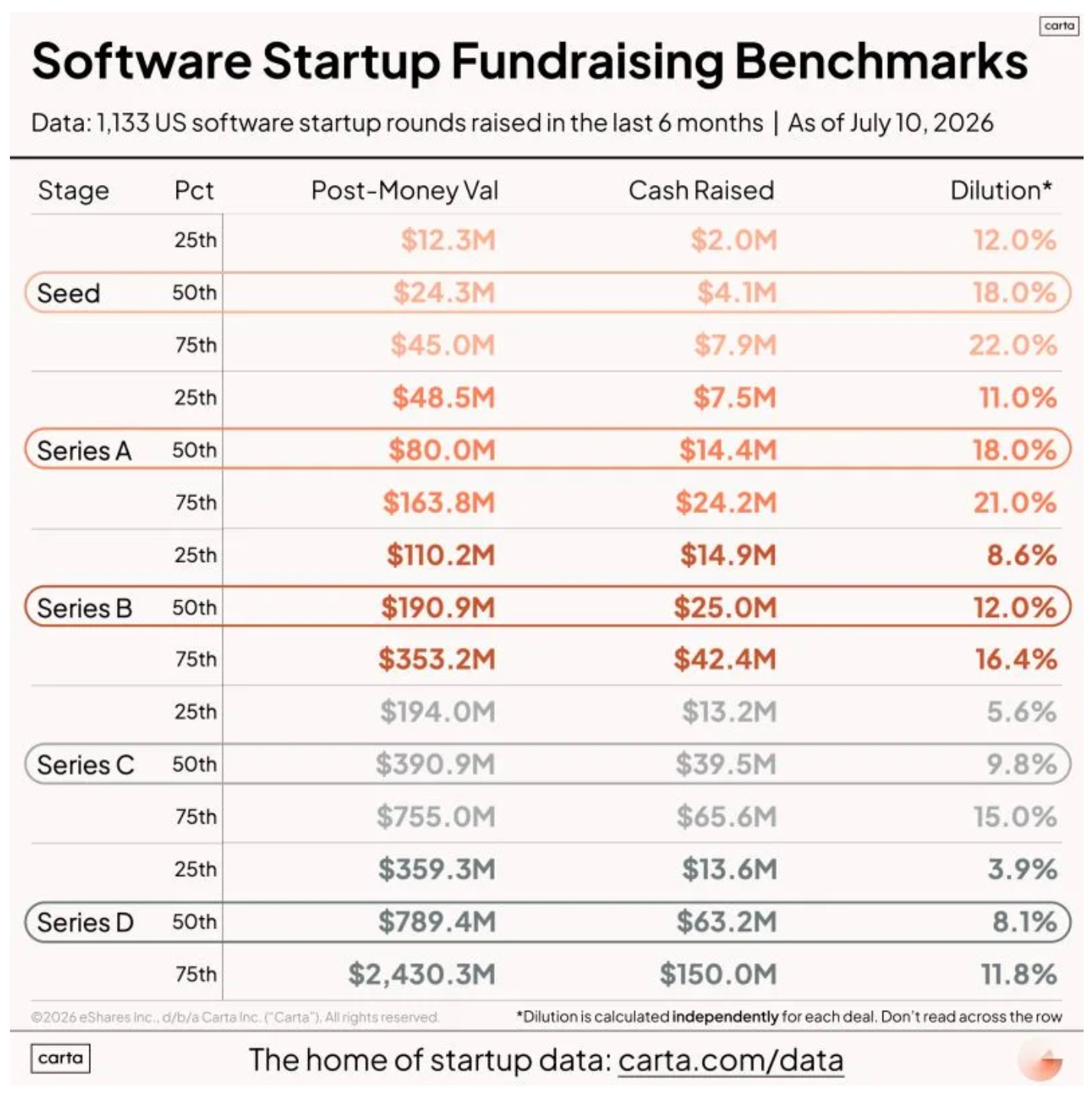
What this means for you: founders are raising bigger checks at lower dilution than in prior cycles, which sounds founder-friendly until you’re the fund trying to maintain a target ownership percentage. Lower dilution per round means you need a larger check just to hold your existing stake, before accounting for anything else.
Valuations aren’t just getting bigger, the gap between them is shrinking, and Tuesday’s issue had the receipts.
What the data shows:
Hadrian went from $1.6B to $7.9B in seven months, and Valar Atomics from $2B to $6B in four, two of the 19 new unicorns Crunchbase tracked raising a fast follow-on round in H1 2026 alone, often in six months or less, doubling an earlier valuation to $2B or more (full breakdown in Tuesday’s issue).
Etched is a sharper example, and one that’s kept moving since: $5B in December 2025, $10.3B at its Series C on July 23, then $21B at its Series D on August 18, led by Jane Street after the firm tested and bought Etched’s hardware. That’s two re-pricings in seven months, the second one doubling the valuation again in under four weeks.
A traditional reserve model that assumes 12-18 months of runway between signal and a follow-on decision has, in cases like these, a fraction of that window to actually act, and Etched shows that window can keep shrinking on the same company, not just once.
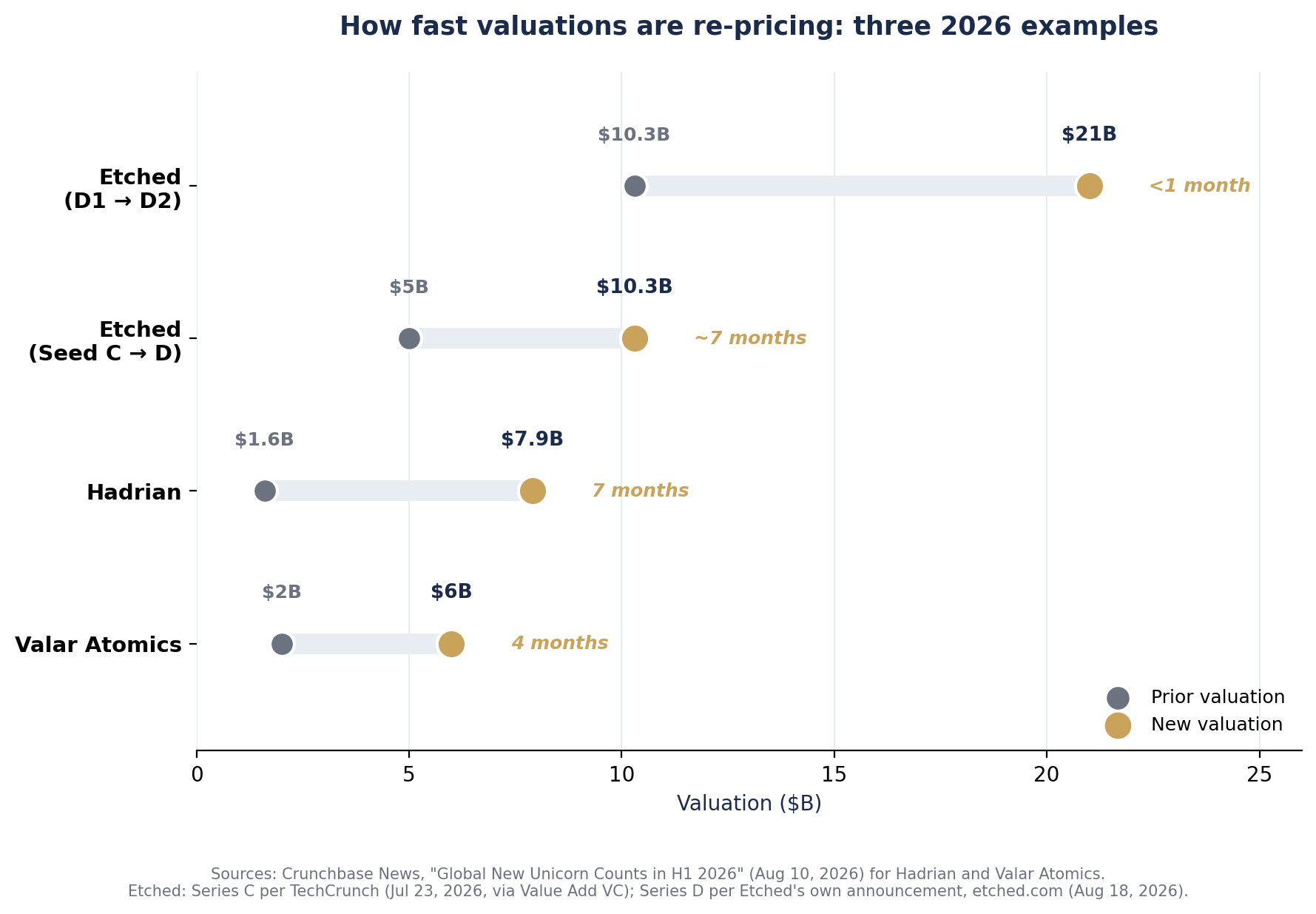
What this means for you: if your reserve capital isn’t already earmarked and your decision process for exercising pro rata takes months of internal deliberation, the fastest-moving companies in your portfolio may re-rate before you’re ready to write the check. Speed of decision-making is becoming as important as the size of the reserve itself.
Put the two data points together and the construction problem gets concrete.
What the data shows:
Holding a target ownership percentage through a round with 18% dilution (current Seed/Series A norm) already requires a larger check than the same target did when dilution ran higher, you’re buying back a smaller slice for the same price relative to prior cycles.
Compress the time between that round and the next one from 12-18 months to 4-7 months, and a fund now needs that larger check ready on a shorter timeline, with less signal accumulated before the decision has to be made.
The combined effect: bigger capital commitment, less time to raise or reallocate it internally, less information to base the call on.
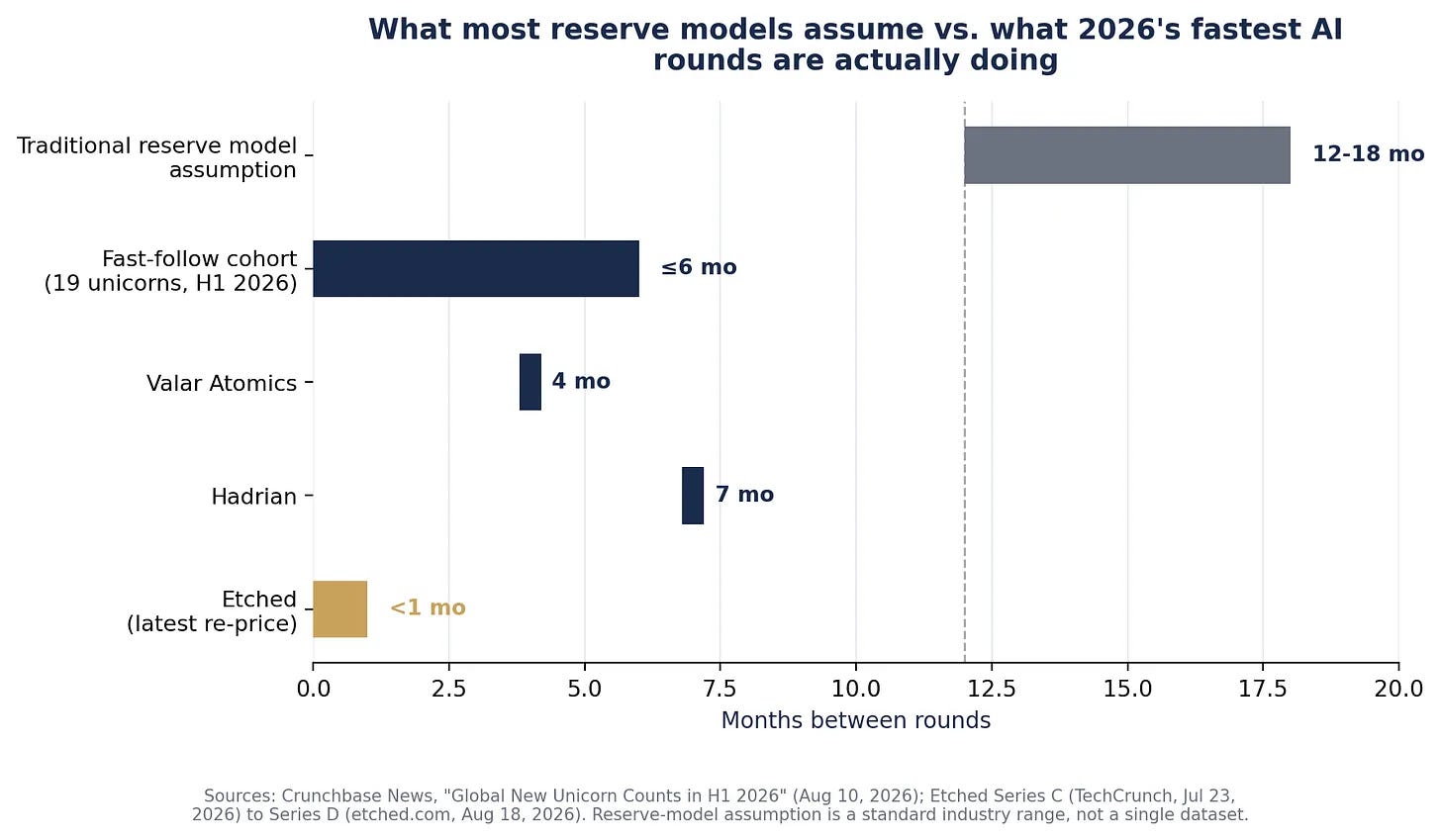
What this means for you: this isn’t an argument for reserving more capital across the board, it’s an argument for reserving capital that’s actually deployable fast, and pre-deciding your follow-on criteria before the round happens rather than during it. A reserve line that takes a full IC cycle to approve doesn’t help if the company doubles before that meeting happens.
Pro-rata math itself hasn't changed: your ownership percentage times the new round's size is what it costs to hold your stake, per the standard formula. What's changed is how little time you get to run that math before the round closes.
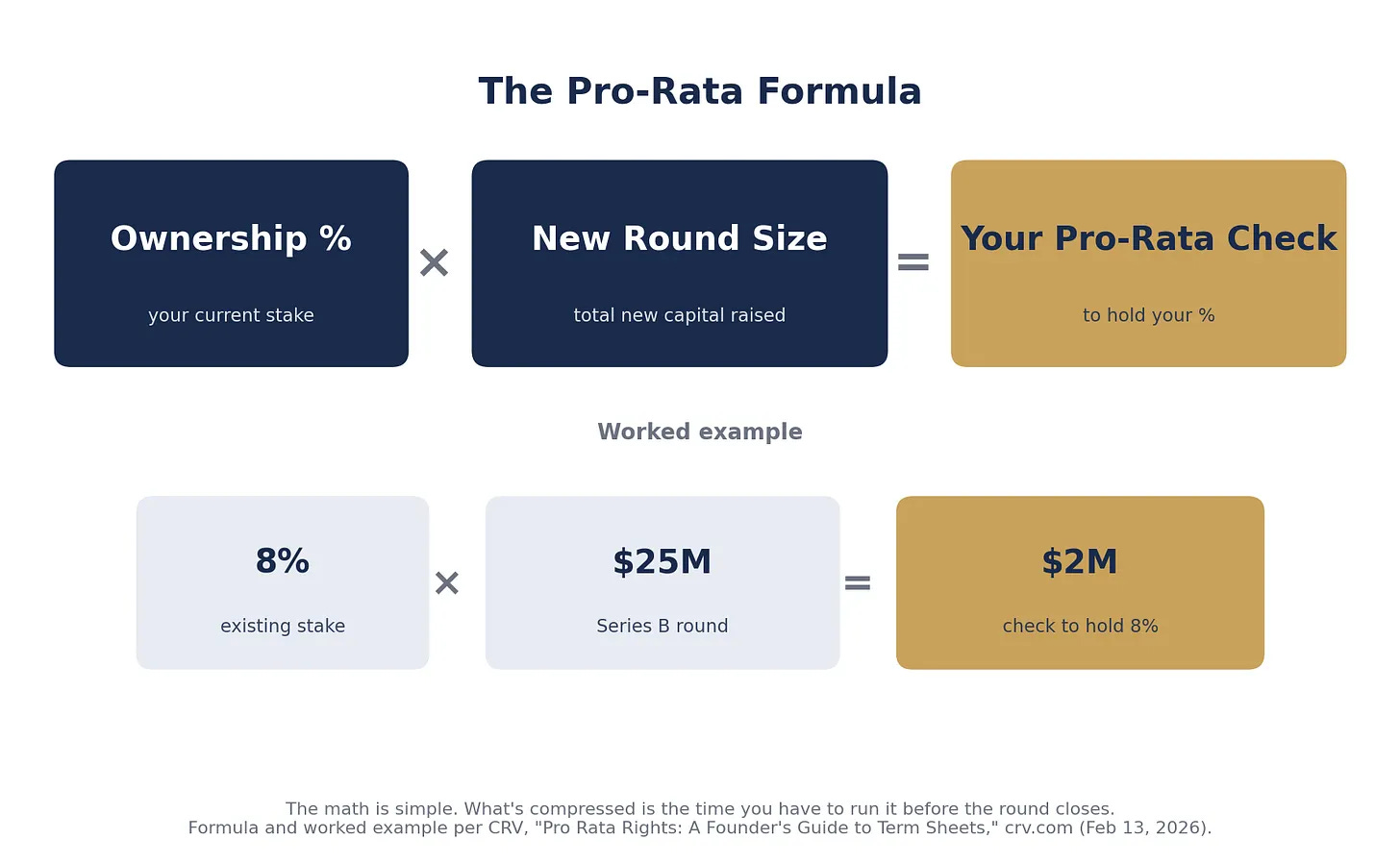
If your fund is still running reserve decisions through a full IC cycle, the harder question is whether your model, not just your process, is built for a market moving this fast.
What this looks like in practice:
The VC Fund Model lets you pressure-test reserve and follow-on assumptions against compressed round timelines instead of the 12-18 month default baked into most templates.
It separates target ownership math from decision-speed math, so you can see where a slow approval process, not a lack of capital, is the actual constraint.
Get the VC Fund Model: if this issue’s compressed-timeline numbers made you want to check whether your reserve process can actually keep pace, this is built for exactly that.
Current round benchmarks show bigger checks at lower dilution across every stage from Seed through Series D, per Carta.
Fewer rounds are being completed even as valuations climb, concentrating dollars into fewer companies.
Real 2026 examples, several covered Tuesday, show valuations doubling in as little as four to seven months, and Etched’s latest re-price did it in under a month, far faster than the 12-18 month window most reserve models assume.
The construction problem isn’t just how much to reserve, it’s how fast that reserve can actually move.
Bottom Line: Portfolio construction in this cycle isn’t only a sizing question, it’s a speed question. The math behind how much to reserve for your winners hasn’t changed, but the clock you have to act on it has gotten dramatically shorter. A fund that reserves correctly but decides slowly will still get diluted out of its best positions, just as surely as a fund that never reserved enough in the first place.
VC Fund Model - model the exact reserve and follow-on math this issue walks through: pressure-test your ownership targets against round timelines that have compressed from 12-18 months to 4-7.
VC Fund Playbook - go beyond this issue’s reserve mechanics to the full strategy: how portfolio construction, check sizing, and follow-on discipline fit together when the market’s moving this fast.
DPI Forecast & Premium Carry Template - see what today’s reserve decisions actually do to your fund’s eventual DPI and carry, not just your ownership percentage on paper.
Comments
Nothing yet. Say the first thing.
Sign in to join the conversation.