
I grew up in Rome as the kid who kept asking why after the adults had run out of answers. Sooner or later every authority I met... teachers, textbooks, catechists, well-meaning uncles... arrived at some version of because that’s how it is. Then I found science, and science appeared to be the one game played by a different rule: here, nobody outranks the experiment. A good result speaks for itself. The truth stays true no matter who says it, no matter what accent they say it in, no matter which building they say it from.
I no longer believe science works that way reliably.
Not because curiosity loses in the end. Often it does not. The problem is what happens before the end... and how long “before the end” is allowed to last, and who is made to pay for the delay.

Alfred Wegener proposed in 1912 that the continents move. He assembled evidence from matching coastlines, fossils, rock formations, and ancient climates... and he could not supply a physically credible mechanism for what could push a continent. That was a real weakness, and objecting to it was legitimate science. But the objection did not stay scientific. Wegener was a meteorologist walking into geology’s house, and the reception made sure he knew it. He died on the Greenland ice in 1930, the idea still ridiculed. When seafloor spreading and paleomagnetism supplied the missing machinery in the 1960s, plate tectonics quietly rebuilt geology on his grave. The bill: roughly fifty years.
Ignaz Semmelweis showed in 1847 that if doctors disinfected their hands, mothers stopped dying of childbed fever... mortality on his ward collapsed from catastrophic to around one percent. Not a subtle effect. But Semmelweis could not explain why it worked. Germ theory did not exist yet, his talk of “cadaverous particles” fit no framework medicine recognized, and his habit of calling colleagues murderers did not smooth the road. The intervention worked anyway, and kept working while it was ignored. Recognition arrived only after Pasteur and Lister supplied an explanation the establishment knew how to accept. Semmelweis died in an asylum in 1865. The bill: two decades, plus the mothers.
Ludwig Boltzmann spent much of his career defending the physical reality of atoms against serious scientists and philosophers who considered them useful mathematical fictions. He was no dismissed outsider... he was one of the great physicists of his age, and the dispute was intellectually real on both sides. He also struggled with illness for years, and I will not insult his memory by reducing his death in 1906 to a physics argument. But the timing stays brutal: within three years, Perrin’s experiments made atoms undeniable, and the opposition conceded. Vindication arrived just late enough to be useless to him.
Now... these are not three identical morality plays, and that matters. One man lacked a mechanism. One had a cure without a theory. One stood inside a deep and honest argument about what a theory is allowed to say exists. Their opponents were not all fools or villains, and some of their objections were good ones.
Yet in every case the same thing happened: the evidence was not allowed to speak for itself. It was made to travel through status, departmental borders, prevailing theory, professional identity, and the simple human reluctance to reopen a drawer already labeled settled. People decided whether to listen... and the deciding took decades.
In Italian we have a word for enduring what you cannot change: pazienza. I am known for having TONS of it… but there is a limit and most importantly, it is not a scientific method…
Let me be precise about the thing I am criticizing, because it is not skepticism. I need skeptics... the way my code needs a hostile reviewer who assumes every function lies until the tests pass.
And notice how that works in my trade:
In a code review, “this looks wrong” is the beginning of the procedure, not the end of it. You say it looks wrong, then you run the test suite, and the suite settles it. A reviewer who rejects the pull request while refusing to run the tests is not being rigorous. He is being decorative. We would find him a different job…
Real skepticism has the same procedure: inspect the claim, design the test, try to break it, report what happened. It is active. It gets its hands dirty. It is the engine of science, and when it kills an idea, the idea deserved it.
What I keep encountering is something else. Not “your evidence is weak”... which is an invitation, and I would accept it gladly. Something else entirely. And I am not inventing hypotheticals. This is the actual repertoire, collected in the field, lightly translated:
“If this were real, it would be worth a Nobel Prize.”
Delivered, mind you, as a refutation. The size of the implication offered as evidence against it. By this logic every major discovery in history disqualified itself on arrival... penicillin was obviously too useful to be real.
“It’s too good to be true. So it’s impossible. Not worth a look.”
Here the accuracy of the results becomes the argument against checking the accuracy of the results. Circular reasoning with a firm handshake.
“Convince a luminary first. Then come talk to us.”
My personal favorite! Evidence, apparently, needs a chaperone. The data cannot enter the building unaccompanied... it must arrive on the arm of someone famous.
Notice what these have in common: not one contains a measurement. Not one proposes a test. Not one engages a single number. Each is a sentence about plausibility and status wearing the costume of a sentence about science. The claim’s actual content never gets touched... it is judged entirely by its size and by the social standing of the person carrying it.
Same posture as skepticism. Opposite act. One is the engine of science. The other is institutional self-protection wearing a lab coat.
And the second one is rational, in its own miserable way. A new result can threaten someone’s authority, a grant, a department, a reputation, a life’s work... or simply the comfort of not reopening a drawer already filed as settled. None of that belongs in the equation. All of it can decide whether anyone runs the experiment. The refusal is sociological before it is scientific.
I say this having lived a very small version of it, more than once.
A result already built and benchmarked. A blind test on the table that could confirm it or kill it in an afternoon... and I mean a real blind test, on terms designed to make cheating impossible for me specifically: targets chosen by the skeptic from their own private holdings, labels kept on their side, the task, sample size, metric, and failure threshold fixed in writing before anything runs, my predictions frozen, timestamped, and hashed before unblinding, scoring performed entirely by them. No moving goalposts. No post-hoc exclusions. No way for me to peek at the answers and quietly improve the machine.
And still: a no, before anyone ran a thing.
Not “we checked, and it failed.” I would have published that. A clean kill is worth more to me than a polite maybe... my logs are full of my own dead ideas, each with a label and a timestamp. No. What I received was “we would rather not check.”
And that is the part that gets to me. Not the disagreement... disagreement is the job. The refusal to let an afternoon of arithmetic settle it.
Ma dai.
If my claim is wrong, the test costs you a few minutes and you get the pleasure of being right in writing. If it is right, you were the first to know. Refusing starts to make sense in exactly one scenario: when the result itself has become less welcome than the uncertainty.
Now, before someone reaches for the obvious objection: no, I am not claiming to be Wegener, Semmelweis, or Boltzmann. The base rates are brutal and I know them. Most people who believe they are being unjustly dismissed are simply wrong. Most outsider theories are craters with websites. I may be one of them... I maintain an entire folder of my own ideas that turned out to be nonsense, so I know the genre from the inside.
Ecco il punto: that is exactly why I ask to be tested, not believed.
Belief is a favor. I am not asking for favors. A blind test is the one room where neither my confidence nor anyone else’s reputation gets a vote. The prediction lands or it does not. The scoreboard does not care who I am, which is precisely what makes it the only referee worth having.
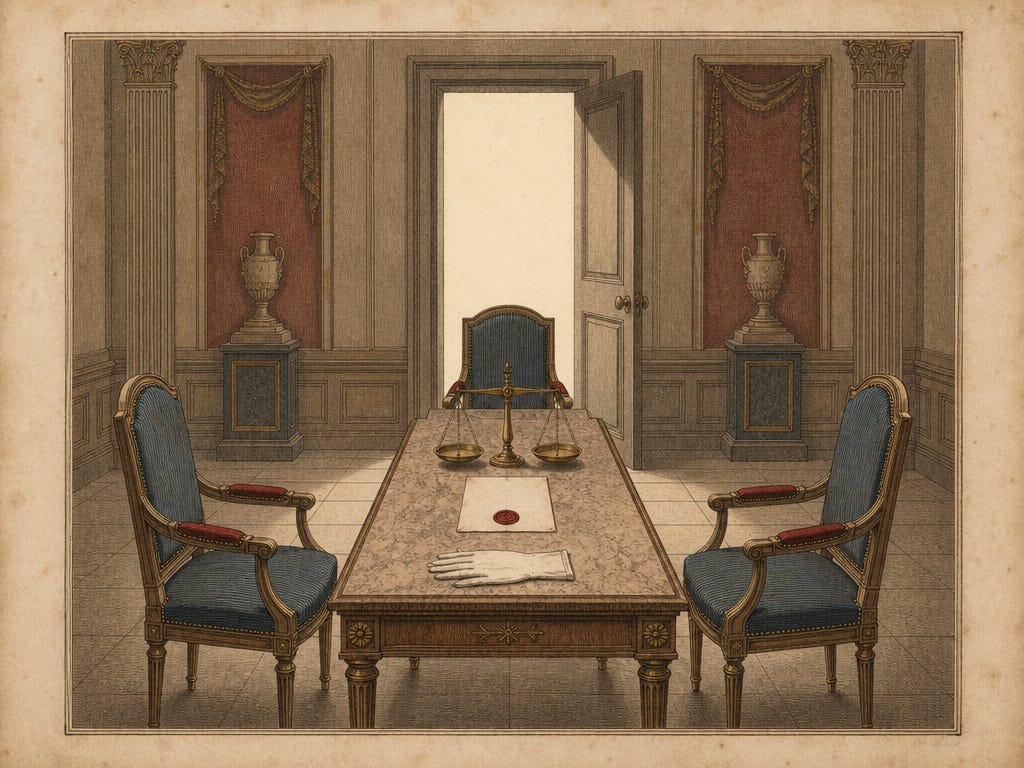
So let me stop describing the test and simply leave it here, on the table, permanently.
To any physicist, chemist, materials scientist, lab, or institution that considers my claims implausible... good, that is the correct prior... here is the protocol, and it does not expire:
Pick one specific claim, inside the capability boundary I publicly declare... a claim has a domain, and testing outside it tests nothing. Then you choose the targets, from data I have never seen and cannot see: molecules, materials, nuclei... whatever matches the claim, from your private holdings. The measured values never leave your side of the table. Before anything runs, we fix the terms in writing: sample size, scoring metric, exclusions, and the threshold that counts as failure. I deliver predictions frozen, timestamped, and hashed before any unblinding. You score them, alone. And the result gets published either way... pass or fail, in my own channels, with the protocol and your scoring attached, while your proprietary inputs stay private. If it fails, you will have killed it properly, in an afternoon, and I will say so in public with your name on the kill.
And one more thing, for the readers who run companies rather than departments. If your business lives or dies on finding the right molecule, the right material, the right catalyst, the right formulation... then this same afternoon carries a second payoff, and it is not symmetrical. If the predictions miss, you have spent an afternoon and gained a public kill with your name on it. If they land... on your data, chosen by you, scored by you, with no way for me to have cheated... then you are the first organization on Earth to know this tool exists and works on your problems, while your competitors are still reading the consensus. The downside is an afternoon. The upside is a head start nobody can buy later at any price, because first is not for sale twice.
No mechanism disclosure required. No trust required. No belief required. Nothing required from you, in fact, except the one thing skepticism was supposed to guarantee: looking.
This offer costs me nothing to write and everything to survive. That is what makes it an offer instead of a press release.
So here is what I genuinely want to know, and I am not asking it rhetorically.
When a claim is cheap to test, the claimant volunteers for a blind test on the skeptic’s own terms, and the answer is still no... what exactly is being protected? The integrity of science? The integrity of science is the test. Now, there are honest reasons to decline: no time, no bandwidth, other priorities, lawyers. Fine. Say that, plainly, and we part as adults. But when the stated reason is that the result is impossible before the instrument is switched on, nobody is defending rigor anymore. What is being defended is the social safety of a conclusion already reached.
From where I stand, every refusal I have collected so far has been sociological before it was scientific. Every single one. I would honestly love to be wrong about this pattern... it would speak better of the whole enterprise.
So prove me wrong the only way that counts.
Bring me the test. I will bring the predictions, frozen and hashed... and if they miss, I will publish the miss myself, with your scoring attached and my name on it.
Roberto Campus (born 1974, Sardinia) is a coder, composer, visual artist, and entrepreneur who’s spent 35 years obsessing over the mysteries of the universe. Grew up in Rome with stubborn questions and an insatiable curiosity. He’s either onto something profound or needs a better hobby. Possibly both. Time will tell.
No posts
Comments
Nothing yet. Say the first thing.
Sign in to join the conversation.