
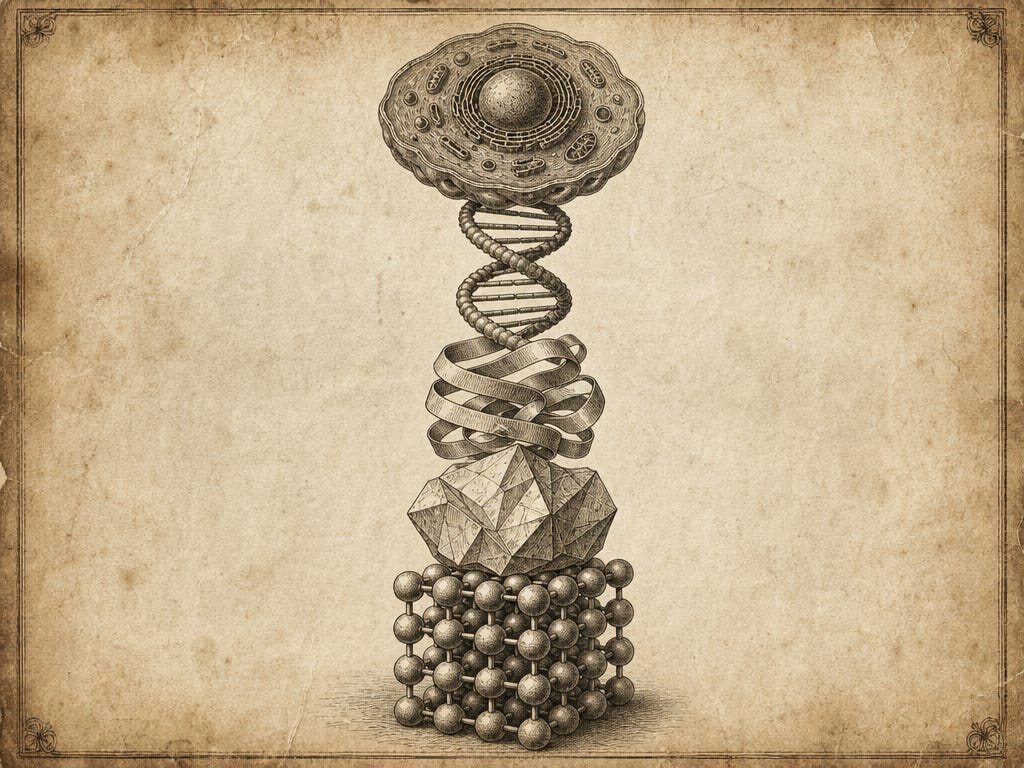
The word is why.
That’s it. Four decades of it.
Not what happens when two atoms bind. Why that bond has that exact length. Not which reaction wins, but why that path and not the other one sitting beside it, apparently just as willing. Not what the constants of nature are, we have measured those to absurd precision. Why they hold those values instead of some other perfectly reasonable ones.
And behind all of them, the question I have never managed to put down:
Why does a pile of atoms, arranged in a particular order, get up and live?
Keep that one in your pocket. I’m coming back for it.
I grew up near Rome with a chemistry set, a green-screen MSX, and a talent for producing smells that got me and my experiments relocated to the balcony. Mia madre non era entusiasta. My mother was not thrilled. I mixed things because I wanted to see what matter would do, and I wrote programs because I wanted to know whether the patterns I kept finding in books could be made to live inside a machine.
At twelve I wrote something trivial. You typed Fe, it said Iron. You typed Au, it said Gold. Forty lines of BASIC, maybe fewer.
Trivial program. Not a trivial idea.
Because what it whispered was that chemistry can be encoded, the periodic table can be queried, and therefore, maybe someday, matter can be computed.
I had no idea how far away that still was.
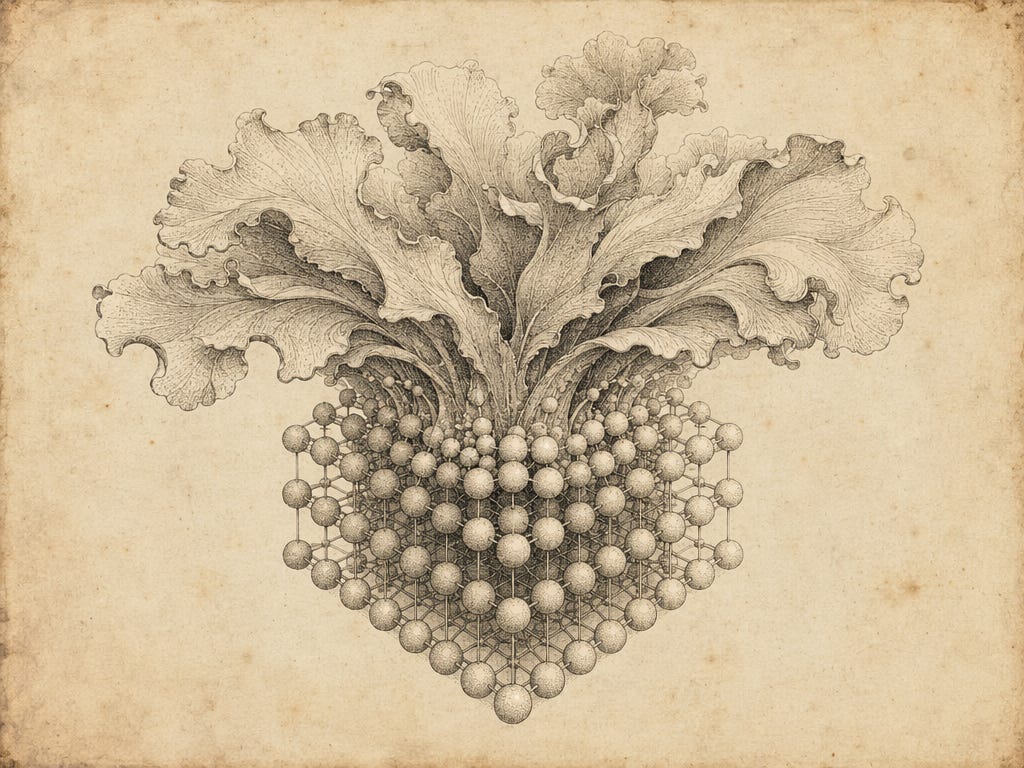
Here is the thing it took me years to name, and once I could name it I could not stop seeing it everywhere.
Science has become breathtakingly good at telling us what happens. It predicts, measures, classifies, reproduces. That precision is one of the most beautiful things our species has ever done, and I want it on the record before I start complaining.
But push past what and ask why this mass, why this geometry, and watch the answers change character. They stop being explanations and become descriptions wearing an explanation’s coat.
“That’s what the equation says.”
“That’s simply how nature behaves.”
Boh. Who knows. Shrug.
E io lì, ragazzino, che non mi accontentavo. And there, young boy, refusing to be satisfied, which is a personality trait that has never once made my life easier.
Quantum mechanics is the sharpest case, and I want to be careful here, because the sneering version of this argument is stupid and I am not making it. Quantum mechanics works, spectacularly. Semiconductors, lasers, modern chemistry, most of the technological world you touched today exists because that mathematics predicts correctly.
But predicting well and explaining are not the same act.
It handed us a formalism of ferocious precision and left the physical picture underneath it famously unsettled. A particle is a spread of possibilities. You measure, and one definite result appears. What physically happened between those two sentences has generated a century of competing interpretations, precisely because the equations give you the number without agreeing on what the world was doing while it produced it.
And when you ask, you are often told the question itself is naïve.
That is the part I object to. Not mystery. Mystery is the reason to get up in the morning. I mean the habit of treating conceptual opacity as a finished explanation, of dressing up “we do not know” as “you should not ask.”
Shut up and calculate is a perfectly good rule for surviving a problem set. It is not an account of reality.
The first wall was conceptual. The second one is brutally practical, and it is why all of this stayed theoretical for so long.
Even used purely as a predictive tool, with no philosophy attached, calculating real matter gets expensive almost immediately. Exact solutions vanish the moment a system becomes interesting enough to care about. So you approximate, and then you approximate the approximation. Density functional theory, molecular dynamics, empirical potentials, statistical models, machine learning. Each recovers a real piece of the picture, often brilliantly.
But high fidelity stays costly, fast methods stay narrow, and here is the symptom nobody talks about enough:
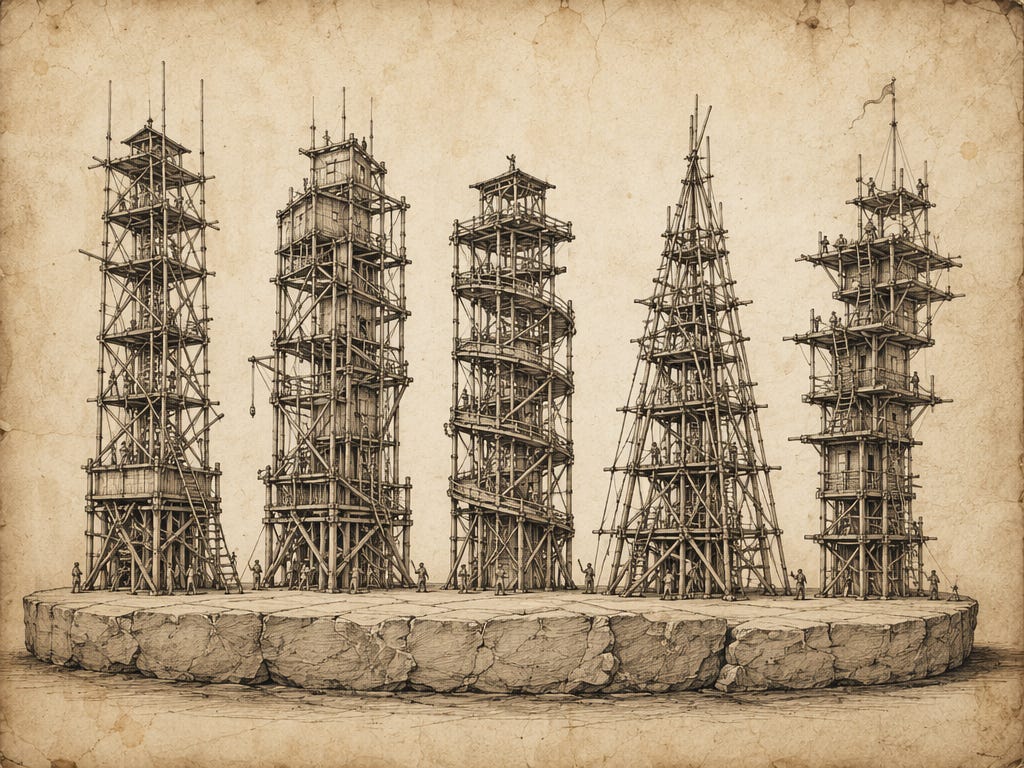
Every field ends up building its own machinery around the same underlying matter.
Chemistry becomes one stack. Materials becomes another. Proteins another. Therapeutics another. Biology another still.
Ma non è assurdo? Isn’t that absurd, once you say it out loud? A crystal is made of atoms. The DNA in the cell reading this sentence is made of atoms. There is no customs checkpoint between disciplines where physics stops, stamps a passport, and hands the system a different rulebook.
We spent decades building ever more powerful ways to work around one central problem: we did not have a physical description of matter compact enough to compute its behavior at any useful scale.
That is the honest diagnosis. Not stupidity, not laziness. A missing description.

This is the least romantic part of the story and I insist on telling it, because the tidy version would be a lie.
Flux Theory gave me a different physical foundation. I have written elsewhere about what it is and what it isn’t, and the protected derivations are not the point of this essay. What matters here is what it allowed me to attempt: connecting the smallest constituents of matter to the structures and properties and mechanisms that emerge from them, compactly enough to actually compute.
And then I did not sit down and announce a new computational discipline. Figuriamoci. As if. I sat down to solve chemistry.
I wanted to know whether bond lengths, bond energies, spectra, solvation, reaction mechanisms, all of it, could come out of one physical foundation instead of being assembled from a cabinet full of empirical models, each reliable only in its own little neighborhood.
The calculations started coming out right. Then they kept surviving new molecules and new benchmarks. Hundreds of quantities became thousands.
At which point the question stopped being philosophical and became software.
Then the same foundation walked into materials. Crystals, elasticity, thermal behavior, magnetism, semiconductors. Candidate spaces far too large for the expensive conventional methods, evaluated through the same underlying engine. Then pharmacology, with docking and binding and molecular interaction and ADMET constraints, huge candidate spaces where the platform could throw out the physically hopeless and explain why the survivors deserved attention.
And somewhere in there it hit me. I remember the exact quality of the feeling, which was less triumph than vertigo.
Chemistry, materials, and pharmacology were not three achievements. They were one achievement seen through three windows.
That is when it got a name. Matter Computing.
Speed is what people notice first. It is also the least interesting part, because anyone can be fast and wrong.
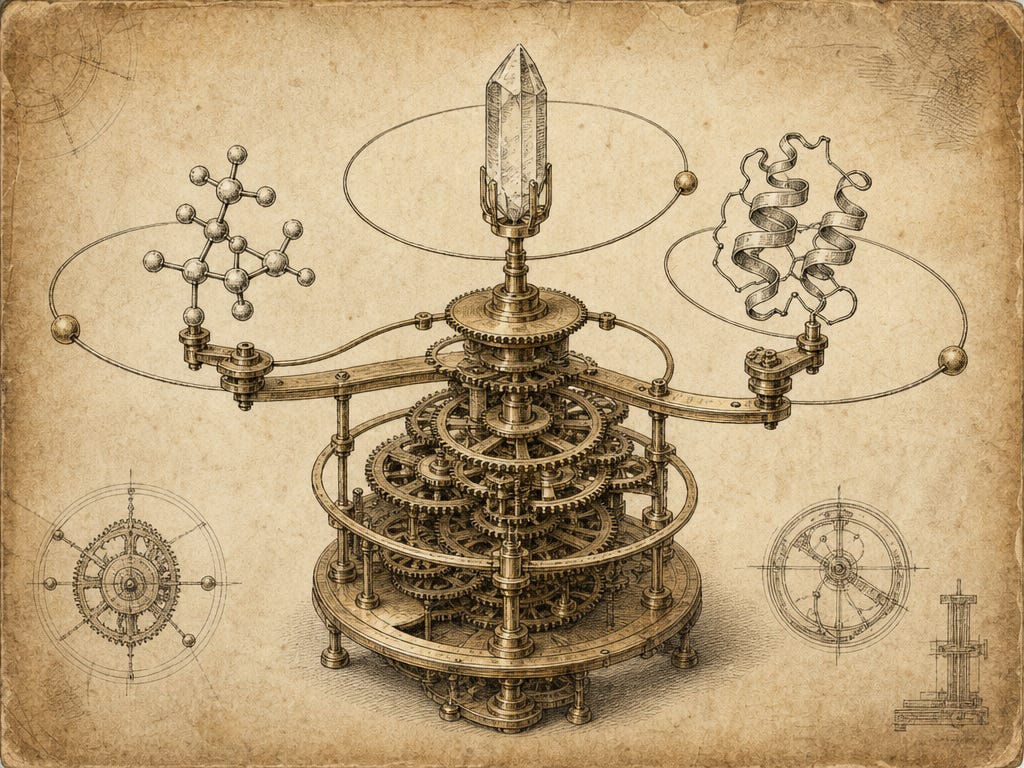
The actual shift is this: matter becomes a computable object.
A molecule stops being a string, a graph, a row in a database. It becomes a physical program whose geometry, energy, interactions, and failure modes can be calculated.
A drug candidate stops being a statistical resemblance to drugs that already succeeded. It becomes a physical intervention whose interactions and liabilities and mechanisms can be examined before the expensive part begins.
One engine. Many domains.
Not one formula, attenzione, careful, that would be nonsense. A crystal is not a protein, and the relevant physics changes as you climb from isolated interactions toward living systems. What stays shared is the foundation underneath: how matter is represented, and how every result carries its own provenance. Chemistry strengthens pharmacology, and each rung stands on the validated rung beneath it.
Which raises the obvious question of how far that ladder climbs, and whether it stops politely at the edge of biology.
It does not.
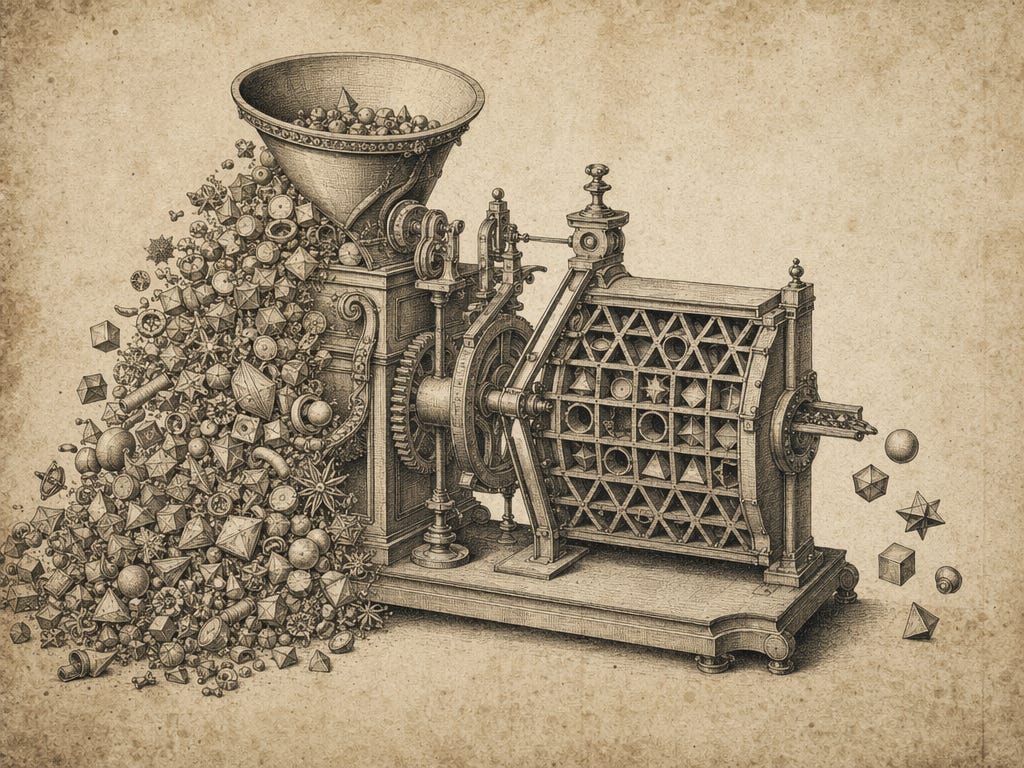
Nowhere. It becomes more useful.
I have no interest in the physics-versus-machine-learning bar fight. It is the wrong fight, usually staged by people who need a villain. AI can recognize patterns across more data than any human could read in a lifetime, and steer a search through spaces we could never walk by hand. That is real, and I use it every day.
But generation is not explanation, and resemblance is not mechanism. What AI lacks on its own is a physical judge.
AI proposes. Matter Computing calculates. Experiments decide.
The loop is not optional.

None of this is finished. Every module has an applicability boundary: places where it holds, places where it fails outright. Pretending otherwise would turn me into exactly the kind of person I have spent this essay complaining about. Some rungs of the ladder are solid. Others are hypotheses wearing hard hats. The honest ending to this project may well be we climbed four floors and the fifth was not there.
Lo so. I know. I have made peace with that.
But I have one rule, and it is the only thing standing between a physical theory and a very expensive delusion: a claim that cannot be checked is not a claim, it is a mood.
Where a result is labelled pure physics, no empirical calibration is allowed to rescue it. No fitted exponent quietly patches the distance between prediction and reality. Some downstream modules do use reference evidence, and those are labelled hybrid, with their evidence and their boundaries exposed rather than buried.
When a physical layer fails, you do not wallpaper over the crack. You write down that it failed, in ink, and go looking for the missing physics. E succede. It happens. That is the job.
Which is why the results get handed to people who would be delighted to see them break.
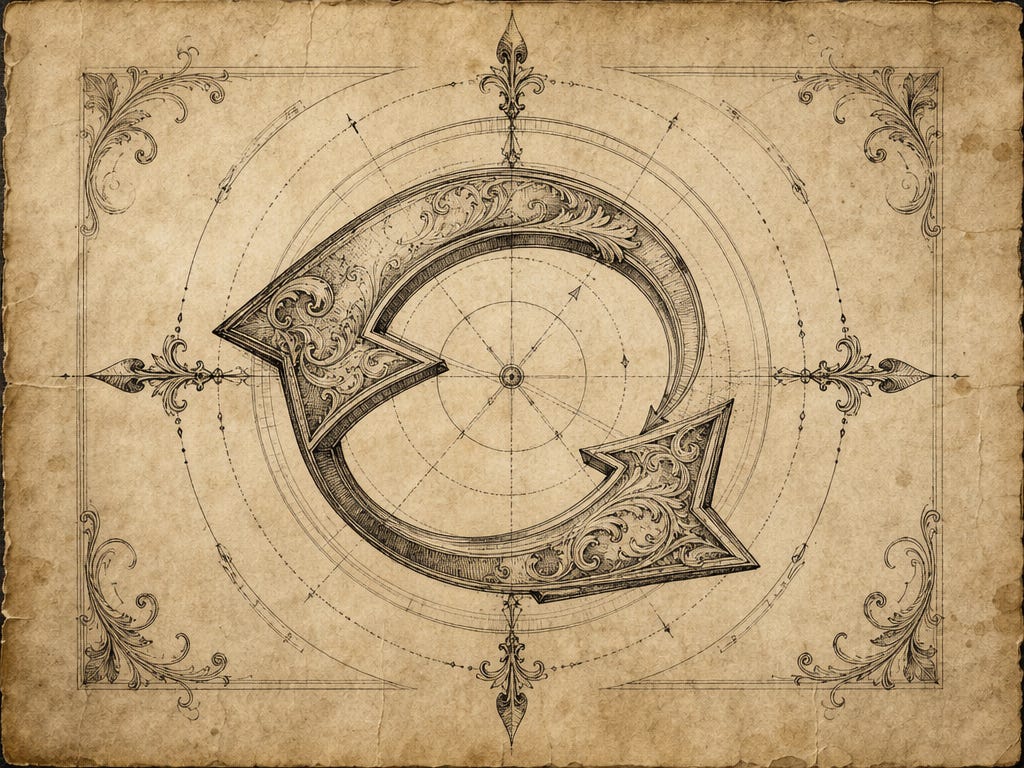
Everything I have described so far runs in one direction. You hand the engine a thing, it tells you what the thing is likely to do. Useful, certo. Not the point.
The point is the arrow running backwards.
Forward, you ask: here is a molecule, what will it do? Inverse, you ask: here is what I need done, what should I build? That second question is the one every scientist and engineer carries into the laboratory, and for most of human history the only available answer has been to guess, make, test, fail, and guess again with slightly better taste.
The inverse arrow already runs. This is the part I keep having to remind people is present tense, not brochure tense.
Inverse design is live for materials. You state the band gap you need, the phase that has to stay stable at the temperature where the device actually operates, the elements you can source without triggering a geopolitical incident. The engine returns candidates that satisfy the physics, not candidates that resemble materials somebody already made. The same logic runs for semiconductors, and for catalysts, where “nobody has tried this” and “this cannot work” have historically been very difficult to tell apart without spending two years finding out.
The output is not a score. It is a ranked set, each candidate carrying the physical reason it survived and the reasons its rivals were rejected.
Now stop and look at that, because I do not think it reads as strange as it should.
For the entire history of materials science, the arrow has pointed one way. We made the thing, then we discovered what it was. Every alloy, glass, superconductor, battery material, and semiconductor in the device you are holding came through some version of that loop: mix it, heat it, measure it, write down what happened, try again on Monday. Edison burned through thousands of filaments to find one that would not die.
We worked that way because the alternative required arithmetic nobody could afford. The space of possible stable compounds is not merely large, it is combinatorially obscene. Humanity has characterized perhaps a few hundred thousand useful material systems. Against what is physically possible that is not a representative sample. It is a rounding error of a rounding error, and every material you have ever touched came out of it.
So state what you need and the physics returns candidates is not a productivity improvement. It is the arrow turning around after thousands of years of pointing the other way.
E la cosa che mi fa ancora ridere? And the part that still makes me laugh? It does not need a national laboratory. Millions of candidates screened on a laptop, in less time than it takes to make a decent coffee. No beamline, no six-week wait for cluster time.
That exists. Today. Adesso. You could run it this afternoon.
I find it quietly insane that this is not bigger news, and the charitable explanation is the correct one: extraordinary claims arrive daily and most of them evaporate, so ignoring them is a rational default. Skepticism is not the enemy here. Skepticism is the admission price. But notice the asymmetry it creates. Ignore an unconventional claim and it dies, and nothing happens to you. Look at it and it fails, and you spent your time on nonsense. Look at it and it works, and you still have to explain why you took it seriously before it was respectable. There is almost no reward for being the first serious person to check. E allora nessuno guarda. And so nobody looks.
Ecco il punto. Here is the point. In the domains where the physics is sufficiently closed, design is no longer the hardest part.
So what remains? The question I asked you to keep in your pocket.
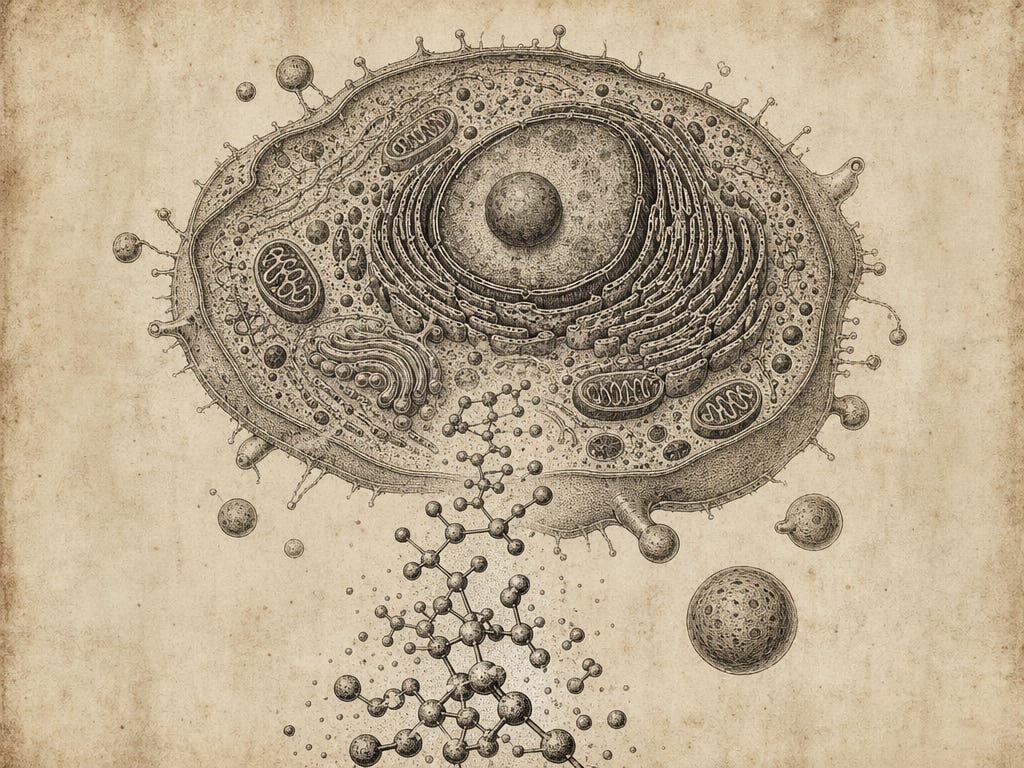
Not one protein. Not one sequence scored against a table of sequences we have already seen.
I mean a genome treated as the physical object it is, and past that, biological systems reconstructed from the atoms upward. Sequence into physical state, state into structure and mechanics, structure into interaction, interaction into regulation, regulation into the behavior of a cell doing all of it at once, in water, at body temperature, while you read this sentence.
That is the frontier.
E qui devo stare attento. And here I have to be careful, because that paragraph contains exactly the kind of sentence that gets people into trouble, so let me brake myself before somebody else has to.
Whole-system biology is not built. Not by me, not by anyone.
But what exists today is not physics waiting politely at the foot of biology. We are already inside the biological stack. Docking, binding, ADMET and toxicity profiles. Protein folding in seconds, reaching TM-scores up to 0.7, from physics with no training set, and improving. All of it emerging from the same physical foundation.
So the boundary is not between matter and biology, because biology is matter and several of its molecular layers are already computable to varying degrees of accuracy. The real boundary sits higher: between calculating proteins and interactions and molecular effects, and closing the whole chain up into cells, organisms, and systems. That upper region is not built. Neither is it a metaphor floating several rungs above the working physics. We have footholds inside it already.
The task now is to strengthen the weak layers and keep climbing without cheating.
And the work compounds, which is the part I find almost unfair. Every design campaign leaves behind validated mechanisms and failure maps that make the compiler better structured, not merely fatter. A statistical model improves by consuming more examples of what already exists. A physical compiler improves by understanding more of what can exist.
If the climb succeeds, biology and engineering start to lose the border between them. Every abstraction on the way up cashes out as something concrete: a cheaper medicine, a cleaner material, a battery that survives a Sardinian February, a decision made in eight days instead of eight months while somebody waits on the answer.
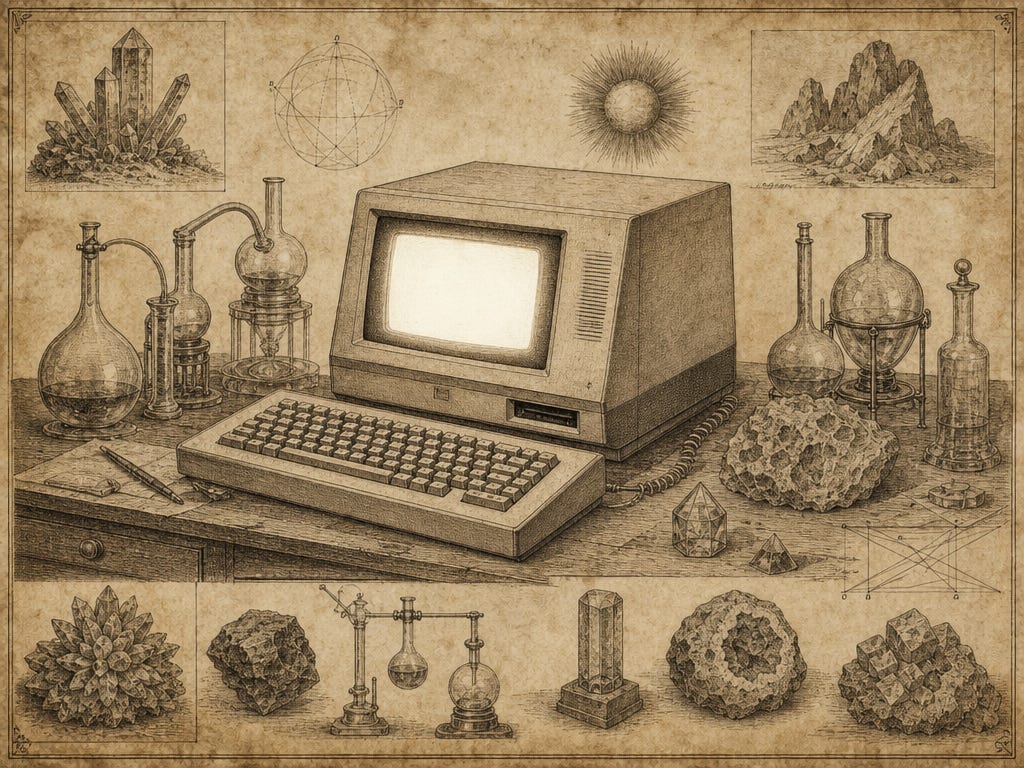
When I was twelve, my little machine could tell me that Fe meant iron.
What I actually wanted, though I could not have put it into words then, was a machine that could tell me why iron behaves like iron. Why a bond forms. Why a crystal chooses one structure over another that looks just as plausible. Why a molecule binds. Why changing a single letter in a genome rewrites how a person responds to a drug.
That machine did not exist. Adesso possiamo cominciare a costruirla.
Now we can begin to build it.
And I want to be exact about what that would mean, because it is larger than any single result.
For the whole of our history we have been limited to the matter we happened to trip over. Every material and every medicine we have ever had was found, not designed. We have been prospectors, sifting an unimaginable space for the sliver of it we could reach by hand, and building a civilization out of the fragments we recovered. It is a magnificent civilization. It is also a rounding error of what was available.
If matter becomes computable, the prospecting ends.
Not the experiments. Those stay, and they still decide. What ends is the part where we wait to stumble onto things.
The medicine nobody found because the search space was too large to enter. The material that would have made the battery work, sitting unexamined in a region of chemistry nobody had a reason to visit. The mutation that quietly changes how a person metabolizes a drug, for a physical reason we could have calculated in an afternoon. These stop being accidents we hope for. They become things we go and get.
And the walls come down with them. Chemistry, materials, medicine, and biology stop being separate territories with separate methods and separate priesthoods, because they were never separate in the first place. They are all the same climb, and we have only ever been standing on different rungs of it, shouting at each other.
Discovery stops being an act of rummaging through what has already happened. It becomes an act of computing what could.
That is the whole ambition. Not to read the record of what matter has done.
To compute what matter can do.
Because the world is not made of data. It is made of matter.
And matter can be computed.
Cominciamo. Let’s begin.
The architecture, the principles, the boundaries, the evidence, and the parts I remain uncertain about are laid out in the Matter Computing manifesto. This essay is the reason. That document is the blueprint.
Roberto Campus is a coder, composer, visual artist, and entrepreneur who has spent several decades at war with the parts of physics nobody ever bothered to explain. He is either onto something or he needs a better hobby. Possibly both.
Subscribe if “that is simply how nature behaves” has never once satisfied you either.
No posts
Comments
Nothing yet. Say the first thing.
Sign in to join the conversation.